Love And Forgiveness

Harold Nicks

Love and forgiveness, two tenets of our Christian faith. Love and forgiveness, something we all desire and something God commands us to give to others. The New Testament is replete with scriptures on love and forgiveness. In Matthew chapter 5, in the sermon on the mount, Jesus instructs us to love our enemies. He also commands us to forgive others knowing the debt He paid for our forgiveness.

I recently attended a funeral. I did not know Elizabeth well, but I knew a lot about her influence. Tommy did her eulogy; she had asked him to do it.

I need to tell their story. A story the world would think odd but not those that know and understand the love and forgiveness we have in Jesus.

Elizabeth and Frank, her husband, had one son, Ted. Ted was coming home for Christmas break from college when he was killed by a drunk driver. Tommy was that drunk driver.

Tommy received what some may consider a light sentence … minimal jail time and community service to talk at schools about the dangers of drunk driving.

In the eulogy Tommy recalled how he felt as if nobody cared about him and that God had turned away from him. He realized the destruction and pain he caused in Elizabeth and Frank’s life.

As Tommy recalled, “I was walking home to my apartment one late evening and Elizabeth thought she recognized me and pulled over to the side of the road. I was fearful and reluctant when she rolled down the window of her car and asked if she could talk to me. She asked me to get in the car, that she just wanted to talk with me. As I got in, she explained that she did not want to harm me. She was desperately wanting to know who I was, how I felt about what I had done. She also wanted me to understand the great harm I had done. I felt the weight of my crime and I could not bear the sorrow. She asked about my past and alcoholism and why I would do something so careless. After several minutes Elizabeth asked me to promise I would not take a drink that night. We cried together and I promised I would not take that drink. Elizabeth had compassion for she could see a life of waste and a lost soul.”

Through her anger, grief and despair, Elizabeth saw a lost soul…someone in need of Jesus.
Elizabeth and Frank fully understood the example Christ left us about love and forgiveness even when it is painful and not easy. The thought of a lost soul was greater than their grief. They began studying the Bible with Tommy and eventually he obeyed the gospel. They became active in Tommy’s life helping to guide him as a young Christian. Tommy is an active faithful Christian some forty years later.

Love and forgiveness – they are choices we decide to give or withhold.

Sometimes it’s loving and forgiving ourselves as Tommy did – sometimes it’s loving and forgiving others as Elizabeth and Frank did … always mindful of what Jesus did for us. HE did not withhold from us.

Love and forgiveness – God has it for each of us – we all need it – and HE freely gives it.

What Could I Say At The Funeral Of A Non-Christian?

Dale Pollard

God is far wiser than we are, and there’s plenty of guidance for such potential scenarios (2 Pt. 1.3). Here are some quick things to fill your mind with before you walk into a room filled with the grieving. 

First, we all need to be reminded

A good name is better than fine perfume, and the day of death better than the day of birth.

It is better to go to a house of mourning than to go to a house of feasting, for death is the destiny of every man; the living should take this to heart.

Sorrow is better than laughter, because a sad face is good for the heart.

The heart of the wise is in the house of mourning, but the heart of fools is in the house of pleasure.” – Ecc. 7.1-4 

A funeral is better than feasting… for three reasons. 

  1. Because a funeral serves as a motivator for needed change. 
  2. Because it serves as a reminder that life is finite. 
  3. Because we inevitably think of what will be said at our own funeral. 

Your name is assigned at birth but defined in life. 

The Trans–Siberian Railway which connects Moscow with the Russian far east is still the world’s longest direct rail route, running for 5,753 miles. The journey passes through the Ural Mountains, Siberia’s birch forest and Lake Baikal, and the entire trip, were you to ride from beginning to end, would take six days. 

We’ll all reach the end of the line at some point. Each of our journeys are at various stages of completion, some just beginning, some farther along, but the meaning of life is that it stops. However, it doesn’t end. The vast majority of all the world’s religions teach and believe in an eternal existence of some kind. 

Death is a reality that’s juxtaposed. 

It’s the end and it’s the beginning. Or as Solomon said, “…the destiny of every man.” 

Many would rather not think of their final destination because they feel it’s unknown while others avoid the thought because the subject of death is an unpleasant one. While we should celebrate the accomplishments and one’s life, funerals have always been for the benefit of the living. 

The “house of mourning” requires at least four areas of focus in order for it to benefit us. 

  1. A time to grieve loss.
  2. A time to reminisce. 
  3. A time to comfort one another.
  4. A time for reflection. 

It’s healing, it’s healthy, and it’s enlightening. Every culture on every continent would attest to this, but more importantly— God’s provided us with this truth. 

Use the time, while in the house of mourning, for the  intended purpose. 

Don’t dismiss any sobering thoughts of mortality and use this valuable time properly. 

“I will not doubt, tho all my ships at sea come drifting home with broken masts and sails 

From seeming evil worketh good to me. 

And tho I weep because those sails are battered, 

Still will I cry,while my best hopes lie shattered, ‘I trust in thee’ 

19th Century poet, Ella Wilcox 

What Will Others Say Mattered Most To Me?

Monday’s Column: Neal At The Cross

I have preached nearly 100 funerals in my 31 years of full-time preaching. That includes funerals for still-borns all the way up to those 100 years old. It includes services for those who committed suicide or died in accidents, but also a great many who were able to prepare for the process of dying. 

In the course of sitting down with families who have just lost a loved one, it is commonplace to talk about the deceased. Sometimes, I have known and been closely tied to the one whose service I was doing. Other times, I have not known them well and it is not uncommon to perform a service for someone I’ve never even met. Meeting with the family is a great way, especially in these situations, to find out who their loved one was. 

The longer they talk and the more they say, the more clearly they paint a picture of what the dear departed prioritized. The stories center around that theme. All of them want the preacher to know some “faith fact(s)” about them–they were raised in the church, they believed in God, they read (or had) a Bible, etc. Some of them have an abundance of stories about a Christ-centered life. All roads seem to lead back to that: Family stories, work stories, and church stories. 

Sadly, others paint a picture of other things predominating their time, passion, talent, and interest. At a time when people are going to say the nicest things about a person, they are also going to give away what mattered most to them–during the visitation, before, during, and after the service, at the graveside, and otherwise. It always happens.

Most days, our funeral is the farthest thing from our minds. We are busy living life. Yet, we are building, day by day and decision by decision, what our legacy will be. In the book of Ecclesiastes, Solomon talks about the many things that are “vanity.” He uses the word 38 times in 30 verses, at times using the phrase “vanity of vanities” to express utter futility and worthlessness. Work, knowledge, pleasure, competition, money, everything, apart from God, is like chasing the wind. 

At the end of his sermon, this wise king says, “The conclusion, when all has been heard, is: fear God and keep His commandments, because this applies to every person. For God will bring every act to judgment, everything which is hidden, whether it is good or evil” (12:13-14). What an encouragement to you and me to build a God-centered legacy. That requires embracing what Jesus taught, to seek first God’s kingdom and His righteousness (Mat. 6:33). Don’t we want others, most importantly God, to say, our faith defined us? Nothing matters more! 

Neal Pollard

Your Dash

Tuesday’s Column: Learning From Lehman

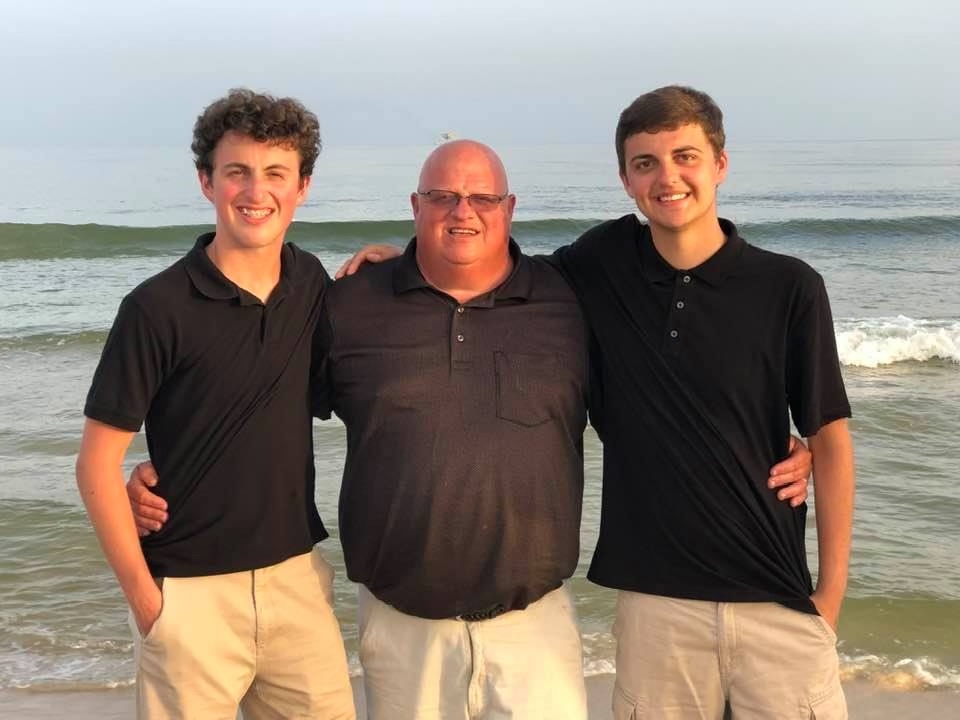
(pictured with his dad and brother to his right)

Caleb Fudge

About a month ago I was sitting at a funeral, my dad was doing the ceremony, and he said something that stuck with me. A guy named Ron Tranmer wrote a poem, and said to sum it up: “When we go to a gravestone we often look at the dates on the stone, but we should look at the dash. The dash serves as an emblem of our time here on earth, although it is small, the dash has touched so many on this earth between our years.” I had never heard this before my dad quoted it, and I think there is a bigger message in this poem.

I want you to take a moment to think about your dash….. Most likely you thought of a big moment in your life, or even a sad time or a time you wish you could redo. As I was thinking of my dash I got caught up thinking about all of my accomplishments and accolades that I forgot about how much I’ve affected others with my dash. I think about Jesus and how he affected and helped so many people. One of the moments that came to mind was when Jesus feeds the 5000 (Mat. 14:13-21). Jesus went out of his way to do something for others. 

One thing that comes to mind when reading this passage was the tornado. I can remember coming here to BG (Bowling Green) after the tornado hit. I had no idea the destruction that was done, because I was in my house when it hit. But when our group was driving around the community and giving some water, food, clothes, or anything to someone that needed it, they were so thankful and relieved that they were getting food. I imagine the 5000 people were grateful when Jesus brought them food.

Our dash also is going to have some times where we wish we can go back and redo a bad decision. Just recently I had a Blue Stars Camp for DCI in March, and one of the teachers said this statement that I will always remember. “Every single time you do a rep of something you make a green marble and a red marble from how that rep was. Whenever it comes to showtime and you are about to do a show, you have the bag of all of these marbles, and for that show your run will be based on either the green or red marble that you chose.”

If we think about our life and how many decisions we make daily, that would add up to be a lot of marbles. Other people are going to remember you from those decisions, green and red. When you pass away and someone looks at your gravestone and looks at your dash, what do you want them to remember? Is it going to be a green or red marble?

MAKING PLANS FOR OUR OWN FUNERAL

Tuesday’s Column: Dale Mail

image

Dale Pollard

Recently I attended the funeral of a loving and godly mother. She was celebrated and greatly mourned over by her family and friends. As the funeral service went on there were memories that were brought up that made the audience laugh and cry, even those that didn’t know her all that well. How we are remembered in life is dictated not by a single day or moment, but how the life was spent overall. This concept should be one that we make a conscious effort to visit often. There’s a great question that every Christian should know the answer to. 

What does it mean to be a person after God’s own heart? 

According to Nathan the prophet, David was “the man”! Today we use that term when we are complementing one who has shown himself to be an overachiever or is excellent in some way. When Nathan said this to David, however, he was speaking on behalf of the king’s King. Nathan was accusing David of a great wickedness. 

That being said, David was remembered at the end of his life as someone who chased the heart of God. The Lord was his passion and his pursuit in life. He wanted to see through the eyes of God, follow in the steps of God, and mold himself into a tool that accomplished a will higher than his own. His life is summed up well in a single verse. 

“For David had done what was right in the eyes of the LORD and had not failed to keep any of the LORD’s commands all the days of his life–except in the case of Uriah the Hittite” ( 1 Kings 15:5). 

This verse does not indicate that David was only guilty of one sin while on this earth. It wasn’t that David stumbled and continued on the path of righteousness, but instead there was a season in his life where he completely abandoned God. He gave up the path of light for one of darkness. After Nathan boldly confronts him, he is reminded of his inward allegiance to his God and he changed his course of direction. David lost his son as a consequence. Another son rebels against him. His kingdom is no longer as peaceful as it once was and at the end of his life he sits on his throne as a weary and restless ruler. Even so, despite the darkness on all sides, he chose to stay in the light. 

In the end he wasn’t remembered as the “adulterous murderer.” He is praised for being Israel’s greatest king because he had a heart that mimicked the king of Kings. Let’s make our plans to be remembered as people who chased after the heart of God. 

How Can I Go On?

Tuesday’s Column: Dale Mail

DaleandJanelledirectorypic

Dale Pollard

How can we handle the hurt of losing someone we love?

Many emotions run through our hearts when we’re faced with the loss of a loved one. These emotions can present themselves as questions:

  • Confusion. Why did this happen?
  • Sadness. How will I go on?
  • Anger. Who allowed this to happen?

Who can answer these questions?  Who can provide comfort?  Who can guide our hearts through the heartbreaking moments of life?

Is it not the Creator of life who can explain the end of life, even though “end” is a very human term?

100 years from now I’ll be alive and so will you. 150 and 200 years from now,  I’ll be alive and so will you.

In Genesis 1:26-28, God said,  “Let us create man in our own image.”

  1. When God breathed into you the breath of life He gave you a piece of Himself called the soul which will live on forever…somewhere.
  2. When God created you in a more intimate way unlike the beasts of the field and the birds of the air He gave you free choice.
  3. He gave you the ability to reason.
  4. He gave you the ability to contact Him and be contacted by him.

How sad and how tragic it would be to live your life with no hope! Today, I’m here to offer wonderful, comforting news, at a time where such news seems all but missing.

God loves you more than anyone else does.

Though many cry for and with you when you grieve the loss of a loved one, that love falls short of the one who expresses His love in a way that’s perfect and unfailing. You will experience feelings you may not be able to put into words, but God feels and understands them. God can walk you through them. Life doesn’t have to be impossibly tragic and void of purpose.

God created the heart, so He can heal yours. God created the mind, so He can sort yours out. God made the soul, so He can save yours. God created the body, so He can give you rest. God created the eyes, so He can wipe your tears away. God created the shoulder, but His are the only shoulders capable of bearing the weight of all those who lean on them.

“Therefore comfort one another with these words” (1 Thes. 4:18).

garan_sunrise


A Beautiful Tribute

Neal Pollard

Kathy and I attended the funeral of Mildred (Millie) King, Larry’s mom and relative to several Bear Valley members, this morning at the Loveland church of Christ.  Ron Lauterbach, the local preacher there, delivered a fine tribute to the godliness of this woman.  So many kind things were said by Ron as well as family members about her faithful Christian life.  It was all very inspiring.  However, the crowning moment of the service was her widower’s words in her honor.  Ron saved these words for last, and they were touching.  He spoke of his “sweetheart” of 62 years, reflecting on how she put Jesus Christ before anything and anyone else.  Then, he spoke about what a devoted mother and wife she was throughout these many decades.  It was touching to hear about this wife who dedicated her life to raising faithful children and standing faithfully behind and beside her man.  When the service was over, Kathy whispered to me, “I don’t know her, but I want to be just like her.”

Is there any better tribute that can be paid than a life lived well?  She served at times as a preacher’s wife, but mostly a school teacher’s wife.  She made many a meal and sent many a card to others.  Her service was very well attended, especially for a late Thursday morning.  All of this honored her, but nothing more than the ones closest to her lavishing such praise about her spiritual maturity and service.  And the one closest to her of all people, Leland King, spoke most tenderly, fondly, and cherishingly.  No praise outshines the genuine admiration and affection of one’s spouse, the person with the most intimate knowledge of that one.  This kind of legacy lives on, even after that one dies (cf. Heb. 11:4b).