I recently read something very powerful and felt it was worth sharing. It is a fitting reminder that materialism and a pursuit of physical wealth do our soul no favors — in fact, they sabotage our pursuit of God’s wisdom. It further illustrates God’s statement that the love of money is the root of all kinds of evil (1 Tim. 6:10).
An obligatory disclaimer: I don’t agree with everything this author wrote. This should not be seen as an across-the-board endorsement of his writings on spiritual topics, though his works on Egyptian history are invaluable. But we’ve likely all heard quotations in the pulpit that were taken from Einstein, Reagan, Eisenhower, and other secular figures — consider this a quotation in the same spirit.
“May the people of our time, who by reason of the alleged comforts derived from their scientific technology are falling more and more deeply into matter, come to understand that if the end of bodily life is death, the end of what constitutes the body’s life is to survive and liberate itself from what is mortal. The means of attaining this end is no more difficult than it is to live. Yet this is precisely what few people know how to do. Most are solely concerned with distracting themselves, passing the time that separates them from the hour of death they so greatly fear.
To live is not to work. If we are condemned to work in order to maintain our life, this sentence constitutes the suffering through which we must acquire the intelligence-of-the-heart that is, in itself, our life’s spiritual aim. To base existence on work is as unwise as to found society on economic principles. Love of the task makes work joyful, and a good economic order is a secondary result. Mechanicalness, the emanation of a warped consciousness, as well as valueless money, these have been the cause and means of action for ambitious leaders to drag our world into the depths of misery. Out of this comes a reaction which will betray the expectations of these misguiding masters. The divine spark ever slumbers within man, and when animated by a new breath is irresistible.”
Scripture offers deeper insights into the nature of truth. When you choose to integrate faith into your everyday life, you will find meaning and you will be fulfilled.
You will find a purpose driven existence that the world longs to have. With God, life has meaning.
Notice with me 5 biblical truths that shape our worldview. There are many more, but these five have been the fundamentals of our faith. These are the ones that the apostles taught to the world after the ascension of Jesus. I am thankful that God has given to us a framework as Christians, a framework through which we are supposed to interpret the world.
We don’t rely on opinions, or feelings, or traditions, or our families, to tell us these truths. These truths were laid upon us by the Lord of Lords. He tells us these truths so that we would have a lens through which we can interpret the world. Without them we are Velma from Scooby Doo. We NEED these glasses to see the world properly.
Pillar number 1 in the biblical worldview…
We Were Created
How does the world say that we got here?
In the beginning there was a cosmic boom.
This is what our children our taught, and what more and more people are believing.
This is totally contrary to the words of Scripture. We say “In the beginning God created.” The world says, “In the Beginning nothing created.” It takes more faith to believe evolution than it does the first five words of the Bible. Pillar number 1 of a biblical worldview contradicts the very nature of modern historical scientists.
In the beginning God said, “Let us make man in our own imagine, in our own likeness” Gen. 1:26
We were created and molded after the Creator. From this first pillar we learn many things. Because we have a Creator we better understand the world God placed us in.
The knowledge of a Creator helps us understand ourselves better since we were made in the image of God. Because we were created we learn of the Creator who shaped us out of dust and breathed life into our bodies. We were created to ENJOY fellowship with our God.
Pillar number 2…
We Fell
In Genesis 3, man rebelled against God and as a result of that, sin entered into the world. This sin caused
Spiritual separation: Adam and Eve and their children were separated from God, both physically and spiritually. They could no longer walk and talk with God face to face.
Physical changes: Adam and Eve became mortal, and they and their children would experience sickness, pain, and physical death.
Cursed environment: The ground was cursed in the Garden of Eden and throughout the earth.
Loss of righteousness: Adam and Eve became aware of their nakedness and knew that their former perfection was gone.
Guilt and shame: Adam and Eve felt guilt and shame they had NEVER felt this before.
Judgment: Satan was judged with a divine curse. The woman would experience pain in childbirth, and her husband was to rule over her. Man must now labor for his existence on a cursed earth.
And if that wasn’t enough, Paul says this in Romans 5:12: “Therefore, just as sin entered the world through one man, and death through sin, so also death was passed on to all men, because all sinned.” From the moment we fell, all people are born into a sinful world, and with a desire to rebel against our God. No matter who you are, you will have sin in your life (Romans 3:23).
There are so many people who don’t believe in God because of the consequences of the fall. They’re angry because there is suffering and death in the world. They think if God exists, why is there so much death and pain? Either He doesn’t exist, is too weak to fix it, or just doesn’t care. In their minds, they don’t believe in God because of these things. Why do so many feel this way? They fail to have a biblical worldview. Otherwise they would realize that all of this death and suffering and sorrow is a direct result of the fall. We recognize through a biblical worldview that we live in a fallen world.
And because of this, although God is good and He exists, suffering also exists because we live in a SINFUL world.
Do you see how these worldviews can start changing your attitude? Every tear you’ve ever shed. Every graveside you’ve ever attended. Every hospital you’ve been in. Every NICU a child is taken to. Every war that is fought. Every cancer treatment you take. Every grey hair or lack of hair. Every divorce, every death, every diseases. Every failure, every insecurity, every struggle ALL exists because we LIVE in a fallen world!
What is the point if there is no God to save us from our sin?
Pillar 3…
We Are Redeemed
We are currently living in the Christian era or dispensation. We exist in a time, after the fall, but before the end. We are in the last times. No newer covenant, this is it.
God has given His Son, we either accept Him or reject it. What more could God give?
How else could He prove to His creation that He loves us? He chose us after the fall.
We are now redeemed through Christ. We are living in a time after the resurrection and before the second coming. God is working on this earth to redeem those whose hearts are soft so that we can escape judgment.
We are redeemed by the blood of Christ, and God is going to make sure that everybody has an opportunity to respond.
And that is where we are now. God is redeeming for Himself a people who will spend an eternity with Him. Ephesians 1:7 says, “In him we have redemption through his blood, the forgiveness of sins, in accordance with the riches of God’s grace.” This word redeemed literally means, to release from a captive condition, to deliver. What are we being released from? What holds us captive? The SIN we find ourselves in as we are living in a fallen world!
Christ is our redeemer who saves us again and again. God has regained His prize possession through the payment of His Son.
Not everyone will be saved, only those who have come in contact with the blood of Christ. This is why call Him our redeemer.
Those who are redeemed will be taken to paradise and saved from the destruction of this world. We live in the era of redemption.
If you don’t have this biblical worldview, you will see no reason to stop sinful behavior.
You will be just like those in the days of Noah, MOCKING the ones who are getting in a boat on dry land. This worldview should shape our perspective of life, to its CORE.
Pillar 4…
We Are A Part of The Kingdom
The Kingdom of God is the reign and rule of God in our lives. We were redeemed to be a new creation in Christ. We are a part of the reign of God in the world. As citizens in this Kingdom, we are called to live in a way that reflects His values and priorities.
We are called to live out the principles of our King in our daily lives. Jesus came, according to Mark one, preaching the kingdom of God is at hand.
It’s here now! Our worldview, that is, our jobs, our families, our friends, our words, our thoughts, our actions, our attitude, our perspective, must ALL be shaped by our citizenship. We. Belong. To God. “But our citizenship is above, and from it we await a Savior, the Lord Jesus Christ, who will transform our lowly body to be like his glorious body, by the power that enables him even to subject all things to himself” (Phil. 3:20).
We are here, but don’t belong. Live like you are in God’s Kingdom.
Pillar 5…
We Will Be Restored
This final pillar looks forward to the ultimate restoration of all things. We are promised that God will make everything new, just as it was in the beginning. Pillars 1 and 5 are connected by redemption and a kingdom.
Through these things we will be restored to God’s original perfection. This is hope greater than any earthly thing. This promise of restoration helps us persevere through this fallen world. This promise helps us live as citizens of the Kingdom. The promise of restoration provides hope for the future.
It encourages the redeemed to work toward godly love, to show mercy and forgiveness.
Universal constants (ie. truth) exist. They must, or civilization would not be able to sustain itself.
Only one religious system has a flawless narrative from beginning to end: Christianity. The collection of sacred writings we call the bible is uncanny in its preservation and authenticity. No other ancient document has ever held up to academic scrutiny like the bible has.
While no organization is perfect, none have positively impacted the planet like Christianity has. Not even close. No civilization has been as functional as those which have been built on Judeo-Christian principles. Literacy is as wide-spread as it is because of the bible.
Evidence for the existence of a higher power is everywhere. If the bible — which contains a supernaturally infallible narrative — claims that the God we serve is that higher power, it is only rational to serve that God.
“Faith is what makes real the things we hope for. It is proof of what we cannot see. God was pleased with the people who lived a long time ago because they had faith like this. Faith helps us understand that God created the whole world by his command. This means the things we see were created by something that cannot be seen” (Hb 11.1-3).
We were not there 2,000 years ago when Jesus walked the earth. We were not there when he created the earth. We were not there when he came back to life. We were not there to witness any miracles.
But what has been left to us is a series of compelling proofs, such as the complexity and order of the universe from the cosmic scale to the microscopic scale. We have a collection of ancient documents which have been preserved to a degree that no other ancient documents have, and which contain no narrative contradictions. We have a system of belief that, when followed properly, is the most functional way to live. We will not see with our own eyes until Jesus returns. Until then we are satisfied with the evidence we have, and we are confident in who God is and that he exists. This is the very definition of faith.
Good evening, Today before church I was working on cleaning a house out; the lady that had lived here passed two years ago, and in the meantime the objects in the house sat and gathered dust. And after taking countless trash bags out to the dumpster, it got me thinking about how none of the earthly possessions we collect in this life matter. They’re not coming with us nor will we need/miss them when we’re gone. Let us turn our attention to Matthew 6:19-21, which says, “Do not lay up for yourselves treasures on earth, where moth and rust destroy and where thieves break in and steal but lay up for yourselves treasures in heaven where neither moth nor rust destroys and where thieves do not break in and steal. For where your treasure is, there your heart will be also.”
These words offer a powerful reminder that our earthly existence is not meant to be permanent. God, in His infinite wisdom, has instilled within each of us a deep yearning for something beyond the boundaries of this temporary life. Our souls are eternal, but we are on a temporary trip. We have a longing and sense to be with him for eternity because that’s what He had intended from the beginning when He was walking in the Garden with Adam and Eve. Making the right decisions in life by focusing on what’s truly important is the only way to get back to him though.
Now, before we jump to the wrong conclusion, Jesus didn’t say that …
You can’t own a phone
You can’t buy a computer.
You can’t purchase a home.
You can’t drive a car.
You can’t buy gifts for someone.
You can’t save or invest money for retirement.
You can’t buy more than one shirt or a pair of jeans.
What Jesus did say was, “Do not lay up for yourselves treasures on earth …”
Said another way, stop focusing on accumulating money and things and set your heart pursuing “treasures in heaven,” which leads us to the next question. What does this mean?
Consider the seasons of life mentioned in Ecclesiastes 3:1-8. A time to be born, a time to die, a time to weep, and a time to laugh – all encompassing the spectrum of human experiences. Each phase serves as a stitch in the tapestry of our existence. However, it’s crucial to recognize that this earthly journey is not our final destination. There’s a longing for eternity within us. In acknowledging our impermanence, we can take a look at the apostle Paul, who in 2 Corinthians 4:18 encourages us to fix our eyes not on what is seen, but on what is unseen, since what is seen is temporary, but what is unseen is eternal. This shift in focus beckons us to consider the eternal significance of our actions, relationships, and faith. Everything that we do in this short life counts, but the possessions we have won’t affect our judgement day determinations, there’s no Forbes list in heaven.
Our temporary journey on Earth prompts us to seek a deeper connection with God. It’s an opportunity to align our lives with His divine purpose, and spread his word along the way. That’s one of the most important parts of our walk in this life, and as we navigate the complexities of life, let us remember that our existence here is just a sneak peak to the everlasting reality promised through faith in Jesus Christ.
The transient nature of life doesn’t diminish its value; instead, it underlines the importance of living purposefully. In Psalm 90:12, we’re encouraged to “Teach us to number our days, that we may gain a heart of wisdom.” This wisdom involves recognizing the brevity of life and using our time wisely, investing in eternal treasures. These eternal treasures don’t care about your credit score or any debt to income ratios but rather of the spiritual score, are you living the way you know you should. Having the spiritual wisdom and maturity to get through this life will be what matters in the end.
Our journey on Earth also invites us to share the love and hope found in Christ with those around us. Matthew 28:19-20 compels us to go and make disciples, baptizing them in the name of the Father, the Son, and the Holy Spirit. In doing so, we participate in God’s redemptive plan, extending the invitation to eternal life to others. While on this earth we were instructed to be fishers of men, and we are meant to use draw people in by showing them the love of God that is pouring out of us. We have been given an opportunity to show the everlasting mercy and grace of God that has been shown to us.
In conclusion, as we contemplate the temporary nature of our earthly existence, let us be inspired to live intentionally. May we find purpose in aligning our actions with God’s will, nurturing deep connections with Him, and sharing His love with a world longing for eternal hope. For in the tapestry of life, our temporary moments find eternal significance in the hands of our Creator.
We established last week that our existence just is. We can’t control that, so we must accept it and make the best of it.
For this question there are two options: do what God wants, or don’t.
If we choose to do what God wants, then we’ve chosen to believe that he exists and has some expectations. We’re going to love people, which is not a natural response. We’re going to pray for our enemies. We’re going to do good things for people who hurt us. Our focus isn’t going to be on stuff that exists on this earth, but on the cosmic (Col 3.2). This lifestyle gives us a passport to the new earth.
If we choose not to do what God wants, we’ll live by our own rules. This lifestyle is focused on happiness and feeling good. It avoids suffering at all costs. It typically rejects any absolute moral standard. All Christians sin (I Jn 1.8), but that’s not what we’re talking about here. This is a lifestyle obsessed with self and with chasing happiness. It concerns itself only with this earth.
Our purpose is to get through this trial period — our first life — with character intact. Our purpose is to help other people. Our purpose is to search for God and all that that entails. Our purpose is to anticipate the next life. This one means nothing to the Christian, aside from being a force for good on a dysfunctional planet. Our purpose is to get home.
We exist and interact with our reality. We drive cars, fly planes, take rockets to space, and use information technology. We study language arts and sciences. We have economies. We have feelings and opinions. We get incredible images from satellites that blow us away. We attempt to understand the complexities of life on this incredible rock. The more we learn, the more we are blown away.
We have stuff, so where did all this stuff come from? Something had to put it there. That something is clearly intelligent beyond our wildest imaginations. It would take an enormous amount of energy to fabricate all this stuff. Studying stars and galaxies leaves us dumbfounded at their sheer size and raw power. Naturalism is a comforting worldview because it removes the necessity for an entity powerful enough to create what we still don’t fully understand. Accepting the existence of such an entity forces us to admit that we’re powerless. That’s scary.
Anyways, stuff exists. We can’t do anything about that.
We have to assume that whoever’s responsible for reality is very advanced. When we research and develop incredible technologies, we’re just using extant material. Metals, power sources, polymers, silicones, electricity, all of this already exists. We just rearrange it into rockets or robots or ring lights. Whoever put everything here is, therefore, way ahead of us.
A handful of theories attempt to explain how everything got here. Many believe an explosion is responsible for reality, but cannot identify its origin. Some believe ancient aliens were responsible for life on earth, but cannot identify the origin of those aliens. Christians believe an intelligent being who exists without limitations of any kind was responsible. Of all the origin theories, this one is the most logical.
Unlike explosions or little gray men, our creator is deeply invested in his creation. He ensures our physical survival (Heb. 1.3). He gave humanity a way to live forever in a perfect world (1.3). Reality is one of the strongest evidences of a sentient, infinitely powerful being (Rom. 1.20). Once we face that reality, we have some choices to make. The choice we make determines our fate, and no choice is more critical.
Our Creator is eternal. Hence, he has and will always exist. Having no beginning, He will never have an end. It hurts our feeble brains to try and comprehend this truth, but we accept it, seeing it with an “eye of faith.” Time is a concept held only by the mortal construct of an immortal God. Time means nothing to Him. Since that is the case, a couple of truth becomes evident.
Since God is outside time, He can work out what is best in our life. From our perspective, life is a complex picture puzzle with pieces collected over some 70 or 80 years (cf. Psalm 90.10). Since Adam opened “Pandora’s Box” of sin, those pieces of the puzzle handed to us do not always make sense. Sin may cause a single bit even to hurt us. Yet, God’s Providence ensures it works out in accordance to His Divine Will (Romans 8.28). God knows how the completed puzzle picture looks. No piece escapes His observation. So, even if a part was not what He had hoped because sin marred the edges, He still ensures that those pieces fall into the right place. When we leave this world, perhaps, we will see the completed picture too. Like the apostle Paul, we might gain clarity before our departure. Paul had a good grasp of his life as he summed it up for Timothy (2 Timothy 4.6-8). Hopefully, we will speak as confidently as Paul concerning our future when granted the clarity of life’s impending end.
Since God is outside time, He is longsuffering. I do not seek to diminish God’s love in making this case. I merely emphasize what Peter wrote in 2 Peter 3.8-9:
But do not let this one fact escape your notice, beloved, that with the Lord one day is like a thousand years, and a thousand years like one day. The Lord is not slow about His promise, as some count slowness, but is patient toward you, not wishing for any to perish but for all to come to repentance. (NASB)
Contextually, the two ideas are related. God’s lack of concept of time equals longsuffering. Can you see how that makes sense? Would it not be easier to be patient with someone if you had no idea of time? We lose patience with others since we feel we can quantify progress with a predetermined amount of time: “I asked you to do this a week ago, and you still have not completed it?” (Can you not hear the frustration in that question? Maybe you even read it in your mind with a voice of exasperation.) Yet, time does not constrain God. He sees the beginning and end of our life simultaneously. Thus, that one becoming a worker at the eleventh hour is paid the same wage as those laborers working all day (cf. Matthew 20.1-15).
We could give other examples to illustrate the benefits of God’s existence outside time, such as how that quality of God enabled prophets to write with 100% about events that would occur hundreds of years after the seer’s lifetime. Hopefully, though, we have considered enough to enrich our faith. Yes, God’s existence outside time enables His Providence to work flawlessly and suffer each of us long. We serve an amazing God!
If you’re remotely religious, you’re familiar with the word “gospel.” It has a wide semantic range, describing everything from a genre of music (and a few sub-genres) to the trustworthiness of a statement (“gospel truth”) to an all-encompassing description of religious doctrine.
The word literally means, “God’s good news to humans,” from εὐαγγέλιον. It is mostly about the life and times of Jesus and the spiritual rewards we have when we accept that hope and follow God’s plan of salvation. It is so common and familiar to many of us that we sometimes overlook its importance.
We often hear about “spiritual blessings,” but the definitions we are given of them are sometimes (if not often) frustratingly ambiguous. Colossians 1:3-12 gives us a beautiful description of those blessings. One of them is the gospel! Here’s why:
1. The Gospel is Hope
A phenomenon so common to my generation (it’s immortalized in more than a few memes) is the idea of existential crisis. We ask questions like, “What am I doing? Why am I here? What’s my purpose? Why am I working this dead-end job?” We don’t like to think of where we’ll be in 20 years because that’s downright depressing. Will it be more of the same? The crushing weight of a meaningless existence is at the forefront of so many minds.
The good news we have is described in Colossians 1:5 as, “…the hope reserved for you in heaven…” That’s purpose! What kind of hope? What are we looking for? We have been given the means to live a life with purpose. It won’t be easy, but it guarantees a perfect existence after we’re gone. This hope for heaven is central to the gospel.
2. The Gospel Makes Us Better People
Once the Colossian Christians changed their lives, were immersed, and changed their lifestyles, they had a great love for each other and all of the other Christians (1:4). We can be friendly to others (even complete strangers), but Christianity promotes unconditional love for others. The world tries to achieve this artificially, but Christianity accomplishes this through unity and self-sacrifice based on guidance from scripture.
If we are as dedicated as we should be, it also gives us endurance and patience when we deal with difficulty (1:11, 12). Those who follow God’s will and are dedicated to serving Him are guaranteed a perfect and meaningful existence after this life (Colossians 1:5, 12).
We are confronted with our own mortality more often than we’d like (especially today). This has a whole lot of people questioning their purpose and their destiny. Christianity offers the greatest gift ever given: purpose and destiny. God has told us how to have both of those things; we can live a meaningful life here, no matter how difficult, and we can have a perfect life there. If you are looking for meaning and purpose in this life, look no further than the gospel – it is how we can be pure here, living a purposeful life with perfect hope for the next.
Waters vast and oceans deep create a marvel and wonder
By its volume and power but also the creatures that you’ll find thereunder.
The stars and planets, galaxies, the universe, the vastness of outer space
The finest particles and smallest molecules, the most infinitesimal place.
The power of the greatest man who rules upon the land
The lowliest person who grovels around unseen and far from grand.
The outward beauty and loveliness of the Lord’s most fair person
The inward workings and intricate details of us all makes this so very certain.
To look upon the mountains high, whether green or rocky or tall
To investigate the tiniest plant and the creatures so delicate and small
Look afar or microscopically, dig and search, uncover
Test it, taste it, see it, smell it, here’s what you’ll discover
Locked within our DNA or viewed from light years away
You see the same truth, over and over, a fact that’s here to stay.
We are the evidence of a Being whose power and knowledge are unending
Who makes what is made extraordinary, through His infinite nature expending
But making what’s made and doing what’s done, His resources are not depleted
Because He is God, He’s never without. He never needs completed.
He’s worthy and mighty, He’s wonderful and true, the God we worship and serve
He’s faithful and ingenious, active and gracious, from perfection He cannot swerve
As you walk through the day and make observations, what you see or happens to you.
Whatever may change, crumble, fall, or fade away, God will still be faithful and true.










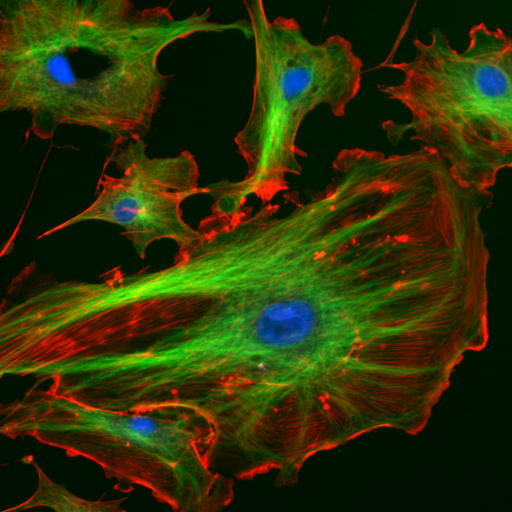 Endothelial cells viewed under a microscope
 The Preacher Pollard Blog