Big question! Apparently, it is at the top of all questions people ask around the world every month, gauging from internet search engine queries. According to dailysearchvolume.com, it spikes “with cultural moments…annual reflection periods…academic calendars…and headline- driven uncertainty.” It “is timeless, cross-cultural, and frequently resurfaced by media references, classroom assignments, life transitions, and news cycles that provoke reflection.” Whether or not we use those exact words, all of us spend a lifetime with that question at the heart of everything we are and all we do.
What does the question imply?
EXISTENCE. We are alive and aware. We exist, and because we exist we want to know why. We can observe much about “life.” It is brief. It has joy and sorrow. It is not always what we want it to be and thought it would be, and we may have to overcome unexpected and adverse things. But there is no way around it. We exist. We are here.
EXPLANATION. Was it random chance? Was it an accident from a cause that did not have me in mind? An unlimited number of “what” questions drive the original question. It is consummately unsatisfying to believe or conclude that there is no answer. The result of such aimless existence is despair, depression, apathy, and a certain fatalistic emptiness, if we accept the consequences of purposeless position.
EXCLUSIVENESS. At the very least, by asking what “is” life’s meaning, we are saying that while there may be many responsibilities and lesser pursuits something is premier and preeminent. There is an ultimate meaning. Discovering and pursuing that should take center stage and demand our highest attention and investment of our basic resources (time, money, and energy). It leads us to ask, could money, pleasure, fame, or education be the answer? Yet, countless people have made that their “why” only to experience utter emptiness at the end of life.
EXPECTATION. We want an answer or we would not ask. Nobody wants to hear, “I don’t know” or “it does not matter.” Life coaches, self-help organizations, mentors, support groups, community, and endless other entities exist to fill the hole induced by our question. We believe we can find it, we want to know, and then we want to do what we can to accomplish our quest with success. We wake up each day wanting to live with significance.
What if there was a resource that seriously, meaningfully, and logically explained an exclusive purpose for our existence and shaped our expectation? It would have to be internally coherent, consistent, and consequential. What if I were to tell you that a single source fully answered the most frequently asked question people ask every day? Would you want to know more about it?
Could it be that mankind is disturbed by the thought of accountability and submission? Would we rather have our fancy tickled by clairvoyance, black magic, and Martians than have it all explained by special revelation brought about by an Uncaused Cause who not only set things in motion but takes an active role and shows active concern in our individual lives even today?
Neal Pollard
“You don’t think the Bible is historically accurate, do you?” “Moses didn’t cross the Red Sea. It was the Reed Sea, only a couple of inches deep.” “Jesus was a good man, but the Son of God, born of a virgin, resurrected from the dead? Come on!” “I just can’t buy that Moses wrote the first five books of the Old Testament.” “Creation took place in six, literal, 24 hours day? Who believes that?!” These are some typical questions people ask, and increasingly they are being asked by professed Christians as well as agnostics and atheists. The concept of a truly limitless God doing the incredible in the unfolding of history and His plan of salvation troubles many.
But, there seems to be an inconsistency if not a contradiction with many of these doubters. They will claim that they, their family or their friends have had many encounters with the paranormal. They have seen ghosts or UFOs. They have “communicated” with “the dead” with Ouija boards or séances. They go to Palm Readers, read Tarot Cards and tea leaves, or religiously scour their horoscopes to get a bearing on how to plan their future. They put complete trust in psychics and spiritualism. They are willing to swallow every “fact” spouted by humanistic, evolutionary scientists. In fact, a good number of things are simply assumed to be true because of the sources themselves.
Why do these glaring inconsistencies exist? Because some of this deals with the heart and motives, one must be careful in assessing the “whys.” However, it is manifest that such a reality prevails. The Bible talks about the mindset that leads one to put faith in the fanciful all while rejecting the reasonable explanation of God and His ways found in scripture. Certainly, we can treat the claims of scripture as fairly as we can a crystal ball or a Himalayan guru.
The pagan mind of the average Roman citizen was susceptible to the mystical and the cultic. Paul writes, “For the wrath of God is revealed from heaven against all ungodliness and unrighteousness of men who suppress the truth in unrighteousness, because that which is known about God is evident within them; for God made it evident to them. For since the creation of the world His invisible attributes, His eternal power and divine nature, have been clearly seen, being understood through what has been made, so that they are without excuse. For even though they knew God, they did not honor Him as God or give thanks, but they became futile in their speculations, and their foolish heart was darkened. Professing to be wise, they became fools, and exchanged the glory of the incorruptible God for an image in the form of corruptible man and of birds and four-footed animals and crawling creatures” (Romans 1:18-23). Ironically, with that worldview as a foundation, immorality of the grossest varieties followed (Romans 1:24-28) as well as unrestrained, chaotic behavior that was violent and destructive (Romans 1:29-31). Tucked into the middle of this latter list was the fact that such were “haters of God” (30). Could this be a viable factor? People might not articulate their personal philosophy in such pungent terms, but what is the consequence of their belief system? They reject out of hand the idea of the incarnation (literally, “God in the flesh”), a vicarious death (an innocent one dying for the guilty), an objective, normative, and authoritative divine revelation (i.e., that the Bible came from God’s work in guiding men to write down His will to guide all people of all time), and such Bible themes as sin, repentance, redemption, a universal judgment, heaven, and hell.
Could it be that mankind is disturbed by the thought of accountability and submission? Would we rather have our fancy tickled by clairvoyance, black magic, and Martians than have it all explained by special revelation brought about by an Uncaused Cause who not only set things in motion but takes an active role and shows active concern in our individual lives even today? I cannot speak for what drives a person to choose the ethereal over the eternal, but I can counter the fanciful with some basic facts of faith. Our morality, our spirituality, our drive to have standards of right and wrong, and our yearning to adore and worship cannot be satisfactorily explained by evolution, synapses of the brain, or even inexplicable chance. In our desire to titillate ourselves with apparitions and interpreting space noise, we have aimed infinitely low. If we will look up and put our trust in the all-powerful, perfect God and live our lives from that perspective, we unlock for ourselves the portal to peace and the pathway to purpose. In our heart of hearts, we know that belief in God is the better explanation. To that end, may we follow our hearts!
A carving on a temple wall shows an animal with a row of vertical plates along its back, sharply resembling a Stegosaurus. Some arguments have been levied against this claim but they’re hardly worth covering as most, upon seeing it, know exactly what’s being depicted. It’s not a porcupine.
Dale Pollard
The Ta Prohm Temple Stegosaurus
Location: Angkor, Cambodia
A carving on a temple wall shows an animal with a row of vertical plates along its back, sharply resembling a Stegosaurus. Some arguments have been levied against this claim but they’re hardly worth covering as most, upon seeing it, know exactly what’s being depicted. It’s not a porcupine.
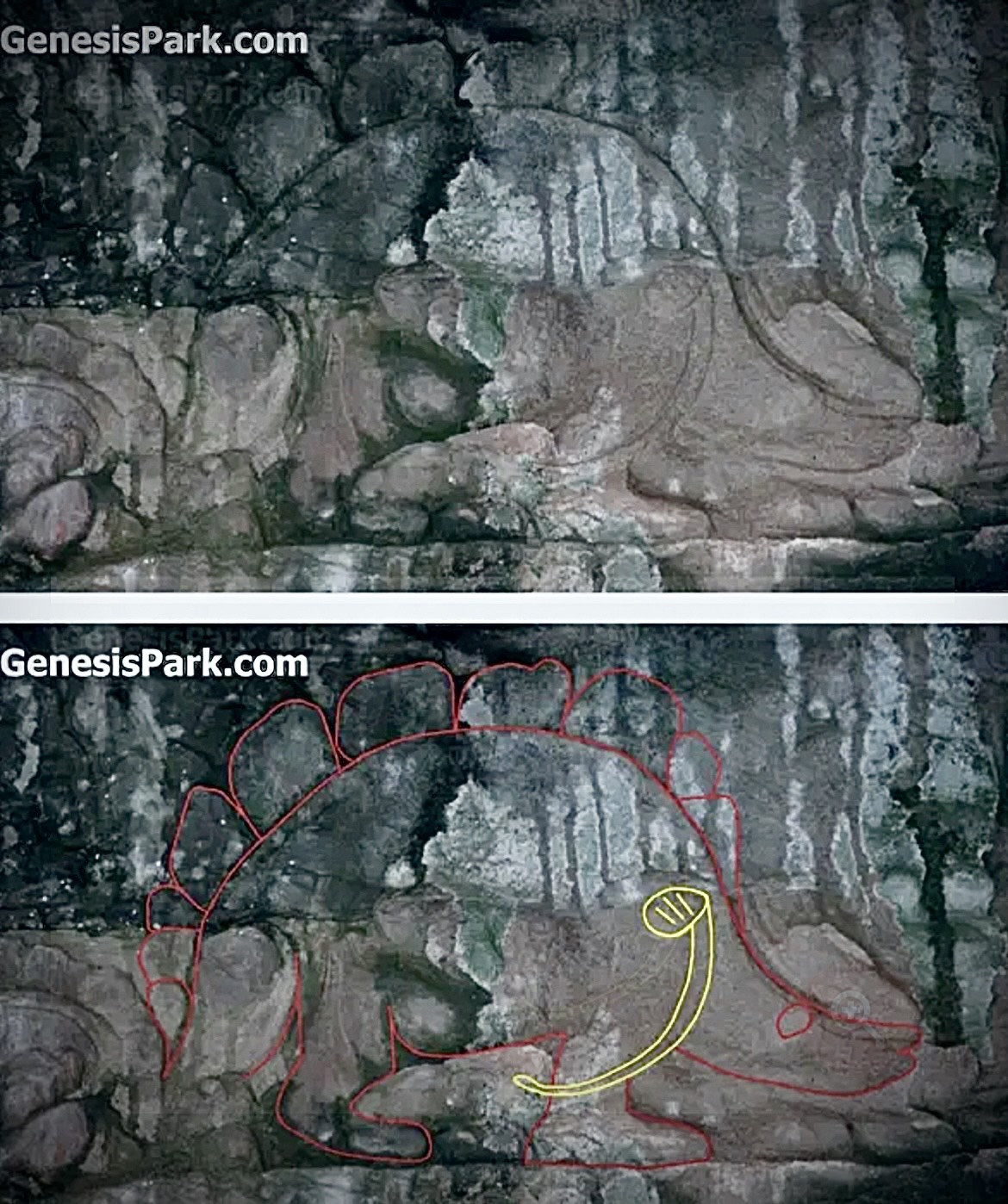
In addition to that well-known stegosaurus carving, the existence of a second, lesser-known relief can be found in the same complex. This carving is larger and more eroded but the features of a stegosaurian dinosaur are clear enough. A bulky body, dorsal plates, and tail are easily made out— along with something else. Interestingly, the head appears elongated and slender in comparison to the first making it more realistic, but it’s what’s on the head and neck that you’ll find amazing.
An unusual feature around the neck shares uncanny similarities to a bridle or harness— suggesting domestication. The work that could (hypothetically) be done with an animal of that size is fascinating to think about. Perhaps it could even explain the massive amounts of stone which were moved to complete the temple it was carved into. Many don’t realize that the volume of stone used at the Angkor Wat complex is greater, proportionally, than even the largest pyramid on Giza plateau in Egypt. But back to the stegosaurus bridle. The evidence is mainly that it mirrors other carvings around Ta Prohm depicting bridles on horses, elephants, and oxen in the same manner.
The Triceratops Rider
Location: Acambaro, Mexico
A clay sculpture depicting a human figure riding a Triceratops was discovered in 1944. This piece is part of a larger collection of around 33,000 ceramic figurines near Acámbaro, Guanajuato, Mexico, by a German man named Waldemar Julsrud.
In the 1950s, Professor Charles Hapgood investigated the site and supported the idea that the artifacts were genuine. Apparently, thermoluminescence dating was done in the 1960s and 1970s (don’t ask me how that works) and the results indicated that the figurines might have a pre-Columbian origin.
Could it be that the mainstream evolutionary timeline is that blatantly false? The author obviously believes that to be the case. Humans and dinosaurs walked the earth at the same time. While some were predators that our ancestors feared (Job 40-41), it seems that some were also tamed and used in a ways not unlike the ox or horse. Could you imagine?
Scripture offers deeper insights into the nature of truth. When you choose to integrate faith into your everyday life, you will find meaning and you will be fulfilled.
You will find a purpose driven existence that the world longs to have. With God, life has meaning.
Notice with me 5 biblical truths that shape our worldview. There are many more, but these five have been the fundamentals of our faith. These are the ones that the apostles taught to the world after the ascension of Jesus. I am thankful that God has given to us a framework as Christians, a framework through which we are supposed to interpret the world.
We don’t rely on opinions, or feelings, or traditions, or our families, to tell us these truths. These truths were laid upon us by the Lord of Lords. He tells us these truths so that we would have a lens through which we can interpret the world. Without them we are Velma from Scooby Doo. We NEED these glasses to see the world properly.
Pillar number 1 in the biblical worldview…
We Were Created
How does the world say that we got here?
In the beginning there was a cosmic boom.
This is what our children our taught, and what more and more people are believing.
This is totally contrary to the words of Scripture. We say “In the beginning God created.” The world says, “In the Beginning nothing created.” It takes more faith to believe evolution than it does the first five words of the Bible. Pillar number 1 of a biblical worldview contradicts the very nature of modern historical scientists.
In the beginning God said, “Let us make man in our own imagine, in our own likeness” Gen. 1:26
We were created and molded after the Creator. From this first pillar we learn many things. Because we have a Creator we better understand the world God placed us in.
The knowledge of a Creator helps us understand ourselves better since we were made in the image of God. Because we were created we learn of the Creator who shaped us out of dust and breathed life into our bodies. We were created to ENJOY fellowship with our God.
Pillar number 2…
We Fell
In Genesis 3, man rebelled against God and as a result of that, sin entered into the world. This sin caused
Spiritual separation: Adam and Eve and their children were separated from God, both physically and spiritually. They could no longer walk and talk with God face to face.
Physical changes: Adam and Eve became mortal, and they and their children would experience sickness, pain, and physical death.
Cursed environment: The ground was cursed in the Garden of Eden and throughout the earth.
Loss of righteousness: Adam and Eve became aware of their nakedness and knew that their former perfection was gone.
Guilt and shame: Adam and Eve felt guilt and shame they had NEVER felt this before.
Judgment: Satan was judged with a divine curse. The woman would experience pain in childbirth, and her husband was to rule over her. Man must now labor for his existence on a cursed earth.
And if that wasn’t enough, Paul says this in Romans 5:12: “Therefore, just as sin entered the world through one man, and death through sin, so also death was passed on to all men, because all sinned.” From the moment we fell, all people are born into a sinful world, and with a desire to rebel against our God. No matter who you are, you will have sin in your life (Romans 3:23).
There are so many people who don’t believe in God because of the consequences of the fall. They’re angry because there is suffering and death in the world. They think if God exists, why is there so much death and pain? Either He doesn’t exist, is too weak to fix it, or just doesn’t care. In their minds, they don’t believe in God because of these things. Why do so many feel this way? They fail to have a biblical worldview. Otherwise they would realize that all of this death and suffering and sorrow is a direct result of the fall. We recognize through a biblical worldview that we live in a fallen world.
And because of this, although God is good and He exists, suffering also exists because we live in a SINFUL world.
Do you see how these worldviews can start changing your attitude? Every tear you’ve ever shed. Every graveside you’ve ever attended. Every hospital you’ve been in. Every NICU a child is taken to. Every war that is fought. Every cancer treatment you take. Every grey hair or lack of hair. Every divorce, every death, every diseases. Every failure, every insecurity, every struggle ALL exists because we LIVE in a fallen world!
What is the point if there is no God to save us from our sin?
Pillar 3…
We Are Redeemed
We are currently living in the Christian era or dispensation. We exist in a time, after the fall, but before the end. We are in the last times. No newer covenant, this is it.
God has given His Son, we either accept Him or reject it. What more could God give?
How else could He prove to His creation that He loves us? He chose us after the fall.
We are now redeemed through Christ. We are living in a time after the resurrection and before the second coming. God is working on this earth to redeem those whose hearts are soft so that we can escape judgment.
We are redeemed by the blood of Christ, and God is going to make sure that everybody has an opportunity to respond.
And that is where we are now. God is redeeming for Himself a people who will spend an eternity with Him. Ephesians 1:7 says, “In him we have redemption through his blood, the forgiveness of sins, in accordance with the riches of God’s grace.” This word redeemed literally means, to release from a captive condition, to deliver. What are we being released from? What holds us captive? The SIN we find ourselves in as we are living in a fallen world!
Christ is our redeemer who saves us again and again. God has regained His prize possession through the payment of His Son.
Not everyone will be saved, only those who have come in contact with the blood of Christ. This is why call Him our redeemer.
Those who are redeemed will be taken to paradise and saved from the destruction of this world. We live in the era of redemption.
If you don’t have this biblical worldview, you will see no reason to stop sinful behavior.
You will be just like those in the days of Noah, MOCKING the ones who are getting in a boat on dry land. This worldview should shape our perspective of life, to its CORE.
Pillar 4…
We Are A Part of The Kingdom
The Kingdom of God is the reign and rule of God in our lives. We were redeemed to be a new creation in Christ. We are a part of the reign of God in the world. As citizens in this Kingdom, we are called to live in a way that reflects His values and priorities.
We are called to live out the principles of our King in our daily lives. Jesus came, according to Mark one, preaching the kingdom of God is at hand.
It’s here now! Our worldview, that is, our jobs, our families, our friends, our words, our thoughts, our actions, our attitude, our perspective, must ALL be shaped by our citizenship. We. Belong. To God. “But our citizenship is above, and from it we await a Savior, the Lord Jesus Christ, who will transform our lowly body to be like his glorious body, by the power that enables him even to subject all things to himself” (Phil. 3:20).
We are here, but don’t belong. Live like you are in God’s Kingdom.
Pillar 5…
We Will Be Restored
This final pillar looks forward to the ultimate restoration of all things. We are promised that God will make everything new, just as it was in the beginning. Pillars 1 and 5 are connected by redemption and a kingdom.
Through these things we will be restored to God’s original perfection. This is hope greater than any earthly thing. This promise of restoration helps us persevere through this fallen world. This promise helps us live as citizens of the Kingdom. The promise of restoration provides hope for the future.
It encourages the redeemed to work toward godly love, to show mercy and forgiveness.
It’s so encouraging that many public figures (by extension, many of their audiences) have rejected outright atheism and godless evolution! Even those who would never consider themselves believers have rejected some of the main pillars of evolution. Among them are people like Joe Rogan, Randall Carlson, Graham Hancock, Jordan Peterson (who does describe himself as a believer in some capacity), Ben Van Kerkwyk, and many others.
What have they rejected (minus Peterson)? Gradualism/Uniformitarianism — a belief (it is a belief) that current processes are sufficient to explain how things were in the past. Uniformitarianism is the foundation supporting a belief that our earth is billions of years old, that geological processes take millions of years, and it serves as the bias behind radiocarbon/radioisotope dating.
So what’s the problem? These same proponents of catastrophism (the belief that geological processes are best explained through natural disasters rather than gradual changes over long periods of time) still view the earth as being billions of years old. They still have an evolutionary view of our timeline. Progress is progress, so I don’t want to be harsh in discussing these people!
But I would like to remind myself (and whoever may read this) of why I don’t believe the earth is any more than (at most) 12-15,000 years old:
Population of earth — We double in population every couple of decades. Allowing for disasters, if humans (or humans-ish, as evolutionists say) came onto the scene 1,000,000 years ago, we’d have something like 1×105000 people on earth today. The known universe couldn’t hold anywhere near that many people, much less our one planet. Since the current population of earth is around 8.02 billion (according to commerce.gov), we can safely assume that we’re no older than 12-15,000 years.
Sediment layers across our ocean floors are far too “thin” to support an age of hundreds of millions of years. Sediment should be “choking the oceans” if the oceans were that old. The salinity (saltiness) of the oceans is another problem for old-earth proponents — it has been convincingly proven that our oceans are getting saltier with time (rather than remaining constant). Based on current salinity, our earth is no more than several thousand years old.
Many other brilliant authors have written much more than can be contained here. I recommend perusing the Institute for Creation Research’s website, as well as Apologetics Press and Answers in Genesis for more proofs. While the secular world is still off on quite a few things, we shouldn’t overlook the fact that progress is being made.
At least for right now, there does seem to be a positive trend in society’s thirst for meaning! Let’s make the most of this by showing God’s love even more. Let’s prove to the world that there’s no better life than a Christian life! Our God is coming back — when he does, the entire world will see him. Let’s show them that we believe in him enough to love like Jesus!
The debate between creationists and atheists is probably not new to you. This heated debate frequently takes the form of verbal duels, with each side trying to persuade onlookers to take their side. Unfortunately, these arguments rarely convince their opponents to change their minds. In most cases, they are speaking to an already confident audience.
Since I hold a creationist worldview, I frequently read works that reinforce that view. Unfortunately, the strategy used to make the case for God’s existence often comes off as bland and unpersuasive. These tactics wouldn’t have influenced me had I not already convinced myself.
Ultimately, faith is the deciding factor. We can’t provide indisputable evidence since we weren’t around for the “Big Bang” or creation. We found our faith in the evidence that we found most convincing, be it ancient fossils or direct revelation from God. This truth leads me to an essential aspect of my approach when discussing my faith.
When asked about my faith, I usually explain why I think there must be a higher power, pleading only for tolerance and acceptance. I want to debunk the myth that people who believe in God are stupid. To this end, allow me to provide two fundamental arguments that offer compelling evidence of a Creator.
First, I’d like to discuss the concept of a “God-shaped void” in every person’s soul. Aurelius Augustinus Hipponensis, a theologian born roughly 320 years after Jesus of Nazareth, is widely credited with developing this idea. However, the French mathematician Blaise Pascal may be a more likely originator. Pascal’s perspective gives us much to ponder.
According to Pascal, the search for and disappointment in material happiness are signs of a more profound spiritual longing. He contended that only something infinite and unchanging, like God, could fill this gaping chasm. This void brings us to an intriguing point about our universal need for worship.
We can’t help but wonder if there is a universal, hardwired urge to worship. How come religion is so pervasive? What accounts for the universality of references to spiritual phenomena like ghosts and ghouls? How do some people discover spirituality in the great outdoors? These occurrences point to an innate desire to worship. Skeptics, however, might have a different take on this.
Skeptics may write off religion as the product of neuroses, thereby tagging the vast majority of humanity as mentally ill. The paradox here is apparent: It takes neurosis or paranoia to believe you’re the only sane person in the room. Interestingly, skeptics themselves seem to show a form of devotion.
Even skeptics have their form of religious devotion. Non-believers hold science in high regard and defend its tenets with great zeal. Like accusations of heresy in religious contexts, challenging their scientific beliefs can elicit strong reactions. This reaction has led me to question the source of our knowledge.
While I value science’s role, I am skeptical of its origins. Believers credit their knowledge to God or a higher power. Atheist scientists rely heavily on human-made discoveries and theories with inherent flaws. Changes in academic science are possible and frequent. However, God’s Word does not change. This immutability brings me to another critical argument I wish to present.
The ontological argument is my second piece of evidence for God’s existence. Anselm of Canterbury first advanced this line of a priori knowledge-based philosophical reasoning in 1078. Here’s what Anselm proposed:
Anselm theorized that God must exist because He is “a being than which no greater can be conceived.” This argument may seem complicated, but it claims that God must exist because everyone can imagine a supreme being and that having a physical presence is one measure of greatness. The universal nature of belief in God provides further credence to this argument.
The fact that people all over the world believe in God lends support to this claim. It resonates with the concept of a “God-shaped void,” implying a global recognition of a supreme entity Whom men desire to worship. With these points in mind, what do I conclude about the existence of God?
Is there a God? Yes, I think so. I suggest you give that idea some thought, too. Perhaps you already know about God but still, feel something is missing. Seek Him out; you won’t regret it. I believe that you can find Him because I have found Him.
“The heavens are telling of the glory of God; And their expanse is declaring the work of His hands.” (Psalm 19.1 NASB1995)
A cold wind bit my exposed skin as I walked to the mailbox. Three cats wove between legs desiring a petting. I wanted to hurry back to the house but feared inadvertently kicking one of the lovable, purring furballs. I carefully made my way from the shadow into the direct sunlight. I felt the warming rays of the sun on that same exposed skin. I closed my eyes but could still sense the bright light of that gaseous ball some 92 million miles away. As I coaxed the cats back up to the house, I contemplated our life-sustaining star.
How is it that we happened to find ourselves in the “sweet spot” in our proximity from this sphere of hot plasma? Were we any closer, the conditions on earth might prove too hot to support life. Were we any further away, the conditions on earth might prove too cold to support life. If you do any searching into this happenstance, you will encounter the expression “Goldilocks zone.” You may recall Robert Southey’s story of the titular Goldilocks who decided to make herself at home in the house of three bears. She tried the food, chairs, and beds of the absented creatures, finding the baby bear’s things to be “just right.”
Somehow we found ourselves on a planet in that spot, which is just right. Atheists say that this is the result of chance. I was reading a site contributed to by those departing the Christian faith as they discussed this very topic. The original poster to the forum said that this habitable zone’s existence was a remaining hurdle for him in his desire to cast off the reality of God. Commentors threw out what I would consider a straw man argument, stating that life is possible elsewhere; it is just that evolution would produce a different result. Thus, some other lifeforms would be having this same discussion about how their planet was in the “right spot.”
Of course, that does nothing to explain how we found ourselves in just that right spot. It was an explosion from nothing (i.e., Big Bang) that scattered the known universe’s material. Gravity also resulted from this explosion somehow. This gravity enabled the cosmic debris to coalesce into the Earth, Sun, and all the tiny dots of sparkling light observable in the night sky. Yet, despite its chaotic beginning, the earth was situated at the proper distance from the sun to allow life to get sloshed together inside primordial oceans.
Those simple lifeforms, defying every observation today that things go from a state of order to disorder, managed to grow more complex over eons of time. Yes, there were untold dead ends in which mutation brought about disastrous results. But finally, homo sapiens (“wise man”) emerged at the animal kingdom’s apex, the hairless primate, to ponder his existence. With his technology, he created machines that enabled him to communicate over much distance instantly about how the Goldilocks zone is just the illusion of an Intelligent Creator.
Call me crazy, but I think it takes more faith to believe that pure chance put us into the sun’s sweet spot. It is much easier for me to accept an Omnipotent God created us and placed us inside the Goldilocks zone He made. Thus, the perfect proximity from our star declared God’s glory to me! As such, as I felt the sun’s warmth on a cold day, rather than think of it merely as a hot ball of gas heating me, I could imagine those sun’s rays were the arms of my Heavenly Father holding me in His loving care.
While in college, I accompanied a friend to Chattanooga to pick up her car from her parents. Both of us were from rural Appalachia and shared a love for nature. Thus, learning that the Tennessee Aquarium was our rendezvous point did not surprise me. It was my first visit to this establishment, and I was impressed. Among the permanent exhibits, there was a temporary one featuring jellyfish. I thought that was lackluster from the sound of it. As I discovered, jellyfish can be quite beautiful.
There were varieties of jellyfish (i.e., comb jellyfish) looking like UFOs, filled with running lights. I felt like I was watching a science fiction movie as the jellyfish slowly moved through the water. If you have seen Close Encounters of the Third Kind, you may recall the scene where the aliens converge on Devil’s Tower in Wyoming. The “men-in-black-types” atop Devil’s Tower used musical tones associated with colored lights to “communicate” with the extraterrestrial visitors who replied with the same notes and colors. That is what I recalled watching those jellyfish.
I suppose there may be a sense in which I was watching ambassadors from another world. These are creatures that humanity does not usually get to see, outside of a documentary such as the BBC’s Blue Planet. I suppose prey are attracted to the light. However, a blind mechanism, like evolution, would not have given them the beauty I witnessed. Intelligence must have designed them this way since a single glowing color would be sufficient to attract their meals. Jellyfish would not need a rainbow of colorful lights. Indeed, these comb jellyfish spoke to me of an unseen God (cf. Romans 1.20).
Isaiah 43.7 informs us God created Israel for His glory. I wish to treat this passage with great care since Christians sometimes use it to give rationale to God’s creation of all humanity. Yet, God made it clear that He picked an insignificant group on purpose (Deuteronomy 7.7). To what end? He could show the world His power and bring salvation through their seed (cf. Genesis 3.15; 22.18). That said, we may safely conclude that God created everything with a purpose. When one can view amazing spectacles, usually observed only by an omnipresent God (cf. Psalm 139), it is hard not to suppose God made things also for His enjoyment.
In addition to these alienesque gelatinous animals, God has other interesting “sights” to which only He has a regular vantage. Beneath the arctic ice, for example, one can find coral with, admittedly, more subdued colors than their kin in warm, tropical waters. Yet, here is something beautiful and unexpected no human typically sees. But God does. What about other aspects of creation that suggest they exist for God’s enjoyment? Some people say platypuses show God’s “sense of humor.” Consider the amalgamation of creatures one sees within the platypus. The platypus is a mammal but lays eggs. Like an avian, platypuses have duckbills and webbed feet. A platypus has a tail like a beaver and otter-like fur. Male platypuses are even venomous! Platypuses are so odd, in fact, that the first scientists examining them felt someone was pranking them. (“platypus”1)
Yes, God created the universe and all that is in it per His Will. Maybe God makes nations that can show His glory like ancient Israel. Perhaps, God creates organisms for no other reason than His enjoyment, like comb jellyfish and platypuses. But we know God created humanity so He could have a relationship with us. That is why the Father intervened by sending His Son (Isaiah 53.10-11; John 3.16), and why we find our purpose in doing God’s Will (Ecclesiastes 12.13-14).
Articles across the scientific community of late have been postulating a similar idea. Astrophysicist Brian Koberlein suggests that there was no single point in space and time when matter was infinitely dense, saying, “The catch is that by eliminating the singularity, the model predicts that the universe had no beginning. It existed forever as a kind of quantum potential before ‘collapsing’ into the hot dense state we call the Big Bang. Unfortunately many articles confuse ‘no singularity’ with ‘no big bang’” (briankoberlein.com). One of the most recent darlings of this explanations are Ahmed Farag Alia and Saurya Das, whose paper “Cosmology from quantum potential” is being cited by quantum physicists and astrophysicists. As this gets traction, there should be a trickle down effect until the broader scientific community embraces this idea.
Let’s hope so!
It could be a pivotal moment in the creation versus evolution debate. Why? When you wade through the technical, obtuse jargon, this theory concludes that the universe is eternal. We all know that something has always had to exist. Our options are “intelligent, moral, animate mind” or “mindless, amoral, inanimate matter.” The faith factor has just multiplied by a centillion for those wanting a God-less explanation. The same argument they have tried to level against those believing in intelligent design and creation applies to them. How did that eternal matter get here?
Here’s the difference between the two arguments. Matter not only had to “create” itself, it also had to develop (evolve?) intelligence, morality, purpose, etc. The Bible reveals an intelligent designer (Creator) with inherent morality, purpose, and sufficient power and energy to make it all. “It’s too simplistic,” they say. “How quaint!” But to a person who is truly trying to approach these two explanations with open-minded fairness, which of these two ideas will seem more plausible? It won’t even be a fair contest!
Let’s hope this latest attempt to explain our origin finds favor among those who “say there is no God” (Ps. 14:1) and who “suppress the truth” (Rom. 1:18ff). Maybe it will help more honest searchers “find” God (Acts 17:27). I think it will!
If the theory of evolution is true, why haven’t they found any transitional fossils? Charles Darwin, on page 413 of his tome Origin of Species, said, “Why is not every geological formation and every stratum full of such intermediate links? Geology assuredly does not reveal any such finely-graduated organic chain; and this is the most obvious and serious objection which can be urged against the theory.” Almost 150 years of archaeological digging and an incredible volume of fossil-findings later, the objection should be even stronger!
If the documentary hypothesis is true, why can’t they find even one copy or fragment? The idea that later scribes and penman wrote the first five books of the Old Testament, some almost 1000 years after the time Moses lived, is widely believed among liberal religious scholars. That there are no copies or fragments of these post-Moses writers has not done much to defuse the zeal of those who teach it. Neither is any attempt given to explain or rebut the many statements in the Pentateuch claiming that Moses wrote them (cf. Ex. 17:14; 24:4-7; 34:27; Num. 33:1-2; Dt. 31:9-11).
If the idea of being genetically predisposed to homosexuality is true, where is the genetic evidence of it? The study most supportive of “the gay gene,” conducted in 1991 by Baiiley and Pillard, found 52% of the pairs of identical twin brothers studied were homosexual. A much larger sample size, in an Australian study released in 2000 by Bailey, Dunne, and Martin, found only 20% concordance in identical twin males and 24% among identical twin females. Bearman and Brucker, in 2002, found less than 10% concordance (via Journal of Personality and Social Psychology, 78(3): 524-36; Archives of General Psychiatry, 48 (12): 1089-96; and the American Journal of Sociology, 107: 1179-1205).
If the idea that a “fetus” is part of the mother is true, why does that unborn one have its own unique genetic code? Not only that, but the unborn can be a different blood type, gender, race, hair color, eye color, and more.
If the big bang theory is true, what did it and why? Whether it is thought to have been highly concentrated matter, energy, or combination, what force acted upon it? It was there, presumably for an eternity. Why didn’t it “bang” before it did? Why did it bang when it did? How did mind emerge from matter? How did morality emerge from non-morality? How did an explosion or expansion form such order out of chance and chaos?
If it is true that making moral judgments about others’ behavior is wrong, why is that moral judgment not wrong?
None of these questions is intended to exhaustively address any of the theories or world-views they represent. Yet, so many unquestioningly and blindly accept these premises as fact when they are far from it. Seemingly, the last resort, if ever taken, would be to accept and follow what the Bible says. However, that is the fundamental dividing line. Hebrews 11:6 puts it well, that “without faith it is impossible to please Him, for he who comes to God must believe that He is and that He is a rewarder of those who seek Him.”








 The Preacher Pollard Blog