Daniel was a faithful servant of God. No matter the circumstances, he would put his trust in God. Let us look at how Daniel was faithful to God in all times.
We see Daniel being faithful to God in trials. The other wise men in the kingdom were jealous of Daniel and wanted to have him killed. So they went to the king and asked for a decree to be made that only the king could be prayed to. Daniel trusted in God even though he could have faced dire consequences if he prayed to God. “When Daniel knew that the document had been signed, he went to his house where he had windows in his upper chamber open toward Jerusalem. He got down on his knees three times a day and prayed and gave thanks before his God, as he had done previously. Then these men came by agreement and found Daniel making petition and plea before his God. Then the king commanded, and Daniel was brought and cast into the den of lions. The king declared to Daniel, “May your God, whom you serve continually, deliver you!” And a stone was brought and laid on the mouth of the den, and the king sealed it with his own signet and with the signet of his lords, that nothing might be changed concerning Daniel.” Daniel 6:10-11, 16-17 shows us that even though the king banned prayer to God, Daniel still put his trust in God.
In our lives today do we show this kind of faith and trust in God? Do we understand the consequences, but stick with God? Many today have a faith that is dependent on the circumstances. But we must be like Daniel. Have a full trust in God to deliver us in our trials and understand that He is in control.
Prophecy is one of the boldest claims any religious text can make: that a transcendent God reveals specific future events, sometimes centuries or millennia in advance, through human spokesmen. The Bible contains roughly 2,500 prophecies, of which most have already been fulfilled with 100 percent accuracy! The remaining prophecy are yet to come with the return of Christ. This track record is unique among world religions and texts.
Deuteronomy 18:21–22 gives us the standard: “If what a prophet proclaims in the name of the Lord does not take place or come true, that is a message the Lord has not spoken.” A single verifiable failure disqualifies a prophet. By this biblical standard, Muhammad, Joseph Smith, Nostradamus, and every modern “psychic” are eliminated. No biblical prophet ever fails when the prophecy is testable.
Biblical prophecy is extremely detailed, not the vague horoscope-style language used by many today. For example:
Micah 5:2 (700 BC) names Bethlehem Ephrathah as the Messiah’s birthplace, out of hundreds of Judean villages.
Isaiah 44:28–45:1 (700 BC) names Cyrus as the Persian king who would release the Jews to rebuild Jerusalem, 150 years before Cyrus was born.
Psalm 22 (1000 BC) describes crucifixion, nails in hands and feet, garments divided by lots, centuries before Rome invented the practice.
Zechariah 11:12–13 foretells the betrayal price of thirty pieces of silver, cast to the potter in the temple, fulfilled to the letter in Judas Iscariot (Matthew 27:3–10).
Mathematician Peter Stoner calculated the odds of one man fulfilling just eight messianic prophecies at 1 in 10¹⁷ (one followed by seventeen zeros). For forty-eight prophecies, the probability drops to 1 in 10¹⁵⁷ a number so large that if you filled the state of Texas two feet deep with silver dollars, marked one, and asked a blindfolded person to pick it on the first try, those are the odds.
Skeptics dismiss prophecy as “after-the-fact interpretation” or “self-fulfilling.” Yet many predictions (the fall of Tyre in Ezekiel 26; the precise sequence of empires in Daniel 2 and 7; the desolation of Edom in Obadiah, Jeremiah 49) were fulfilled centuries later in ways no human could manipulate.
Biblical prophecy is not fortune-telling; it is history written in advance by the only Being who stands outside time. Its perfect record remains the strongest external evidence that the Bible is exactly what it claims to be: the word of the living God!
Daniel prophesied of the Persian and Greek eras of Israelite history. The angel interpreted that for us, so there’s no mystery there. That mean man of the Diadochi, Antiochus Epiphanes, is described with his persecution lasting 2300 days. It was concluded by the Rededication of the Temple by Judas Maccabee, and that day became the Jewish Festival of Lights (John 10:22).
Daniel 11-12
The number of days in this query are set in a prophetic history that covers the entire second temple era of Judaism.
It relates the Persian kings to the conquest of Alexander the Great, to the break-up of that empire into the Diadochi, to the rise of Antiochus Epiphanes and the Maccabees, to the Roman conquest of the East, to Herod the Great, and to the final Destruction of Judea by the Roman generals and the Zealots.
Some of the final verses in this vast prophecy are referred to by Jesus in the address on Mount Olive (Dan. 12:1,11; Matt.24:15,21).
The interpretation of these number of days must fit into this first century time period (the end of the Second Temple Era).
Abomination of Desolation
According to the synoptic section in Luke, the Abomination of Desolation (that which makes desolate) was the Roman Legions (Luke 21:20). The number of days that those armies marched up and down the land of Judea was 1290! Recall that Jesus warned His disciples to flee Judea, not just Jerusalem.
This devastation was widespread with villages being torched in Galilee, Perea, Samaria, and Judea proper, with supply lines cut off from Jerusalem. When the soldiers finally besieged Jerusalem their fate was sealed— literally! All of this time period (with dates) is recorded by an eyewitness Jewish general by the name Flavius Josephus who had been captured.
The 1335th Day
The city of Jerusalem had its three defensive walls breached. The inhabitants were slaughtered. The Temple was burned and torn down just like Jesus said. Everything was trampled down except for a Herodian palace in the Upper City where the last Jews barricaded themselves and refused to surrender. It’s estimated that they had plenty of water and food supplies to last for an unknown period of time. The walls were so thick the Roman General, Titus, decided to wait it out.
But amazingly, the remaining Zealots opened the gates on the 1335th day of this war!
Note the remarks of Josephus’s history concerning Titus’s surprise:
“Now when Titus came into this (upper city), he admired not only some other places of strength in it, but particularly those strong towers which the tyrants in their bad conduct had relinquished; for when he saw their altitude, and the largeness of their several stones, and the exactness of their joints, and also how great was their breadth, and how extensive their length, he expressed himself…’We have certainly had God for our assistant in this war, and it was no other than God who ejected the Jews out of these fortifications; for what could the hands of man or any machine do towards overthrowing these towers?’” (Wars, VI,9:1)
If the tyrants had stayed in the fortress, the Roman Legions would have stayed around the territory and continued to massacre the Jewish people. The soldiers had seen the despicable display of gross inhumanity the Zealots committed on each other and innocent people, and they had no mercy for them. But as Jesus said, with the mysterious surrender— the killing would stop:
“And except those days be shortened, there would no flesh be saved, but for the elect’s sake those days shall be shortened.”
(Matthew 24:21-22)
Conclusion
These days, 1290 and 1335, are seen fulfilled by recorded history. There is no need for guessing or speculation. They fit the time period required by the chapters 11-12 which end with the topic of the Ending of the Jewish Era. It is this same topic that Jesus dealt with in the first half of the Olive lesson, which Jesus said was to occur within that generation (30-70 A.D).
No, these days do not refer to any Great Tribulation at the End of the World. These prophesied days were fulfilled to the day— in the first century! They’re important because they mark the end of the Old Testament economy, and the rise of the fantastic Kingdom of God.
(Hebrews 8:13, Luke 13:35, 16:16; the years 30-70 A.D. were transitioning times)
If you like fishing, you know it can be fun; and overwhelming sometimes.
One day I was just sitting at home and one of my friends invited me over to go fishing with them, so I packed my gears and went. On that day I did not catch anything, not even a little fish. On the second I got invited over to go fishing but still I did not catch any fish. On the third day I got invited again so I packed my gear and went and I caught a big fish! That third trip taught me something, to never give up.
Just like the story of Daniel as we read about in in (Daniel 6:10). He never gave up. He prayed to God three time a day and he never stopped praying and God delivered him from the lion’s den.
Or the story of Abraham, as we read about it in Romans 4:18-21. He never gave up. He kept believing he would have a son and trusted God.
We can also learn something from the story of Job as we read about it in James 5:11. Job didn’t give up when he was suffering. He kept waiting for God’s help.
Or as we read in Luke 8:40-48 about the bleeding woman. She didn’t give up trying to be healed. She came to Jesus and he healed her.
Or as we read it in John 17:4. Jesus didn’t give up on saving us!
So we shouldn’t give up either; just because you are having a bad day or dealing with a life crisis that shouldn’t stop you or discourage you from praying to God. Leave you worries to God. You know that He will never leave you if you keep on seeking Him first. And stay courageous because there’s a happy ending and endless joy in God’s kingdom!
Do not give up!
(Jermie is a refugee originally from the Congo who came to the International Center in Bowling Green. He obeyed the gospel only a few months ago! He was invited by another new Christian and fellow refugee, Jonas Gwishi, who was invited by one of our young adults, Chase Johnson)
The author of Hebrews uses the example of the Melchizedekian priesthood to establish the priesthood of Christ. Jesus belonged to the tribe of Judah, which Moses did not mention regarding the earthly priesthood. Therefore, there was a need for a covenant change to allow a non-Levite to serve as a priest. The writer of Hebrews spends chapters eight and nine explaining how the New Testament replaced the Old Testament in line with prophecy (see Jeremiah 31.3–14). In summary, the Holy Spirit confirmed that it was God’s will for Jesus to be a priest, but since He could not serve as a priest on earth because of Moses’ Law, Jesus instituted the New Testament so that He could be our High Priest in heaven.
Some believe that Jesus will reign as King from David’s throne in a future Jerusalem-based kingdom. However, there is an obstacle preventing Jesus from doing so on earth. God cut off David’s seed from sitting on David’s throne, as mentioned in Jeremiah 22:30, making it impossible for any of Jeconiah’s (or Jehoiakim’s) descendants to reign in Judah. This fact is relevant because Jeconiah was an ancestor of Joseph, Jesus’s foster father. Matthew traces Jesus’s legal lineage through Joseph in Matthew 1:12. Since Jesus is a descendant of Jeconiah, he cannot reign as an earthly king even though it was God’s will for Christ to be King. If God had not taken away the right of Jeconiah’s descendants to reign in Judah, Jesus could have certainly been an earthly king.
So, how is Christ a king? Jesus promised to establish a kingdom (Matthew 16:18–19). When Pilate pressed him, Jesus admitted to being a king (John 18.37). However, consider how Jesus qualified the nature of His kingdom in John 18.36. “My kingdom is not of this world. If My kingdom were of this world, then My servants would be fighting so that I would not be handed over to the Jews; but as it is, My kingdom is not of this realm” (NASB 1995). This truth means that Christ’s kingship is spiritual rather than earthly, as is His priesthood. It is worth noting that Jesus also accomplished this through His New Testament.
Many people misunderstand the truth and think that the apocalyptic language of a millennial kingdom in Revelation 20.6 refers to a future earthly kingdom that Christ will rule in Jerusalem. This misunderstanding is because they do not understand the interchangeability of the terms “kingdom” and “church” in Matthew 16.18–19. The word “church” is a Latin loanword that does not appear in the Bible. The actual word for church is “assembly.” Thus, the church represents the people. The word for “kingdom” is “basileia,” which means a kingdom or realm over which a king has sovereign authority. Therefore, God’s will was for Christ to choose a group of people from all over the world willing to submit to his authority.
According to the Book of Daniel, God showed King Nebuchadnezzar a prophetic dream about the future (see Daniel 2). In the dream, a cut stone struck a large image at its feet, causing the entire image to shatter and signifying the end of all worldly authority. Different materials comprised the image’s body parts, representing different empires. Babylon was the head of gold, Persia was the chest and arms of silver, Greece was the belly and thighs of bronze, and Rome was the legs of iron and feet of iron and clay. The feet mingled with clay represented the internal weakness of Rome. Commentators are familiar with this dream’s timeline. However, some believe that the Kingdom of God, symbolized by the cut stone, is yet to appear. However, according to Daniel, the kingdom emerged during the reign of the Roman emperors, referred to as “those kings.”
Jesus said, “Truly I say to you, there are some of those who are standing here who will not taste death until they see the kingdom of God after it has come with power” (Mark 9.1 NASB 1995). For those who refuse to believe that Jesus established His kingdom as He intended, there must be more than one person of advanced years who can prove they are older than two millennia! We understand that the power to which Jesus referred was the Holy Spirit, who descended on the apostles on the day of Pentecost, around 33 AD (Acts 2.4). As a result, Jesus reigns as King today and will continue to do so until His return. Following His return, Jesus will hand over His authority to the Father and the redeemed from all ages (1 Corinthians 15.24).
Combining biblical texts and prophecies creates a deep understanding of Jesus Christ’s position as King and High Priest, which goes beyond worldly limitations. Jesus fulfills the roles God has designated for Him, not as a political leader or a member of the old priesthood, but in a heavenly and everlasting sense through the New Testament and His heavenly kingdom. This understanding challenges traditional beliefs about a future earthly kingdom, instead emphasizing Christ’s spiritual reign, which began during His ministry and continues today. As Christians, we have the honor of living in this heavenly kingdom that Christ, our eternal King and High Priest, rules over in a merciful and benevolent manner. Recognizing this broadens our spiritual understanding and strengthens our faith in the eternal truth of God’s word and His ultimate plan for redemption.
The concept of angels and angelic beings filling the role of guardian is found several times throughout scripture. A cherubim with a flaming sword that flashed in every direction to guard the the way to the tree of life (Genesis 3.24). Jesus tells us that each child is assigned an angel and that angel is of such high rank that it can see the face of God (Matthew 18.10). While certain angelic beings, like the Cherubs, are depicted as guardians— it’s possible that any rank of angel might serve in this way (Psalm 34.7).
Here are a few fascinating sections of scripture that shed light on the mysterious operation of God’s heavenly host.
Daniel’s Angel
The Old Testament provides several examples of angelic intervention, but what unfolds in Daniel 10-12 stands apart. A distressed Daniel had been praying for three weeks and it was starting to look as if God had forgotten about His prophet. After Daniel had spent twenty one days of fasting and prayer, we read,
“I looked up and there before me was a man dressed in linen, with a belt of fine gold from Uphaz around his waist. His body was like topaz, his face like lightning, his eyes like flaming torches, his arms and legs like the gleam of burnished bronze, and his voice like the sound of the multitude” (Daniel 10.5-6).
Daniel’s unnamed angel has finally arrived and he actually provides a reason for why it had taken him so long to respond to Daniel’s prayer. The angels explains, “Since the first day that you set your mind to gain understanding and to humble yourself before your God, your words were heard, and I have come in response to them. But the prince (patron angel) of the Persian kingdom resisted me twenty-one days. Then Michael, one of the chief princes (angels), came to help me, because I was detained there with the king of Persia” (Daniel 10.12-13).
Daniel’s angel was locked in combat with an evil spiritual force he called “the prince of Persia” and things had become so heated that Michael the Archangel (see also, Jude 1.9) had to intervene. Paul would later confirm the reality of spiritual warfare when he tells those first century Christians, “…we do not wrestle against flesh and blood, but against the rulers, against the authorities, against the cosmic powers over this present darkness, against the spiritual forces of evil in the heavenly places” (Ephesians 6.11-12).
Just as Daniel is about to receive information about the future sourced from the Book of Truth (see also, Revelation 20.12), the unnamed angel tells him, “No one supports me against them (the evil forces) except Michael, your prince. And in the first year of Darius the Mede, I took my stand to support and protect him” (Daniel 10.21,11.1).
Michael is called by the unnamed angel, “your prince.” The use of the term prince in Daniel 10 has only been used to describe spiritual beings that seemed to yield some kind of ruling power over a nation. Michael isn’t Daniel’s personal angel but instead Israel’s “patron angel.” If Michael wasn’t Daniel’s guardian angel, then perhaps the unnamed angel fulfilled that role. While the unnamed angel responded to Daniel’s prayer and revealed visions of the future— he then returns to continue fighting the prince of Persia. We’re also told that he took special interest in Darius the Mede, so it’s not likely that he was Daniel’s sole protector either.
Peter’s Angel
In Acts 12 we find King Herod on a rampage. He kills James the Brother of John with the sword and then throws Peter in prison. While Herod is persecuting the church, the church begins praying— and God answers with an angel. Peter’s trial is scheduled for the next day but he wouldn’t make it because, “Suddenly an angel of the Lord appeared and a light shone in the cell. He struck Peter on the side and woke him up. “Quick, get up!” he said, and the chains fell off Peter’s wrists.
Then the angel said to him, “Put on your clothes and sandals.” And Peter did so. “Wrap your cloak around you and follow me,” the angel told him. Peter followed him out of the prison, but he had no idea that what the angel was doing was really happening; he thought he was seeing a vision.
They passed the first and second guards and came to the iron gate leading to the city. It opened for them by itself, and they went through it. When they had walked the length of one street, suddenly the angel left him. Then Peter came to himself and said, “Now I know without a doubt that the Lord has sent his angel and rescued me from Herod’s clutches and from everything the Jewish people were hoping would happen.”
The way in which the angel strikes Peter to wake him, the chains falling off his wrists, the iron gate opening by itself, and then the angel’s sudden disappearance are all details we can appreciate. However, the following verses are also intriguing. Notice who Peter is mistaken for, “…. He (Peter) went to the house of Mary the mother of John, also called Mark, where many people had gathered and were praying. Peter knocked at the outer entrance, and a servant named Rhoda came to answer the door. When she recognized Peter’s voice, she was so overjoyed she ran back without opening it and exclaimed, “Peter is at the door!”
“You’re out of your mind,” they told her. When she kept insisting that it was so, they said, “It must be his angel.” But Peter kept on knocking, and when they opened the door and saw him, they were astonished” (Acts 12.7-16). The early Christian’s make an interesting assumption and they must have had reason to think that Peter’s angel either resembled or could resemble Peter himself.
Non-Canonical Coincidences
The Early Church Fathers On Patron Angels
Clement of Alexandria (Post 202 A.D.): “…for regiments of angels are distributed over nations and cities; and perhaps some even are assigned to particular individuals.”
Origen, Homilies on Luke (Post 233 A.D.): “To every man there are two attending angels, the one of justice and the other of wickedness.If there be good thoughts in our heart, and if righteousness be welling up in our soul, it can scarcely be doubted that an angel of the Lord is speaking to us. If, however, the thoughts of our heart be turned to evil,an angel of the Devil is speaking to us.”
Rabbinic Commentaries & The Mistaken Identity of Angels
An angel appears in the likeness of Moses (Devarim Rabbah 2.29).
In a Jewish commentary on Ecclesiastes; “At that time an angel descended in the form of Solomon and sat upon his throne” (Kohelet Rabbah 2.4).
Another commentary on Genesis, possibly based on older sources, claimed that Jacob wrestled with Esau’s guardian angel (Bereshit Rabbah 77.3).
There are a plethora of men and women in the Old Testament who we can look to as an example of faith. Abraham, Joseph, Joshua, Sarah, and many more. However one of the strongest examples of true faith in God is found in the book of Daniel. Daniel is someone we would say was a faithful servant of God. No matter the circumstances, he would put his trust in God. Even in the toughest times, Daniel remained a servant for the Father. One instance where Daniel showed this incredible trust is found in Daniel 6.
Daniel was apart of the kings appointed wise men. However, the other wise men in the kingdom were jealous of Daniel and wanted to have him killed. So they went to the king and asked for a decree to be made which stated that only the king could be prayed to. they did this knowing that Daniel prayed constantly to God. Despite this decree, Daniel trusted in God even though he faced dire consequences if he prayed to God.
Daniel 6:10-11, 16-17, “When Daniel knew that the document had been signed, he went to his house where he had windows in his upper chamber open toward Jerusalem. He got down on his knees three times a day and prayed and gave thanks before his God, as he had done previously. Then these men came by agreement and found Daniel making petition and plea before his God. Then the king commanded, and Daniel was brought and cast into the den of lions. The king declared to Daniel, “May your God, whom you serve continually, deliver you!” And a stone was brought and laid on the mouth of the den, and the king sealed it with his own signet and with the signet of his lords, that nothing might be changed concerning Daniel.”
The king banned prayer to anyone other than himself, but upon learning this Daniel still fell to his knees and prayed. In fact, the moment he learned that the document had be signed, he left and went to go pray to God.
In a culture that is consistently moving further and further from Gods Word, how will His people respond? In our lives today do we show this kind of faith and trust in God? Do we understand the consequences, but still choose to obey God? Sadly many today have a faith that is dependent on circumstances. But we must be like Daniel. We should have a full trust in God to deliver us in our trials and understand that He is in control.
If prayer was outlawed, would you publicly show your faith in God? If going to church was made illegal, would you still show up on Sunday morning? These are situations that will hopefully never happen, but if they do I pray that we will be like Daniel in our response.
John is getting ready to faithfully record more of the incredible (and incredibly bizarre) visions in heaven as Revelation ten begins. However, the text says this,
“Then I saw another mighty angel coming down from heaven. He was robed in a cloud, with a rainbow above his head; his face was like the sun, and his legs were like fiery pillars.He was holding a little scroll, which lay open in his hand. He planted his right foot on the sea and his left foot on the land, and he gave a loud shout like the roar of a lion. When he shouted, the voices of the seven thunders spoke. And when the seven thunders spoke, I was about to write; but I heard a voice from heaven say, “Seal up what the seven thunders have said and do not write it down.” 10.1-4
This wouldn’t be the first time that partial information is purposefully held back. The book of Daniel is considered to be “Revelation’s relative” and in Daniel 12 we see a similarity. The prophet understands that Israel will be destroyed and, understandably, he would like to know when these things will take place.
“Although I heard, I did not understand. Then I said, “My lord, what shall be the end of these things?” 12.8
The answers aren’t given and Daniel is left to wonder. The angels goes on to say,
“Go your way, Daniel, for the words are closed up and sealed till the time of the end. Many shall be purified, made white, and refined, but the wicked shall do wickedly; and none of the wicked shall understand, but the wise shall understand. And from the time that the daily sacrifice is taken away, and the abomination of desolation is set up, there shall be one thousand two hundred and ninety days. Blessed is he who waits, and comes to the one thousand three hundred and thirty-five days. But you, go your way till the end; for you shall rest, and will arise to your inheritance at the end of the days.”
9-13
We don’t get to know everything. In fact, we know based on these two accounts that God doesn’t reveal all of the information we’d like to know. We can rest peacefully knowing that God does reveal everything we need to know. For those of us who enjoy a good mystery, there are many to be found within scripture.
The content shared by the thundering voices in Revelation 10 aren’t revealed in scripture. Perhaps because we don’t need to know these things. Maybe what was being said has already taken place, or maybe the information is beyond our earthly comprehension. God’s Word is a fascinating and incredible collection. It has the ability to save all of us— as well as the tendency to make us scratch our heads.
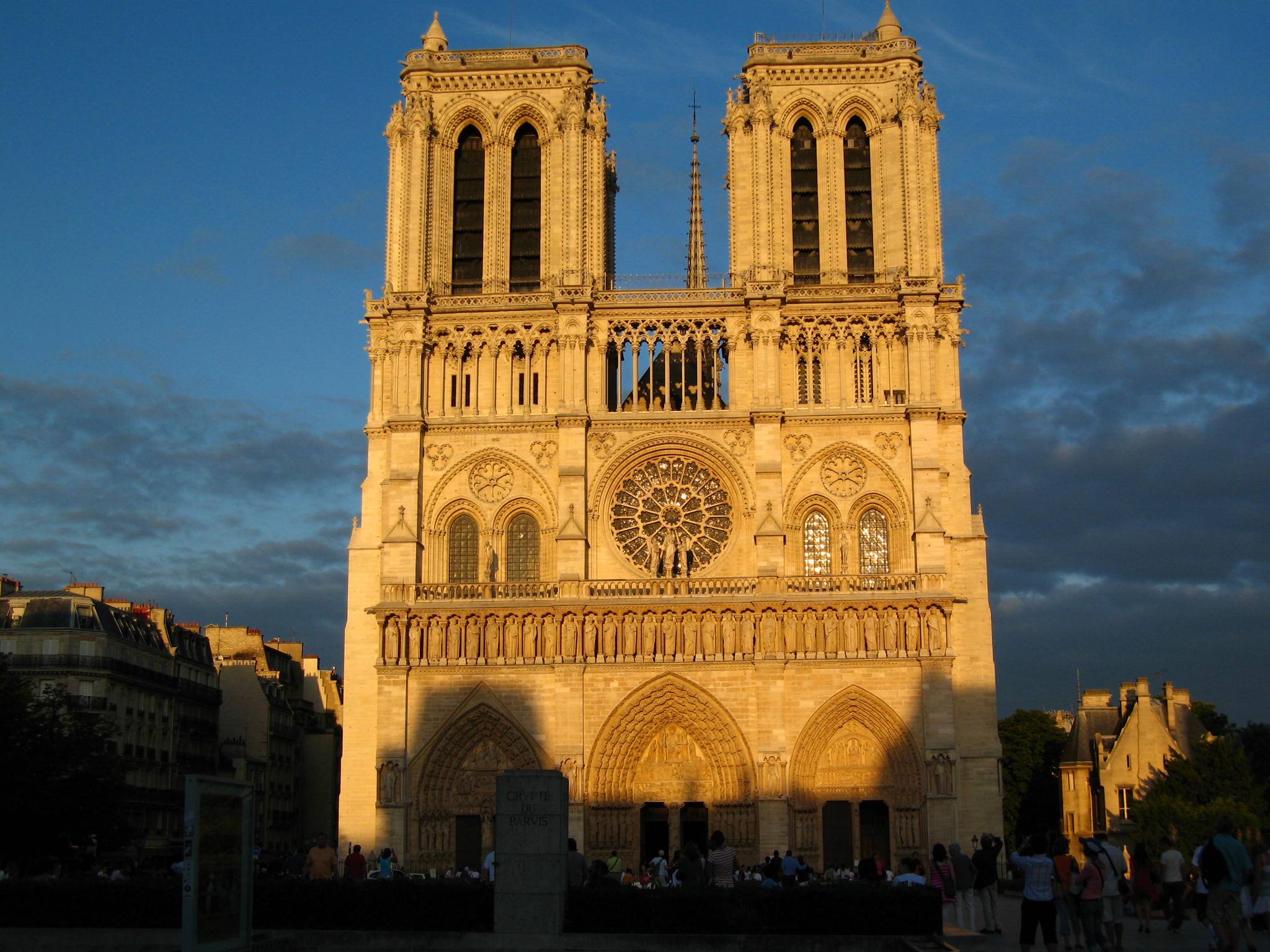
Kathy and I visited the Notre Dame Cathedral in Paris, France, in February of 2006. It is an ornate, historic building. It dates to the 1100s, surviving the threats of many wars including World War I and World War II. But, it has been dilapidating for some time. Earlier today, a fire inside the spire caused it and one of its towers to collapse. Now, officials are saying that the whole frame is burning and will not survive. Whether or not they rebuild this Catholic Church building, this 900 year edifice will be gone.
There are buildings that have been around millennia before New Testament Days on most of the continents. If they continue until the Second Coming of Christ, they will cease to exist that day (2 Pet. 3:10). King Nebuchadnezzar had a dream over 500 years before Christ, and God helped Daniel understand its meaning (Dan. 2:28). The colossal figure he saw in that dream was a vision about the coming Kingdom of Christ. Daniel says, “In the days of those kings the God of heaven will set up a kingdom which will never be destroyed, and that kingdom will not be left for another people; it will crush and put an end to all these kingdoms, but it will itself endure forever” (Dan. 2:44).
A careful study of unfolding history reveals this particular kingdom to be the church of our Lord, a Kingdom Jesus said would be established during the lifetime of some of His disciples (Mat. 16:28). It would come with power (Mark 9:1), a promise Jesus reiterates in Acts 1:8-11. That power came by way of the Holy Spirit’s coming upon the apostles on the Day of Pentecost in Acts 2. Through this means, the Lord’s church was established in Jerusalem that day (Acts 2:37-47). The Roman Empire, which ruled the earth that day, eventually collapsed. No nation or empire can rival the spiritual Kingdom of Christ. His church will stand forever (Heb. 12:28). Nothing can overtake or overpower it (Mat. 16:18).
Assaults against the church have been ongoing for twenty centuries. At times, it has been invisible to recorded history, but it continues to stand. Her members have been assaulted many times throughout the centuries. Property has been destroyed. Possessions have been taken. Lives have been lost. But, still she stands! This Kingdom shall stand forever! A Divine promise encircles it. This confidence is fire proof!







 The Preacher Pollard Blog