A Bear Attack And Two Blind Men

Thursday’s Column: Dale Mail

image

Dale Pollard

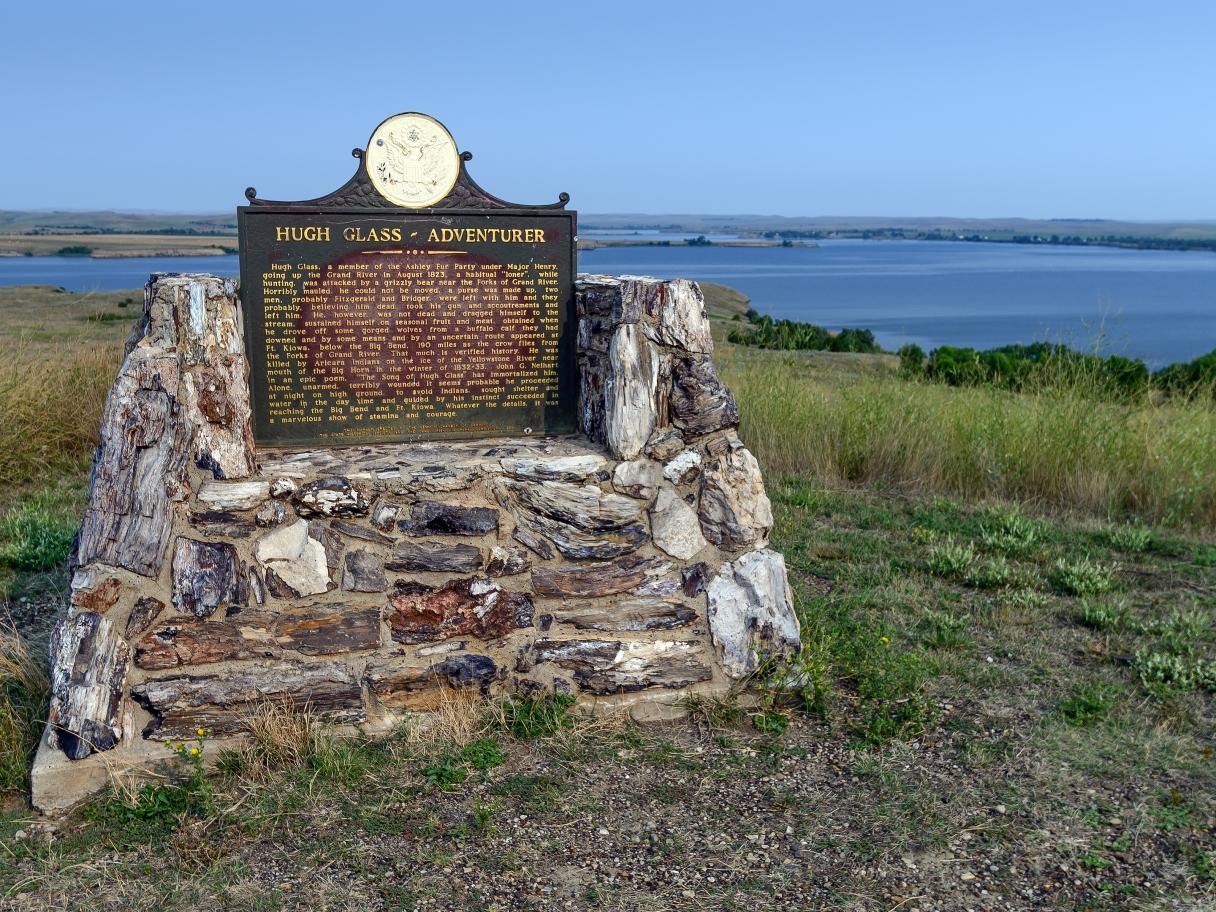
Hugh Glass decided to live the difficult and adventurous life of a fur trapper and pioneer. He embarked on an expedition to North Dakota in early August, 1823. The vast wilderness of the Badlands set the stage for the events that transformed him from a man to a legend. North Dakota, also known as the “Rough Rider State,” would not reach it’s statehood for another sixty five years. In these wild days thousands of buffalo still roamed the endless plains and were hunted by the Native American tribes, of which were the Mandan tribe. Hugh Glass and his men would encounter the Mandan early on in their expedition and a skirmish would ensue. Hugh would emerge alive, but not unscathed. Before his wound had time to heal, the largest predator on earth, the Grizzley Bear— nearly takes his life. The nature of his gruesome injuries were such that two men were ordered to remain with Glass until he met a seemingly inevitable end. Due to either their impatience or threatening weather, the two men hurriedly dig a shallow grave, lower Hugh inside— and leave. But Hugh wasn’t dead. He claws out of his grave and over the next two months he would make a grueling three hundred mile trek to Fort Kiowa near modern day Chamberlain. His will to live was matched by his determination to wreak revenge on the two who had prematurely laid him to rest. For the time being, however, Hugh found himself on his hands and knees making agonizingly slow progress but— he inches forward. 

In the months to follow Hugh Glass would make a full recovery and in that time, he also forgives the wrongs that were done to him. He had buried his grudge and unlike him— it would remain buried (source). 

While the long journey of Hugh Glass took a great deal of grit and resolve, the journey Jesus made from Jericho to Jerusalem is far more inspiring.

 When we get to Matthew 20 the cross is already on our Savior’s mind. The following chapters will focus on the teachings of Jesus and the moments leading up to the His ultimate sacrifice. We won’t read about miraculous healings after this point, but the final healing that Jesus makes on that walk from Jericho to Jerusalem, is a special one. 

Ahead of Jesus and one excited crowd, are two men intently listening on the side of the road. They’re blind. They survive off of the charity that’s shown to them by a minority. As Jesus draws ever closer they begin to yell in desperation for His attention. There are some in the crowd, perhaps those closest to them on their side of the road, who scold them. 

Can’t these sad beggars see that Jesus has more pressing matters on His mind? 

The rebukes don’t quiet the men from calling out; in fact, they raise their voices above the crowd. Christ wasn’t lost in any thoughts about a military takeover, but we can assume that Calvary was on His mind. Now Calvary— that was a pressing matter. 

Nobody would blame Him for ignoring two blind men. After all, the crowd didn’t need to witness some miracle to solidify their belief in His power (John 6.30), and beggars on the side of the road were a common sight. 

Even so, Jesus stops. 

He calls out to them and then asks, “What would you like me to do for you?” 

The blind men respond with, “Lord, we want our sight.” 

These men should have been paying attention when the Rabbi’s read from the scrolls of Daniel or Isaiah. The Jewish people had hundreds of years to piece together the true nature of the Messiah’s mission. 

Yet, the response of Jesus is compassion and it’s followed by His touch. 

That masterful plan was set in place the foundations of the earth were waiting to be laid. A plan that involved Jesus trading heaven for earth in order to answer the call of two blind men. He created time for them and He proved it by making time for them a second time— so that they could see it. 

He would make a special stop for you, too. 
The Reality Of Jesus Christ

Johnson Kell

He was born of a virgin and when He was about thirty years of age He was baptized in the Jordan River by John the Baptist. And being full of the Holy Spirit He began His ministry walking the dusty roads of Judea, Samaria and Galilee, performing miracles and preaching the gospel. And He did go out carrying His own cross toward Calvary, and He did hang there for hours writhing in anguish and pain. And He did cry out, “My God, My God, why have You forsaken Me?” He did die there, shedding His blood for the sins of the world.

But there was a resurrection and He spent forty days with His apostles providing many proofs of a bodily resurrection–the tomb was found empty. And after forty days He spoke to them for the last time and as they watched intently He disappeared through the clouds on His way back to heaven. Some time later, when Stephen was being stoned to death, he cried out, “I see the heavens opened and the Son of man standing at the right hand of God.”

And so we have the assurance that our Savior is at His Father’s side making intercession for each one of us. And we can recall in the letter that the apostle Paul wrote to the Christians in Colosse, where he cried, “Christ in you the hope of glory!” So as we are born-again children, we, too, can say, “Christ in us the hope of glory!”

This was and this is the reality of Jesus Christ.

IMG_3446

The Convictions Of The Lost

Neal Pollard

The lost are convicted, too. Don’t let anybody say they’re not. Some of the strongest-held beliefs, some of the most fully-persuaded minds, and some of the most determined hearts are attached to lost individuals. Even in the Bible, one finds the deepest rooted convictions in the heart of the lost sinner. If one wants to find a people wholly dedicated, he should take a trip into Noah’s world (see Gen. 6:5). If one wants to find a people completely set in a given pursuit, he should visit with King Solomon about the sons of men (Ecc. 8:11).

We should abhor rather than admire the lifestyle of the lost. This statement, if it has ever been true, applies to the people who spread themselves around Pilate’s judgment seat. Grounded in their hatred and jealousy of Jesus, the chief priests, the elders, and the persuaded multitude had as their singular focus the destruction of Jesus. They wanted Him gone, and any way they could do it they were willing to try. The rulers of the people had tried to ridicule, embarrass, trap, frustrate, tempt and discourage Him, but they had failed. One would think that, after three years of trying, they would have given up on their task. But, they were convicted.

The mob who finally “got rid of Jesus” (actually, they fulfilled God’s eternal plan for their and our salvation, and they did not foresee the resurrection) was a crowd we could learn a few lessons.

THEY WERE UNITED (Mat. 27:22). Pilate asked them what he should do with Jesus. All of them said, “Let Him be crucified.” No dissension is recorded by Matthew. Together, they forced a governor to submit to their wishes. How unfortunately that they were united to do evil.

When the righteous are united under the proper standard (Eph. 4:13), “how good and how pleasant it is…” (Psa. 133:1). Think of the untold good Christ’s disciples can do under the banner of brotherly love (Heb. 13:1), outdone only by our love, devotion and obedience to the Lord (Heb. 5:9).

THEY WERE DECISIVE (Mat. 27:21,22). There were no long committee meetings. There were no endless business meetings. They did not vacillate in this moment of decision. Pilate knew who they wanted crucified and who they wanted released. Though iniquitous, their decision was most expedient for their stated goal.

The Lord’s church in most places does an adequate job of planning its local work. Alas, in some cases, their best laid plans get lost somewhere between the forming and fulfilling. No congregation wants to rashly enter any endeavor–whether it be picking up support of an extra missionary or the execution of a needed program or plan. Yet, at times, the church can be overcautious and ponderous in discharging their responsibilities. Surely God was thrilled at the decisive way the disciples in the early church mobilized, spread the gospel, and reached the lost. The book of Acts is the model of decisiveness for today’s church.

THEY ACCEPTED RESPONSIBILITY (Mat. 27:25). Pilate wanted to know who was going to take moral responsibility for killing the just Jesus (24). Seemingly without hesitation, “All the people…said, His blood be on us, and on our children.” They collectively pointed the finger of guilt at themselves. Later, when Peter’s Pentecost preaching pricked their hearts, in a different way they took responsibility for this heinous acts (Acts 2:36-37).

Every person must take responsibility for his actions. Everyone must reap what he, individually, has sown (Gal. 6:7-8). In the congregational setting, the eldership must accept responsibility for what goes on among its members. When congregations individually begin to accept responsibility for themselves, theretofore avoided subjects will again be addressed courageously and frequently by the pulpit, eldership, and classroom.

We do not admire those responsible for slaying the sinless Savior. They were callous-hearted wretches darkened by the night of sin. However, they teach us the power of a united people ready and eager to stand accountable for what they decided to do. Churches will grow who follow God’s blueprint for His kingdom with enthusiasm and conviction. Let us maintain our convictions in “well doing” (Gal. 6:9).

thecrowdatcrucifixion

How Do You Spell “Cross”?

Neal Pollard

  1. “SEE”– Look at Calvary. Don’t turn away. I know it’s not easy. What is done to Him is shameful. I know. But, look closely! Past the spittle. Beyond the blood. There. In His eyes. Friend, that is love. It is love for you! See the nails in His hands and feet, fastening Him to a tree He created for man’s use. Look at the love He has for you!
  2. “ARE?”–Are you able to see that He bled and died for you? Are you willing to admit you’re lost without Him? Are you ready to submit to His will, to obey Him, and to live for Him? Are you prepared for eternity? Are you convinced?
  3. “OH”–Hear His cries of pain and agony. The death of a thousand deaths. Bitter moans of His disciples. The gasp of heaven’s angels. The sorrow of a Father for His only begotten Son! The gasps and exclamations of a hateful mob.
  4. “SS”–That’s the hiss of the beguiling serpent. The one who is bruising the heel of the perfect One, putting God the Son in the tomb. This is his moment of triumph. Though resurrection will soon spell victory for Christ and hope for man, at the cross the devil must be enjoying his front row seat at Calvary. Doesn’t he anger you? Disgust you? Motivate you? Live for Jesus, the Lion of Judah. Don’t live for the roaring, devouring lion.

Friends, the cross spells the difference between heaven and hell, hope and hopelessness, joy and sorrow, night and day!

4468491785_0c64a0f076_o_d

What The Blood Of Christ Meant

Neal Pollard

  • To Christ, an expression of love (John 15:13)
  • To God, an appeasement of His wrath (Rom. 5:9).
  • To the Devil, the scribes, and Pharisees, a sign of their supposed victory (Heb. 2:14; John 19:6ff).
  • To the mob, apparent weakness (Mat. 27:42).
  • To the disciples, seeming defeat (John 21:3).
  • To those who lived rebelliously, nothing (1 Cor. 1:17).
  • To those who died in disobedience, an essential but missing element (cf. John 6:53).
  • To those who lived obediently, atonement (Eph. 1:7).
  • To those who died having walked in the light, everything (1 Jn. 1:7).

Untold millions are unaware of the value of the blood of Jesus. You and I must decide what the blood of Jesus means to us. Interestingly, in four different ways, the Bible tells us that what the blood does for us we obtain the benefit of through baptism.
—The blood of Christ sanctifies (Heb. 13:12). We are sanctified by baptism (Eph. 5:25-27).
—The blood of Christ washes away sins (Rev. 1:5-6). Sins are washed away at baptism (Acts 22:16).
—The blood of Christ remits sins (Mat. 26:28). Sins are remitted through baptism (Acts 2:38).
—Jesus shed His blood in His death (John 19:34). We contact the dead of Jesus at baptism (Romans 6:3-4).
The Bible makes clear not just what the blood of Christ means to our souls, but also how we get the benefit of that blood. May we do what God says do to receive the benefits of Jesus’ blood and continue to walk in the light of Christ in order to have that blood continually cleanse us from all unrighteousness (1 Jn. 1:7).