The Meat

Gary Pollard

There were some members of the early church who had difficulty accepting some of the basic teachings of Christianity. The Hebrews writer told them, “We have many things to tell you about this. But it’s hard to explain because you’ve stopped trying to understand. You’ve had enough time by now that you should be teachers. But you need someone to teach you again the first lessons of God’s teaching. You still need the teaching that is like milk. … Anyone who lives on this is still a baby and not able to understand much about living right. But solid food is for people who have grown up. From their experience they’ve learned to see the difference between good and evil” (Hb 5.11-14). 

What’s the basic stuff that prevents us from being mature? 

6.2 — Baptisms. This is probably Jewish washings and other irrelevant customs from the old system. They should’ve been past this by now. 

6.2 — This one doesn’t really apply to us today, but “laying hands on people”, usually to give them God’s blessing or supernatural power. 

6.2 — The resurrection of the dead and final judgment. 

These basics should be a given for every Christian. The Hebrews writer’s audience had “had enough time by now to become teachers” only a couple decades after Jesus’s work. It’s been about 2,000 years for us. We have no excuse to be stuck in the basics! 

So what should we be doing? 

Hebrews 7-10 — Understand that Jesus is far superior to any other system of belief, he’s in the highest position of power in the universe, he lives to serve as our perfect high priest, the old system (Old Law) is irrelevant now (8.13), that Jesus’s sacrifice cleared humanity of how the Old Law convicted us of sin (9.15), understand that his return means rescue for those of us who are waiting for him (9.28), to think about and encourage each other to show love and do good things for other people (10.24-39), and to never lose our confidence in the power of our king (10-11). 

This is a very simplified list for the sake of brevity, but a mature Christian tries hard to be like Jesus in how they live. They don’t give in when pressured by circumstance to deny Jesus through bad behavior. They accept suffering with grace and patience. Their confidence in who Jesus is and what he will do for us is never severely shaken. Their love for Christian family compels them to do good for them, and to encourage them by living like Jesus. 

Good Dirt

Wednesday’s Column: Third Words

garyandme521

Gary Pollard

Ephesians 4 describes some spiritual gifts. Their purpose is to allow the church to function as it should. A properly functioning church spends eternity with God. A functional church is on the same page (one mind), has spiritual depth, and is workable (more on that in a bit). 

Ephesians 4.12ff is about members’ roles. What are they for? Everyone serves to equip saints. Saints are people who have pledged allegiance to God. 

We train for morally good works and become stronger through encouragement (12,16). We work toward a unified mindset, knowing Jesus, spiritual maturity, and we pursue the highest standard (Jesus) (13,14). 

We work to avoid immaturity and gullibility (14). We pursue maturity until our mindset emulates Christ’s (15). He is described (multiple times) as the standard we have to imitate. There’s no room for spiritual laziness here. 

Jesus causes growth spiritually, but only if we’ve become soil that can be worked. If our minds aren’t mature, we aren’t workable. Elders are spiritual farmers, our hearts are the soil. If we use Jesus as our standard, we are workable. If not, we’re spiritually dead. 

So, what can we do individually? Make the church strong by pursuing unity, by having spiritual depth, and by being workable. If we work on those things we will spend forever with God. 

Mine!

Wednesday’s Column: Third’s Words

garyandme521

Gary Pollard

When I first got into shooting, I relied pretty heavily on what others believed. There was (and is) a wide range of opinions on which platforms are the best, which calibers are the most effective, or which subcultural group is the worst (mall ninjas, fuds, tacticool operators, etc.). Most hold their opinions with great passion and will advocate for their position vehemently. I never really enjoyed shooting with the platforms and calibers I initially chose because I made all of my decisions based on the preferences of people I respected and admired. There’s nothing wrong with this, but I did not yet feel as if the sport was truly mine. Several years later, countless thousands of rounds, and hours of research, and I’ve found my place. I prefer 9mm, Glocks or Caniks, Combloc, AR platforms, 6.5 Grendel is the best intermediate round, etc. In other words, it’s not an “inherited” faith. I like what I like based on the energy I’ve dedicated to study and practice.

When it comes to elements of our faith, how often do we challenge our personal beliefs? Unlike firearms – which are subjective and spiritually irrelevant – our faith is based on an objective standard. It is difficult to have a strong, personal faith if most of what we believe is based on what others taught us or what others believe. We may even adopt their beliefs because we admire and respect them as people. That’s not a great foundation. Humans are fallible!

Approaching scripture as a blank slate, asking only, “What does God want me to believe about ______?” is the best way to grow. The only opinion that matters is God’s! When we hear something that elicits an emotional response and seems to conflict with our current beliefs, we shouldn’t panic. God’s word determines validity. If we can approach scripture without bias, we’ll grow exponentially. Challenging our beliefs does more than simply refine our understanding – it forces us to take ownership of our faith. Not only will this cause growth, it will also deepen our love for God and our confidence in eternal destination!

On an elk hunting trip in Gunnison, CO, around 2008.

But Grow In Grace And Knowledge…

GUEST WRITER: Charlie Smith

smith20web20column_2

“But grow in the grace and knowledge of our Lord and Savior Jesus Christ. To him be the glory both now and forever. Amen.” – 2 Peter 3:18

Peter writes this letter knowing that he’s going to die soon (2 Peter 1:14), and he wants the church to remember his teachings after he’s gone (1:15). This illustrates how deeply invested Peter was in the church’s success:

  • He had been on the ground floor of Jesus’s ministry, literally walking off the job site, leaving everything behind, to become a fisher of men
  • He had seen the crucifixion, the empty tomb, and the pierced side of his resurrected savior
  • He had helped the church grow from 120 to untold thousands covering the entire known world in one generation

And now Peter realizes that he’s soon going to be gone and the church will not have the direct guidance of the apostles but instead will need their indirect guidance through the New Testament writings. What are the last words of this apostle, his final thoughts for the church that he loved so dearly, which continue to echo down to us today as the spiritual successors of those first-century Christians?

Always keep growing!

First, he asks us to grow in the grace of Christ. When we obey the gospel, our sins are completely forgiven; God forgets them; we are “saved to the uttermost,” according to Hebrews 7:25, and when we walk in the light, the blood of Jesus cleanses us from all sins (1 John 1:7). So how can we grow in something that is complete?

I think a key is found in 2 Cor. 12:7-9. Paul has been given this thorn in the flesh, a messenger from Satan, to torment him, and he prays three times that the Lord will take it away. But God tells Paul that His grace is sufficient. It was enough that Paul was a Christian; Paul did not need any particular problem taken away; God’s grace sufficed.

Likewise, no matter what we face in this life, it really doesn’t matter if we’re a Christian.  God’s grace is enough. It takes effort and maturity, though, to gain this perspective. We need to keep growing in the grace of Christ!

Second, Peter asks us to grow in the knowledge of Christ. This is an easier interpretation: We must go to The Book! In my experience, and from what I’ve observed in others, those who grow as Christians are those who study the Bible on their own, digging in to see for themselves what God says. The preacher who baptized me told me one time that, in addition to his other study, he read a chapter a day from Proverbs and the gospels because he wanted to remain connected to the wisdom of God and the heart of Jesus; this is the attitude of someone who, know matter how much they know about the Bible, is still striving to grow in the knowledge of Christ.

May we all have this desire to grow in the grace and knowledge of our Lord and Savior Jesus Christ.

We’ve been blessed to have the Smiths at Lehman since last August. Charlie begins work as an economics professor at Freed-Hardeman next month. We’re so sad for us, but very happy for them. What a wonderful family!

9 Kernel Crop

Thursday’s Column: Carlnormous Comments

carl-pic

Carl Pollard

 
Have you ever seen those little rocking horses that little kids ride? They hop on and rock back and forth, but they never go anywhere. There’s a whole lot of motion and work put in, but there’s never any progress made. Just like we don’t sit in a rocking chair to go somewhere, we need to understand how to work towards growth and maturity in our faith and knowledge.

We can work towards growing as Christians, but if we aren’t studying properly, or have the wrong mindset, our work and effort will never produce the outcome we are looking for. 2 Peter 3:18 tells us to “grow in the grace and knowledge of our Lord and Savior Jesus Christ. To him be the glory both now and to the day of eternity.” We are told by Peter through inspiration from God to “grow” and this isn’t a suggestion. It’s an imperative we are commanded to obey.

If you’re like me, this seems like a general command that can be overwhelming. If we want to grow a garden we have to do several things in order to be successful. We have to prepare the soil (no rocks or weeds) in order to give the plants what they need to grow and produce. There’s maintenance work to be done once the plants begin to grow. Keep weeds from choking out the plants, and make sure they are watered. Keep animals and bugs from destroying the plants. Make sure they get enough sunlight. And depending on the type of plant we will need to trim and cut excess leaves and stems to help it produce more produce (see what I did there?). Having a garden takes time, effort and patience.

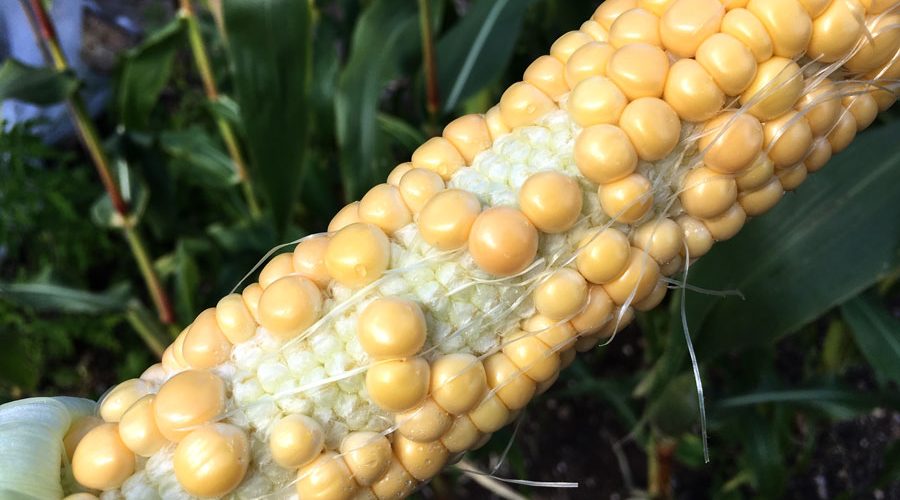
Gardens don’t just magically appear. But there are some rare exceptions. I was burning some old clothes and furniture last year and I decided to throw some spoiled corn in the fire. When summer came around guess what I had sprouting out of my fire pit? Stalks of corn! And I got a great harvest of about 9 kernels. I ate them and it was pretty good! As Christians we will grow to a point without having to work too hard. We can learn from the lessons we hear at church, we can grow from what our parents teach us, but there will come a time when that won’t be enough. The corn in my fire pit only grew so much before it started turning brown. Turns out the roots were only surface deep because there was a sheet of metal keeping them from growing deeper. This in turn affected the produce that came from the plant. Hopefully as Christians we want to produce more than 9 kernels, and in order to grow properly we need put in the work.

Peter tells us that as Christians we must increase in grace (Eph. 2:8-9; Col. 3:16; 2 Pt. 1:2), grow in knowledge (Eph. 4:15; Col. 1:10, 2:19; 1 Pt. 2:2), and be motivated by a desire to glorify Christ (2 Pt. 3:18).

Our effort should produce results. In order for this to happen we must know the proper steps to take. We should never be satisfied with our knowledge of scripture. There’s no such thing as knowing too much Bible. We should never settle for the small amount of growth we encounter at services 3 times a week.

Am I willing to put in the work?