Unleavened Religion

Friday’s Column: Brent’s Bent

The misunderstanding of the disciples recorded in Matthew 16.5–12 and Mark 8.13-21 has always amused me. Jesus warned them about the leavening of the Pharisees and Sadducees as they sailed away from Magadan, where He had just encountered some annoying members of those religious sects. According to Matthew and Mark, the disciples assumed Jesus was disappointed that they had forgotten to bring bread. Instead, Jesus reminded them that He had recently fed a total of 5,000 and 4,000 men with only a few loaves and fish. In Matthew’s account, the disciples finally realized Jesus was referring to their teaching when he repeated that they should avoid the leaven of the Pharisees and Sadducees. Luke tells us that Jesus had also given a similar warning to the people (Cf. Luke 12.1-2).

Pharisees and Sadducees crop up in every era, and it is vital to identify the error we should avoid. Thus, let us think about the fallacies against which Jesus cautions. We begin with the issues that characterized the Pharisees. The original Pharisees, whose name comes from the Hebrew word for “to separate,” were strict observers of the elders’ traditions. The Pharisees separated themselves by refusing to assimilate into Greek culture. Though laudable, the Pharisees eventually revered their traditions as sacred as the Law of God, which Moses received on Mount Sinai. 

We can find similar practices today in creeds, catechisms, disciplines, and papal decrees. These traditions, however, need to be more trustworthy. Stories can be altered, manipulated, and distorted to the point where the original narrator would not recognize them. The only way to avoid this is to keep the divine inspiration flowing throughout the distribution process. God only put such safeguards in place for His Word. Traditions can also be harmful to God’s Law. The ancient Pharisee, for example, interpreted the Law according to his rules, rendering it null and void. And so, the Pharisees would do things like pay tithes on items in their herb garden while neglecting the weightier matters of the Law (Matthew 23.23; Luke 11.42). Jesus called them experts at setting aside God’s commands to keep their traditions (Mark 7.9).

And what of the Sadducees? The Sadduccees’ origins are up for debate. The Sadducees claimed descendancy from a priest named Zadok, who anointed Solomon as king (cf. 1 Kings 1.39). On the other hand, the Sadducees were most likely the followers of a man named Zadok, who had been a pupil of the Pharisee Antigonus of Sokho. Zadok misinterpreted what Antigonus of Sokho said to mean there was no afterlife. (According to Antigonus of Sokho, one should obey God out of love and reverence rather than expectation of reward.) The spreading of Zadok’s beliefs to others formed the Sadduceean sect. The Sadducees were similar to the Epicureans, except that the former believed God created the world and governed it through his providence. 

The Sadducees were wealthy and boasted of superior intelligence. Herod was a Sadducee who led the Galilean Sadducees. As a result, the group is also referred to in the Gospels as Herodians (Mark 3.6). The leavening agent introduced by this sect is probably called pseudo-intellectualism. Sadduceeism exists not only in the past; we can also find it today under different names such as atheism, deism, agnosticism, positivism, rationalism, and Erastianism. We typically observe these beliefs in opposition to modern Phariseeism.

But what do the Pharisees and Sadducees have in common? To put it briefly: hypocrisy, lack of knowledge of God’s Word, and hostility toward Jesus. Jesus more effectively exposed their hypocrisy than I could, so I will let His condemnations stand in my stead. So, let us first observe how both groups failed to understand how the prophecies of God fit into the divine plan. They were not spiritually enlightened enough to see the signs that God was giving through Christ. As a result, they did not benefit from Jesus’ teachings in the here and now or the hereafter. (This is especially true of Jesus’ warnings in Matthew 24 about the Romans destroying Jerusalem. Cf. Matthew 24.15, 28.) If the Pharisees had been less concerned with tradition and the Sadducees with looking smart, they could have saved themselves by actually listening to Jesus’ words. But today’s society is just as blind to God’s Word and, therefore, blind to vital information.

Second, there was another thing upon which Pharisees and Sadducees could agree. They both opposed Jesus and could put aside their differences to crucify Him. The proverb, “The enemy of my enemy is my friend,” has been around for a long time; scholars traced the earliest known use of the phrase back to a 4th century BC Indian Sanskrit. And unfortunately, even those who advocate opposing errors frequently join forces to fight God’s truth today. The Pharisees act piously while ignoring God’s goodness, and the Sadducees claim scholarship while opposing God’s truth.

When we consider the errors Jesus found in the leaven of the Pharisees and Sadducees, we can appreciate the importance of His warning. The Bible emphasizes the pervasiveness of leaven. Any substance you add it to will be altered. For example, accepting sinful behavior in Corinth introduced a type of leaven (1 Corinthians 5.6). A Christian had married his father’s wife! Even the heathen, according to Paul, would not do such a thing. As a result, Christians must discipline the sinner to correct this error. And, according to Galatians 5.9, a little false teaching, like yeast, can leaven the church. In this context, Paul refers to the Judaisers’ negative influence on the Galatian saints. Paul expressed his surprise that a false gospel could easily persuade them in Galatians 1.6-7. In Galatians 3.1, Paul even says it is as if the Judaisers bewitched them.

The leaven of Phariseeism and Sadduceeism can cause us to be hypocritical, remove the boundaries of belief, and lead us to false doctrines. Their teachings can demoralize us and make us feel hopeless if we don’t have faith. We must also be aware that false teaching can discourage our temperament and behavior, even leading to blasphemy. If you recall the context upon which I based this article, Jesus separated Himself from the Pharisees and Sadducees by crossing the sea, which may be a good symbol of the great chasm between the righteous and the wicked. We must also distance ourselves from the leaven of the Pharisees and Sadducees today. Let us be more like good King Josiah of whom God said walked righteously without departing to the right or left (2 Kings 22.2).

Brent Pollard

“Do As I Say, Not As I Do” 

Thursday’s Column: Captain’s Blog

Carl Pollard

At the 1993 annual meeting of The American Heart Association, 300,000 doctors, nurses, and researchers met in Atlanta to discuss, among other things, the importance a low fat diet plays in keeping our hearts healthy. Yet during meal times, they consumed fat-filled fast foods such as bacon cheeseburgers and fries at about the same rate as people from other conventions. When one cardiologist was asked whether or not his partaking in high fat meals set a bad example, he replied, “Not me, because I took my name tag off.”

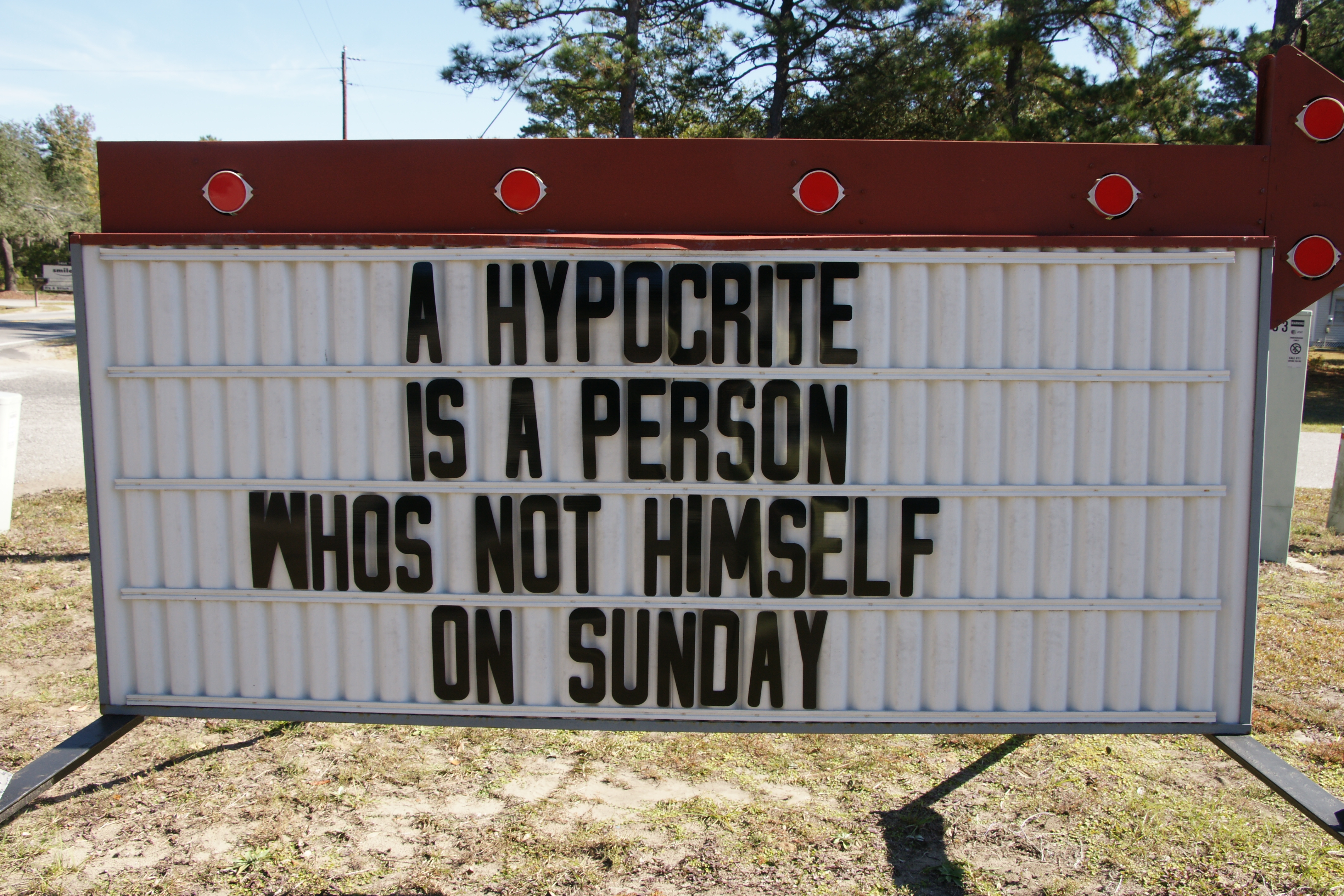
Seeing hypocrisy in the church has caused many people to fall away. Sadly there are some who claim to be Christians, and it’s in name only. These people often give the church a bad reputation. Many in the world look at the church and say that it runs rampant with hypocritical people. 

Being a Christian means following Christ all the time. No natter the circumstances. We can’t just “take our name tag off” so to speak. People are always watching. They’re looking to us on how to act. 1 Thessalonians 2:9 reads, “For you recall, brethren, our labor and hardship, how working night and day so as not to be a burden to any of you, we proclaimed to you the gospel of God.” 

Paul and the other apostles showed the Christians at Thessalonica, by example, how to act. Notice what Paul says: “For you recall, brethren, our labor and hardship.” The Thessalonians could look back and remember the example that the Apostles gave for them to follow. Are we like this? Or are we all talk? People will follow the examples that our actions portray. 

The example that our actions set are powerful. 

So the question is, “what kind of example are we setting?” We can have only two types of example–good or bad. Our example, whether good or bad, can decide the eternal fate of those that see our actions. Paul and the apostles set a great example for the church at Thessalonica. 

Paul writes in Philippians 4:9, “What you have learned and received and heard and seen in me—practice these things, and the God of peace will be with you.” We see from this how Paul’s example was so good that he tells the Philippians to practice it and God would be with them. Are we confident enough to say this to another Christian? We must be careful that we show by the way we live that we truly believe what we preach to others. 

Goose Hunting

Scott Philliips

A few years back I started goose hunting and I found out something very interesting about myself. I like it a lot! They are exciting to hunt, easy to harvest the meat, and they are delicious when I smoke them into jerky. Many of you probably don’t understand the challenge and excitement involved since most of the time you could just grab one off the street and throw it into your car. But out in the open, where it’s legal to shoot them, it can be a real challenge.

In order to get flying geese to come in for a landing close enough to shoot them, there are two basic tactics. One is decoys. Geese want to join up with other geese, and if they see some on the ground it tells them that it is probably a good area to feed and that it’s safe. In order to fool them, your decoys need to look real, and mine look real. Anytime I leave my spot and return, I spend an embarrassing amount of time sneaking up on my own decoys. The second thing you need is to sound like a goose. Your call needs to be authentic. It needs to get their attention to draw them into the kill zone.

Many of you have already connected the dots in my story. It’s so simple really. It’s a do-it-yourself lesson.  We need to be on guard as Christians so as not to be fooled or deceived by teaching that is not authentic, not the real deal. Teaching that may look and sound good, but will cost us our souls, can fool us.

But that’s not the lesson. I challenge myself and all of us to consider an even more sobering question. Have I become the decoy? Has looking and sounding like a Christian become enough for me? My calls are spot on. I can speak their language. My decoys look fantastic. They dutifully show up for every hunting trip. But they are not real, and they don’t move.

A real goose moves.
A real goose flies.
A real goose feeds.
A real goose is active all the time.
A real goose is busy being a real goose, all the time.

Read Matthew 25:34-36.

So are you, am I the real deal? It depends on what we do between “hunting trips.”

3387888544_9eae5ea589_b

[Originally from Scott’s “90 Seconds of Power” devotional at Bear Valley]

WISDOM IS VINDICATED BY ALL HER CHILDREN

Neal Pollard

There was an old joke or riddle that went, “Have you stopped beating your wife yet?” How would a man respond? If he said “no,” it was tantamount to confessing to being a wife beater. If he said “yes,” it suggested that he was a former wife-beater. Either way, the conundrum had him struck.  Have you ever had someone try to place you into such a bind?

It has been said that the only way to avoid criticism is to say nothing, do nothing, and be nothing. If you are striving to serve Christ and fulfill your purpose as a Christian, there is at least some likelihood that you will be opposed and even accused in some way. Jesus discusses that very matter in Luke seven. He’s teaching His disciples and compares His generation to children who criticize no matter what a person does—some criticizing people for being too somber, others criticizing people for being too festive. Jesus uses that illustration to speak of how God’s enemies criticized John the Baptist and then Himself. The criticism revealed that if John had acted like Jesus and Jesus had acted like John, the critics would still have been dissatisfied.

Isn’t it interesting that Jesus did not give us a manual for handling labeling, libelous critics? He does not say to write books or articles, preach sermons, get on TV or the radio, and the like, spending the precious resources of time, money, and influence countering the charges of those who are seemingly not content unless they can bully or intimidate their prey into conforming to the gospel according to them—the arbitrary standard for others they have created and uphold.

Here is Jesus’ summation: “Yet wisdom is vindicated by all her children.”  What does that mean? Look at the offspring of the teaching. What is the result of Jesus’ ministry? People are taught the truth, led to live the way God wants, and are pointed to the narrow way. Criticisms notwithstanding, that’s the fruit.  Speaking of which, Jesus also uses that analogy in the sermon on the mount. He begins and ends the analogy with the idea that “you will know them by their fruits” (Mat. 7:16,20).  But, this is a fair test for everyone.

What is the fruit of the hypercritical attacker? Not only ask if what they teach is technically true, but do they meet the tests of honesty, consistency, kindness, fairness, and love. Do they demonstrate the spirit of Christ, bear the fruit of the Spirit, demonstrate the Christian graces, fulfill the inspired definition of love in 1 Corinthians 13, act like the new man, and the like? So often, we do not stop to inspect the inspector. Whether we do or not, the Lord will inspect the work of us all at the end.

Each of us must focus on pleasing God and being absolutely sure that we are submitting to His authority and obeying His will. The standard of judgment at the last day will not be the man-made rules of even the potshot-takers, but instead the words of Christ (John 12:48). Let us be careful to grow in our knowledge of His will each day so we can discern between divine expectations and human regulations. At the end, what we should desire is heavenly vindication. The rest will ultimately take care of itself.

a-the_peanut_gallery-1577449

The REAL Terry Symansky Can’t Stand Up

Neal Pollard

There is a famous line from the longstanding game show, To Tell The Truth, that is so apropos here. On the show three people would all claim to be someone and make their pitch to “prove” it, then at the end the host would ask, “Will the real __________ please stand up?” Recently, a real-life version of this game surfaced in Pasco County, Florida, regarding a seemingly harmless man with a normal life in Zephyr Hills. He was a husband, father, landlord, pilot, and upstanding citizen, and he carried off the ruse for over 20 years! But the real Terry Symansky drowned in 1991.

Richard Hoagland, who had once boarded with Terry’s dad in Palm Beach, Florida, learned of Terry’s death, stole the death certificate to get his birth certificate from Ohio, which he used to obtain an Alabama’s driver’s license in order to obtain a Florida’s driver’s license! He also married Mary Hossler Hickman in 1995, with whom he has a teenage son. Meanwhile, back in Indiana, Hoagland has a wife and four children whom he abandoned with a story that the FBI was after him for embezzling millions of dollars (The Washington Post, “He Left A Family And Started A New One Using A Dead Man’s Identity, Police Say,” Peter Holley, 7/24/16). Think of the carnage for at least three families: the real Symanskys, the fake, Florida Symanskys, and the Indiana Hoaglands. Untangling this mess will not be easy, all because a man decided to try and be someone he obviously wasn’t. A professor who studies identity theft summed it up rightly, saying, “It will all catch up with you” (Holley).

Sure, this is outrageous and despicable. But, have we stopped to consider that something far worse than this happens, spiritually, more times than can be counted? Whenever a Christian behaves one way among the saints but another way away from that fellowship and environment, a similar phenomenon unfolds. Some would be blown away to learn that their co-worker, fellow team parent, neighbor, classmate, and the like, is actually a Christian. Were they to see them participating in worship, they would be baffled, using God’s name in a reverent, respectful way. To know that they, perhaps, were a church leader would be beyond the pale. In this way, it can be quite easy to assume an identity. All it requires is keeping “Group A” (the church) separated, as much as possible, from “Group B” (worldly associations). But, persisting in such a life will, sooner or later, catch up with the perpetrator (cf. 1 Tim. 5:24).

God sent Jeremiah to stand at the “front door” of the “church building” (so to speak) and tell the people entering for worship, “‘Hear the word of the Lord, all you of Judah, who enter by these gates to worship the Lord!’” Thus says the Lord of hosts, the God of Israel, “Amend your ways and your deeds, and I will let you dwell in this place” (7:2-3). He specifies, “Will you steal, murder, and commit adultery and swear falsely, and offer sacrifices to Baal and walk after other gods that you have not known, then come and stand before Me in this house, which is called by My name, and say, ‘We are delivered!’—that you may do all these abominations? Has this house, which is called by My name, become a den of robbers in your sight? Behold, I, even I, have seen it,’ declares the Lord” (7:9-11).  They thought a day of worship substituted for six days of ungodly living, but the last word is most chilling. God says, “I, even I, have seen it.” Whoever else we may fool with a double-life, we cannot fool God.

Integrity requires honesty and strong, moral character. There must be genuineness, wherever we are and whoever we are with. May God help us to be the genuine article, all the time.

richard-hoagland-terry-symansky
Hoagland (L) and Symansky (R)

I Don’t Want To Know!

Neal Pollard

Too often, it’s a great disappointment to learn about the personal lives of politicians, athletes, musicians, actors and actresses, and other professional entertainers. Their public persona and abilities may attract, inspire, and move us, but the aforementioned details are all too sordid. What might look wholesome on closer examination has a very seedy side.  Perhaps this says as much about any of us who place them on a pedestal, but that doesn’t lessen the chagrin.

Hypocrisy is something that can occur among “normal” people like Christians, too. Sadly, we can appear to be one thing around those of “like, precious faith” but have a different side that we show away from them. This is a spiritual malady that can afflict anyone, preachers, elders, deacons, and their families included. It can have such a devastating effect. To think that our poor example could cause a new, a weak, or any other Christian to stumble and fall should fill us with dread.  The precious influence we build by our talents and positions must never be squandered by defects of character or even bowing to pressures in specific circumstances.

Peter preached the first and second recorded gospel sermons. He was an apostle and one of Jesus’ closest friends on earth. Yet, Paul recalls an occasion where Peter succumbed to his flesh and sinned in a way that hurt his influence. In Galatians 2:11-14, Paul says,

But when Cephas came to Antioch, I opposed him to his face,
because he stood condemned. For prior to the coming of certain
men from James, he used to eat with the Gentiles; but when they
came, he began to withdraw and hold himself aloof, fearing the
party of the circumcision.  The rest of the Jews joined him in hypocrisy,
with the result that even Barnabas was carried away by their hypocrisy.
But when I saw that they were not straightforward about the truth of the
gospel, I said to Cephas in the presence of all, “If you, being a Jew, live
like the Gentiles and not like the Jews, how is it that you compel
the Gentiles to live like Jews?

Peter was driven by fear and favoritism. His action was devastating, dragging even “the son of encouragement” to follow his discouraging behavior. Thankfully, Paul loved Peter (and the Lord) enough to challenge the hypocrisy.

Friends, none of us will ever be perfect. We’re continually susceptible to sinful words and deeds. But let us guard against secret, double, or insincere lives knowing that such can totally destroy the faith of those who look to us to show them what Christlikeness looks like. In other words, let us be what we tell others that we are and that they should be. Consistency and integrity are some of the Lord’s most potent tools in our lives to bring others to Him.  Take care of His tools!

SONY DSC

Why Don’t YOU “Stop The Violence”?

Neal Pollard

To borrow the words of our own Mike Bennett, “Excuse me?”  An AP story published this morning is so thick with irony it is palpable!  Two people were arrested and put in jail on Tuesday in Washington, Pennsylvania.  They were two community organizers “with a local Stop the Violence group” and they “severely beat a former roommate with whom they had a property dispute” (via FoxNews.com).  They “allegedly jumped the man as he was walking down the street on Tuesday. Police say the defendants kicked the victim as he was unconscious…” causing injuries too gruesome for me to describe here.  The female defendant “was still wearing the same ‘Stop the Violence’ T-shirt that she had on the night before when she led a march in the city protesting two recent shootings” (ibid.).  “The victim remains in critical condition” (ibid.).

Could there be a clearer example of hypocrisy from the world?  We have seen or heard of the environmentalist driving the gas-guzzling SUV and the televangelist having an adulterous affair, but the peace protestor beating up somebody?  That’s very unattractive!

It is also a reminder to us as Christians about practicing “true religion…unstained by the world” (Jas. 1:27).  Not only are we ineffective, we are counterproductive when we claim to wear the name of Christ and then defame it by our words and deeds.  What about mouths praising God in worship on Sunday profaning man at work on Monday?  What about hands shaking hands or embracing fellow Christians one day then typing in ungodly websites or texting someone not our spouse in sexually suggestive ways the next?  What about words of kindness to each other when we meet followed up by slandering speech about each other or those in the world when we are away from the assemblies?

The Bible warns against hypocrisy, saying “beware of it” (Luke 12:1), “let love be without it” (Rom. 12:9), “don’t be carried away by it” (Gal. 2:13), “eliminate it” (Jas. 3:17), and “put it aside” (1 Pet. 2:1).  It’s easy to see why.  Few things are more repelling and disgusting than to witness hypocrisy.  Let us consider that as we conduct our own lives before the watchful eyes of the world!