“Son of Man”: Ezekiel, Jesus, and the Pattern of Prophetic Humility

God repeatedly reminds Ezekiel that he is not superhuman. He is a mortal man, chosen to carry the very words of God to a rebellious and hard-hearted people. His identity itself—son of man—becomes a walking testimony to humility.

Brent Pollard

When God called Ezekiel to his prophetic ministry, He chose not to address him by name, but by a title that would echo through the corridors of time: “Son of Man.” Ezekiel heard this title over ninety times from God’s lips throughout the book that bears his name. The Hebrew, ben adam, means “descendant of man” or “human one.” At first glance, it might seem like a poetic flourish. Since the title “son of man” is intentionally repeated and later used by Jesus of Nazareth, we should pause and ask: Why did He choose this title for both figures?

Isaiah may rightly bear the title “Messianic Prophet” for his remarkable prophecies of Christ’s birth, suffering, and coming reign (Isaiah 7.14; 9.6; 53). But Ezekiel’s role as “son of man” unveils something equally profound—it foreshadows the very form the Messiah would take, especially in His humble incarnation and prophetic ministry.

A Title That Humbles and Separates

Adam Clarke observed with penetrating insight that this term serves to humble Ezekiel, preventing him from being exalted in his mind because of the extraordinary revelations granted to him. Here is God’s gentle yet firm reminder of Ezekiel’s frailty and mortality—set against the backdrop of those overwhelming divine visions, particularly that awe-inspiring glimpse of the Almighty’s throne in Ezekiel 1. Matthew Henry echoes this truth, observing that despite the abundance of revelations, Ezekiel remains “a son of man, a mean, weak, mortal creature.”

God repeatedly reminds Ezekiel that he is not superhuman. He is a mortal man, chosen to carry the very words of God to a rebellious and hard-hearted people. His identity itself—son of man—becomes a walking testimony to humility.

John Gill observes deeper significance in this choice, noting that this title connects Ezekiel to the coming Christ. He points out that “this is a name which our Lord frequently took to himself in his state of humiliation” and that “the reason of it is, because he was an eminent type of Christ.” Thus, “son of man” becomes more than humiliation—it points forward to the One who would perfectly embody both human weakness and divine mission.

Prophetic Suffering and True Representation

Beyond its humbling power, the term “son of man” positions Ezekiel as one who truly represents his people. He stands not as an outsider hurling judgment from afar, but as a fellow exile (Ezekiel 1.1-3). God called Ezekiel to speak as one of them—and more, to suffer in symbolic ways that would paint vivid pictures of their coming condition (Ezekiel 4–5).

Burton Coffman observes that Ezekiel’s very actions embodied the message he delivered: lying upon his side for appointed days, shaving his head with a sword, cooking with defiled fuel, refusing to mourn when his beloved wife died—each act a living parable of Israel’s approaching judgment. In this suffering service, Ezekiel points forward to a greater Prophet yet to come, One who would bear not symbolic griefs but actual sorrows, not representative suffering but substitutionary sacrifice.

Daniel’s Vision: The Title Transformed

In Daniel 7.13-14, something remarkable happens. “Son of Man” takes on entirely different colors. Daniel sees in his night visions “one like a son of man” coming with the clouds of heaven, receiving dominion that shall never pass away. What a contrast! Ezekiel’s “son of man” is lowly, suffering, and representative of human weakness. Daniel’s “Son of Man” is exalted, glorious, clothed with eternal authority.

Yet both point toward the same magnificent Person: Jesus Christ. In the Gospels, our Lord refers to Himself as “the Son of Man” more than eighty times—more than any other title He claims. In taking this name, Jesus gathers up both streams—Ezekiel’s humble suffering and Daniel’s eternal glory.

Jesus bears the full weight of human suffering, as Ezekiel did in shadow and type. Yet He also inherits that eternal kingdom promised in Daniel’s soaring vision.

Ezekiel: Pattern of the Incarnate Christ

Here then is the glory of it: if Isaiah introduces us to the person and mission of the coming Messiah, Ezekiel shows us the very form He would take—a suffering servant, fully human, yet burning with divine purpose. The constant repetition of “son of man” in Ezekiel prepares our hearts to recognize the breathtaking paradox of the incarnation itself—God in human flesh, humble yet holy, obedient unto death, acquainted with our griefs (Isaiah 53.3; Philippians 2.5-8).

Jesus, the true and ultimate Son of Man, fulfilled every aspect of Ezekiel’s prophecy, not only through His words but also through His life. He was the ideal representative of all people, carrying God’s final message as well as everyone’s sins.

Conclusion: The Seed of Eternal Purpose

It was not God’s caprice leading him to employ the phrase “son of man” to reference Ezekiel. The expression was a designation of Ezekiel’s humanity, prophetic duty, and role as the people’s representative. Yet, we understand it also served as a divinely planted seed, preparing hearts and minds to understand the Messiah—not only as conquering King and eternal Savior, but as One who would walk among us in perfect humility and carry all our sorrows.

In this “son of man,” we glimpse the wisdom of our God, who chooses frail vessels for eternal purposes—and who, when the fullness of time had come, became one Himself.

“Son of Man” represents grace beyond measure since the God calling a mortal man by that title would Himself take it for Himself, taking our nature and our place—that we might share in His glory forever.

Two Goats, One Savior

Sometimes, we read in the Old Testament about events, people, and things, wondering its significance. But, if we keep reading, we will often see why they are there. Brent discusses one of those today.

Brent Pollard

An intriguing aspect of the Day of Atonement—frequently neglected—is the significance of the scapegoat. In Leviticus 16.10, the English Standard Version designates the scapegoat as Azazel. In contemporary discourse, scapegoat refers to an individual unjustly laden with blame during strife or turmoil. Remarkably, that concept traces back to the holy observance established by the Lord for the Day of Atonement.

We often focus on the goat whose blood the priest sprinkles on the mercy seat (Leviticus 16.15). And rightly so—this initial offering represented reconciliation, a blessing we yearn for profoundly. A definition of atonement is “making amends by offering something of equal value for a wrong done.” To put it succinctly, because the result of wrongdoing is death (Romans 6.23), the goat’s demise satisfied God’s just wrath.

However, the second goat—the one designated for removal—holds an equally important significance. Once offering the initial goat, the High Priest placed his hands upon the head of the scapegoat, proclaiming the people’s transgressions before releasing it into the wilderness (Leviticus 16.21–22). I have a deep appreciation for the way the NASB1995 translates verse 22:

“The goat shall bear on itself all their iniquities to a solitary land; and he shall release the goat in the wilderness.”

This vivid image reminds me of Psalm 103:12, “As far as the east is from the west, so far has He removed our transgressions from us.” While this imagery may not resonate with flat-earthers, round-earthers understand that traveling east or west never ends—you never “arrive.” Similarly, the scapegoat symbolically carried the people’s sins to a distant place where they could never return.

The significance for Christians is deeply impactful. The Lord Jesus, the Lamb of God, offered His blood, establishing a lasting atonement for our transgressions (1 John 2.2; see Hebrews 9.12; 10.10). Yet He also embodied the scapegoat—removing our sins (see 1 John 3.5). Both were essential for our purpose. For reconciliation, death was necessary; therefore, Jesus took on the role of our Paschal Lamb. However, reconciliation with the Divine necessitated the removal of sin—and it is in this context, the symbolism of the scapegoat fulfills its purpose.

Ultimately, the scapegoat is extremely important to believers. It reminds us that Jesus paid the price for our sins and took them away altogether. Jesus bridges the gap between us and God by dying and absolving our sins. He is both the slain Lamb and the scapegoat who carried our sins away. Through this dual work, we experience forgiveness, freedom, and reconciliation—a gift we should never take for granted.

Genesis: These Are The Generations (XV)

War And (The King Of) Peace (14:1-24)

Neal Pollard

Genesis 14 is more than a Sunday morning Scripture-reader’s nightmare (though the first ten verses would intimate the most golden-tongued!). We are introduced to an obscure, enigmatic character whom David and the writer of Hebrews will compare to Christ. However, what is the background of this King of Salem and his important encounter with Abram?

There is a local war around the Salt Sea, “four kings against five” (9). The cause of the conflict is the rebellion of the kings of the valley (Sodom, Gomorrah, Admah, Zeboiim, and Bela) against Chedorlaomer, who had conquered all the nations in the region–the Rephaim, the Zuzim, the Emim, the Horites, the Amalekites, and the Amorites (4-7). The confederation of the valley kings “arrayed for battle against” Chedorlaomer and his allies (1) “in the valley of Siddim” (8). The kings of Sodom and Gomorrah, Bera and Birsha, died in the tarpits of Siddim as they fled from the invaders’ army, and the rest of the army of the five kings fled to the hill country (10).

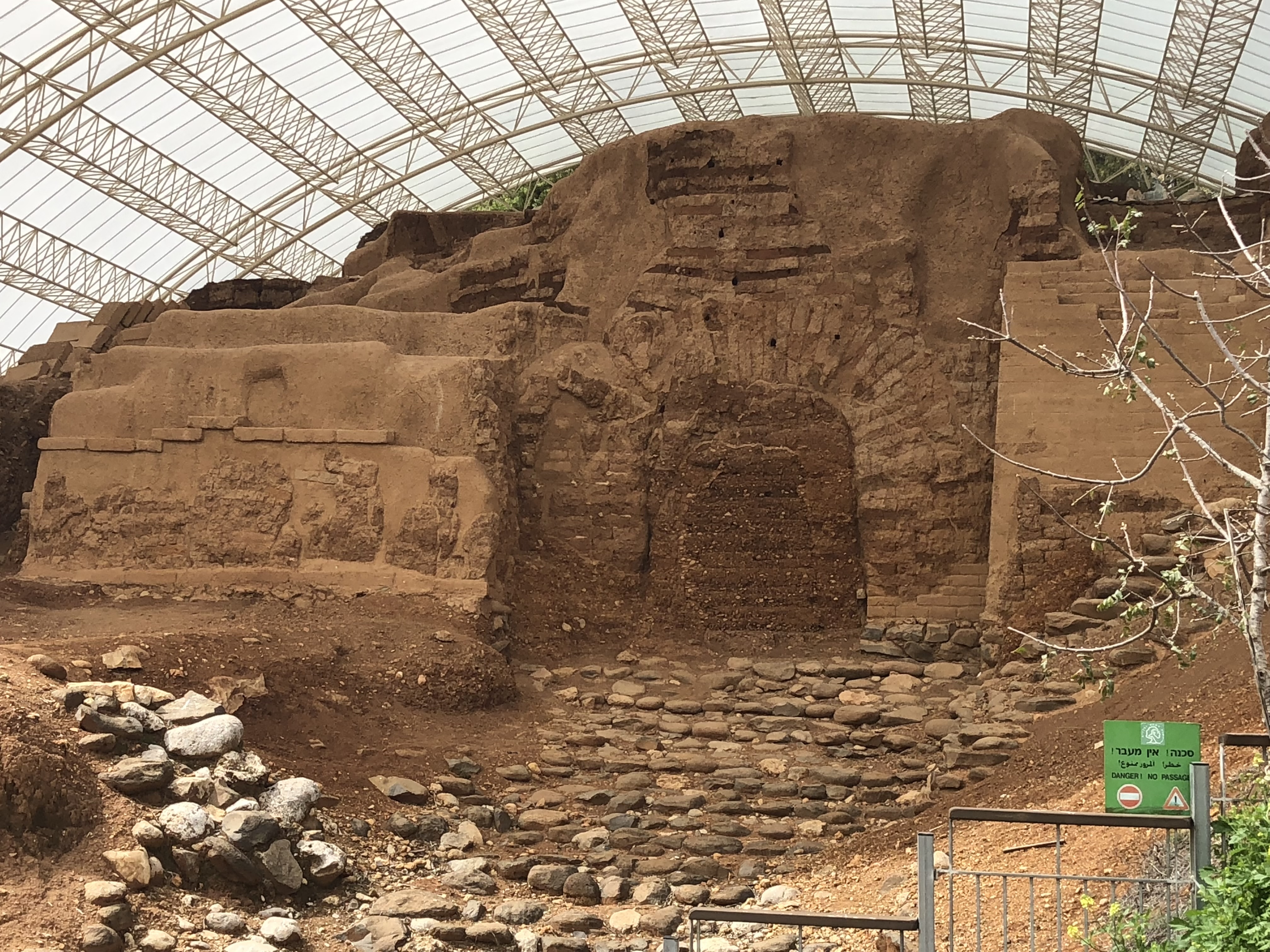
Chedorlaomer and his allies plunder all the goods of Sodom and Gomorrah and take Lot, the women, and the people of his house along with his possessions (11-12,16). An escapee tells Abram what happens, and the patriarch musters his allies and his own personal army to get his nephew and his house back safely (13-15). He has a battle plan, dividing his forces and attacking at night, and they defeat the invader in what is modern-day Syria (15-16). On multiple occasions, I have visited the ruins at Dan and have seen the so-called “Abraham Gate.” It dates back at least as far as Abraham’s day, almost 2000 years before Christ. 

(My photo of the “Abraham Gate,” March 2018)

After rescuing Lot and his house and goods, Abram is met by a priest named Melchizedek (18). The Holy Spirit, through the author of Hebrews, uses Genesis 14:17-20 and Psalm 119:4, and this one incident with Abraham to drive home an incredibly powerful point. Jesus is a High Priest, not like the Levites who descended from Aaron, but like this obscure figure, Melchizedek. 

The Bible uses a literary device called an antitype. “From the Greek antitupos, which occurs in Heb. 9:24 and 1 Pet. 3:21, where the AV translates it ‘figure.’ An antitype is the substance of which a type is the shadow, or the fulfilment of that which the type foreshadowed” (Cairns, Alan. Dictionary of Theological Terms 2002: 33). The antitype is always the greater; the type is always lesser and represents in some way the greater. So, Melchizedek is a type of Christ. He himself was greater than the Levitical priesthood in the ways we read in Hebrews 7, but the specific attributes we read about Melchizedek in this chapter are more fully and greatly found in Jesus.

What are the specific types? 

  • His position (18; Heb. 7:1). He is the king and priest of the Most High God. As king, he is king of righteousness and king of peace (2). 
  • His preeminence (20; Heb. 7:2,4-5). Abraham paid tithes to Melchizedek, signifying the greater prominence of the priest over the patriarch.
  • His perpetuity (Psa. 110:4; Heb. 7:3). “Without father, without mother, without genealogy, having neither beginning of days nor end of life, but made like the Son of God, he remains a priest perpetually.” None of Melchizedek’s ancestors or descendants filled this role, so in that way “he remains a priest perpetually.”
  • His purpose (19; Heb. 7:6-7). Melchizedek blessed the one who had the promises, an indication of his greater position and authority.
  • His precursory place (Heb. 7:8-11). Melchizedek lived many generations before Aaron, through whom the Levitical priesthood descended. Aaron was still in “Abraham’s loins,” meaning that Abraham did not have children yet. Much later, he would sire Isaac, who beget Jacob, etc., until finally Aaron was born through this genealogy.

In the way that Melchizedek served as greater than Levi, Jesus more fully and greatly serves as greater than Levi. If it were a math problem, we would say Levi < Melchizedek < Christ. Obviously, then, Levi < Christ. The writer of Hebrews, in chapter seven, draws some conclusions about this type of Christ. Because Christ is the antitype of Melchizedek,

  • It makes sense that perfection comes from His priesthood rather than the Levitical priesthood of Judaism (11).
  • There needed to be a change of laws (from Moses’ to Christ’s)(12).
  • It is right that this greater High Priest comes from a different tribe in which none had or could have served as priest (13-14).
  • Christ serves as priest “not on the basis of a law of physical requirement, but according to the power of an indestructible life” (15-17).
  • He sets aside the old law and brings in a better hope (18-19).
  • He was appointed High Priest by means of the oath of God (20-21).
  • He has become the guarantee of a better covenant (22). 
  • He does not die, but continues forever as High Priest (23-24).
  • He is able to save forever those who draw near to God through Him (25-28). 

It is this last truth, concerning His salvation, where the author draws out several incredible points for our consideration. It is the crescendo of his “Melchizedek argument.” His work is unparalleled–He always makes intercession for us (25). His character is unparalleled–He is holy, innocent, undefiled, separated from sinners and exalted above the heavens (26). His sacrifice and offering is perfect (27). His oath is unparalleled–He is a Son, made perfect forever (28).

Of all the ways the writer establishes the superiority of Christ over all rivals, this one is the most interesting to me. It shows the masterful way God weaves events and Scripture together. The writer of Hebrews is making the point that the Levitical priesthood has been replaced by something better. Why would you exchange the superior for the inferior? 

After this encounter, which seems relatively insignificant until David and the writer of Hebrews later expound upon it, Abram refuses to enrich himself by the unsavory people of Sodom. The new King of Sodom only wants the people, but offers Abram to keep all the returned spoils from Chadorlaomer. Abram will have no part in that, taking only provisions necessary for the completed battle. Abram will continue to rely on God’s promises to take care of his needs, and he parts company with the king of this wicked domain. 

(Picture taken on March 10, 2018, running at the Dead Sea with Keith Kasarjian)

Supersize Your Scripture Smarts!

Tuesday’s Column: Dale Mail

Dale Pollard

The Bible is not a mysterious book of codes that can’t be cracked, though some might try and lead you to believe that. 

We know that the water can be metaphorically muddied rather quickly when there are countless faulty interpretations of books like Revelation, Daniel, Ezekiel, Isaiah, and other prophetic or apocalyptic literature. Typology is another misunderstood, and often misapplied, method of Bible study. I’m convinced that if we can spend some time studying the different “types” found in scripture, we can see God’s message for mankind more clearly and have a more profound grasp of His Word. This also happens to be a great way to grow our knowledge of scripture more quickly!

So first, let’s try to clarify exactly what Typology is. 

Summed up in one sentence it’s referring to Old Testament things which are prefigured or symbolized by events and characters of the New Testament.

This may sound a little confusing, but let’s look at a few examples. 

  1. John 3:14 says that just as Moses lifted up the snake in the wilderness, so the Son of man must be lifted up (Num. 21:9). The Christ “type” is the bronze serpent. We know because of a specific New Testament reference. 
  2. 1 Peter 3:20: “…God waited patiently in the days of Noah while the ark was being built, only a few people, 8 in all were saved through water,” This illustrates how in the same way baptismal water saves those who submit to Christ today. 

Typology is not some mystic Bible code where we are free to translate events and characters in scripture as we please because God tells us exactly what He intended to say. 

1 Cor. 14:33 says that God is NOT the “author of confusion.” He has a message for us all— and it’s a message of hope. 

Are you interested in learning more about typology? The perfect book for you to study would be the book of Hebrews as it makes more Old Testament references than any other New Testament book. By diving into Hebrews you will appreciate and understand both the Old Testament, and the Bible as a whole. 

The Shadow of Things to Come 

Friday’s Column: Brent’s Biblical Bytes

81121814_2462862270639428_5746232403106463744_n

Brent Pollard

Standing before a lantern flashlight, I happened to notice my shadow on the wall. I won’t lie. I was displeased by what I saw. My large stomach? No, that is not what bothered me. That has been with me most of my life. What disturbed me was seeing evidence of how advanced my ankylosing spondylitis has become. To put what I witnessed in self-deprecating humor: my shadow confirmed that a certain cathedral in France could hire me to be a bell ringer. I should start practicing my dialogue. “Sanctuary!”  

Though I am confident of my person at this point in my life, I appear to be hunched over with insecurity since my head seems downcast. I admit to being perturbed by that since confidence is a part of the initial impression one makes on another. I must bend my knees to straighten upright (somewhat). It isn’t easy to walk with your knees bent! I take a TNF inhibitor to slow the progress. (Ankylosing spondylitis has no cure.) However, my shadow is a preview of things yet to come, the substance of who I will later be. If only my material substance was going to be as marvelous as the spiritual “substance” I will eventually enjoy (1 John 3.2).

Paul calls the Old Testament the “shadow of things to come” (Colossians 2.17). The New American Standard Bible adds the adjective “mere” (“a mere shadow”). Yet, what the Old Testament portended was the wondrous substance of Christ. It is odd to see the shadow of something before seeing that which cast the shadow, but that was the case with God’s eternal plan. One might philosophize about humanity’s ability to witness the substance first that he could not do so.  

Suppose you recall the people’s reaction to Moses’ glowing face after he had been in God’s audience (Exodus 34.29-30). In that case, you ponder whether they could have endured seeing something as glorious as the transfigured Christ, like Peter (Matthew 17.1ff). Whatever the reason, God had selected the optimum time for the incarnation of Christ. That time coincided with the Roman Empire’s days (Daniel 2.40-45; Galatians 4.4). However, even then, the appearance of Christ remained as unexpected to them as vegetation sprouting from the parched ground (Isaiah 53.2). 

Paul said that this “shadow” served like a tutor taking people to Christ (Galatians 3.23-25). A “tutor” during the days of Paul was a servant who took the master’s children to their teacher. In the twenty-first century, we might call the Old Testament the “bus driver.” I can recall several of the bus drivers I had in my youth. I think a couple of drivers would serve as a good role model, but at least one would have invited me along to commit mischief.  

We note that bus drivers only need a high school diploma with no disrespect intended toward bus drivers. (I’ve had family serve as bus drivers.) On the other hand, teachers must go to college and earn a specialized degree. The teacher is the one to whom you entrust the child’s education. Yet, we have people showing a preference for the “bus driver” today. These prefer the shadow to the substance. That preference is not in the best interest of his or her undying spirit. 

In what ways do people show a preference for the shadow? For example, in worship, they might indicate a preference for manmade mechanical instruments of music allowable under the Old Testament but unauthorized in the New Testament (cf. Ephesians 5.19; Colossians 3.16; Hebrews 13.15). In Hebrews 8-10, the Hebrews’ writer discusses at length the necessity for covenant change and the transference of authority from one to the other. Saying one can use a guitar or piano because David employed a lyre in his songs overlooks that David lived in the shadow. 

People also show a preference for the shadow when doing things like following the kosher diet of Judaism for religious purposes. Some of these same people will likewise insist that the day of worship remains on Saturday. Even though Gregory XIII, an apostate from the Faith, changed the calendar, he did nothing to change the verbiage indicating Sunday (“the first day of the week”) as the day of observing Christ’s memorial feast and giving of one’s means (Acts 20.7; 1 Corinthians 16.1-2). We might also note that when people prefer the religious use of iconography and incense, they likewise demonstrate a desire to live in the shadow rather than walking by faith (2 Corinthians 5.7). 

Yes, the Old Testament was only the shadow of things to come. It cannot save (Hebrews 10.1-4). We can enjoy and fellowship with the Substance, Jesus Christ. Come out from the shadow today! Live in the blessed Sonshine of Jesus Christ.