Deuteronomy: The Second Giving Of The Law (XIII)

Of Prophets And Gods (13:1-18)

Neal Pollard

We are surrounded by a world whose view of the world is decidedly different than what the Bible teaches. We know that well, but still find ourselves swayed and influenced by their thinking. Whether it is because we want to fit in or because it seems to be “working” for them or maybe because it appeals to us to some degree, we can become susceptible to their habits, customs, beliefs, and views. 

God knows human nature and has seen it play out since the Garden of Eden. As Israel gears up for the conquest of Canaan, God wants them forewarned about this timeless trouble. So, Moses explains it in terms of the familiar and divinely-ordained (“a prophet or dreamer of dreams,” 1) and the mysterious and divinely-condemned (“other gods,” 2). He presents a few scenarios that his brethren needed to seriously take to heart.

First, scenarios where a false prophet correctly foretold events, then urged idolatry (1-5). This was uniquely challenging. Israel might be persuaded to follow a false prophet whom God allows to accurately predict some future event (1-2). God said He would allow this because “the Lord your God is testing you to find out if you love the Lord your God with all your heart and with all your soul” (3). God’s will had already been revealed and they knew the truth (4). They were not to be susceptible to contrary messages, to violate the first two commandments. Instead, they were to see this as seduction and evil (5). The false prophet was to be put to death, to eliminate his sinful influence (5). In rejecting the false prophet, they would be following, fearing, obeying, listening to, serving and clinging to the Lord their God (4). False faiths could not trump the will of God. 

Second, scenarios where an idolater was a family member (6-11). This would be challenging for a different reason, not because they correctly foretold the future but because they were close relatives. Moses is unambiguous; we’re talking “your brother, your mother’s son, or your son or daughter, or the wife you cherish, or your friend who is as your own soul” (6). It just doesn’t get more intimate than that, whichever of the scenarios played out. These with whom they shared such a bond might “secretly entice” them to abandon God for a false god (6-7). How should they respond? Not only were they not to yield to them or listen to them, they were not to pity or spare or conceal them (8). More than that, they were to kill them (9)! Not just kill them, but be the first to cast a stone at them (10). In so doing, it would deter the nation from being seduced by gods, of seducing their family, or allowing a loved one to seduce them into idolatry (11). In Jesus’ earthly ministry, Israel should not have been surprised by a statement like this: “He who loves father or mother more than Me is not worthy of Me; and he who loves son or daughter more than Me is not worthy of Me” (Mat. 10:37). Or, as Luke records it, “If anyone comes to Me, and does not hate his own father and mother and wife and children and brothers and sisters, yes, and even his own life, he cannot be My disciple” (14:26). Moses will commend the Levites for observing this principle, allowing them to be priests of God (Deut. 33:8-9; Ex. 32:27-29). It is what it takes for us to be His priests today. 

Third, scenarios where an idolater was a neighbor (12-18). The last scenario would not pull on their heartstrings as much as it would be social pressure, dealing with a fellow Israelite who was stirring up desires to serve other gods. God’s response to that, in preserving the spiritual purity of Israel, is radical! If after investigation a city is found to have apostatized, they were to destroy it and its livestock (15). Additionally, this would not net the punishers in any financial way. All “booty” was to be burned. God says, “Nothing from that which is put under the ban shall cling to your hand…” (17a). This was a gracious, merciful gesture on God’s part. He was acting in order to bless them and guide them in doing what was right (17-18).

Three areas where we are tempted to ignore God or replace Him as authority are religious influences, family influences, and community influences. That is not new to our day; it has long been that way. While our response is not to be physical or military, we still must act when these influences attempt to pull us away from God. Paul reflects back on this general time period, even quoting Exodus 25, when he writes, “Do not be bound together with unbelievers; for what partnership have righteousness and lawlessness, or what fellowship has light with darkness? Or what harmony has Christ with Belial, or what has a believer in common with an unbeliever? Or what agreement has the temple of God with idols? For we are the temple of the living God; just as God said, ‘I will dwell in them and walk among them; 

And I will be their God, and they shall be My people.  Therefore, come out from their midst and be separate,’ says the Lord. ‘And do not touch what is unclean; And I will welcome you. And I will be a father to you, And you shall be sons and daughters to Me, Says the Lord Almighty” (2 Cor. 6:14-18). This is still our responsibility! We must hear God’s voice above the din of competing messages, being faithful to Him no matter who is saying something different or how much we care about them. God’s message then and now is, “Seek first His kingdom and His righteousness” (Mat. 6:33a). 

Deuteronomy: The Second Giving Of The Law (X)

Why Israel Was Inheriting The Land (9:1-29)

Neal Pollard

The challenge was formidable! The inhabitants still included giants and their fortifications were still high and impregnable (1-2). How would they do it? More to the point, why should they anticipate that it would happen? 

The power and promise of God (3-4a,5). He builds on something he has just said,  “But you shall remember the Lord your God, for it is He who is giving you power to make wealth, that He may confirm His covenant which He swore to your fathers, as it is this day” (8:18). God would be a consuming fire destroying, subduing and driving the natives out of the land (3-4). They could believe this because God had sworn it with an oath to their forefathers, Abraham, Isaac, and Jacob (5; Gen. 12:7). The ark of the Lord would go ahead of them as they invaded Canaan (Josh. 3:11). Consider the prayer the weeping prophet would pray, thinking back to this moment in history, when his people faced a self-induced crisis (read Jeremiah 32:17-22). 

The wickedness of the Canaanites (4-5). God makes a point of it to say that the conquest was not a matter of Israel’s meritorious goodness. He warned against such self-righteousness. He corrects the mindset, stating, “It is not for your righteousness or for the uprightness of your heart that you are going to possess their land, but it is because of the wickedness of these nations that the Lord your God is driving them out before you” (5). Genesis 15:16 had predicted this day would come. Now it was time. Even today, we are saved “not on the basis of deeds which we have done in righteousness, but according to His mercy, by the washing of regeneration and renewing by the Holy Spirit” (Titus 3:5). This should humble us and combat any self-righteousness on our part. 

The righteousness of God (6). This is implied by Moses’ three-fold use of “righteousness” (4,5,6), when the people are told it was not because of their righteousness. The word means “the state of doing what is required according to a standard, the state or condition of fairly deciding what is right in a legal case, without prejudice, and the state of not having any sin or its associated guilt, according to a standard” (Swanson, DBL, np). This does not describe man at his best, much less the conduct of Israel from the moment they left Egypt. Instead, God’s faithful character was bringing this conquest about. They needed to never forget that. Through Christ, we are made the righteousness of God through Him (2 Cor. 5:21). We have no basis to establish our own righteousness (Rom. 10:1ff). Isaiah would describe our righteous deeds, at best, as “filthy garments” (64:6). 

The intercession of Moses (7-29). What a powerful illustration we have in the bulk of this chapter. Moses reviews how they provoked the Lord to wrath, from Mount Sinai through these 40 years in the wilderness (7-8). They were rebellious against God (7,24). They acted corruptly and turned aside (12). They were stubborn and fit for destruction (13-14). They sinned against God (16). They were wicked (27). They needed to clearly understand this to grasp why they were alive to hear this impassioned sermon. In addition to the character of God already mentioned, there was the righteous intercession of their godly, earthly leader. Moses pleaded with God on their behalf. What did he do?

  • He fell down before the Lord (18).
  • He fasted for 40 days and nights (18).
  • He prayed for Aaron and the people (19-20,26).
  • He destroyed what offended God (21). 
  • He appealed to God’s goodness and promises (27-29).

Consider how wonderful it is to know that godly people are praying for us. Many times throughout the years, I have bowed my head in meetings with elders where they prayed earnestly on behalf of their sheep who struggled physically, financially, emotionally, and spiritually. This is in addition to their private petitions. What about the godly women, older and younger, whose ministry includes intercessory prayer? How much have we been spared and what floodgates of blessings have been opened to us because of the righteous prayers of others on our behalf (Jas. 5:16)? Thank God for godly Christians who steadfastly pray for their brethren, for you and me (1 Th. 5:17). May we be people who do that for others, too! 

Deuteronomy: The Second Giving Of The Law (V)

The Power Of The Law (4:1-40)

Neal Pollard

In the New Testament, we are going to read about the superiority of the New Covenant over the Old (Heb. 8:6-10:18). But, even in touting the superiority of faith in Christ over the Law, Paul calls it holy (Rom. 7:12) and good (Rom. 7:16). It’s deficiency was in man’s shortcoming to fully keep it, not in the ordinances or statutes themselves. Yet, before Christ, they were kept in custody under the law (Gal. 3:23ff). Moses says, “listen to the statutes and the judgments which I am teaching you to perform, so that you may live and go in and take possession of the land which the Lord, the God of your fathers, is giving you” (1). 

The Law Exhorts (1-14)

He begins by stating emphatically that this Law could not be altered either by addition or subtraction (2). Its benefit was in keeping it just as God gave it. This law was to govern and guide them in the new land they were about to take possession of. When they kept it, the people would see through their obedience what a special and loved people they were in the sight of God (6-8). The Law contained reminders of where they had been and what had happened in the past, both good and bad (9-14). Life and blessing would be the consequence of this revelation. It brought honor in the eyes of men and favor in the eyes of God. 

The Law Warns (15-31)

We see the warning in words and phrases like “watch yourselves carefully” (15,23) and “beware” (19). The warning here centered especially around them turning to something in substitution for their faithfulness to God. He is speaking more thoroughly here about the second commandment which he will restate as part of the second giving of the ten commandments in the next chapter (5:8-10). 

The basis of the warning is what it would do to them–it would be corrupting (16) and the source of their swift perishing (26). The warning is also because of what it would cause them to do–be drawn away and worship and serve them (19). Further, the warning is because of what God would do to them if they gave themselves over to it–scatter them among the nations and cause their numbers to be decimated (27). Moses reminds them, “For the Lord your God is a consuming fire, a jealous God” (24) and idolatry would provoke Him to anger (25). 

God did not want the relationship to be marked by threat and punishment. These are forewarnings, for their own spiritual good. Even if they fell prey to them but genuinely, wholeheartedly repented, God would restore them (29-30). The God who warns through His Word “is a compassionate God; He will not fail you nor destroy you nor forget the covenant with your fathers which He swore to them” (31). 

The Law Gives Relationship (32-40)

Thus, with the blessings and cursing of the Law set before them in brief, God reminds them of the unprecedented relationship He had entered with them. No one had ever known a relationship with their gods, much less the God of gods, as Israel would enjoy (32-36). The foundation of this relationship was love (37). It was proven by His sovereign choice (37). Because of this relationship, God would stand at the front of their armies and fight for them (38), and He would bless their children and grandchildren with life and land (40). He wants them to take this to heart (39) so that they would play their part in this special relationship (40).

The Law of Moses was to be their national, political, and spiritual governance. It would remind them of their past, reinforce them in their present, and reassure them of their prospects. It was the mind of God revealed, the way He wanted them to go and the ways He wanted them to avoid. As their maker and redeemer, He knew what was best for them and what would hurt them. Israel needed to trust that, so Moses takes the time to lay the groundwork for the retelling of the commandments. They needed this foundation. 

Deuteronomy: The Second Giving Of The Law (IV)

“Conquering” Before The Conquest (3:1-29)

Neal Pollard

We can read ahead in the book of Joshua, appreciating that these military maneuvers were vital to building the confidence and experience of Israel in conquering their enemies and the territory belonging to them. Chapter two shows the first such battle, with the defeat of Sihon and the Amorites (2). The conquered territory was ceded to Reuben and Gad (12). Let us notice the content of this chapter briefly.

The defeat of the kingdom of Og in Bashan (1-11).  “The narrative says nothing of the route that was taken, though Numbers indicates that the point of origin was Jazer (Khirbet Jazzir) and, with Deuteronomy 3:1, agrees that its destination was Edrei (Derʿa), thirty miles southeast of the Sea of Galilee (Num 21:32–33). This would have been a fifty-mile march from the southwest to northeast through the Gilead tablelands” (Merrill, NAC, 105). Pointing to the previous battle, God reassured Israel that He would deliver Og into their hands, too (2-3). Again, they showed total obedience to God by utterly destroying everyone (3). They took 60 cities (4), “fortified with high walls, gates and bars, besides a great many unwalled towns” (5). While they destroyed men, women, and children, they took animals and spoils as booty (7). An important fact, though subtly inserted, is the impressiveness of King Og. He was the lone surviving descendant of a race of giants called the Rephaim (2:11). His enormous size is supported by his bed, confiscated by Israel. It was 13 feet long and 6 feet wide (cf. 11). 

The review of the conquered territory to this point (12-17). Moses summarizes all the land they had taken to this point in the region we call the trans-Jordan region (on the other side of the river). This will factor again in Joshua’s writings in his book that follows. Land is distributed to Reuben, Gad, and half the tribe of Manasseh here. Here, Moses gives the eastern boundary of the nation of Israel. 

Preparation for passing the baton of conquering (18-22). This is summed up in two statements: “I commanded you (valiant men; the sons of Israel)” (18) and “I commanded Joshua” (22). The soldiers from this already-conquered territory would leave their wives, children, and livestock behind, and go into battle with their brethren to conquer the rest of the territory in the allotted promised land. The soldiers are told to cross the Jordan and fight until the whole land is subdued (18-20). Joshua, the next commander-in-chief, is told to use these victories over Og and Sihon as object lessons for what was to come. He is also told not to fear, since God would be fighting for them (22). 

Moses, a man conquered by time and circumstance (23-29). Moses begged God to be able to cross over into Canaan with the people and see the land up close (23-25). This is only one of two uses of the name “Lord God” in the entire book of Deuteronomy (the other is 9:26). It means “Yahweh, the Most Powerful One.” Moses speaks optimistically, knowing what God can do (24-25). God replies emphatically, saying what He will do (26-29). He will allow Moses to see the promised land from the mountaintop view of Pisgah, but not enter. Moses once again, in verse 26, makes implicit reference to his striking the rock when asked by God to speak to it (cf. 1:37; Num. 20:12).  Instead, Moses was to focus his final energies on preparing Joshua to finish the task of conquering (28-29). 

Moses appears to allude to one other “conquering” in the last verse of the chapter. Beth-peor (29) is probably the same as Baal-peor (4:3) where Balaam’s evil influence leads to the deaths of 24,000 people who served idols and committed fornication (Num. 25:1-9; Ps. 106:28; Hos. 9:10; 2 Pet. 2:15; Jude 11; Rev. 2:14). Thankfully, not all were conquered by that temptation to sin (4:4)! 

Reading through this chapter, I am reminded of Peter’s observations about certain false teachers in his day. He writes, “For speaking out arrogant words of vanity they entice by fleshly desires, by sensuality, those who barely escape from the ones who live in error, promising them freedom while they themselves are slaves of corruption; for by what a man is overcome, by this he is enslaved” (2 Pet. 2:18-19; cf. Rom. 6:16; John 8:34). There is literal, physical conquering in this chapter (1-22) and figurative, spiritual conquering in this chapter (23-29). Deuteronomy helps us see the way to overcome, submitted fully to God’s revealed will! 

Deuteronomy: The Second Giving Of The Law (II)

Why They Wandered In The Wilderness (1:1-46)

Neal Pollard

Interestingly, Moses begins the book of Deuteronomy by giving the date, location, audience, and reason for writing. He gathered all Israel in the portion of the wilderness in the land of Moab, on the first day of the 11th month of the 40th year of their wandering. He writes that with his first address to the people he did so to “expound this law” (5). In order to give a detailed explanation of the law, he chooses to review exactly how they came to be in their current predicament. 

A Rejected Mission (6-25). Moses starts his review at Mt. Sinai, where God told them to go and take possession of Canaan (6-8). To mobilize and care for a people so numerous–at the suggestion of his father-in-law (Ex. 18)–wise and experienced men were delegated to judge any grievances and issues among the people (9-18). When they arrived at Kadesh-Barnea in the hill country of the Amorites (19-20), they glimpsed their promised land (21). Moses admonished them, “Do not fear or be dismayed” (21b). The people devised the plan of sending spies into Canaan to bring back produce and a report of what they found in the land, which Moses approved (22-25). What he did not approve was their evaluation. 

A Rebellious Men (26-33). Moses says that despite acknowledging that the land was good, they were rebellious and unwilling (26). They grumbled (27). The spies spread fear into the hearts of the people (28). They were shocked and afraid (29). They did not trust God, despite His faithful leadership and protection (30-33). An objective as ancient as Abraham, the very target they aimed at upon their exodus from Egypt, was now shunned. They let emotions overshadow their God-given purpose. For this, God calls them an “evil generation” (35). 

A Recompensing Maker (34-46). Moses tells us how God felt about their distrust and disobedience. Not only was He angry with the nation (34), He would be angry for Moses during the wandering (37; Num. 20:12; Deut. 3:26; 4:21). God took an oath against them, a sobering image to consider (34). That generation was forbidden from entering Canaan (35,40), with the exception of Caleb who “followed the Lord fully” (36) and Joshua who would succeed Moses (38). Their children, whom they used as an excuse for disobedience, would grow up and go do what they lacked the faith to accomplish (39). Hearing this, the people suddenly mustered their courage and attempted to take the land. But God had withdrawn His help, and the people were chased as if by bees and “crushed…from Seir to Hormah” (41-44). Again, they were being  rebellious and presumptuous (43). They wept to the Lord, but He would not listen to a people who had stubbornly rejected His Word (45). They were consigned to circle around Mount Seir for the duration of their wandering (2:1ff). 

This new generation needed to know exactly why there were in the wilderness. They needed to know the way to leave the wilderness and to take the promised land. They needed to be more intimately acquainted with the God who had preserved them these 40 years, to trust Him as He led them in the conquest to come. They needed to come face to face with the faults of their fathers, to avoid repeating the deadly cycle. To go forward, it is often helpful to remember the past. We do not have to be enslaved by it, but we must be educated by it. Therefore, the wilderness experience will be retold by Bible writers throughout the Old Testament and even reviewed in the various genres of New Testament literature: the gospels (John 3:14; 6:32), history (Acts 7:44), and the epistles (1 Cor. 10:5; Heb. 3:8,17). In fact, Paul said God wants us to learn from this generation how not to live (1 Cor. 10:11). Moses is trying to do that with the next generation, to get them to see where their fathers had fallen short. 

Deuteronomy: The Second Giving Of The Law (I)

Background And Introduction

Neal Pollard

It is majestic. It is Messianic. It is a masterpiece of literary genius, even among the inspired books of the Bible. Delivered by an aging Moses as Israel stands at the cusp of Canaan, it is full of preaching and persuasion. The book is material that is necessary for the next generation, who had survived forty years in the wilderness, to ready themselves for what God had prepared for them. As James Smith puts it, there was a new generation, new land, new dangers, new prospects, new challenges, new duties, and a new leader about to emerge (478). 

There are 34 chapters, 958 verses, and 28,461 words in this book. The book’s name comes from the Septuagint (Greek Old Testament) and literally means “second law.” It actually goes deeper and further applies the original law given in Exodus to the previous generation. Deuteronomy has been called “Moses’ farewell address.” The Hebrew title comes from the first line of the book–אֵ֣לֶּה הַדְּבָרִ֗ים (“these are the words”). It is written in the plains of Moab east of the Jordan River in 1406 B.C., the last year of the period of wandering.

Try to go to far without reading a command, promise, or warning. Moses’ life’s work has been to get these people into the land God promised Abraham He would give to them. He knows he will not physically finish that job, but the law-giver was trying to ready them for life on the other side of the Jordan River in their new home.

There are different ways to divide the material of the book of Deuteronomy. One can see it as three individuals sermons, a shorter one (ch. 1-4), a long one (ch. 5-26), and a last, shorter, and summarizing one (ch. 27-34). The theme of each sermon is “obedience.”  Griffith Thomas sees it as giving the necessity of obedience (the Law of God), the motive of obedience (the goodness of God), the standard of obedience (the word of God), the incentive of obedience (the faithfulness of God), and the alternative of obedience (the justice of God)(166). These sermons may have all been delivered in the same day, and the timespan of the whole book is measured in weeks. 

Alternately, one could see the book as centering around the idea of “covenant.” God initiates the covenant, Israel receives the covenant, and the book of Deuteronomy contains the recording of the covenant. As such, the book gives the character of God, the character of Israel, and the nature of their relationship. Regarding God’s character, the book reveals Him as Elector of Israel (26:5-9), Redeemer of Israel (many places including 3:24-29), Defender of Israel (ch. 2,7,31), Benefactor of Israel (32:15-18), and Judge of Israel (ch. 7, 30,32-33)(cf. Merrill, NAC, 47). 

Kline Meredith observes that Deuteronomy reflects “vassal treaties” of their time, consisting of six parts: (1) preamble (1:1-5), (2) historical prologue (1:6-4:43), (3) general stipulations (5:1-1132), (4) specific stipulations (12:1-26:14), (5) divine witnesses invoked, and (6) blessings and curses (ch. 27-28)(Treaty Of The Great King, 1963). 

One other way to break down Deuteronomy would be to see it as looking back (ch. 1-4), looking up (ch. 5-26), and looking ahead (ch. 27-34). 

There are no new characters introduced in Deuteronomy, but a total of 15 characters already introduced are found in this book. They include God’s chosen, but also God’s enemies. Yet, the focus is upon the nation as a whole and their responsibility to hear God’s Word and do it. Their obedience would cause divine blessings. Their rejection would cause divine curse.

Themes to look for include the land, remembering, blessings, repentance, ethical and moral purity, listening, and loving God. Key words include all (264), today (59), statutes (29), sons (74), see (33), people (86), live (35), heart (46), earth (34), covenant (27), and eat (59). This is not exhaustive, but helps us get some idea of what the book is about and the material it covers. 

Let us drink deeply of this divine discourse, making application as we see how God longs to interact with His chosen people. 

The Dangers Of Forgetting God In Prosperity (Deuteronomy 8:7-20)

Brent Pollard

“But that is the time to be careful! Beware that in your plenty you do not forget the Lord your God and disobey his commands, regulations, and decrees that I am giving you today” (Deuteronomy 8.11 NLT).

In today’s world, self-sufficiency and autonomy are highly valued. But Deuteronomy 8.7-20 reminds us of our reliance on a higher power. Moses used this passage to warn the Israelites before they entered Canaan, and it teaches a valuable lesson for individuals and nations: the dangers of forgetting God in times of prosperity.

Humans often overlook and take the natural world’s consistent and predictable patterns for granted. When we receive everything we require from the natural order, we may mistakenly believe our success and sustenance are solely due to our efforts or luck. We fail to recognize the divine orchestration underlying the natural order. This passage encourages us to look beyond the natural laws that govern our daily lives and recognize the divine hand that propels these laws forward.

Moving from direct divine provision in the wilderness to self-sustained agriculture in Canaan represents a spiritual journey. It depicts a shift from visible reliance on God toward a faith-based partnership. As we live, success may tempt us to forget that our progress results from working with divine will and instead take sole credit for our efforts. This forgetfulness can cause alienation from our spiritual source, arrogance, and a false sense of self-reliance.

Many civilizations rose to great heights throughout history but eventually collapsed when they abandoned divine principles. The text warns us that ignoring God’s role in our success leads to spiritual decay, which frequently precedes physical and societal decline. The Canaanites and Israelites serve as stark reminders of what awaits those who choose to live without acknowledging God’s authority.

In an increasingly atheistic society, where people prioritize “science” over spiritual beliefs, it is critical to acknowledge God’s presence in all aspects of our lives. Our achievements and the beauty and order we see in nature are not solely the result of human effort or natural laws but rather evidence of God’s grace.

As we navigate the complexities of modern life, Deuteronomy 8.7–20 reminds us of God’s omnipresence and benevolence. Remembering God during times of prosperity promotes humility, gratitude, and a sense of purpose. Let us strive to keep God at the forefront of our minds and recognize that every blessing, no matter how small or insignificant it appears, is a testament to God’s unfailing love and provision.

What’s the call to action? How can we apply the lessons from Deuteronomy 8.7–20? Take a moment to reflect on your own life. Are there any areas in which you may have overlooked God’s role? Try something as simple as keeping a gratitude journal to record God’s providence. Also, consider ways to work with God to bring about good in the world. Instead of waiting for adversity to remind you of your need for the divine, strive to live each day with a conscious recognition of God, who is the source of all your blessings (see James 1.17).

The principles outlined in Deuteronomy 8:7-20 hold significance for individuals and our communities, cities, and nations. In this secular and complex world, it is crucial to have a place where people can gather and celebrate their shared values, including faith. Coming together can cultivate wisdom, kindness, and cooperation in these spaces. Let us consider this timeless advice as a guide that reminds us that we cannot achieve true prosperity unless we are at peace with God, ourselves, and each other, not just in material terms.

A Tower Reaching Heaven (And Comparative Mythology)

Dale Pollard
Babylon’s Babel 

Sumerian culture talks about a ziggurat dubbed “Etemenanki” and it was hailed as the “House of the Foundation of Heaven and Earth.” It was dedicated to Marduk, a serpentine/dragon deity, and the patron deity of Babylon. It was said to have measured three-hundred feet tall and featuring seven stacked levels.

Famed Assyriologist, George Smith (1840-1876), provided a translation of some Sumerian clay tablets and here’s his brief summary of the inscription: 

“…we have the anger of the gods at the sin of the world, the place mentioned being Babylon. The building or work is called tazimat or tazimtu, a word meaning strong, and there is a curious relation, lines 9 to 11, that what they built in the day the god destroyed in the night.”
(The Chaldean Account of Genesis, 1876, p. 162).

Egypt’s Babel 

A portion of the Qur’an makes a few claims that resemble the legendary biblical tower— save a few key differences. In the Islamic story, the event takes place in Egypt and the Pharaoh orders a minister named Haman to build a tower that reaches the heavens.

Mexico’s Babel 

Pedro de los Rios, writing sometime before 1565:

“Before the great inundation which took place 4,800 years after the erection of the world, the country of Anahuac was inhabited by giants, all of whom either perished in the inundation or were transformed into fishes, save seven who fled into caverns. When the waters subsided, one of the giants, called Xelhua, surnamed the ‘Architect,’ went to Cholula, where, as a memorial of the Tlaloc which had served for an asylum to himself and his six brethren, he built an artificial hill in the form of a pyramid. He ordered bricks to be made in the province of Tlalmanalco, at the foot of the Sierra of Cecotl, and in order to convey them to Cholula he placed a file of men who passed them from hand to hand. The gods beheld, with wrath, an edifice the top of which was to reach the clouds. Irritated at the daring attempt of Xelhua, they hurled fire on the pyramid. Numbers of the workmen perished. The work was discontinued, and the monument was afterwards dedicated to Quetzalcoatl.”
(Mexico as it is and was, 1844, Brantz Mayer, p. 28)

Non-Canonical Coincidences 

In the Greek Apocalypse of Baruch (written between the 1st-3rd Cen.) we find a description of the condition of Jerusalem after the sack by Nebuchadnezzar.

The Greek Apocalypse details a vision of Baruch ben Neriah and in it he sees the punishment of the builders of the “tower of strife against God,” which sounds remarkably similar  to the Tower of Babel.

Abydenus (a Greek historian of the mid-fourth century B.C.), as quoted by Eusebius, spoke of a great tower at Babylon which was destroyed. The record notes:

“[U]ntil this time all men had used the same speech, but now there was sent upon them a confusion of many and divers tongues”

Josephus, the Jewish historian, quoting from an ancient source, records these words:

“When all men were of one language, some of them built a tower, as if they would thereby ascend up to heaven, but the gods sent storms of wind and overthrew the tower, and gave every one his peculiar language; and for this reason it was that the city was called Babylon”

(Antiquities of the Jews, 1.4.3).

THE TRUTH BEHIND THE TOWER 

While we don’t need the extra biblical evidence and anecdotes to prove what God already told us, it’s certainly interesting and faith-building to discover. We shouldn’t forget the main message of His account. When humans are united we’re either powerfully wicked or powerfully righteous. The top of our metaphorical towers will either touch heaven or hell and the end result depends on what we’ve decided to unite under. If Christ is on the banner we fly then we’ll find success. If pride, greed, or any other selfish ambition brings us together— that tower will inevitably fall.  

The Birth of Behemoth-Buildings 

First to Scrape The Sky: 

The first skyscraper was built in Chicago by William LeBaron Jenney in 1885. While that nine story structure no longer stands, many skyscrapers from that time period remain.

King of the Towers: 

The Burj Khalia in Dubai is the tallest building in the world— standing at 2,717 feet tall. 

Jenney’s “Home Insurance Building” (demolished in 1932 to make room for a larger building)

“I Am He”

Carl Pollard

Jesus describes Himself in many ways throughout the Gospels. Each name further explains His love, care, protection, judgment, and attitude towards us. There is one name He used that caused quite an uprising in His earthly ministry. However before we dive into the New Testament, we must start at the beginning. 

Exodus 3. 

Here we read that Moses was shepherding his father-in-law’s flock. He takes the herd to Horeb, the mountain of God. While he is there with the animals he notices a bush engulfed in flames, but the bush wasn’t consumed by the fire. Moses goes closer to investigate, and he hears a voice from the bush call his name. This voice is the voice of God and He had a job for Moses to do. 

He had heard the cries of His people in Egyptian captivity, and verse 10 He tells Moses to deliver them from the hand of Pharaoh. Moses isn’t too thrilled with his new task, but pay special attention to the next few verses: Exodus 3:13–14 says, “Then Moses said to God, “Behold, I am going to the sons of Israel, and I will say to them, ‘The God of your fathers has sent me to you.’ Now they may say to me, ‘What is His name?’ What shall I say to them?” God said to Moses, “I AM WHO I AM”; and He said, “Thus you shall say to the sons of Israel, ‘I AM has sent me to you.’ ” 

When God revealed Himself to Moses, He identified Himself as “I AM.” These two words summarize God’s nature. He is the only: 

  • Uncreated
  • Eternal 
  • Always-existing Being. 

He is the I AM because He just is. He exists in all power and majesty, He has no timeline, no beginning, no end. He is I AM. No one else is like Him. Well, maybe someone is…

Seven times in the gospel of John, Jesus used the name “I Am” while claiming to possess certain attributes of God. For the Jews, numbers had special meaning. Seven is quite possibly the most important. In Hebrew numerology the number 7 represents completion or perfection. God created the world in 6 days, and rested on the seventh. The Jewish week had 7 days. Shabbat occurred every seven days. Noah brought 7 pairs of clean animals on the ark. The number Seven is the most important symbolic number in the Hebrew Bible. It conveys wholeness, perfection and for the Jew it came to represent holiness. 

It could be a coincidence, but I do think it’s interesting that Jesus says “I AM” 7 times in the gospel of John. He is God in the flesh, He came to make us complete, and whole. 

He came to make us holy. Seven times, He says, “I AM.” With that in mind, let’s look at the last time He says this. 

John 18

Jesus has just finished a lengthy discussion with His apostles at the last supper. He goes to the garden where He knows that He will be arrested. 

Verse 3 tells us, “So Judas, having procured a band of soldiers and some officers from the chief priests and the Pharisees, went there with lanterns and torches and weapons. Then Jesus, knowing all that would happen to him, came forward and said to them, “Whom do you seek?” They answered him, “Jesus of Nazareth.” Jesus said to them, “I am he.” Judas, who betrayed him, was standing with them.“ 

Look at the very next verse, “When Jesus said to them, ‘I am he,’ they drew back and fell to the ground.” This claim is made as a blatant show of divine power. A band of heavily armed men have shown up to arrest Jesus. Jesus asks who they were there for, and they respond “Jesus of Nazareth.” 

His self-identification in verse 6 does something incredible. Every last Pharisee, Roman soldier, and chief priest stumbled back and fell to the ground when Jesus spoke the words “I AM HE.” At His spoken word, these men are blown back. 

It’s interesting that this same apostle wrote later of the power of the LOGOS. 

So why did John record this? They came to arrest Jesus with weapons. Christ was clear that He knew what would happen, and He chose to cooperate with God’s plan. This moment highlights His sovereignty, reminding everyone that nothing happens to Him which is beyond His own control. 

He WILLINGLY gave Himself because no man can destroy the I AM. But the I AM can sacrifice Himself.

Genesis: These Are The Generations (XI)

The Generations Of The Sons Of Noah (10:1-32)

Neal Pollard

With his next use of “toledoth” (generation), Moses gives the background for all the nations. Everyone on earth today has descended from one of these three men–Ham, Shem, or Japheth. This table of nations is both informative and important. One can consult various commentaries (Kenneth Matthews has a twenty-page discussion in the New American Commentary, while Kurt Strassner has a much more concise breakdown in the Opening Up Commentary series) of the nations which descended from these three men. 

The latter ties today’s Eastern Europe to Japheth (10:2-5), North Africa and the Middle East (on the southern and eastern coasts of the Mediterranean) to Ham (10:6-19), and the dominant nations of the Middle East to Shem (10:21-31)(51). But there is more to this list than a geography and ethnic studies lesson. Moses is setting the reader up for the material he will share in the next chapter, when the people of earth will disperse and settle in various places ( see 5,11,18, etc.). 

The observation of Reyburn and Fry is correct when they say, “This follows a pattern that is repeated a number of times in Genesis, in which the individuals and their descendants who are not in the line chosen by God are mentioned first, while those who are in the chosen line are mentioned last, and the story then continues with them” (Handbook, 228). You see that first in Genesis 4-5, and you will see it again in Genesis 10-11. There are a few matters of note which Moses lays out in giving this genealogical record.

First, he mentions the mighty hunter, Nimrod (8-12). He is so renowned for these skills that subsequent great hunters were likened to him. Look up “hunter” in the dictionary and one of its synonyms is “nimrod.” He will be listed in the genealogies of 1 Chronicles 1:10, then in the prophetic work of Micah (5:6). Yet, more important than his skill is the place he settled. Though Moses would not have to deal directly with them, the Assyrians would factor prominently in the later history of Israel. The foreknowledge of God is at work here, informing the people of God of the “genesis” of this wicked enemy. Verses ten through twelve unambiguously mention not only Babel (i.e., Babylon–another later, even stronger enemy), but Nineveh and Assyria. These are kingdoms and lands built by Nimrod.

See also more local enemies which would plague Moses’ ancestors, Moses himself, and Moses’ descendants. He mentions where the original inhabitants of the promised land originated. Ham’s descendants would give us the Canaanites, Amorites, Hivites, Jebusites, and Girgashites (13-17), along with the other thorns in the people’s sides. Soon, Moses will be moved by God’s Spirit to share His promise to Abraham concerning the ultimate expulsion of these people in favor of his descendants (15:18ff).

Among others of Ham’s descendants are the inhabitants of Sodom and Gomorrah, who will also feature prominently in the narrowing focus on Shem’s (8th great-grandson), Abraham (19). They will grow so wicked that God destroys them.  Here, we are simply taught of their origin.

Moses is setting up the reader for one family among all the nations, while giving us five generations of Seth (Shem, Arpachsad, Shelah, Eber, and Peleg; see ch. 11). In this accounting, Moses is more interesting in giving us the rest of the descendants of Shem before he rivets in on Abraham’s line. One other interesting line, nestled in those genealogies of Shem, is the statement made about Peleg. “In his days the earth was divided” (25). While many take this to refer to the incident at Babel, when the inhabitants were socially divided, it is also possible that this refers to a breaking up of the continents into a continental drift. A study of earth’s major land masses shows a complementary form between those separated by seas and oceans. Robert Utley tells us, “The Hebrew term literally means ‘irrigation canals’ which would fit southern Mesopotamia, but the popular etymology is ‘divisions’” (How It All Began, 123). Given the ambiguity of the word in this context, no one should be dogmatic about either position. 

Isn’t it incredible all the layered, even subtle, discoveries possible when studying even apparently obscure, mundane chapters of the Bible? This rich book is full of discoveries waiting for the Bible student to find by mining its inspired veins. With this listing, Moses gets down to the more specific interest of his inspired record. 

Genesis: These Are The Generations (VI)

The Descendants Of Adam (5:1-32)

Neal Pollard

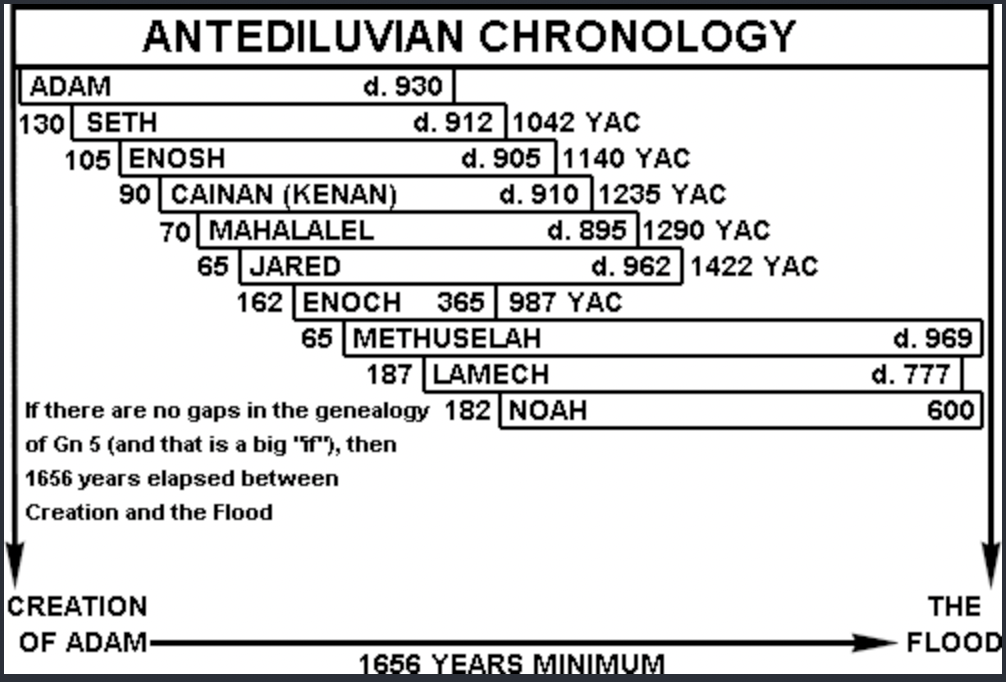
The men who are listed in the genealogies of Adam in this chapter have been called “the ten commitments,” trusting in God’s promise (3:15). There were spiritual giants among this group. Two of them were said to have “walked with God”–Enoch (5:24) and Noah (6:9). We probably know them most, as a group, for their longevity. In the pre-flood world, when the cursed earth was its youngest and least tainted, conditions were most ideal and genetics most favorable for long life. 

James Smith gives us this chart:

In laying out the genealogies, Moses goes back and speaks of the theology and biology of creation. Man is made in God’s likeness (1), and God made them male and female (2). Adam becomes father to a son (3), and thus it goes through all the genealogies. Moses’ record follows the same formula in laying out these ten generations: the father lives so many years, has a notable son (in the Messianic Genealogies–Luke 3:36-38), lives so many years after that birth, and finally dies. As the chart suggests, there is vast opportunity to populate the earth as they live on for centuries.

There are some interesting insights among the Bible’s first look into a family tree. Furthermore, there are implications from this chapter that resonate throughout the rest of Scripture. Notice just a few of these.

“…And he died” (5,8,11,14,17, 20,27,31; cf. 3:19). While these men lived nine or ten times longer than any of us would dare to believe we could live (imagine your life overlapping the lives of Saladin, Genghis Khan, and Thomas Aquinas; see also 6:3), they could not escape the reality of the death sentence brought on by Adam’s sin. Hebrews 9:27 avers that death is an inevitable appointment.  1 Corinthians 15:21-22 reiterates that by a man came death and that in Adam all die. 

“Enoch walked with God” (21-24). He is the exception to the rule just mentioned. Moses  writes a beautiful truth about this man. He strove for intimate fellowship with God. This is indicated by the phrase that “he walked with God.” This phrase might be ambiguous and unclear, if not for subsequent Scripture. This is tied to his faith (Heb. 11:5). Therefore, “he obtained this witness that before his being taken up he was pleasing to God.” He was a prophet of God sharing the word of God (Jude 14). We are told nothing about his wife or any of his other children apart from the famously old Methuselah, but if he lived anywhere close to the others he would likely have been alive the year of the flood if not taken by God. 

God defines what walking with Him should look like, as He speaks to His people at the end of the Old Testament. Speaking of the faithful Levitical priests, He says, “He walked with Me in peace and uprightness, and he turned many back from iniquity” (Mal. 2:6). His lips preserved knowledge and He was a devoted messenger of God (Mal. 2:7). That harmonizes with what Scripture says about Enoch. 

“(Noah) will give us rest” (29-32). Lamech “became the father of a son” (28) he named Noah. Why? “This one will give us rest from our work and from the toil of our hands arising from the ground which the Lord has cursed” (29). As it turns out, Noah will give comfort not to those before him but to those who would come after him through Shem, Ham, and Japheth (32). The same word translated “rest” is found in a different form in Genesis 6:6,7 and is translated “sorry.” Because God was sorry for making man, who had become sinful, He resolved to destroy man and beast. But Noah will find grace in the eyes of the Lord (6:8). The ground would continue to labor under the curse (Rom. 8:20-21). But spiritual rest would be possible through Noah’s obedience (1 Pet. 3:20; Heb. 11:7).

With all this time that passed as recorded in Genesis 5, God’s eternal plan was still in motion. Salvation would ultimately come, starting with these ten generations. Through His sovereignty and providence, God would ensure that “the kind intentions of His will” (Eph. 1:5,9) would be accomplished despite man’s continual faults and failings. 

Much Better To Listen And Obey

Neal Pollard

God has a straightforward task for Saul in 1 Samuel 15. As a consequence for their opposition to Israel as they are fleeing Egypt in the battle where Aaron and Hur hold up Moses’ arm as Joshua leads the battle (Ex. 17:8-16), Amalek was devoted for destruction by God (Deut. 25:17-19)(1 Sam. 15:1-3). God is not ambiguous. He says “devote to destruction all they have” (3) and “do not spare them” whether man, woman, child, infant, or livestock (3). 

Saul is given the task of carrying out that total annihilation. He amasses a huge army of 210,000 soldiers and sets out against Amalek (4). After warning the Kenites (5-6; Num. 10:29-32) among the Amalekites to leave or die, Saul and his army thoroughly defeat this enemy (7). Up to this point, Saul’s effort has been nothing but a success!

However, Saul decides to do things the way he thinks is best. While he kills all the people as God instructs, “Saul and the people spared Agag and the best of the sheep and of the oxen and of the fattened calves and the lambs, and all that was good, and would not utterly destroy them. All that was despised and worthless they devoted to destruction” (9). God commanded Saul and he “would not” do it.

Samuel records some pretty chilling words regarding His choice of Saul. God says, “I regret that I made Saul king” (11,35). This is very similar to what God said about humanity in Noah’s day (Gen. 6:6-7). The text reveals several factors that led to God’s grief. 

  • Saul turned back from following God (11)–He followed what he wanted to do
  • Saul had not performed God’s commandments (11)–He neglected or omitted what God instructed
  • Saul blamed his followers for this sin (15,21)–He left out his part as decision-maker and pinned it on the people
  • Saul forgot his humble roots (17)–He allowed his position to go to his head
  • Saul was disobedient (19)–This was at the very core of Saul’s issues
  • Saul was greedy (19)–He pounced on the spoil
  • Saul had no fear of God (19)–He did evil in the very sight of Him
  • Saul rationalized (20-21)–He claimed to have done what God said except for the “best of the spoil” in order to sacrifice them to God; He reasoned that it was OK since his motives, he claimed, were right.
  • Saul feared the people and listened to them (24)–He got things backward!

But, that is when Samuel delivers the well-known, oft-quoted response to Saul. He tells the king, ““Has the Lord as great delight in burnt offerings and sacrifices, as in obeying the voice of the Lord? Behold, to obey is better than sacrifice, and to listen than the fat of rams. For rebellion is as the sin of divination, and presumption is as iniquity and idolatry. Because you have rejected the word of the Lord, he has also rejected you from being king” (22-23). What was going through Saul’s mind? Whatever it specifically was, he decided his way was better than the way God commanded him to go. 

God’s attitude toward such a spirit and mindset is crystal clear. God rejects it! It’s obvious that Saul knew what he was doing. His confession of sin reflects he completely understood what he had done wrong (24-25), but he still feels more concerned about his image with the people than his integrity before God (25,30). He falls at Samuel’s feet and tears the prophet’s robe, and Samuel tells him that symbolized how the kingdom has been torn away from him and his descendants (27-29). Samuel tells him he cannot and he will not keep up appearances for Saul’s sake, but he does follow Saul back to the people so that he can finish the job Saul had not done. He kills Agag (32-34). Then, he leaves Saul never to see him again (35). Samuel was far from hard-hearted, but instead grieved over how Saul had turned out.

It is dangerous for us to put question marks where God has put periods and exclamation marks. We have no right to make right what God has clearly deemed wrong, and we’re wrong to make wrong what God has not forbidden. Saul put himself in God’s place and thereby placed himself in spiritual danger. Perhaps worst of all is behaving in such a way that God regrets choosing to use us to accomplish His will because we would not trust and obey! We can always be sure that what God says is right and only His way is the way to go. In case we lose sight of that, we help ourselves by reviewing the sad case of Saul! “Behold, to obey is better than sacrifice, and to listen than the fat of rams” (22).

Fearless

Dale Pollard

It began with just a few men. They didn’t know exactly what kind of damage they were about to inflict on their own reputation— for all eternity. There’s an intense account found in Acts 15 where we’re introduced to  “some men” and they’re on their way from Judea. They begin to teach,

 “Unless you are circumcised according to the custom of Moses, you cannot be saved.”

 Paul and Barnabas rise to the challenge and they debate them fearlessly, but the damage had already been done. The argument had  not only confused them but it stirred up the entire group to the point that it was decided to take matters to the very top. Off they went to the apostles and elders in Jerusalem. 

HERE’S WHAT WENT DOWN

Paul and Barnabas hadn’t lost faith and in fact, they proclaimed what God had done for the Gentiles to all who would listen on their trip. The news of God’s grace to all races and nations brought them great joy. In Jerusalem the apostles and elders had gathered to deal with the conflict. It didn’t take long for the group to separate into two teams with two different beliefs about God’s will for us all. It was at this moment where Peter stands up and begins to speak. He explains that God knows the heart of all of us. He’s always known this! 

HERE’S HOW IT HAPPENED 

The Spirit had descended on the apostles to prove that there is no discrimination between Jews and Gentiles. The demand for proof is always in our hearts, and so the Spirit demonstrated miraculous powers to give credence. Peter would explain that under the Jewish law, even Moses and the greats couldn’t bear the load. It wasn’t sustainable, and it wasn’t meant to last. 

It’s verse twelve that gives one some additional insight. It says,

 “And all the assembly fell silent, and they listened to Barnabas and Paul as they related what signs and wonders God had done though them among the Gentiles.” 

HERE’S THE POINT

How do we solve our conflicting views that spring up in our midst? There’s only one effective way to do so and that’s to take our matters of division to the top. Not preachers, teachers, deacons, or elders, but to the very top. But if God is going to speak, we’ve got to be quiet. The assembly went silent. Everyone there, no matter what their belief decided to listen. Speaking over each other never solved a problem and this is true on a congregational level, and a personal one.

HERE’S A QUESTION 

 How many times do we fall victim to the bias assembly of thoughts in our own minds when reading God’s word? It can be difficult to hush those voices, but it’s when we do that real, positive change finally has a chance to take root. 

Hur The Hero

Friday’s Column: Brent’s Bent

“Hur” appears three times in the Bible, all in the Old Testament. Many people have also heard of an extra-biblical Hur. This latter Hur is associated with the character “Judah Ben-Hur” from the film Ben-Hur. However, the character in the movie is not based on any of the men named “Hur” in the Bible. Instead, the author of Ben-Hur likely chose the name Judah Ben-Hur as a nod to the biblical Hurs. Still, the character in the movie is entirely made up, except for maybe their name, and has nothing to do with any of the men in the Bible named Hur.

Nehemiah mentions the least-known of the three in passing in Nehemiah 3.9. Hur was the father of Rephaiah, who was a leader in Jerusalem and fixed a part of the city’s walls while Nehemiah was in charge of rebuilding.

A Midianite king was another Hur in the Bible during Moses’ time. In the land of Shittim, the Midianites deceived God’s people, leading them into sexual immorality and idolatry. As a result, God gave Moses the command to exact vengeance on the Midianites and their chiefs: Evi, Rekem, Zur, Hur, and Reba. As a result, the Israelites slaughtered every Midianite man, including all five commanders (Numbers 31.7–8). This battle was Moses’ last.

But the most famous Hur is found in the book of Exodus. He is said to be of the Judah tribe. Hur was probably in charge of the Israelites because Moses talks a lot about him in connection with Aaron, his brother, and the high priest of the Israelites. During the Israelites’ battle with the Amalekites, Hur was one of two men who supported Moses’ arms. Moses stood on a hill with his staff in hand and raised his arms in prayer when the Israelites were under attack from the Amalekites on their way to the Promised Land (Exodus 17.8–9). The Israelites were victorious as long as Moses raised his arms, but once he did, the Amalekites began to overtake the Israelites (Exodus 17.11). When Moses’ arms grew tired, he sat down on a stone, with Aaron and Hur standing beside him to support his arms. Joshua used the sword to defeat the Amalekite army as they did so (Exodus 17.12–13).

When Moses went to Mount Sinai to get the Ten Commandments, he gave Aaron and Hur the responsibility of caring for the people (Exodus 24:13–15). When Moses returned, he found the people worshiping a golden calf instead of the Lord. So Aaron created a golden calf (Exodus 32.2–4)!

We don’t know what role, if any, Hur played in this incident, but according to Jewish tradition, the people killed Hur because he tried to prevent idolatry. The story goes that when the Israelites murdered Hur, Aaron capitulated to the people out of fear. The Midrash says that Satan used Moses’ lateness to make the Israelites think that Moses had died. The terrified Israelites demanded that Aaron and Hur produce gods to lead them. Hur stood up and rebuked the people, reminding them of God’s miracles. People rose and killed him right away. As a result, Jewish tradition holds that the Israelites broke three commandments on the day of the Golden Calf, the last of which was the murder of Hur. Of course, there is no way to validate this Jewish tradition.

Still, this Jewish tradition may have come about to explain why Moses doesn’t talk about Hur after Exodus 32 and the golden calf. Hur’s name appears only once more in the Torah, within a genealogy. So, what became of Hur? Moses had again left him in charge with Aaron before ascending to the top of Mount Sinai. He was a man of some importance. So, it is odd that he seemingly evaporates.

The last time the Bible talks about Hur is when it says that he was the grandfather of Bezalel, the inspired craftsman who oversaw the building of the tabernacle and the Ark of the Covenant (Exodus 31:1–11). Returning to Jewish tradition, it concludes with redemption. According to Rabbi Ohr Hachaim (1696–1743), the name Hur derives from the same root word as “freedom.” He explains that the Israelites were only finally freed from the stain of their sins with the golden calf through the tabernacle’s construction. Their penance for their sinful behavior that had driven God away was to build a house for God. In other words, Betzalel, Hur’s grandson, provided a way for the Israelites to atone for their sins, including his grandfather’s murder.

That is all very well, but it is a Jewish tradition. Moses’ inspired account is silent on whether or not God granted Hur’s grandson the task because of its symbolism. But we can draw some lessons from Hur’s life for today’s people.

The first application is that we must support those who do church work, whether leaders, evangelists, or servants. Hur may not have been able to fight the Amalekites, but he could help Moses, whose obedience brought the Israelites victory. We can inspire others. In this way, we should always appreciate our ability to influence Christ’s cause. The second application is that we can never know how our lives will affect God’s eternal plans. Hur may have made a small name for himself, but his grandson was in charge of building the Tabernacle and Ark of the Covenant. Thus, without Hur, there could have been no Betzalel. God could have chosen someone else for the job, but Betzalel was the one God chose. As a result, the good you’ve done in the world may live on in the person whose life you’ve touched.

Brother Flavil Nichols tells how a young woman’s baptism resulted in the conversion of over 21,000 people! She taught her husband to read, so he studied the Bible. That man became a preacher and converted another man, who also became a preacher. And that preacher was the one who baptized Flavil’s father, Gus Nichols. Because of this long chain of influence, one woman’s life has incredible value. How many people will eventually receive salvation as a result of her actions? It reminds you of the importance of one life in this world.

So, whether it’s helping other people with their work or leaving a mark on the world through our actions, one thing is sure: we must stay strong (1 Corinthians 15.58)! Paul’s message reminds us to remain steadfast in our work and not give up, while Hur’s example reminds us that even those who work behind the scenes can make a significant impact. Both teachings encourage us to stick with our goals and make a positive difference in the lives of those around us.

Yes, we must emulate Hur, the unsung hero.

Brent Pollard

If The Blind Lead The Blind

Sunday’s Column: Learning From Lehman

Kason Eubanks

In Matthew 15:14, Jesus said, “If the blind lead the blind both will end up falling in a pit.” Moses taught Joshua and Joshua knew what to do, but now Joshua would have to go without Moses. Joshua could still be a successful leader without Moses being with him, as long as he followed the way Moses set for him. I have three points to share with you today.

The first one is that God was with him. In Joshua 1, towards the end of verse 5, God said as he was with Moses he will always be with Joshua. Let’s say you just started a new job and have no idea what you’re doing. Your boss is never there and your coworkers don’t know what to do either. The job wouldn’t be a good job and you would be very unsuccessful. Joshua had to remember that God was with him because he had seen all the things that Moses had done when God was with Moses. Just as Moses had done, Joshua could do the same things with God by his side. In Matthew 28:20, just like with Joshua, God promises to be with us.

The second point is that Joshua had to be strong and courageous. According to Webster’s dictionary, courage means the quality of mind that enables a person to face difficulty, danger, pain, etc., with firmness and without fear. On your job during the week you go through pain but you know what’s coming at the end of it so you go through anything to get that paycheck. Going back to the first point, God was with Joshua. Joshua should have had no fear because God was with him. Joshua 1:6-7 says “Be strong and courageous, for you shall cause these people to inherit the land that I swore to their fathers to give them. Only be strong and very courageous, being careful to do according to all the law that Moses my servant commanded you. Do not turn from it to the right hand or to the left, that you may have good success wherever you go.” What we need to do is be like Joshua and learn from our parents or even other people in the congregation so that we can not only learn to do what is commanded but what we need to teach others. Joshua was not the only one who needed to be strong and courageous, we all do. Tom staltman is the world’s strongest man. He’s pretty strong but no one can match the strength of Christian’s if we follow God’s word.

The last point is that Joshua had to read the word of God regularly and stick with it. The reason he had to read and memorize the word was so that he could faithfully lead God’s people in the right direction. Joshua 1:7-8 says, “Only be strong and very courageous, being careful to do according to all the law that Moses my servant commanded you. Do not turn from it to the right hand or to the left, that you may have good success wherever you go. This Book of the Law shall not depart from your mouth, but you shall meditate on it day and night, so that you may be careful to do according to all that is written in it. For then you will make your way prosperous, and then you will have good success.” 

If we read the word of God and meditate on it and remember it, we will be very successful in all that we do. I would like to end this point by reading a couple of passages. Psalm 1:1-2 tells us,  “Blessed is the man who walks not in the counsel of the wicked, nor stands in the way of sinners, nor sits in the seat of scoffers; but his delight is in the law of the Lord, and on his law he meditates day and night.“ And the other passage is Matthew 4:4, where Jesus answered, ‘Man shall not live by bread alone but by every word that comes from the mouth of God.”

In Joshua 1, I would say the theme is obedience to God and his law. It is mentioned in verse 8 of the chapter that if we make our way prosperous we will be successful in all that we do.

page4image63215040

Darkness, Earthquakes, And The Dead Walking!

Tuesday’s Column: Dale Mail

Dale Pollard

In Matthew 27 we find the start of what appears to be a mixture of supernatural and natural phenomena. 

Clearly, Matthew, Mark, and Luke (the inspired authors of the synoptic gospels) make an airtight case for the diety of Jesus. Additionally, three extra biblical historians validate their accounts as well: Thallus, Africanus (the name of Janelle’s and my future first born— I hope), and Phlegon. 

The Darkness 

“From noon until three in the afternoon darkness came over the land.” Matt. 27.45 

Phlegon records in the 2nd Century AD, 

“…in the time of Tiberius Caesar, at full moon, there was a full eclipse of the sun from the sixth hour to the ninth—manifestly that one of which we speak. But what has an eclipse in common with an earthquake, the rending of rocks, and the resurrection of the dead, and so great a perturbation throughout the universe? Surely no such event as this is recorded for a long period. But it was a darkness induced by God, because the Lord happened then to suffer.”

Not that we need Phlegon to confirm what God told us three times, but it’s interesting! 

The Earthquake That Freed The Dead 

Beginning in v.51ff, an earthquake splits the veil in the temple. The veil wasn’t a thin piece of fabric either— it’s thickness was equivalent to a man’s hand. 

Next, the earthquake (used directly or providentially by God) cracks the circular stones open and the dead walk the earth. There’s some discussion over the identity of these “Saints” or “Holy ones” but it’s likely that they are followers of God who died in the past. Whether they were faithful servants that we read about in the Old Testament or followers of Jesus who were killed for their loyalty isn’t made clear in the text. My personal opinion on the matter is that they are Old Testament followers of God as this would indicate to “many” that a new Covenant or Testament is being fulfilled. These risen ancient followers would effectively convince those following the Jewish religion that Jesus is now who they should look to, and not Moses or Elijah (see the Transfiguration, Matt.17). 

The Timeline Of Events 

View One Of Chronology: 

“The dead rise with Christ.”

Matthew captures the magnitude of Jesus’ death on the cross by describing the abnormal events surrounding his death in chapter 27. It’s important that the reader keep in mind the goal of the letter, and that’s Jesus. The tombs splitting open, then, likely occurred during the death of Jesus. After three days, the dead would then emerge along with Jesus and appear to many. 

Matthew records what literally takes place, then, as well as alludes to the Day of His return. On that Day, all of the dead in Christ will rise. 

View Two Of Chronology: 

“The dead rose first before Jesus.”

The Bible is saturated in types and apocalyptic language. The New Testament brings a new light and depth to the things of the past. For instance, the flood account directs our minds to the second destruction of earth. The crossing of the Red Sea alludes to baptism. The blueprint of the tabernacle is symbolic of church and the entrance to her. 

With that in mind, 1 Thessalonians 4.16 says, 

For the Lord Himself will descend from heaven with a cry of command, with the voice of an Archangel, and with the sound of the trumpet of God. And the dead in Christ will rise first.”

This seems to indicate an order of resurrection. Those who followed God in life— rise first. This would fit beautifully with Matthew’s record of events in Matthew 27. 

View Three of Chronology: 

“The dead rise at the death of Christ, but enter Jerusalem three days later with Jesus.” 

The NIV suggests that the dead were resurrected when Jesus died and then went into Jerusalem after Jesus’ resurrection. A number of theologians and Christians agree with this view. 

Many others say that since Christ is the firstfruits of the dead (1 Cor. 15.22), then the resurrection did not occur until He was raised. This view takes the phrase “after Jesus’ resurrection” and then fits them with “…were raised to life and came out of the tombs.” This is possible in the Greek and is also hinted at in the KJV and the NASB. The tombs broke open at Christ’s death due to the earthquake, but the bodies were not raised till Christ was raised— which is the view I currently hold. 

A special thanks to Brittany Dyer for posing some interesting questions. She’s a committed student of the Bible and an excellent example to the Tompkinsville church of Christ family. 

Talking About Fear

Saturday’s Column: Learning From Lehman

Travis Harrison

The fear I’m talking about is not the kind that tells us be cautious or keeps us from harm, it’s the kind that fills our hearts and minds with doubt, apprehension, and anxiety. When this fear keeps us from doing things that please God, things that he expects from us and commands of us, it is a big deal. 

When preparing for this I was given the advice that we should speak about things we are familiar with.  I say that because fear has kept me for a long time avoiding opportunities such as this. I have never given a devotional before tonight. It is because of that Fear I mentioned. This type of fear convinces us of things that aren’t true.  It convinces you that you’re not good enough to get up here and speak. You are not qualified or educated enough to speak to a group of people; you care too much about what people think of you and the things you say. It convinces you that you are terrible at public speaking, you won’t speak well, or say the right things. This is my personal fear, but all of us here tonight deal with fears that keep us from doing what God wants us to do and what pleases him.

A great biblical example of this is:

  • Moses,  in Exodus 3: 8-10 when God called him to go lead Israel out of Egypt and speak to pharaoh. 
  • In vs 11 you can tell he is afraid because he says, “who am I that I should go to pharaoh and that I should bring the children of Israel out of Egypt?” God is quick to reassure Moses “I will certainly be with you.” 
  • He continues in chapter 4:1 to make excuses to God “what if they will not believe me or listen to my voice” So, God sent miraculous signs to help convince the people. 
  • In 4:10 he basically said I can’t speak “I’m not eloquent, I’m slow of speech and slow of tongue.”  So, God reminded him who made man’s tongue, have not I?! He then said He would be his mouth and teach him what to say. 
  • And finally in vs 13 he even asked the Lord to send someone else. We should never get to this point. 
  • We should always look to God, put our faith and trust in the Lord, because fear is not from God. He is a God of love and fear does not have to consume us. 
    • We should always trust in God when we are afraid. If we draw near to God, he will cast out that fear. In Isaiah 41:10, God reassured Israel – “Fear not, for I am with you; Be not dismayed, for I am your God. I will strengthen you, Yes, I will help you, I will uphold you with My righteous right hand”
    • II Timothy 1:7 reminds us that “God gave us a spirit NOT OF FEAR, but of power and love and self-control”.
    • “I will never leave you nor forsake you. So, we may boldly say: ‘The Lord is my helper; I will not fear. What can man do to me?’” in Hebrews 13: 5-6
  • Ultimately, we can’t let fear keep us from doing what God has commanded of us – we are to go into all the world to spread the gospel with everyone. How can we do that if we carry around the burden of Fear. 
  • In closing tonight, I want to ask each of us to think about what gets us out of our comfort zone when it comes to doing the will of God? Is it speaking to someone about Christ? Is it inviting our friends or co workers to come to worship service with us? Maybe having a Bible study with a complete stranger? Perhaps leading a devotional for the first time, or maybe leading singing. 
  • Whatever those things are, we should set aside our fears, put our trust in God, let our hearts be full of Love, not Fear. We should be on fire for God as Jeremy said last week.  We as Christians are capable of much more than we realize but how will we ever know those capabilities if we are too afraid to try. 
  • Philippians 4:13 doesn’t say I can do some things….it says I can do ALL things through Christ who strengthens me.
  • How amazing is it that we serve a God that loves us so much, and says he will always be with us, that he will never leave our side. He tells us time and time again we have no reason to be afraid. 

(From Travis’ first-ever devotional delivered at Lehman on Wednesday night, 2/16/22)

Fred Baur

Thursday’s Column: Learning From Lehman

bwilsons

Braden Wilson

It was 2008, just 20 days shy of his 90th birthday, when Fred Baur died. On the way to the funeral home, his kids decided to stop at a nearby Walgreens to pick up some salty snacks. They debated for a bit, should it be sour cream and onion, cheddar cheese maybe? Larry and his siblings finally decided on Original. 

You see, Fred adored his kids, but his passion was snacks. His accomplishments included a variety of frying oils and freeze-dried ice cream. 

Fred was an American organic Chemist that had received both his masters and PhD at The Ohio State University, and it was 1966 when P&G came calling. Evidently, in the 1960s, there was a problem with the packaging and shipping of potato chips. By the time the consumer would pick up potato chips at a store, well, they were merely in pieces. This is where P&G thought Fred could help solve this problem. 

After two years of experimentation, Fred developed a chip of dried potato flakes, added a bunch of unpronounceable ingredients, and cut them into thin hyperbolic paraboloids. With this shape, Fred could neatly stack his chips into his vacuum sealed tube. 

By this time, you know that I am referring to Fred’s invention of Pringles, but the story doesn’t end there. Fred still wasn’t done with his invention. 

There were problems:

First and foremost, they tasted like sawdust, so Fred spent another 2 years to improve the taste. Then, another issue. Frito-Lay sent lawyers because they said Fred’s chips weren’t potato chips at all because they were just 42% potato. 

After some time and haggling, they decided to call them potato crisps. 

Fred persevered.

He gave birth to an iconic brand that many of us still enjoy today. Through years of experimentation, development, and disappointments, lawyers-at one point P&G wanted to trash the idea. 

But Fred persevered. 

He was able to see his brand break 100 million in sales. He was able to see it break 500 million in sales. However, he wasn’t there in 2011 when P&G sold Pringles for almost 2.5 Billion Dollars. 

That brings us back to 2008 when Fred’s children showed up to the funeral home with the Original flavored can of pringles. Fred’s wish was to have his ashes be placed in a Pringles can when he passed. 

Fred got his wish.

As great as this story is, we wouldn’t have this story if it wasn’t for Fred’s perseverance. And as great as Fred’s perseverance was, we have so many examples of greater perseverance in the Bible. 

Consider Joshua, Job, Jeremiah, Nehemiah and our greatest example of perseverance, Jesus. These are just a few of the many examples the Bible gives us. 

Two points I want to quickly make about Perseverance, and the lesson is yours. 

Number 1. WE HAVE A NEED FOR PERSEVERANCE.

It’s not a matter of if, but when…Christians Will Face Tribulations in Life. Jesus says in John 16:33, “These things I have spoken to you, that in Me you may have peace. In the world you will have tribulation; but be of good cheer, I have overcome the world.” 

Christ never promised us that this life would be a bed of roses. The Gospel never said we’d go to Heaven on “flowery beds of ease.” Rather, we are promised that we shall have hardships and tribulations in this life, especially if we are faithful Children of God.

Only those who persevere receive the reward. Revelation 2:10-11 tells us, “ Do not fear any of those things which you are about to suffer. Indeed, the devil is about to throw some of you into prison, that you may be tested, and you will have tribulation ten days. Be faithful until death, and I will give you the crown of life.”

Number 2. PERSEVERANCE IS DEVELOPED IN TRIBULATION.

Romans 8: 18-28 can be summarized as this: Viewed in faith, tribulation is a friend rather than an enemy. I don’t know a lot of adversity that is necessarily fun, but we can learn from it, and we can grow from it. 

In Deuteronomy 8, the Israelites failed to see the benefits of their trials. 

In Numbers, we see there was an Exodus of over one Million Israelites. 

We later see that only two Persevered and reached the promised land. 

In 1 Corinthians and Hebrews, Paul admonishes us not to imitate the Israelites.

Rather than complain, rejoice in God’s work in your life. 

Difficulties and trials would not normally be considered an occasion for joy but think about James and Paul and how they exhort us to look beyond the immediate pain and discomforts of trials to the lasting effect they have on the character of the Christian. 

It is the development of our character, that should cause us to rejoice in adversity. Always remember who wins in the end. 

We all have mountains to climb and sometimes holes to dig ourselves out of. Perhaps you want to begin to persevere and put on the armor of God through Baptism. There is no better time than now. Perhaps you’ve been baptized, and you’re currently trying so hard to climb the mountain that you’re on and you’ve had setbacks. We would love to help you reach the peak. 

Sunday’s Bulletin Article: “F-E-A-R”

Neal Pollard

61482521_10156347607435922_101144894977867776_n

It will make congregations forsake God’s command to practice church discipline, especially in the age of Facebook and Instagram. It will disrupt, cancel, and in other ways impact congregational plans, faced with something that has killed .0004% of the world’s population. It will cause congregations to abandon the biblical position on any number of things that accommodates the cultural point of view. But, biblically speaking, what is particularly the fear of the devil, mankind, or things of this earth?

F-AITHLESS. You’ll find fear and faith contrasted in Scripture (Mat. 14:31; Mark 4:40; Heb. 11:23). Jesus rebukes a fear which hinders faith more than anyone. When we are driven by fear rather than faith, we confess that we believe in something more than we believe in God. Fear is completely understandable, something the Bible’s greatest heroes felt. But, they overcame their fear of men and even the devil by a greater faith in God’s power. The generation of Israel Moses led were the poster children of fear (Num. 14:9), yet what does the writer of Hebrews diagnose as the root cause of their punishment and rejection? “Unbelief” (3:19).

E-PIDEMIC. Have you noticed how quickly and widely fear spreads? The spies sent to Canaan came back afraid and they transmitted it to the whole nation almost immediately (Num. 13:31-33; 14:1ff). The devil has plenty of channels to transmit fear, from traditional to social media. But even pulpits, private meetings, and informal discussions can fan the flames of fear. Fear plays to our flesh, and the voice of fear travels at light speed. 

A-MPLIFYING. Have you ever suffered from economic, relationship, occupational, or spiritual problems? Lie still in your bed at night (or wake up in the middle of the night) and those fears grow exponentially. Like worry, fear is often greater than the problem. It’s why the devil finds it a useful tool in his warfare (cf. Rev. 2:10; 21:8–“cowardly” is the word “afraid” in Mark 4:40; 2 Tim. 1:7). The enemy looks bigger and scarier than it is, but giving in to fear can make it seem gigantic.

R-ASH. Jesus makes this clear during His earthly ministry. He says, “Do not fear those who kill the body but are unable to kill the soul; but rather fear Him who is able to destroy both soul and body in hell” (Mat. 10:28). The analogy is definitely disturbing. There are physical and spiritual entities out there with the power to take our lives. We can be so quick to respond to them by retreating or withdrawing. But if the fear of those things replaces or supplants the fear that belongs rightfully only to God, we are in big trouble. 

These, are fearful times! Who doesn’t wrestle with fear? It seems that Jesus did (Luke 22:44; Heb. 5:7). God understands we’ll struggle with fear (Psa. 103:14). But His lovingkindness and compassion are “on those who fear Him” (Psa. 103:11,13,17). There is more Kingdom work to do than ever! There are numerous obstacles, but let’s not get in our own way through fear! 

“I’m Better Than That”

Tuesday’s Column: Dale Mail

image

Dale Pollard

When you’re reading the Bible or sitting in a Bible class do you ever secretly think you’re better in some ways than the characters you’re studying? Before that sounds terrible let me explain. 

Moses is walking along minding his own business and tending to his father in-law’s flock in Exodus three. As the chapter progresses we see that he has a supernatural encounter with God when God appears to him from a burning bush. The voice of The Angel of the Lord is speaking from a bush that isn’t consumed by this supernatural fire— incredible.  Would that be enough to convince you to go and confront the most powerful and powerfully stubborn world leader of the day? 

What about the disciples when Jesus calms the storm in Mark four then walks on the water in Mark six? After these encounters the disciples still respond, “Who is this Man?” 

Maybe on occasion we find ourselves thinking that we would react and act more favorably in similar situations. 

As Christians there are certainly times when we fall embarrassingly short, but the same God that spoke from a burning bush to Moses and calmed the seas is the very God that reaches out to pick us back up when we fall. It’s tragic that some, even in the church, have this image of God in their minds as a stern tyrant waiting for us to become hopelessly tangled in this messy world. Your Creator is just too perfect to act like that. If you find yourself struggling spiritually then may this be a friendly reminder to look up and grab the hand of our Savior. He understands how human we are and how desperately we needed the One He sent in the first place.