
Remember Lot’s Wife

Carl Pollard

Nowhere in the Bible are we told to remember Abraham, Isaac or Jacob. We are not commanded to remember Ruth or Rahab, David or Joshua, but we are commanded to remember Lot’s wife!

What is there to remember? She was married to Lot and she lived in Sodom. 

These cities were notorious for their wickedness and moral decay. Before God’s judgment came on Sodom and Gomorrah, she, along with her husband and two unmarried daughters, was forced from the city. God sent angels to urge Lot and his family to flee the city. They were all commanded not to look behind them as they fled (Gen. 19:17), but she disobeyed and was instantly killed and transformed into a pillar of salt.

Apparently, there is more to the story, and Jesus gives us that insight. Her glance back at the city represents more than just curiosity, it was longing for a life she was leaving behind. There are some lessons that can be learned from Lot’s wife. 

Our assignment from the Lord is that we remember her. But before we jump into our main scripture, we need some context. 

In Luke 17, Jesus has just been asked by the Pharisees when the kingdom of God will come. His answer is to warn them to be ready because the coming of the kingdom is like the flash of lightening that instantly lights the sky. It is compared to the coming of the flood in Noah’s day and to the destruction of Sodom and Gomorrah in Lot’s day. On the day of the flood, people got up and did exactly what they always did. 

They got dressed, ate some food, went to the market. Others were at their wedding ceremony, celebrating. Then suddenly, their world ended. This is exactly what happened to the cities of Sodom and Gomorrah. It was just another day, until it wasn’t. 

Those who hear are warned to be ready to go when the Lord comes, and they are warned against turning back for anything. 

Then, in the midst of His teaching, the Lord tells those listening to Him that they should “remember Lot’s wife.” Luke 17:32. These three words spoken by the Savior invite us to examine our hearts, our choices, and our relationship with God. What can we remember about her? 

Remember Her Privileges

She had valuable relationships. To fully appreciate the significance of Jesus’ words, we need to revisit the story of Lot and his wife as recorded in Genesis 19. Lot was a man chosen by God to be saved from the impending destruction of Sodom and Gomorrah due to the rampant wickedness of those cities. He had the privilege of being a part of God’s redemptive plan, meaning that Lot’s wife also had this privilege. She was exposed to divine revelation. 

She lived with Lot, who was visited by angels sent from God with a clear message of warning. She was part of a family chosen for deliverance, witnessing firsthand the miraculous intervention of God. This is a privilege many long for—to experience the direct guidance and presence of God in their lives. The problem is that privilege without action leads to complacency.

Lot’s wife had the incredible opportunity to flee the city of Sodom, to escape its destruction. She had the chance to step into a new life and avoid the burning sulfur in her future. Not many receive such a clear opportunity for redemption. Yet, the very opportunity given to her was met with hesitation. Lot’s wife was part of a family that was chosen for salvation. She had the privilege of being surrounded by those who were meant to protect her spiritually. 

Lot, as her husband, was a righteous man who had made the choice to follow God. However at times his faith was a little cloudy, Peter still calls Lot a righteous man. 

With privilege comes the responsibility of choice. Lot’s wife had the opportunity to escape and start anew, but her heart was still tied to the life she was leaving behind. Her choice to look back was a rejection of the new life God was offering her. How easy it is to cling to the past, even when we know it is harmful.

God has blessed us with so many privileges in Christ like salvation, grace, prayer, and forgiveness. But how quickly we often throw it all away. Lot’s wife is a reminder that regardless of what privileges you may have, you can still choose to look away and let sin take control. It also doesn’t matter who is in your life, you will have to answer for your own choices. Lot’s uncle was Abraham, and that meant nothing to his wife. She was warned about the future. But she didn’t seem to believe the word of God. We have also been warned, and God gives us the choice to turn to His Son, or turn back to a life of sin. 
Genesis: These Are The Generations (XV)

War And (The King Of) Peace (14:1-24)

Neal Pollard

Genesis 14 is more than a Sunday morning Scripture-reader’s nightmare (though the first ten verses would intimate the most golden-tongued!). We are introduced to an obscure, enigmatic character whom David and the writer of Hebrews will compare to Christ. However, what is the background of this King of Salem and his important encounter with Abram?

There is a local war around the Salt Sea, “four kings against five” (9). The cause of the conflict is the rebellion of the kings of the valley (Sodom, Gomorrah, Admah, Zeboiim, and Bela) against Chedorlaomer, who had conquered all the nations in the region–the Rephaim, the Zuzim, the Emim, the Horites, the Amalekites, and the Amorites (4-7). The confederation of the valley kings “arrayed for battle against” Chedorlaomer and his allies (1) “in the valley of Siddim” (8). The kings of Sodom and Gomorrah, Bera and Birsha, died in the tarpits of Siddim as they fled from the invaders’ army, and the rest of the army of the five kings fled to the hill country (10).

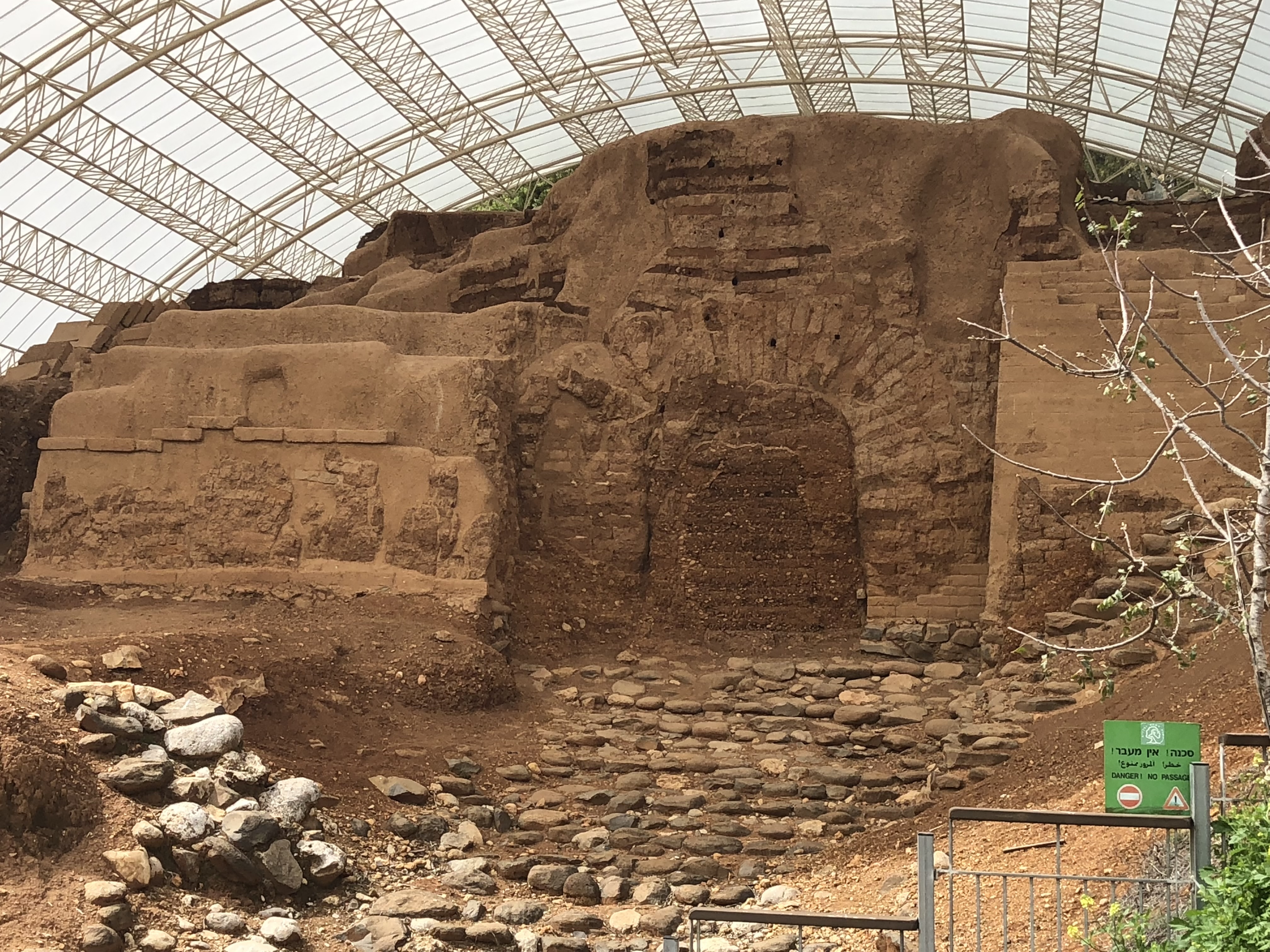
Chedorlaomer and his allies plunder all the goods of Sodom and Gomorrah and take Lot, the women, and the people of his house along with his possessions (11-12,16). An escapee tells Abram what happens, and the patriarch musters his allies and his own personal army to get his nephew and his house back safely (13-15). He has a battle plan, dividing his forces and attacking at night, and they defeat the invader in what is modern-day Syria (15-16). On multiple occasions, I have visited the ruins at Dan and have seen the so-called “Abraham Gate.” It dates back at least as far as Abraham’s day, almost 2000 years before Christ. 

(My photo of the “Abraham Gate,” March 2018)

After rescuing Lot and his house and goods, Abram is met by a priest named Melchizedek (18). The Holy Spirit, through the author of Hebrews, uses Genesis 14:17-20 and Psalm 119:4, and this one incident with Abraham to drive home an incredibly powerful point. Jesus is a High Priest, not like the Levites who descended from Aaron, but like this obscure figure, Melchizedek. 

The Bible uses a literary device called an antitype. “From the Greek antitupos, which occurs in Heb. 9:24 and 1 Pet. 3:21, where the AV translates it ‘figure.’ An antitype is the substance of which a type is the shadow, or the fulfilment of that which the type foreshadowed” (Cairns, Alan. Dictionary of Theological Terms 2002: 33). The antitype is always the greater; the type is always lesser and represents in some way the greater. So, Melchizedek is a type of Christ. He himself was greater than the Levitical priesthood in the ways we read in Hebrews 7, but the specific attributes we read about Melchizedek in this chapter are more fully and greatly found in Jesus.

What are the specific types? 

  • His position (18; Heb. 7:1). He is the king and priest of the Most High God. As king, he is king of righteousness and king of peace (2). 
  • His preeminence (20; Heb. 7:2,4-5). Abraham paid tithes to Melchizedek, signifying the greater prominence of the priest over the patriarch.
  • His perpetuity (Psa. 110:4; Heb. 7:3). “Without father, without mother, without genealogy, having neither beginning of days nor end of life, but made like the Son of God, he remains a priest perpetually.” None of Melchizedek’s ancestors or descendants filled this role, so in that way “he remains a priest perpetually.”
  • His purpose (19; Heb. 7:6-7). Melchizedek blessed the one who had the promises, an indication of his greater position and authority.
  • His precursory place (Heb. 7:8-11). Melchizedek lived many generations before Aaron, through whom the Levitical priesthood descended. Aaron was still in “Abraham’s loins,” meaning that Abraham did not have children yet. Much later, he would sire Isaac, who beget Jacob, etc., until finally Aaron was born through this genealogy.

In the way that Melchizedek served as greater than Levi, Jesus more fully and greatly serves as greater than Levi. If it were a math problem, we would say Levi < Melchizedek < Christ. Obviously, then, Levi < Christ. The writer of Hebrews, in chapter seven, draws some conclusions about this type of Christ. Because Christ is the antitype of Melchizedek,

  • It makes sense that perfection comes from His priesthood rather than the Levitical priesthood of Judaism (11).
  • There needed to be a change of laws (from Moses’ to Christ’s)(12).
  • It is right that this greater High Priest comes from a different tribe in which none had or could have served as priest (13-14).
  • Christ serves as priest “not on the basis of a law of physical requirement, but according to the power of an indestructible life” (15-17).
  • He sets aside the old law and brings in a better hope (18-19).
  • He was appointed High Priest by means of the oath of God (20-21).
  • He has become the guarantee of a better covenant (22). 
  • He does not die, but continues forever as High Priest (23-24).
  • He is able to save forever those who draw near to God through Him (25-28). 

It is this last truth, concerning His salvation, where the author draws out several incredible points for our consideration. It is the crescendo of his “Melchizedek argument.” His work is unparalleled–He always makes intercession for us (25). His character is unparalleled–He is holy, innocent, undefiled, separated from sinners and exalted above the heavens (26). His sacrifice and offering is perfect (27). His oath is unparalleled–He is a Son, made perfect forever (28).

Of all the ways the writer establishes the superiority of Christ over all rivals, this one is the most interesting to me. It shows the masterful way God weaves events and Scripture together. The writer of Hebrews is making the point that the Levitical priesthood has been replaced by something better. Why would you exchange the superior for the inferior? 

After this encounter, which seems relatively insignificant until David and the writer of Hebrews later expound upon it, Abram refuses to enrich himself by the unsavory people of Sodom. The new King of Sodom only wants the people, but offers Abram to keep all the returned spoils from Chadorlaomer. Abram will have no part in that, taking only provisions necessary for the completed battle. Abram will continue to rely on God’s promises to take care of his needs, and he parts company with the king of this wicked domain. 

(Picture taken on March 10, 2018, running at the Dead Sea with Keith Kasarjian)

Genesis: These Are The Generations (XIV)

Lot And Abram Separate (13:1-18)

Neal Pollard

If you grew up going to Sunday School, this may be one of the lessons you learned as a child. The kernel I remember is that Abram gave Lot the first choice of land and Lot chose the one that looked better; that would cost him, but God would richly bless Abram. As I recall, the takeaway for us preschoolers was not to be selfish and trust that God will take care of us. Not bad, sister Gober!

But, keeping with the context of the call of Abram, perhaps we can glean even more. Let us examine how they got to this point and what significance it has on the overall objective given to Abram.

First, we see Abram’s prosperity (1-4). As we saw, the Pharaoh unwittingly adds to his resources when he thought he was wooing a potential wife. But with all Abram brought and accumulated, it amounted to him being “very rich in livestock, in silver and in gold” (2). He has left Egypt and returned to Bethel, where he had formerly built an altar (3-4; 12:8). 

Second, we see Abram’s piety (4b). Abram was an altar-builder (12:8; 13:4,18; 22:9). No doubt, he influenced his son, Isaac, who would also become an altar-builder (26:25). Abram repeatedly found it necessary, in arriving at some significant point, to call on the name of the Lord. While his faith is still developing, he understands the uniqueness and power of Jehovah. It drives him to his knees in worship. 

Third, we see Abram’s problem (5-7). Sometimes, we refer to “good problems”–dilemmas that grow out of otherwise positive circumstances. That is what happens on this part of the journey (cf. 36:7). Lot and Abram both had so much flocks, herds, and tents that “the land could not sustain them while dwelling together” (6). There was strife between the men’s herdsmen (7), and perhaps it threatened the peace between them (8). Sometimes, growth and progress create problems that would not exist in periods of decline and difficulty.

Fourth, we see Abram’s proposal (8-13). Choosing unity over plenty, Abram proposes that they separate with all their goods and possessions so that each could sustain and provide for their own (8-9). For him, the overriding concern was, “we are brothers” (8). Abram tells Lot that whichever way he chose, he would then chose the other way (9). Lot looked down on the valley of the Jordan and saw well-watered plains “like the garden of the Lord” (10). Lot took all he had with him and went east to the land of Canaan in the cities of the valley (12). There is foreboding in Moses’ summation of Lot’s destination, first alluding to the coming destruction of Sodom and Gomorrah (10) and the little city of Zoar where Lot and his daughters will flee during that destruction (10). Second, there is the startling statement: “Now the men of Sodom were wicked exceedingly and sinners against the Lord” (13).

Finally, we see Abram’s prospects (14-18). The Lord appears to Abram and tells him to look in every direction. God promises to give all the land he could see to his descendants, offspring that would be as prevalent as the dust of the earth (16). He tells Abram to walk the land and survey it, with the promise, “I will give it to you” (17). Abram takes his household and belongings and camps in Hebron, where he promptly builds a place of worship (18). 

God is blessing this man of faith, who, in turn, is remembering God and following the ways of God in his dealings with others. God rewards His proper prioritizing, and sees fit to use him in furthering His plans and intentions. God uses faithful, selfless people to accomplish His will. May we have a heart of wisdom which approaches life’s decisions, big and small, with the sole motivation of loving God wholeheartedly and loving our neighbors as ourselves. Out of this drive, we will be people God partners with to do great things to His glory! 

2 Peter (Part 3)

Wednesday’s Column: Third’s Words

Gary Pollard

I’ll be repeating the book of II Peter in present-day terminology. It’s not a true translation of the book, as I am not qualified to do so. It will be based on an exegetical study of the book and will lean heavily on the SBL and UBS Greek New Testaments, as well as comparisons with other translations (ESV, NASB, NIV, ERV, NLT). My goal is to reflect the text accurately, and to highlight the intent of the author using concepts and vocabulary in common use today. 

This is not an essentially literal translation, and should be read as something of a commentary.

The Liars

There have always been liars who claim to be speaking on God’s behalf, so you’ll encounter them, too. They’ll secretly teach things that will wreck your faith. They’ll even disown the one who saved them, but they’ll be destroyed soon. They don’t have moral restraint, so a lot of people will follow them. This will make the world think of us as hypocrites. They don’t even have your best interests in mind! They’ll take advantage of you and lie to you. They will face inescapable consequences. God didn’t even give angels a free pass when they sinned. He sent them to a dark place where they’ll stay until judgment. God didn’t give the ancient world a free pass. In fact, only Noah and his family survived the flood that destroyed everything else. God didn’t give Sodom and Gomorrah a free pass, either. He completely destroyed them as a warning to everyone who might be interested in living like they did. Lot was a good man and he was extremely upset by how everyone in his city was living. God rescued him from the bad conditions he had to live through, so he knows how to rescue us from temptation. He also knows how to take care of godless people who do whatever they want and reject authority. They’ll have to answer to him. These people don’t even get nervous when they insult angelic beings! Even though angels are considerably more powerful than humans, they wouldn’t ask God to condemn those liars with that kind of animosity! These liars are just like dumb animals. They act on every impulse, they insult in ignorance, and they will be destroyed. They’ll gratify their passions in broad daylight. They drag you down with them, and they’re excited about that! They’re a cancer. They are obsessed with gratifying their impulses and they won’t stop. They drag down people who aren’t strong in their faith. They only care about themselves and they’ve abandoned the right path. Remember Balaam? He enjoyed living by his own rules, too. He was reprimanded by a donkey, of all things, so that he’d get a grip on himself. Donkeys aren’t even supposed to talk, but God did whatever it took to make sure he’d get back under control. These liars are like wells that don’t have water. They’re like rain that gets blown around by the wind. They’re destined to spend forever in the darkest place. They lie with confidence and bring down people who have a hard enough time staying pure as it is. They promise freedom, even though they’re slaves. After all, we’re slaves to whatever controls us. This is really bad for them. If you learn about God and escape the influence of worldliness, but fall right back into your old ways, you’re much worse off. It’s better to not know God at all than to know him and then reject him. You’ve heard the old saying, “Dogs eat their own puke,” and, “Pigs get right back into the mud after they’ve had a bath.” That’s what these liars have done. 

Should We Let The Devil Make The Rules Of Engagement?

Neal Pollard

Thanks to the hospitality of my good friend, Jason Jackson, I had the opportunity to visit beautiful AT&T Park in San Francisco, witnessing a rarity (a Rockies win) against his beloved Giants.  It was LGBT Night at the old ballpark, an annual sponsorship of “SF Pride.” It was also the day of the historic Supreme Court decision mandating the recognition of same-sex marriage in all 50 states. The crowd was enthusiastic about that event in Washington, D.C., cheering when it was proclaimed over the P.A.  The videoboard featured gay and lesbian couples for its “kiss cam.”  While San Francisco is renowned for its “sexual progressiveness,” the city of Denver has earned a reputation for similar liberality of thought regarding homosexuality. In a growing number of places in our nation and especially among those under a certain age, there is welcoming, sanctioning language for homosexuality and vehement intolerance for the least word of condemnation of the behavior as sinfulness.  Even among those professing to be Christians, there is a changing posture in how or if it is dealt with.  Understanding that no sin is worse than any other, that it is not right to display an ungodly attitude in addressing any sin, and that there should not be an inordinate amount of time, attention, and energy given to any sin to the exclusion of the other, I wonder if even some of our Christian brothers and sisters have become unwitting pawns of the prince of this world regarding this matter.  The devil is at war against the Word and will of God, and he is at war against anyone loyal to such (Rom. 13:12; 2 Cor. 10:3-6; Eph. 6:10ff; etc.).  He wants his cause, the ultimate end of which is the spiritual destruction of all men, to succeed, and he wants the cause of Christ to be overthrown.  We know that his mission will ultimately fail, with there being those who are welcomed by our Lord to heaven (1 Cor. 15:24; Mat. 25:34-39). Yet, most will follow him to everlasting punishment and destruction (Mat. 25:41-46).  He has the bulk of the resources and influence of this world, as he almost always has had in every generation. He has powerfully allies and mouthpieces from Washington to Hollywood and most media and education outlets in between.

  • Who is behind the idea that we are not loving the sinner when we speak of homosexuality as sin?
  • Who would have us believe that we are mean-spirited or unrighteous if we use terms like “unnatural” (Rom. 1:26), “exceedingly grave sin” (Gen. 18:20), “ungodly” (2 Pet. 2:6), “gross immorality” and “going after strange flesh” (Jude 7) to describe homosexual behavior?
  • Who would sell us on the idea that loving the homosexual means keeping quiet about their practice of it, failing to warn them to repent (Ezek. 33:8)?
  • Who would seek to equate a behavioral choice (1 Cor. 6:9) with one’s race or skin color (Acts 17:26; Acts 10:34-35)?

What happened in our nation’s highest court last Friday may have been necessary to shake the church out of its general lethargy and indifference regarding evangelism.  What happened there will ultimately be overruled in the highest court there is (Mat. 25:31ff).  What happened there should not become our obsession, but neither are we wrong to take note of how this is a significant societal erosion.  Jesus implies how intolerable it would be for Sodom and Gomorrah at the Judgment (Mat. 10:15). The Lord overthrew them in “in His anger and in His wrath” (Deut. 29:23). Homosexuality is not the only sin there is nor is it the chief sin, but may we not be intimidated away from calling it what it is—“sin.”