The Religion Of Resolutions

Neal Pollard

Have you ever wondered about the origin of New Year’s resolutions? I have. If they are to be trusted, the folks at the History Channel denote the Babylonians, nearly 4,000 years ago, as the founder of such culture-wide determinations. It was as part of a 12-day religious festival known as Akitu. Later, at the prompting of none other than Julius Caesar, the Romans, again as a nod to a god—Janus, the two-faced god who looked backward and forward—observed the advent of a new year with the intent of improving areas of their lives in need of such. Sarah Pruitt, author of the piece, claims that Christians, since early times, have approached the new year to rededicate themselves to Christ. Pruitt seems to be indicting so many today who observe this holiday in a purely secular fashion, and wonders if such humanistic emphasis is why so many resolutions fail (source).

It is noteworthy that the history of making resolutions is so closely tied to religious devotion. Perhaps this is because we, as human beings, recognize our innate inadequacy. Paul, feeling it necessary to defend himself against unnamed critics of his work, wrote, “Such confidence we have through Christ toward God. Not that we are adequate in ourselves to consider anything as coming from ourselves, but our adequacy is from God, who also made us adequate as servants of a new covenant…” (2 Cor. 3:4-6a). Paul, so accomplished as a Christian, preacher, leader, mentor, missionary, and more, was always striving to do more for Jesus. He was not trying to earn God’s love and approval. Whether looking back at his successes or failures, Paul, in his love for his Lord, wanted to serve Him more effectively. He told Philippi that he pressed on (Phil. 3:12), “forgetting what lies behind and reaching forward to what lies ahead” (Phil. 3:13). He advised the conscientious Christian to follow his example (Phil. 3:15-16).

Christianity is not a religion of annual intention. It is the religious of daily determination (Luke 9:23). January 1 is an ideal time to reflect, review, and resolve, but is far from the only time.  In a significant sense, each new day for us involves a resolve within ourselves to deny self and dedicate to the Savior. As I have done every year of my adult life, I will again set out objectives and goals, physically, financially, and familial. Yet, the most important will involve my faith. As always, these will need review, not just in January, but throughout the year. In my prayers today, I prayed for every Christian who resolves to conquer a sin problem, reach a lost soul, be more active in their local congregation, and any other noble aim for the Master. If you make some such specific resolution and would honor me with the privilege of partnering with you in prayer about it, please email me (mrnealpollard@gmail.com) and let me know. Then, let me know how it goes and especially tell me about your success. May God bless each of us with the resolve to be more faithful in our relationship with Him.

o-new-years-resolutions-facebook

Christian, Who Are You?

Neal Pollard

  • You Are An Insurance Agent—Life (Philippians 2:16), Health (cf. 1 Peter 2:24), and Fire (2 Peter 3:9-10).
  • You Are A Tour Guide (1 Peter 2:9; Acts 8:31).
  • You Are A Soldier (Ephesians 6:10ff; 2 Timothy 2:1-3).
  • You Are A Slave (Romans 6:17).
  • You Are A Firefighter (Jude 23).
  • You Are An Ambassador (2 Corinthians 5:20).
  • You Are A Priest (Revelation 1:6).
  • You Are A Conductor (2 Corinthians 2:14; 9:11).
  • You Are A Day Laborer (John 9:4; cf. Matthew 20:1ff).
  • You Are A Farmer (2 Timothy 2:6; Luke 8:5).
  • You Are A Fisherman (Matthew 4:19).
  • You Are A Gem Distributor (Colossians 1:27).
  • You Are A Taste Tester (Colossians 4:6; Hebrews 5:14).
  • You Are Royalty (Revelation 1:5-6).
  • You Are A Student (2 Timothy 2:15).
  • You Are A Body-Builder (Ephesians 4:16).
  • You Are A Restorer (James 5:19-20; Galatians 6:1).
  • You Are A Physician’s Assistant (Hebrews 12:12-13; cf. Mark 2:17).
  • You Are A Standard-Bearer (Philippians 3:16; 2 Timothy 1:13).
  • You Are A Builder (1 Corinthians 3:10).
  • You Are A Judge (John 7:24; 1 Corinthians 6:2).
  • You Are A Nutritionist (1 Timothy 4:6).
  • You Are A Maintenance Worker (Phlippians 2:2; Titus 3:8,14, KJV).
  • You Are A Cleaner (2 Timothy 2:21; James 4:8).
  • You Are A Runner (1 Corinthians 9:24; Galatians 2:2; 5:7; etc.).
  • You Are A Boxer (1 Corinthians 9:26).

I’d be amazed if I did not leave out several of our job titles and descriptions. Suffice it to say that there is plenty of work for all of us to do. The next time we find ourselves figuratively twiddling our spiritual thumbs, wondering how we can be involved, let’s draw from the exhaustive inventory of tasks the Lord has left us!  Remember, “Whatever you do, do your work heartily, as for the Lord rather than for men” (Col. 3:23).

laborer

What Are You Living For?

Neal Pollard

A man had the good fortune and insight to take a chance with a credit card company in the Baltimore area several decades ago. He retired a wealthy, high ranking executive. In the course of his career, he put together a streak so impressive–35 years in which he never missed a day of work–that “Iron Man” Cal Ripken, Jr., wrote him a letter commending him for it. When he retired, the company gave him a classic car as well as many other lavish gifts. He had a great many benefits and perks, the admiration of peers and competitors, resort townhouses, and considerable wealth. But, one day very soon after he retired his life was dramatically changed after a visit to the doctor. He had an aggressive form of cancer. A few months later he was dead.

This is not a commentary on the morality or priorities of the man. I know nothing about either. His story points out that his well-laid plans and successful career could not forestall the inevitable end result common to every man.

It should also provoke a question. What are we living for? Is our identity tied to our career? Do we want to be known as the life of the party? Is it all about travel and adventure? Does life revolve around going to the river, campground, fishing hole, beach, or mountains? Is it sports, shopping, spending, or spirituality? Of necessity, all of us have a central focus. It is the thing that forms the bull’s eye we repeatedly find ourselves aiming at. Too many times, some thing becomes the thing in “first place” over Christianity. Colossians 1:18 reminds us Christ must come to have first place. When it comes to our jobs, Jesus must take first place. When it comes to our recreation, same thing. When it comes to relationships, He deserves primary position. Whatever we say or do, Jesus must be at the forefront.

He warns that we may invest in the wrong kind of treasure rather than the true riches (Mat. 6:19-21). He admonishes us to seek the kingdom first over “things” (Mat. 6:33). He warns against choosing family members over Himself (Mat. 10:37).

When life draws to a close, one will be confronted by the reality of what he or she made first place. Certainly, when we cross the sea of time to eternity, there will be no denying, rationalizing, debating, or arguing what our “bull’s eye” was. But, in our heart of hearts, don’t we all know what’s most important to us right now? It’s what occupies the greatest amount of our interest, time, energy, emotion, and effort. It is what we live for. When we die, will what we live for help us live eternally or be the cause of eternal death (cf. Rev. 21:8)? Let’s hear Paul’s encouragement to “set your affection on things above and not on things of the earth” (Col. 3:2).

Spofforth Church Grounds

Copperopolis, California

Neal Pollard

It boomed when “copper was king” and owed its thriving existence to shell casings made for the Union Army in the far-away Civil War.  Fittingly, her downtown streets were Union, Grant, Lincoln, and Sherman. There were 90 businesses in “Copper City” from 1865-1867. The extraction and production of copper ore found in such strikes as at Gopher Ridge, Quail Hill, and Hog Hill made Copperopolis a boom town for a short time.  A huge fire in the center of town, in 1867, coupled with the enormous drop in demand for copper following the end of the Civil War, left the community a virtual ghost town. So, despite a few modest copper mining rebounds periodically through World War II, Copperopolis, which yielded $12 million in copper from 1861 to 1946, is a shell of its former self. It is a resort and recreation area today, a modest little town who  once entertained the likes of Mark Twain, Nikola Tesla, and “Black Bart” (Charles Boles)(mymotherlode.com,  calaverashistory.org/copperopolis).

History is fascinating, with its “rags to riches,” “riches to rags,” and even “rags to riches to rags” stories.  Family histories play out the same way.  So can the rise and fall of nations.  The history of the church, wherever she has existed, may follow the same trajectory.  The Jerusalem church of Christ, where it all began, once boasted thousands of members.  In time, due to persecution and the introduction of false doctrines, the church there faded from view.  Today, it has only a modest presence. The same could be said of other congregations we read about in the New Testament.  Our congregation is somewhere on its course from the past to the future.  Where will it be in 10 years? 50 years?

Then, I look at my own life.  I have been a Christian for over 30 years.  I have preached for over 25 years. There have been Bible studies with non-Christians and new Christians. There have been efforts to try and influence others with the gospel.  My three sons are all nearly grown and on their own.  My wife and I have labored together to serve Christ.  But, each day, I must look and sincerely investigate what my spiritual trajectory is.  Am I growing nearer to Christ, acting more like Christ? Am I bearing more or less fruit? Are my best days in His kingdom behind me or in front of me? The good news is that, to a great degree, that lies within the scope of my free will and deliberate choices. With God’s help and to His glory, I can make today, tomorrow, and beyond the brightest days of service to Him.

Look at your life.  What legacy are you building? You will help determine that by what you do today.  Paul says, “Therefore be careful how you walk, not as unwise men but as wise, making the most of your time, because the days are evil” (Eph. 5:15-16).

Photograph taken of ruins in Copperopolis, California.

LONGEST SPEECH, SHORTEST TERM

Neal Pollard

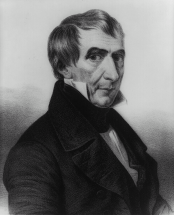
The shortest inaugural address was George Washington’s second, in 1793, and it was comprised of 193 words! William Henry Harrison, though raised a cultured, educated man, campaigned on a folksy ticket symbolized by the log cabin. To set a different, more cultured tone for his presidency, Harrison decided to give a lengthy, erudite speech on a bitterly cold, early March day in 1841. He spoke for nearly two hours, doing so without benefit of a topcoat or hat. Historians are generally agreed that Harrison’s motivation was to show himself not be a country bumpkin or simpleton. While it is unclear if his exposure led to the pneumonia that killed him exactly a month later, it still boils down to a lot of talk and very little execution.

How often do we, as congregations, spend a seemingly endless amount of time outlining, discussing, and rehashing grand plans? Goals and planning are vital to a church’s existence, but so often much talk produces little action. In any congregation’s mind, they are going to be a fast-growing, active, moving, and shaking bunch. Yet, so few churches are that. We spend our time laying out the plan and give ourselves so little time to do it.

We do that in our individual lives, too. We make big plans for tomorrow (cf. Jas. 4:13-15). Like the poet expressed it, “He was going to be all that man should be…tomorrow; no one would be kinder or braver than he…tomorrow.” Yet, the poet depicts the dreamer as one who died today while hoping for tomorrow. Are we making grand, long-winded speeches about all we are going to do? Are we spending such time outlining it that we have so little time left to execute it?

Think of all you know about William Henry Harrison compared to George Washington. Both were thinkers and planners, but oh the difference in how we remember each of the. Think, then do!

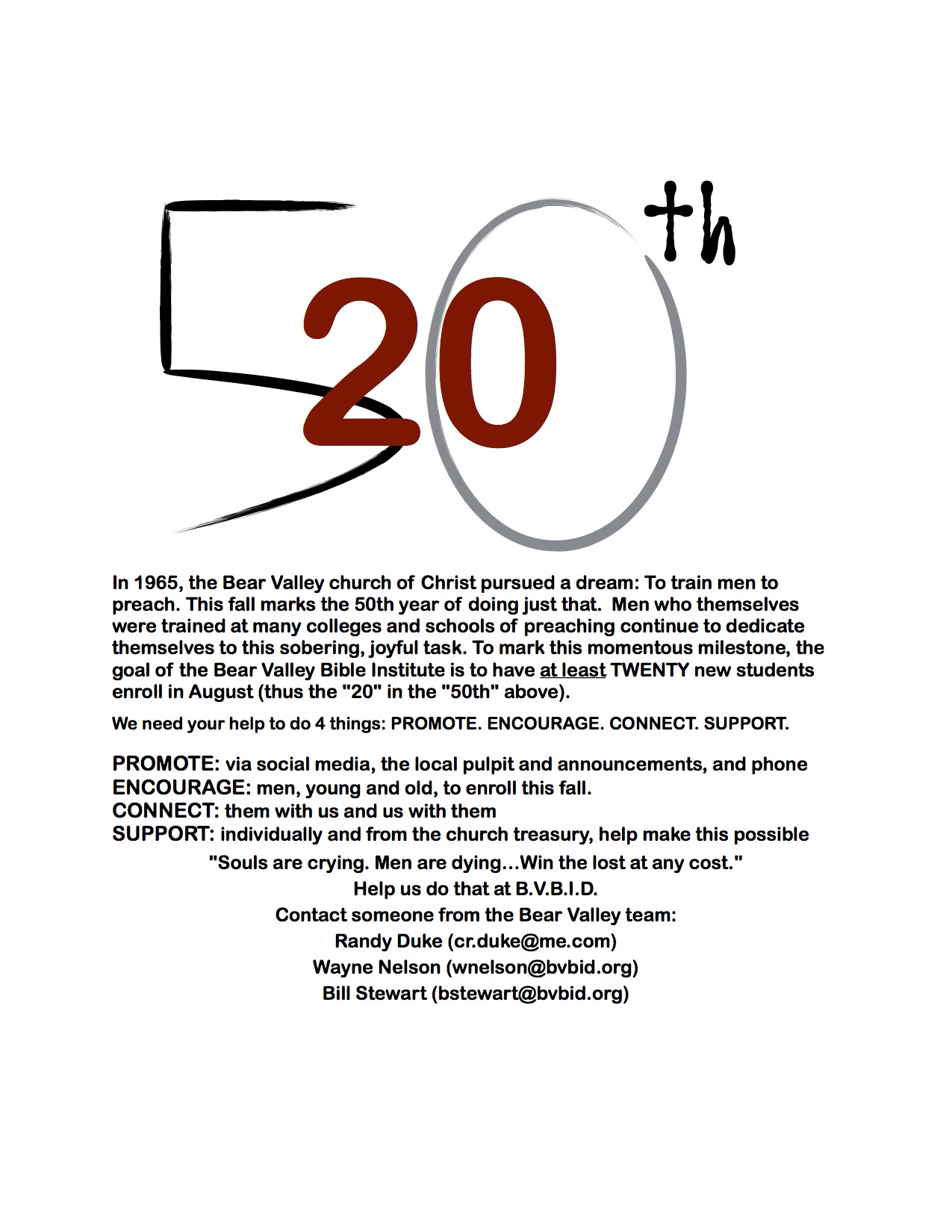
A Mass Appeal To Help Us Reach A Worthy, Wonderful Goal!

50th anniversary

Melvin Otey’s lecture from the 2013 lectures. Stay tuned for details on 2014’s program!