Genesis: These Are The Generations (XXII)

A Birth, A Rivalry, And A Covenant (21:1-34)

Neal Pollard

We have constant reminders in the Bible that God keeps His promises, even ones that seem impossible or far-fetched. The chapter begins with the assertion that the Lord “took note” of Sarah, doing what He promised (1; 17:15-21; 18:10-14). The name “Isaac” (laughter) is fitting since both Abraham and Sarah laughed when they were first given the promise from God, but at his birth a different kind of laughter filled their home (6-7). There is abundant joy as this elderly couple welcome the son of promise into their family. Domestic tranquility does not last forever, though. The rivalry that first appeared between Sarah and Hagar has transferred to the next generation.

Ishmael mocks Isaac on the day he is weaned (9). Sarah makes the extraordinary demand that Abraham drive out Hagar and Ishmael, for whom he felt responsibility–especially for his first-born son. Yet, God assures Abraham that what Sarah wants is appropriate (12; Gal. 4:30) and that He will take care of them in the wilderness. He assures Abraham that Ishmael would father a nation, since he was his descendant (13). But “through Isaac [his] descendants would be named” (12).  

Undoubtedly, Hagar is not privy to this revelation Abraham received. She is left to cope with the frightening prospect of fending for herself and her teenage son with only the bread and water Abraham sends her away with (14). She wanders about and when the supplies run out, she braces for their deaths (15-16). They are helpless on their own, but God intervenes. 

I find several interesting parallels between what happens in this chapter with Hagar and Ishmael and what happens in the next chapter with Abraham and Isaac. First, both leave Beersheba at the command of God. Second, each time a son of Abraham faced seeming certain death. Third, neither time do we hear the child speak in protest or self-defense. Fourth, the angel of the Lord speaks in both cases to intervene. Fifth, God makes promises about the descendants of both sons. Finally, God opens the eyes of both parents to see what God provided, for Sarah a well of water and for Abraham a ram. 

God is with Hagar. He develops a life-preserving skill (archery) and his mother finds him a wife from their native Egypt. They live in the wilderness of Paran, a place we first encounter in the wars of Genesis 14:6. It is between Canaan and Egypt, northeast of Mt. Sinai. It will be the site of much of the wilderness wanderings in Numbers as well as the place David goes following Samuel’s death (1 Sam. 25:1ff). 

With the domestic issues settled and Abraham and Sarah fully focused on raising Isaac, a familiar face reemerges in their lives–Abimelech (22-33). He and his army commander can see how God is blessing everything Abraham had and did, and so they want there to be a covenant between the two clans. They swear peace between themselves, but Abraham has a complaint against Abimelech’s servants (25). They had seized the well of water Abraham’s servants were using. Abimelech, seemingly consistent with his character as revealed in Genesis, is totally unaware of such a breach and did not endorse it. Abraham shows great wisdom in gifting sheep and oxen and making a covenant with him (27). Additionally, he provides Abimelech seven ewe lambs, explaining to the puzzled king that they were a witness that he had dug the well at the place he calls Beersheba (“the well of the oath” or “swearing by seven lambs”). 

After Abimelech and Phicol return to the coastal area called here “the land of the Philistines” (32), Abraham plants a tamarisk tree there and worships “the Lord, the Everlasting God” (33). He resides for many days at what apparently was the northern end of Abimelech’s domain (Smith, 160). Abraham continues to do what he has been doing, publicly worshipping his God (12:8; 13:4). 

The table certainly seems set. They have the improbable son of promise. There is no domestic strife or competition between sons to distract the family. They are at peace with their neighbors. Life is good! How often do we encounter the calm before the storms of life, blissfully ignorant of impending crisis? Faith and spiritual strength are built in such times of peace and help us weather the storms that inevitably calm. We will see this more clearly when we turn the page to chapter 22. 

Genesis: These Are The Generations (XXI)

Abraham Deceives Abimelech (20:1-18)

Neal Pollard

God’s choice of people to carry out His plan is never solely based on merit. If so, who could He use? Noah had exceptional, extraordinary faith, but he also struggled with weakness. Abraham is renowned for his faith, but in Genesis 20 he is going to fall back into the same moral trap he had previously laid for himself. In fact, this chapter reveals a habitual failing on his part (12-13). Developing faith is not flawless or perfect, even as it grows and matures. Let’s notice five things in Abraham’s stumbling steps on his road of trusting God’s providence. 

The Deception (1-2). It seems like deja vu, a repeat of the circumstance with the Pharaoh in Egypt (12:11-13). Abraham has journeyed south, back near the border of Egypt. He encounters the king of Gerar, Abimelech, there, and he tells the king that Sarah is his sister. Taking Abraham’s word at face value, Abimelech “sent and took Sarah” (2) in order to make her his wife. 

The Dream (3-7). We know nothing of the man’s character until God comes to him in a dream. Abimelech could declare his blamelessness to God (4), his integrity of heart, and the innocence of his hands (5). God validates his claim and informs him that He had intervened to prevent sin in his interaction with Sarah (6). The heart of God’s message to Abimelech is to restore Sarah to Abraham, a prophet, to have him intervene on his behalf. There is also a warning concerning His wrath if the king disobeys (7). 

The Discussion (8-13). Abimelech’s first discussion is with all his servants, “greatly frightened” at their master’s news (8). There had to be no small amount of righteous indignation when the king addresses the patriarch, asking, “What have you done to us? And how have I sinned against you, that you have brought on me and on my kingdom a great sin?” (9a-b). Abraham receives a deserved, stinging rebuke (9c). The king also shows incredible empathy, wondering aloud what Abraham had experienced to resort to such tactics (10). The best Abraham could do is rationalize that he anticipated widespread unbelief and aggression wherever he went, and telling a half-truth (whole lie!) would keep his wife and himself safe (11-13). You wonder if Abraham could see the flimsiness of his excuse as he said it out loud. 

The Diplomacy (14-16). Abimelech believes what God says about his counterpart, and the offended shows great kindness and generosity to the offender. He endows Abraham with sheep, oxen, male servants, female servants, land, and 1000 pieces of silver. With this, he shows his integrity and character from beginning to end in this matter. 

The Devotion (17-18). The best thing Abraham did in this encounter was pray to God for the king of Gerar. In response, God opened the wombs of Abimelech’s household, wombs he had closed because of the appropriation of Sarah. While there was certainly a lesson for Abimelech to learn concerning the uniqueness and greatness of Jehovah (we will see this king not only in the next chapter, but in the next generation in an eerily similar situation with Isaac in chapter 26), was there also a lesson for Abraham? He had already shown so much faith in his life, going where God said go and believing what God promised. But, he had this blind spot in his faith. 

We should constantly evaluate our faith. Are there any blind spots? Maybe we trust Him in our relationships, but not in our finances. Maybe we are trying to seek Him first in so many areas, but we keep falling into the same bad habits or poor coping mechanisms in some area of struggle. This incident shows us God’s patience and special regard for His children, but it also reveals the need we have for letting our trials and temptations refine us and get us to a better spiritual place. We might occasionally be shamed by those outside of Christ who prove greater integrity than we show in a moment of weakness. That should drive us closer to God and make us trust Him more in subsequent trials! It appears to work that way for Abraham. 

Genesis: These Are The Generations (XX)

The Destruction Of Sodom And Gomorrah And Rescue Of Lot (19:1-38)

Neal Pollard

Back in the ’90s, I wrote an article entitled, “When Sodom Lived In Lot’s Family.” While I don’t have an electronic copy, the main points and content were adapted by another preacher and can be found here (click here). The thrust of the article was that not only did Sodom bring his family to live in Sodom, but subsequent events show that the influence of that wicked city lived in Lot, his wife, his daughters, and his sons-in-law.

As the chapter begins, Moses writes, “The two angels came to Sodom…” (1; see the discussion from chapter 18 on their likely identity). Lot apparently has gained influence, to be sitting at the gate of the city. Lot, like his uncle, sees something special and important about these city guests as he bows to the ground before them (1). Lot urges them to spend the night in his house, but the angels respond that they will spend the night in the square (2). That Lot knew the city was full of wickedness is implied in his stronger urging that they enter his house (3). Peter confirms this, writing that Lot, “while living among them, felt his righteous soul tormented day after day by their lawless deeds” (2 Pet. 2:8).

Sure enough, after the evening meal and at bedtime, all the men of the city come to Lot’s house and clamor for these men to come out to them “that we may have relations with them” (5). While some have tried to put a different spin on their demand, it is clearly homosexual desire. Both Testaments clearly place the practice of homosexuality in the category of sinful (Lev. 18:22; 20:13; Rom. 1:26-27; 1 Cor. 6:9-11). The very term “sodomy” takes its name from this city. Jude 7 says, “just as Sodom and Gomorrah and the cities around them, since they in the same way as these indulged in gross immorality and went after strange flesh, are exhibited as an example in undergoing the punishment of eternal fire.” 

There is further confirmation that their desire is sexual in Lot’s response, offering up his daughters “who have not had relations with man” in place of the angels (8). They are angered at Lot’s rebuff and intend to take the men and Lot by force (9). The angels strike the aggressors with blindness and rescue Lot from them (10-11). They order Lot to gather any from his family that he can muster to flee, since the Lord was about to rain down destruction on these cities (12-13). Lot’s son-in-laws take his warning as a joke and do not leave (14). Despite the great wickedness of the city, including what they endured the night before, the compassionate Lord through the strong angels lead out Lot, his wife, and their daughters (15-16). 

So morally and emotionally compromised was Lot that he does not have the faith or moral strength to flee to the mountains, as the angels commanded. The angels allow them to escape to the little village of Zoar, stipulating only that they not look back at Sodom (17-20). As many of us learned in Sunday school as children, Lot’s wife disobeyed and looked back, “and she became a pillar of salt” (26). Jesus will use Lot and his wife as illustrations about the destruction of Jerusalem, that it will come on an ordinary day (Luke 17:29-30) and one must flee without looking back (Luke 17:31-32). The cities of the valley, from inhabitant down to vegetation, are utterly destroyed with fire and brimstone. 

Abraham looks down from the heights and witnesses God’s judgment (27-28). For Abraham’s sake, He delivers and preserves Lot and his daughters (29-30). But, their moral compass is so distorted (by their time in Sodom?) that the daughters concoct a plan to get their father drunk and commit incest with him (31-38). As the result, both become pregnant and bear sons. The eldest names her son Moab and the youngest names her son Ben-ammi (37-38). From this unrighteous union come the Moabites and Ammonites, nations that would be a thorn in the side of the Israelites. 

What a contrast of legacies! Abraham will be the father of many nations. Lot will be the father of wicked unbelievers. Abraham’s faith is getting stronger. Lot’s faith is weak and imperceptible. Lot disappears from the scene until the New Testament, a footnote in Abraham’s story. Abraham will become one of the heroes of the faithful, the epitome of righteousness. It was more than a choice of pastureland, but it is a contrast of hearts and lives. This chapter should motivate us to consider the spiritual legacy we are leaving with our families. Our decisions and our priorities not only effect our own spiritual fate, but also that of our spouse and children. We do well to revisit “the days of Lot” (Luke 17:30) and “remember Lot’s wife” (Luke 17:32). 

Genesis: These Are The Generations (XIX)

The Twofold Mission Of The Three Men (19:1-33)

Neal Pollard

We cannot miss the opening phrase in this chapter–“the Lord appeared to him at the oaks of Mamre”–in connection with the events that follow. The entire episode constitutes a “theophany” (a visible appearance of God to humans) and helps us understand what transpires, including God’s difficult statement in verse 21. 

Abraham is camped at or near Hebron, a city that would have significance among his descendants for multiplied centuries. Sitting at his door, he sees three men approach (2). This appears to be the Angel of the Lord (seen by Hagar in chapter 16) accompanied by two angels (cf. 19:1; see vs. 13). We also do not know if Abraham immediately recognized one of them as being the Angel of the Lord, even though most translations capitalize “lord” (3). He otherwise does not seem to grasp until later that these are anything more than distinguished guests deserving of hospitality (3-8). It seems that through subsequent conversation Abraham is enlightened that these guests are divinely sent and that one of them is the Lord. 

That begins when these men turn the conversation to the subject of Sarah (9ff). They issue a promise that Sarah would have a son when the spokesman (the Angel of the Lord?) returned the next year. Sarah could hear this discussion from inside the tent, where she laughed at the thought of having relations and through that conceiving a child (10-12). The omniscience of the Lord is revealed in His knowing that Sarah laughed within herself (12;15). He appeals to His omnipotence, asking, “Is there anything too hard for the Lord?” (14). He reiterates the promise of a son (14b). The first mission, to promise Isaac, is completed. 

This heavenly entourage rise up and look toward Sodom (16). As they walk that direction, Abraham accompanies them. The Lord says to (presumably) the two angels (19:1), “Shall I hide from Abraham what I am about to do, since Abraham will surely become a great and mighty nation, and in him all the nations of the earth will be blessed?” (17-18). He contrasts the faithfulness of this chosen patriarch with the wickedness of the people of Sodom (19-20). Think about the confidence vested in Abraham to be a righteous father urging obedience contrasted with the weak and pitiful condition of Lot’s household (ch. 19). The sin of Sodom is exceedingly grave, but Abraham would do righteousness and justice.

This heavenly visitation (21) is not suggesting that the Lord will discover anything He did not know. He has already proven His omniscience. It is obviously accommodating. This is a mission of executing judgment, and He is about to go among the people of Sodom and Gomorrah in advance of His punishment. In this context, Abraham shows his compassion for his neighbors and the close relationship he had developed with God (23-32). He urges God not to destroy the righteous with the wicked, and the Lord shows Abraham the great extent of His patience and mercy. We are not told how many people lived in that valley, but if there were even ten righteous people among them He would not destroy it. The second mission, that of informing Abraham of the coming judgment on Sodom and Gomorrah, was accomplished. The two parties part company.

These two missions led in opposite directions. One meant life where none was expected. The other meant death where that was not expected. One would perpetuate righteousness while the other would exterminate wickedness. One would bring a life into existence which would lead to a Savior while the other would end life that was thoroughly immersed in impenitent sin. The same Lord was in control of it all, demonstrating the perfect balance of His flawless character. For the obedient, this meant blessing. For the disobedient, this meant destruction. 

Genesis: These Are The Generations (XVIII)

God’s Covenant With Abram (17:1-27)

Neal Pollard

Sometimes a chapter makes its emphasis very clear through such means as the repetition of words. In Genesis 17, that word is “covenant.” We come across it 13 times in these 27 verses. Most frequently, God is speaking and calls it “My covenant.” It is repeatedly called the “everlasting covenant” or simply “the covenant.”

A covenant is a “treaty, compact, i.e., an agreement between two parties” (Swanson, np). Addressing the specific covenant here in Genesis 17, Kyle Hughes says, “This Hebrew word is used to refer to the imposition of an obligation upon someone. God’s covenant (bĕrît) with Abraham stipulates that Abraham and his male descendants be circumcised (mûl; Gen 17:10). God speaks of circumcision as an “everlasting covenant (bĕrît; Gen 17:13)”; circumcision is the means by which one becomes a member of the people with whom God has established his covenant” (Magnum, Lexham Theo. Wdbk, np).

This covenant came with blessings (2-8,15-16). Before God shares what He wants from Abram, He tells him what He will do for him. There are multiple blessings, but all spring from God’s lead statement: “I will multiply you exceedingly” (2). What did this entail? Making him exceedingly fruitful (6), making nations of him (6), bringing kings of him (6), blessing his descendants (7-8), and giving them the land of Canaan as a possession (8). No wonder 99-year-old Abram (1,24) fell on his face (3) as God disclosed these incredible promises.  God had been blessing Abram and delivering him, and now He has even more in store for him. He will bless the barren Sarah similarly (15-16). May I suggest that we serve the same God? Since early in our marriage, Kathy and I have loved and leaned on an old hymn that reminds us: “The Lord has been mindful of me, He blesses and blesses again; My God is the God of the living, how excellent is His name!”

This covenant came with transformation (5,15). As part of this covenant, God was giving them a new name. “Abram” (“exalted father”) would now be called “Abraham” (“father of a multitude”)(5). “Sarai” would now be called “Sarah” (“queen”)(15). The new names reflected not only blessings, but also exaltation. God was elevating their status as part of what He brought to the agreement. No wonder New Testament writers use Abraham as an illustration of what God has done most perfectly through Christ, elevating our status when we are in His Son (Rom. 4; Gal. 3; Jas. 2). In Christ, we are given a new and glorious name that reflects our blessings (Isa. 62:2; Acts 11:26). 

This covenant came with expectations (9-14, 23-27). A covenant demands participation from both parties. So, God tells Abraham what he must do to receive the blessings. Generically put, he and his descendants were to keep the covenant. Specifically, the males were to be circumcised. It applied to him, his children, and his further descendants. The stipulation would be males must be circumcised the eighth day. But Abraham would undergo this surgery at 99, Ishmael at 13 (26), and all the men of his household at whatever ages they were (27). Under Christ, the nature of the circumcision has changed. It is a circumcision for both male and female, but a figurative rather than a literal one. Paul writes about those in Christ, saying, “in Him you were also circumcised with a circumcision made without hands, in the removal of the body of the flesh by the circumcision of Christ; having been buried with Him in baptism, in which you were also raised up with Him through faith in the working of God, who raised Him from the dead” (Col. 2:11-12). The “old man” who served sin is cut off, as we keep seeking those things above (Col. 3:1ff).

This covenant came with divine power (17-22). Understandably, Abraham is wrestling with believing this promise. He fell on his face, laughed, and reasoned within himself that it was hard to accept that he and Sarah could have children at their age (17). He asks God if Ishmael could be the answer (18). While God will bless Ishmael (20), He says, “But My covenant I will establish with Isaac, whom Sarah will bear to you at this season next year” (21). 

We began our exploration of Abraham’s life by saying his faith was developing. This is a crucial stage of development. We are not told how he felt in Genesis 17, but inspired New Testament writers reveals this about his faith in God’s power. Paul says, “In hope against hope he believed, so that he might become a father of many nations according to that which had been spoken, ‘So shall your descendants be.’ Without becoming weak in faith he contemplated his own body, now as good as dead since he was about a hundred years old, and the deadness of Sarah’s womb; yet, with respect to the promise of God, he did not waver in unbelief but grew strong in faith, giving glory to God, and being fully assured that what God had promised, He was able also to perform. Therefore it was also credited to him as righteousness” (Rom. 4:18-22). This contains a blessing and an example for us, too, if we imitate his faith (Rom. 4:23-25). 

Genesis: These Are The Generations (XVII)

A Presumptuous Decision (16:1-16)

Neal Pollard

It is very possible that Hagar was a consequence of Abram’s decision to go down to Egypt to escape drought, where he deceived the Pharaoh and was given livestock and servants (12:16). If she came into his house through Abram’s weakness, she becomes the center of domestic drama through Sarai’s weakness. Genesis 16 tells us that Sarai “conceived” the plan to raise up children through Hagar, her handmaid, and she pitches this idea to Abram (1-2). 

This practice of a wife giving her maid to her husband is admittedly a difficult thing for most of us to grasp, but it was apparently common in the Patriarchal Age as demonstrated by Leah and Rachel (ch. 30). Typically, the child born of the union was thought to be credited to the wife. Here, Sarai defended her rationalizing by blaming God. She said, “The Lord has prevented me from bearing children” (2). Scripture does not indicate this, but simply that she was barren (11:30).

Things changed after the union of Abram and Hagar was successful. Hagar despises Sarai in a way that was transparent to Abram’s wife (4). While Sarai takes the blame for the horribly misguided choice (5), she pressures Abram to do something about it. Abram leaves it to Sarai to handle, and she treats Hagar so harshly that the Egyptian flees (6). Interestingly, her name is Semitic and means “to flee” (TWOT, 206). 

That is exactly what Hagar does. The angel of the Lord finds her by a spring of water in the wilderness (7). It seems indisputably clear that the angel of the Lord here is a theophany (physical manifestation of God, NP). This is not merely an angel, but God Himself. I agree with good men, such as Roy Lanier, Sr., and Wayne Jackson, that this is even more than a manifestation of God. This is the preincarnate (before becoming flesh) Son of God (see https://christiancourier.com/articles/a-brief-study-of-the-angel-of-jehovah and Timeless Trinity). How do we know that Hagar encounters God here?

  • He approaches her as God approaches Adam and Eve in the garden (3:9).
  • His promise to her is delivered with the weight of God, as when He issues promises to Abraham in chapter 15.
  • Moses calls this Being “Lord” (13a).
  • Hagar calls this Being “You are a God who sees” (13).
  • She marvels that she did not die, since she saw Him (13b).
  • The name given to the well where she encountered Him signifies Deity (14).

The angel of the Lord issues promises and prophesy concerning the son to be born to her. He tells her what to name the child (Ishmael) and why–“because the Lord has given heed to your affliction” (11). He foretells the contentious nature of Ishmael and his descendants, and indicates where they would settle (12). 

Abram must have believed that God spoke to Hagar since he names the child Ishmael (15). We are also informed that Abram is 86 at the time of the boy’s birth. Ishmael will become a teenager before God’s seed promise will be fulfilled. As we will see, this will cause more strife.

What a reminder that we add trouble to our lives when we make decisions without consulting God or when we take matters into our own hands. When God has revealed His will, our only response should be to wait and trust. We cannot anticipate the trouble we will bring into our lives and the lives of others when we insist on pursuing our own agenda. Yet, even when we falter, the faithful God not only sees but He foresees. The faithfulness of God persists even when we waver in our faithfulness (2 Tim. 2:13). 

Genesis: These Are The Generations (XVI)

God Points Abram To The Future (15:1-21)

Neal Pollard

I like the way James Smith puts it, that in Abraham’s life there is a pattern of consolation following crisis (The Pentateuch, 129). How often has that been true in your life and mine? Paul reminded the church in Corinth that God comforts us in all our afflictions (2 Cor. 1:3-7)! Aren’t you thankful? With the battle won, God speaks to Abram. What He has to tell this man of faith is dramatic, and God is equal to the occasion speaking to Abram first in a vision (1-11) followed by a dream (12-16). Whether the promise of verses 18-21 were spoken as part of the dream or otherwise, there is incredible news delivered through incredible means. All of it involves either the near or distant future, promised fueled by the integrity and power of God.

First, God foretells a coming child (1-6). Even as God promises Abram reward, this man ties that assurance to an heir. He had no direct blood descendant (2-3), yet God says that one would come forth from his body and be his heir (4). Coupled with this fantastic pledge, God directs Abram to His starry skies and uses it as an illustration of how numerous his descendants would be (5). 

One of the most powerful statements God ever made about any man is made concerning Abraham’s reaction to this. The first use of “believe” in all the Bible describes what this man regarding God’s promise. New Testament writers, Paul and James, will repeatedly quote Genesis 15:6 to show that we are justified by faith rather than works of the law (Rom. 4:3, 20-22; Gal. 3:6; Jas. 2:23). Trusting that God would do what He said, as unlikely as it seemed, was counted to Abram as righteousness. 

Then, God foretells the coming bondage and exodus (7-14). After reminding Abram of where He had brought him from (7) and what He had brought him to (7), Abram wants to know how he would know that this land promise would come true (8). In response, God tells Abram to offer sacrifice (9-11). After sunset, a deep sleep falls on Abram along with terror and great darkness (12). Having his rapt attention, God predicts the sojourn in Egypt down to the nature (enslaved), the time (400 years), the reprisal (“I will judge the nation they serve”), and the parting reward (his descendants would “come out with many possessions”)(13-14). 

From this moment to the call of Moses is in excess of 400 years! Imagine God appearing to the leadership of Jamestown, shortly after 350 of its 1200 citizens were killed by the Powhatan and freshly named capitol of a newly formed British royal colony, and telling them that their descendants would be free of foreign rule, a sovereign nation from their coast all the way across the continent to another sea, traversed by trains, planes, and automobiles, 330-plus million strong. That’s our timeline! Truly, God sees the end as if it were the beginning (Isa. 46:10). 

Also, God foretells Abram’s happy ending (15). For all the struggle his descendants would have, things would be different in this man’s own life. God assures him, “As for you, you shall go to your fathers in peace; you will be buried at a good old age.” 

Further, God foretells a coming conquering (16-21). Not only does God show the incredible foreknowledge only Deity could possess, He shows incredible forbearance like only He could show. When God looked at the Amorites, He saw their iniquity. But His long-suffering would continue another 400 years before He exacted punishment on them. Had they turned from their sin, surely God would have spared them (Lev. 18:24-28). As it was, Abram’s descendants would eventually make it from Egypt to Canaan, where they would receive the promised land and conquer its inhabitants. It was sealed by Abram’s sacrifice and God’s covenant (17-18).

Think about God’s foreknowledge in our lives today. He knows the physical and financial details of our future. He knows the emotional and social details of our future.  He knows the spiritual details of our future. He does not determine them, but He is at work in our lives. We know that He desires for it to be well with us ultimately (2 Pet. 3:9), even if there are rocky roads and uphill climbs between here and there. He has “granted to us His precious and magnificent promises, so that by them you may become partakers of the divine nature, having escaped the corruption that is in the world by lust” (2 Pet. 1:4). If we choose to believe these promises and act on our faith, it will be credited to us for righteousness. Not only do we benefit from the promises God makes to Abram (Gal. 3:26-29), we benefit from the ones He’s made to us. 

Genesis: These Are The Generations (XIV)

Lot And Abram Separate (13:1-18)

Neal Pollard

If you grew up going to Sunday School, this may be one of the lessons you learned as a child. The kernel I remember is that Abram gave Lot the first choice of land and Lot chose the one that looked better; that would cost him, but God would richly bless Abram. As I recall, the takeaway for us preschoolers was not to be selfish and trust that God will take care of us. Not bad, sister Gober!

But, keeping with the context of the call of Abram, perhaps we can glean even more. Let us examine how they got to this point and what significance it has on the overall objective given to Abram.

First, we see Abram’s prosperity (1-4). As we saw, the Pharaoh unwittingly adds to his resources when he thought he was wooing a potential wife. But with all Abram brought and accumulated, it amounted to him being “very rich in livestock, in silver and in gold” (2). He has left Egypt and returned to Bethel, where he had formerly built an altar (3-4; 12:8). 

Second, we see Abram’s piety (4b). Abram was an altar-builder (12:8; 13:4,18; 22:9). No doubt, he influenced his son, Isaac, who would also become an altar-builder (26:25). Abram repeatedly found it necessary, in arriving at some significant point, to call on the name of the Lord. While his faith is still developing, he understands the uniqueness and power of Jehovah. It drives him to his knees in worship. 

Third, we see Abram’s problem (5-7). Sometimes, we refer to “good problems”–dilemmas that grow out of otherwise positive circumstances. That is what happens on this part of the journey (cf. 36:7). Lot and Abram both had so much flocks, herds, and tents that “the land could not sustain them while dwelling together” (6). There was strife between the men’s herdsmen (7), and perhaps it threatened the peace between them (8). Sometimes, growth and progress create problems that would not exist in periods of decline and difficulty.

Fourth, we see Abram’s proposal (8-13). Choosing unity over plenty, Abram proposes that they separate with all their goods and possessions so that each could sustain and provide for their own (8-9). For him, the overriding concern was, “we are brothers” (8). Abram tells Lot that whichever way he chose, he would then chose the other way (9). Lot looked down on the valley of the Jordan and saw well-watered plains “like the garden of the Lord” (10). Lot took all he had with him and went east to the land of Canaan in the cities of the valley (12). There is foreboding in Moses’ summation of Lot’s destination, first alluding to the coming destruction of Sodom and Gomorrah (10) and the little city of Zoar where Lot and his daughters will flee during that destruction (10). Second, there is the startling statement: “Now the men of Sodom were wicked exceedingly and sinners against the Lord” (13).

Finally, we see Abram’s prospects (14-18). The Lord appears to Abram and tells him to look in every direction. God promises to give all the land he could see to his descendants, offspring that would be as prevalent as the dust of the earth (16). He tells Abram to walk the land and survey it, with the promise, “I will give it to you” (17). Abram takes his household and belongings and camps in Hebron, where he promptly builds a place of worship (18). 

God is blessing this man of faith, who, in turn, is remembering God and following the ways of God in his dealings with others. God rewards His proper prioritizing, and sees fit to use him in furthering His plans and intentions. God uses faithful, selfless people to accomplish His will. May we have a heart of wisdom which approaches life’s decisions, big and small, with the sole motivation of loving God wholeheartedly and loving our neighbors as ourselves. Out of this drive, we will be people God partners with to do great things to His glory! 

Genesis: These Are The Generations (XIII)

Stumbling In The Face Of Blessings (12:1-20)

Neal Pollard

How important is Abram to the subsequent narrative of the entire Old Testament? From creation to the flood is at least 1656 years, and it is covered in six chapters. Abram’s lifespan is 175 years (25:7), and it is covered in 15 chapters (ch. 11-25)! In the first full chapter, this chapter, we see the development of Abram’s faith.

To say “development” is to point out that it needed to grow and mature. As this chapter and even later circumstances show, Abram wrestles with fear and anxiety when facing intimidation. Yet, God foresaw what his faith could become and chose this man to father the nation through whom His Son would come. 

A Commission (1,4-6,8-10). Let’s not dismiss the greatness of Abram’s faith to receive and obey such an incredible charge, a call to leave his homeland for a distant land (1). The commendation of Scripture is, “So Abram went forth as the Lord had spoken to him” (4a). He was 75 years old, and while he would live another century he was at best middle-aged! Abram collected his apparently considerable possessions and the people of his household and traveled toward Canaan. The trek recorded here covers hundreds of miles, with Abram first going northeast well into modern-day Syria before heading southwest into the heart of what would become Israel. However, Abram goes on his own much further south into Egypt because of famine (10). This would prove a stumbling block in his journey of faith.

A Commitment (2-3, 7). God binds Himself with an incredible promise to Abram that requires divine ability to fulfill. There are several components to this promise:

  • I will make of you a great nation (2).
  • I will bless you (2).
  • I will make your name great (2).
  • I will bless those who bless you (3).
  • I will curse those who curse you (3).
  • In you all the families of the earth will be blessed (3).
  • To your descendants I will give this land (7).

As you can see, there are seven parts to what God promises Abram. Eventually, God will fulfill every one of them even though some would be long after this patriarch’s death. While we see obedient faith on this man’s part, we also see grace and mercy on God’s part through each stage of this mission.

A Concern (11-14). Perhaps it was a lapse of faith that caused Abram to head into Egypt for famine relief (there is no record of God telling him to go down there). His confidence is certainly shaken once he and Sarai get into this pagan territory. Knowing his wife’s beauty, Abram coaches her to mislead any who inquire about her by telling them he was her brother rather than her husband. Technically, they are half-siblings (20:12), but that was not the nature of their relationship. Sure enough, his concern was well-founded. The Egyptians, seeing Sarai, found her “very beautiful” (14).

A Compromise (15-20). Abram’s faith failed him in Egypt. By his influence, Sarai sells the lie. Because of it, Pharaoh takes her into his house (15) and gifts Abram with much livestock and servants (16). The Lord strike’s the pharaoh’s house with plagues, leading him to confront Abram (17-18). Not only did Abram deceive, but he also brought suffering on others and was the proper subject of rebuke from this pagan ruler. Pharaoh says, ““What is this you have done to me? Why did you not tell me that she was your wife? Why did you say, ‘She is my sister,’ so that I took her for my wife? Now then, here is your wife, take her and go” (18-19). God’s providence is still with Abram and Sarai, as they are allowed to leave unharmed and with increased goods (20). God shows grace and favor even when His people fell short.

While these words are written worlds away from where we are today, I think about some unmistakable parallels to our circumstances today. We have been given a commission (Mat. 28:18-19), one requiring faith on our part to follow. Yet, with that comes a divine commitment of help and His presence (Mat. 28:20). We are going out as sheep among wolves (Mat. 10:16), and being frightened and intimidated in carrying out our mission is an ever-present concern (1 Pet. 3:14-15). What we cannot do is compromise our faith! God is counting on us to faithfully represent Him to the world. However, isn’t it wonderful that God extends His grace and mercy when we do fail? This is not a license to give up and stop pursuing our mission! Abram doesn’t stop. Let us be thankful for God’s patience and faithfulness, even when we are not at our best. We can still be people of faith, even if we stumble along the narrow road.  

Genesis: These Are The Generations (XII)

“The Records Of The Generations Of Shem” (11:1-32)

Neal Pollard

The observation of Shem’s genealogies is a significant turning point in the book of Genesis. With it, Moses is closing his focus on the global situation and initiating his focus of his family situation. As we will see, this family warrants special attention for at least two reasons. First, this family would eventually be the Jewish nation, and, second, this family would eventually give the world its Savior. 

Before giving this special information, though, Moses shows us what happened to the rest of the world and how the population spread to different lands. In fact, notice the bridge between the two chapters: ” These are the families of the sons of Noah, according to their genealogies, by their nations; and out of these the nations were separated on the earth after the flood” (10:32).

How were they separated? That is the task of Genesis 11:1-9. The people gather in the plain of Shinar, hundreds of miles due east of the Jordan River, and begin a building project. Most translations call their structure a “tower,” and the root of the word signifies “greatness” and “growing up.” A tower would be the highest or greatest structure in a town or area. Certainly, that seems to be what is intended by this construction feat. 

When we think tower, we think tall, narrow defensive building (Swanson, Dict. Of Bib. Lang., np). But just how narrow and tall, we aren’t told. Neither are we told if this was to protect them from enemies or an attempt to prepare for a future calamity like the flood which wiped out their predecessors. We do know that their motivation seems self-serving (4) and lacking in faith (4). We also know that the Lord saw a unity on such a shaky foundation as a cause for divine concern (6). Their intention certainly seems in conflict with God’s mandate to “be fruitful and multiply; populate (lit., “swarm in”) the earth abundantly and multiply in it” (9:7).

Some years ago, in teaching about God’s eternal plan of salvation, I shared these lessons to be learned from Babel:

  • They Left God Out Of Their Plans (3-4)
  • They Had Improper Motives (4)
  • We Cannot Hide Ourselves Or Our Work From God (5)
  • The Value Of Unity (6)
  • God Is In Control And Always Has The Last Word (7)
  • Division Thwarts (8)
  • Unless The Lord Build The House, They Labor In Vain Who Build It (Ps 127:1)

Whenever God confuses their languages and communication is so hindered, they stop building and scatter (8). The city with the tower came to known as Babel, a name then and now that means confusing or confusion (i.e., to babble; cf. Acts 17:18). 

In Genesis 11:10-32, Moses turns his attention away from the rest of the earth and examines Seth’s family tree. As I teach “scheme of redemption,” I call these generations planks on a bridge leading us closer to Christ: Shem, Arpachsad, Shelah, Eber, Peleg, Reu, Serug, Nahor, Terah, and Abraham (10-26). God is building a bridge to allow us to be reconciled to Him, accomplishing it generation by generation through time. As with Babel, nothing could subvert God’s intentions and plans in bringing His Son, our Savior, into this world.

Within this lineage of Shem, Moses includes the “generations of Terah” (27-32).  In so doing, he explains how Lot came to be traveling with Abram and Sarai, with the loss of his father, Haran (27-28). Moses also introduces us to an important fact which will come to the foreground later, that Sarai “was barren; she had no child” (30). He also introduces what he will explain in the next chapter, the sojourn of Abram, Sarai, and Lot from Ur to Canaan (31-32). They pause their journey in Haran, where Abraham’s father, Terah, dies (32). We will learn more about this journey in the next chapter. 

Genesis: These Are The Generations (XI)

The Generations Of The Sons Of Noah (10:1-32)

Neal Pollard

With his next use of “toledoth” (generation), Moses gives the background for all the nations. Everyone on earth today has descended from one of these three men–Ham, Shem, or Japheth. This table of nations is both informative and important. One can consult various commentaries (Kenneth Matthews has a twenty-page discussion in the New American Commentary, while Kurt Strassner has a much more concise breakdown in the Opening Up Commentary series) of the nations which descended from these three men. 

The latter ties today’s Eastern Europe to Japheth (10:2-5), North Africa and the Middle East (on the southern and eastern coasts of the Mediterranean) to Ham (10:6-19), and the dominant nations of the Middle East to Shem (10:21-31)(51). But there is more to this list than a geography and ethnic studies lesson. Moses is setting the reader up for the material he will share in the next chapter, when the people of earth will disperse and settle in various places ( see 5,11,18, etc.). 

The observation of Reyburn and Fry is correct when they say, “This follows a pattern that is repeated a number of times in Genesis, in which the individuals and their descendants who are not in the line chosen by God are mentioned first, while those who are in the chosen line are mentioned last, and the story then continues with them” (Handbook, 228). You see that first in Genesis 4-5, and you will see it again in Genesis 10-11. There are a few matters of note which Moses lays out in giving this genealogical record.

First, he mentions the mighty hunter, Nimrod (8-12). He is so renowned for these skills that subsequent great hunters were likened to him. Look up “hunter” in the dictionary and one of its synonyms is “nimrod.” He will be listed in the genealogies of 1 Chronicles 1:10, then in the prophetic work of Micah (5:6). Yet, more important than his skill is the place he settled. Though Moses would not have to deal directly with them, the Assyrians would factor prominently in the later history of Israel. The foreknowledge of God is at work here, informing the people of God of the “genesis” of this wicked enemy. Verses ten through twelve unambiguously mention not only Babel (i.e., Babylon–another later, even stronger enemy), but Nineveh and Assyria. These are kingdoms and lands built by Nimrod.

See also more local enemies which would plague Moses’ ancestors, Moses himself, and Moses’ descendants. He mentions where the original inhabitants of the promised land originated. Ham’s descendants would give us the Canaanites, Amorites, Hivites, Jebusites, and Girgashites (13-17), along with the other thorns in the people’s sides. Soon, Moses will be moved by God’s Spirit to share His promise to Abraham concerning the ultimate expulsion of these people in favor of his descendants (15:18ff).

Among others of Ham’s descendants are the inhabitants of Sodom and Gomorrah, who will also feature prominently in the narrowing focus on Shem’s (8th great-grandson), Abraham (19). They will grow so wicked that God destroys them.  Here, we are simply taught of their origin.

Moses is setting up the reader for one family among all the nations, while giving us five generations of Seth (Shem, Arpachsad, Shelah, Eber, and Peleg; see ch. 11). In this accounting, Moses is more interesting in giving us the rest of the descendants of Shem before he rivets in on Abraham’s line. One other interesting line, nestled in those genealogies of Shem, is the statement made about Peleg. “In his days the earth was divided” (25). While many take this to refer to the incident at Babel, when the inhabitants were socially divided, it is also possible that this refers to a breaking up of the continents into a continental drift. A study of earth’s major land masses shows a complementary form between those separated by seas and oceans. Robert Utley tells us, “The Hebrew term literally means ‘irrigation canals’ which would fit southern Mesopotamia, but the popular etymology is ‘divisions’” (How It All Began, 123). Given the ambiguity of the word in this context, no one should be dogmatic about either position. 

Isn’t it incredible all the layered, even subtle, discoveries possible when studying even apparently obscure, mundane chapters of the Bible? This rich book is full of discoveries waiting for the Bible student to find by mining its inspired veins. With this listing, Moses gets down to the more specific interest of his inspired record. 

Genesis: These Are The Generations (X)

The Rest Of Noah’s Days (9:1-29)

Neal Pollard

With a global clean slate, the survivors emerged with a need for purpose and direction. As He had from the beginning, God gives just that. God issues a series of mandates:

  • Be fruitful and multiply, and fill the earth (1,7).
  • Reign over the living creatures (2).
  • Eat meat as well as plants (3).
  • Abstain from eating blood (4-5).
  • Do not shed man’s blood, as he is the image-bearer of God (6).

Before there was a written code, God spoke to the fathers as the book of Genesis and Job bear out. As He spoke to Noah before the flood, so now He gives he and his sons these basic rules of conduct for order and prosperity. 

Along with instructions, God issues promises (8-17). That a sovereign, all-powerful, and eternal God would voluntarily desire to enter into covenant with man is not only humbling, but incredible! A covenant is a “treaty, compact, i.e., an agreement between two parties” (Dict. Of Bib. Lang., np). The Greek counterpart means “to make a solemn agreement involving reciprocal benefits and responsibilities” (Louw-Nida, 451; cf. Acts 3:25; Heb. 8:10). Here, God only speaks of what He will do. The now culturally-infamous rainbow was established by God as a signal of His promise never to destroy the earth with water again (11). Interestingly, it would not only serve as a reminder to man (12-13) but also, according to God, a reminder for Himself when He sees it (14-16). Have you considered that whenever you see a rainbow and remember what it represents that your Almighty Creator is doing the exact same thing?!

As a bridge to the next “toledoth” (generation) mentioned by Moses, he sets it up by explaining the role of Noah’s three sons in populating the whole earth (19). Along with this, Moses summarizes the last portion of Noah’s life. He became a farmer and planted a vineyard (20). Knowledge of fermentation and winemaking must have survived the flood or at least Noah learned the art. More than that, he imbibed in his product and got drunk (21). As so often accompanies drunkenness (read Prov. 23:29-35), Noah lost control of his faculties and did what he would not have done in sobriety. 

The greater focus of the paragraph is on Ham’s response when he sees his naked father in his tent. What was Ham’s sin? “Both Jewish and Christian interpretation speculated that Ham’s deed was a sexual offense since the same language is found in the Pentateuch describing sexual transgressions. Further support was garnered from v. 25, which refers to what Ham ‘had done to him’” (Matthews, NAC, 418). However, we leave solid ground when we speculate, and there is no reason for this. At the very least, Ham’s action in seeing his father then telling his brothers was sufficient enough for Noah to curse his son. They imitate God’s compassionate response to Adam and Eve in the garden, clothing their naked father. They deliberately avoid looking at their father (23).

Moses’ underlying purpose in this event is to give the background of the descendants of Noah, which he will continue to develop in the next two chapters. Ham’s son, Canaan, is cursed and consigned to serve the lineage of Shem and Japheth (25-26). Then, he pronounces the prolific line that would proceed from Japheth, who would have fellowship with Shem and be enlarged (27). Here, Moses simply mentions the blessed state of Shem’s line and his sovereignty over Ham’s line (26). We will read more of Shem’s descendants as the genealogical forerunners of not only Abraham, but David, and ultimately Christ (Mat. 1; Luke 3).

Concerning any further descendants of Noah, Scripture is silent. It simply says he lives 350 years after the flood, making him 950 when he died (28-29). What can we apply from this chapter to our lives?

First, God keeps His promises. Often, He signifies them in some way. They may not necessarily be physical and tangible like a rainbow in the sky, but He promises to never leave nor forsake us. How often have we felt the full force of that through trials, difficulties, and temptations (Deut. 31:6,8; Heb. 13:5)?

Second, God cares how we treat our parents. This isn’t just true when we’re little children. Preserving this event in history, including Noah’s cursing of Ham, we see how God feels when children abuse, in any way, those who gave them life. Also, as Scripture repeatedly identifies God as Father and we are His children, we are taught a certain respect and honor for that relationship. To fail in this is not only unnatural, but unholy (Prov. 30:11). 

Third, God is at work on His eternal plan. What begins as a promise in Genesis 3:15 is played out, day after day and year after year, through time and events. God is building a bridge that will lead to the Messiah, through whom man can be reconciled to God. There are dramatic moments in God’s “scheme of redemption,” but there are also multitudes of moments that unfold in mundane, ordinary ways–generation after generation, decision after decision. 

Genesis: These Are The Generations (IX)

“But God Remembered Noah” (9:1-22)

Neal Pollard

On the 17th day of the second month in his 600th year, they entered the ark (7:11). This is followed by 40 days of rain and flooding. The water prevailed on earth for 150 days. The ark rested on the 17th day of the seventh month (8:4). From that day until the cover is removed on the first day of the first month of Noah’s 601st day (8:13), there were 163 days in which the water recedes. During that period, the mountains are seen on the first day of the 10th month of his 600th year (8:5) and the raven is sent on the 10th day of the 11th month (8:6). From the day the cover is removed until they exit the ark, there is 57 days spent waiting. The 27th day of the second month of his 601st year, they do finally leave (8:14). The total time of the flood, then, is 313 days and their total time in the ark is 370 days. 

This past fall, we went on our first cruise as part of a Bibleland Passages tour. We spent 12 nights at sea in very comfortable accommodations, all the food you could eat, and even amenities like fitness centers and theaters. When we moved to Bowling Green, we stayed in the Hammers’ RV for a month in the KOA. Though the quarters were cramped, it was very comfortable and had indoor plumbing, running water, and air conditioning. Can you imagine spending just over a year in a floating barge without electricity, running water, climate control (apart from nature), and so many conveniences we simply take for granted today?

Noah and his family waited on the Lord as He, the great and original scientist (the very maker of the laws of science), not only destroyed the earth but provided a feasible timetable to make it habitable again (2) for the eight souls who would leave the ark up on Mt. Ararat (4). It was a gradual, but steady process (5) until the ground was dried (13-14). 

Moses begins the chapter with a summary, including the idea that “God remembered Noah” (1). On His timetable, He affects the conditions necessary for Noah and the rest of his family to repopulate the earth. It is equally beautiful that Noah remembers God, sacrificing “of every clean animal and of every clean bird” (20). The Lord accepts Noah’s worship and vows never to duplicate this act, despite man’s evil inclinations (21). Instead, God would perpetuate “seedtime and harvest, and cold and heat, and summer and winter, and night and day” (22). No wonder Moses would encapsulate this great patriarch’s faithful life as a man who walked with God (6:9). And what a humbling truth that God walked with Noah, all the way through these cataclysmic events and brought them safely through the water (1 Pet. 3:20).

While you will not ever face any global floods, you will be deluged with difficulties in this short life. Do not think that God could ever forget you, even as you are tossed about in the sea of struggle! God will remember you, rescue you, and reward you as you keep walking with Him! The waters of weeping will dry up and you will again stand on solid ground–whether in this life or in the eternity which follows! Trust that! 

Apple-Cation Of Spiritual Leadership

Dale Pollard

The Adam’s Apple takes its name from a Jewish myth which states that God caused the forbidden apple to become lodged in Adam’s throat after swallowing. In reality, the Adam’s Apple is made up of the thyroid cartilage and is the same tissue that makes up your nose, ears, and windpipe (i.e., trachea). The voice box and windpipe have several kinds of cartilage, which work together to make sure your airways stay clear and that you’re able to speak.

Ironically enough, one of Adam’s biggest failures in the garden had to do with his speech— or lack of it. Adam should have spoken up when his wife first spoke with the serpent. He should have said something or perhaps even grabbed her hand and walked elsewhere as they headed towards the forbidden tree. He certainly should have spoken up when the serpent offered her the fruit. Genesis gives us a small detail that almost places the blame squarely on Adam. 

“She gave to her husband who was there with her…”  Genesis 3.6

Adam was there! So why didn’t he speak up? Today men can fall into this same sin of silence. Just because an argument could be made that Adam was setting the right example by not eating the fruit himself (at first), there’s more to spiritual leadership than simply not doing something wrong. Maybe Adam didn’t see any obligation to speak on behalf of Eve? Maybe he was convinced by the serpent himself. Either way the bottom line is this, a lack of spiritual leadership in our congregations and homes will lead to sin. If the serpent is allowed to speak to our families through music, media, or any other medium— the consequences are the same. There’s a fall. Spiritual leadership requires more from men than just avoiding sin ourselves, it must include actively guiding our families away from what’s forbidden. It demands our full time attention. 

Genesis: These Are The Generations (VIII)

God Brought A Flood Upon The World Of The Ungodly (7:1-24)

Neal Pollard

In Genesis 5:32, Noah was 500 years old when blessed with his sons. Here, in verse six, he is 600 years old when he and his family enter the ark. In that 100 years, he learns of God’s resolve to destroy the earth with water and receives his commission to build the ark. Peter says he also preached righteousness (2 Pet. 2:5) during an age of utter unrighteousness (6:5). 

Noah: The Ideal Candidate (1-10)

Can you imagine a commendation like Noah receives? Already given a glowing tribute in Genesis 6:8-9, this chapter begins with this further compliment: “Enter the ark, you and all your household, for you alone I have seen to be righteous before Me in this time” (1). So, he is ideal because of his character. Apparently, his family shares at least the influence of his righteousness (7). 

He is also ideal because of his obedience. This is how he proves his character. Three times in this chapter, Moses says Noah obeyed what God commanded (5,9,16). In the first reference, he puts it that “Noah did according to all that the Lord had commanded him” (5). See that as he fulfills what God calls for regarding taking clean animals (2-7), taking in the animals two by two (8-9). See it in what was previously observed, regarding the many commands he obeyed in constructing the ark (Gen. 6). 

He is ideal because he seems to do everything without debate and resistance. This dutiful submission is unlike the response of even many of the Bible’s greatest heroes, including the inspired author of Genesis! Read through this entire account and every inspired reflection on his life and see if there is any questioning of God’s wisdom or His plan. Instead, “By faith Noah, being warned by God concerning events as yet unseen, in reverent fear constructed an ark for the saving of his household. By this he condemned the world and became an heir of the righteousness that comes by faith” (Heb. 11:7).

The Rest Of Humanity: Subjects Of Judgment (11-24)

After the graphic account of the wickedness of humanity (6:5-7), we have an almost matter-of-fact accounting of their destruction and that of the rest of creation. The rains and floods that saved the family of Noah (7,13,16) served to obliterate what was outside. Peter writes, “the heavens existed long ago, and the earth was formed out of water and through water by the word of God, and that by means of these the world that then existed was deluged with water and perished” (2 Pet. 3:4-5).

Moses tells us “the water” six times from verse 17 to 24. It prevailed and it increased and covered the earth. “The earth perished” as the result of that (21). All flesh (21)… died (22). “He blotted out every living thing…from the earth” (23). The “crime” is in chapter six and the “consequence” is in chapter seven. So it ever is (Rom. 6:23).

Chapter eight chronicles humanity’s reemergence from this destruction and judgment. God accomplishes this and preserves His promise through the hero of this account. He will not be a perfect man, but he will be a pliable man ready to do God’s will. First, though, God had to judge the iniquity of this world. He plans to do that one more time. Remember, “But by the same word the heavens and earth that now exist are stored up for fire, being kept until the day of judgment and destruction of the ungodly. But do not overlook this one fact, beloved, that with the Lord one day is as a thousand years, and a thousand years as one day. The Lord is not slow to fulfill his promise as some count slowness, but is patient toward you, not wishing that any should perish, but that all should reach repentance. But the day of the Lord will come like a thief, and then the heavens will pass away with a roar, and the heavenly bodies will be burned up and dissolved, and the earth and the works that are done on it will be exposed” (2 Pet. 3:7-10). We are encouraged to be Noahs in a world destined for destruction! Like him, we can be rescued through God’s plan. 

Genesis: These Are The Generations (VII)

The Generations Of Noah (6:1-22)

Neal Pollard

Again, understanding that chapter divisions are man-made, we should appreciate that the individuals covered in the first seven verses of this chapter are part of the “toledoth” (generations/descendants) of Adam (4:1-5:1). Moses gives the genealogies of the first ten generations from Adam to Noah, and it is at Noah that the examination of lineages splits. Adam’s descendants, apart from Noah, give us the lamentable conditions we read about in the opening verses of chapter six. Noah is a stark contrast to all of that, as we will see. Also keep in mind that the problems we read about can be traced back to when men began to multiply on the face of the land (1). These circumstances had been building from early on and only came to a climax in the days of Noah. 

The earthly wickedness (1-5)

The problem with man was not their procreating and proliferating (1,4). Neither was the problem the fact that women were beautiful and men were attracted to them (2). The problem was not their might or renown (4). The problem originated in their hearts (5) and permeated into their lives, which Moses dubs great wickedness (5). 

Perhaps the subject of greatest fascination revolves around the identity of “the sons of God.” Maybe the oldest interpretation among Jewish scholars is that these are angels. “Sons of God” elsewhere in the Old Testament refer to angels (Job 1:6; 2:1; Psa. 29:1; 89:6; Dan. 3:25). Added to that is an apparent connection made by Peter and Jude to these circumstances in Genesis six, where angels are discussed (2 Pet. 2:4-5; Jude 6). We should be careful about putting too much on the meaning of “Nephilim,” which is difficult to precisely define and is as likely “warrior-like people” as the offspring of fallen angels and humans (see Peterson, Lexham Bible Dictionary, np).

There is also a good argument to be made that this is a spiritual designation rather than a reference to a literal cohabitation between angels who assumed flesh and Adam’s descendants. Saying it this way (sons of God and daughters of men), it lays a foundation for how Noah stands out from the wicked others of his time. The line of Adam (and Cain) spread their corrupting influence until the situation grew to the grim point we are reading about. 

Whichever answer is ultimately correct, the point seems to be the impact of living enslaved to the flesh rather than pursuing righteousness. Moses describes a moral erosion that had reached its zenith. Something had to be done. 

The heavenly sentence (6-7)

Moses shifts attention from the earthly iniquity to the heavenly response. This is evident before verse six. First, “the Lord said” He was not going to let this continue as it was (3). Second, “the Lord saw” the depraved condition in Noah’s day (5). This leads to the assessment in verse six: “The Lord was sorry that He had made man….”  Thus, “the Lord said” He would destroy all flesh (7). Man was acting like a beast, driven by lust. Thus, God was going to destroy mankind along with the rest of all flesh (11-13). This is not some impetuous response from a petulant being. God is long-suffering, and He will show it for a century longer while Noah preaches and builds the ark (1 Pet. 3:20). He had patiently endured, but men had exhausted His patience. What a sobering thought, that there is a point where the all-powerful God’s patience is completely used up! 

The righteous exception (8-22)

In light of the seeming promise to save mankind through the seed of woman (3:15), we are reminded of the character of God. As a perfect being, He will keep His word. Satan will be crushed! The vast majority of mankind would be judged and destroyed, “but Noah found favor in the eyes of the Lord” (8). 

Noah had exceptional character (9). He is said to be “righteous” (innocent; in the right). He is “blameless in his time” (complete; having integrity). He walked with God, a phrase always indicating fellowship and harmony with God (see 5:24-26). 

Noah had exceptional opportunity (13ff). God spoke to him directly, sharing His plans and intentions with this righteous patriarch. He was warned by God concerning things that had not happened, and the writer of Hebrews says he believed God (Heb. 11:7). He had access to God’s Word and he shared that word with others (2 Pet. 2:5). 

Noah had exceptional faith (14-22). That faith is demonstrated by his obedience (22). “According to all that God had commanded him, so he did.” God gives Noah at least eleven commands: “make” (14), “make” (14), “cover” (14), “make” (16), “finish” (16), “set” (16), “make” (16), “enter” (18), “bring” (19-20), “take” (21), and “gather” (21). There was nothing God required which Noah failed to do. He was not perfect, but his faith was resilient and unwavering. 

Genesis: These Are The Generations (VI)

The Descendants Of Adam (5:1-32)

Neal Pollard

The men who are listed in the genealogies of Adam in this chapter have been called “the ten commitments,” trusting in God’s promise (3:15). There were spiritual giants among this group. Two of them were said to have “walked with God”–Enoch (5:24) and Noah (6:9). We probably know them most, as a group, for their longevity. In the pre-flood world, when the cursed earth was its youngest and least tainted, conditions were most ideal and genetics most favorable for long life. 

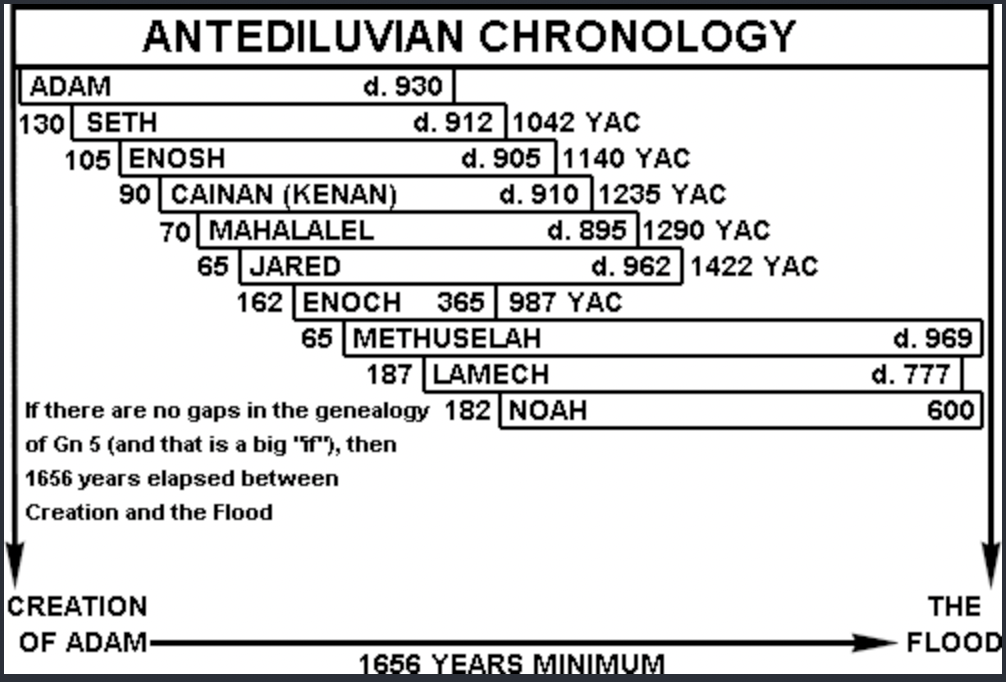
James Smith gives us this chart:

In laying out the genealogies, Moses goes back and speaks of the theology and biology of creation. Man is made in God’s likeness (1), and God made them male and female (2). Adam becomes father to a son (3), and thus it goes through all the genealogies. Moses’ record follows the same formula in laying out these ten generations: the father lives so many years, has a notable son (in the Messianic Genealogies–Luke 3:36-38), lives so many years after that birth, and finally dies. As the chart suggests, there is vast opportunity to populate the earth as they live on for centuries.

There are some interesting insights among the Bible’s first look into a family tree. Furthermore, there are implications from this chapter that resonate throughout the rest of Scripture. Notice just a few of these.

“…And he died” (5,8,11,14,17, 20,27,31; cf. 3:19). While these men lived nine or ten times longer than any of us would dare to believe we could live (imagine your life overlapping the lives of Saladin, Genghis Khan, and Thomas Aquinas; see also 6:3), they could not escape the reality of the death sentence brought on by Adam’s sin. Hebrews 9:27 avers that death is an inevitable appointment.  1 Corinthians 15:21-22 reiterates that by a man came death and that in Adam all die. 

“Enoch walked with God” (21-24). He is the exception to the rule just mentioned. Moses  writes a beautiful truth about this man. He strove for intimate fellowship with God. This is indicated by the phrase that “he walked with God.” This phrase might be ambiguous and unclear, if not for subsequent Scripture. This is tied to his faith (Heb. 11:5). Therefore, “he obtained this witness that before his being taken up he was pleasing to God.” He was a prophet of God sharing the word of God (Jude 14). We are told nothing about his wife or any of his other children apart from the famously old Methuselah, but if he lived anywhere close to the others he would likely have been alive the year of the flood if not taken by God. 

God defines what walking with Him should look like, as He speaks to His people at the end of the Old Testament. Speaking of the faithful Levitical priests, He says, “He walked with Me in peace and uprightness, and he turned many back from iniquity” (Mal. 2:6). His lips preserved knowledge and He was a devoted messenger of God (Mal. 2:7). That harmonizes with what Scripture says about Enoch. 

“(Noah) will give us rest” (29-32). Lamech “became the father of a son” (28) he named Noah. Why? “This one will give us rest from our work and from the toil of our hands arising from the ground which the Lord has cursed” (29). As it turns out, Noah will give comfort not to those before him but to those who would come after him through Shem, Ham, and Japheth (32). The same word translated “rest” is found in a different form in Genesis 6:6,7 and is translated “sorry.” Because God was sorry for making man, who had become sinful, He resolved to destroy man and beast. But Noah will find grace in the eyes of the Lord (6:8). The ground would continue to labor under the curse (Rom. 8:20-21). But spiritual rest would be possible through Noah’s obedience (1 Pet. 3:20; Heb. 11:7).

With all this time that passed as recorded in Genesis 5, God’s eternal plan was still in motion. Salvation would ultimately come, starting with these ten generations. Through His sovereignty and providence, God would ensure that “the kind intentions of His will” (Eph. 1:5,9) would be accomplished despite man’s continual faults and failings. 

Genesis: These Are The Generations (V)

The First Children (4:1-24)

Neal Pollard

The sobering truth about sin is that we cannot anticipate its consequences. Scripture credits sin as entering the world through Adam, not Eve (Rom. 5:12). Despite her role for which she received her own consequences (1 Tim. 2:8-15), God places the responsibility ultimately upon her husband. It is still the same today (Eph. 5:23). The Bible does not tell us how the events regarding his sons, Cain and Abel, emotionally impacted him. If you are a parent, you can well imagine.

Moses is not concerned with giving us a strict chronology in chapter four. This will help when reading through the narrative where certain details are omitted. They are not deemed as important to the story, though they might drive our imaginations wild. Like what, specifically? How many siblings (male and female) were born after them before the egregious actions of Cain in verse eight? Apparently, a great many–though Moses does not record it. Where did Cain get his wife (see 3:20)? Was incest permitted? Obviously, in accord with the mandate of Genesis 1:28, it had to be. In fact, it is not “outlawed” until the Law of Moses (Lev. 18:6). How much time occurs between verse one and verse fourteen, when Cain is worried about people finding him and killing him? Antediluvian (pre-flood) lifespans reached in excess of 900 years old, which we will see in the next chapter. 

The focus of the chapter appears to be the divergent mindsets of obedience and disobedience in the world after the fall. The chapter begins by chronicling the births of the first two known children of Adam and Eve. Cain is firstborn, followed by Abel (1-2). Cain was a tiller of the ground while Abel was a keeper of flocks (2). 

Why did God accept Abel’s offering, but reject Cain’s (3-5)? Genesis four does not spell this out. John tells us Cain’s “deeds” were evil, and Abel’s deeds were righteous (1 John 3:12). More clearly, the writer of Hebrews says, “By faith Abel offered to God a better sacrifice than Cain, through which he obtained the testimony that he was righteous, God testifying about his gifts, and through faith, though he is dead, he still speaks” (Heb. 11:4). On the other hand, rebellion and apostasy are implied in Cain’s actions (Jude 11). Abel complied with what God wanted, but Cain did not. It was an error of worship. Cain offered what he wanted rather than what God wanted. 

Cain compounded the problem by his intemperate response (5-7). God warns him of the price for sinful anger, but the older brother loses all self-control and murders Abel (8). Once again, we find the offended God seeking out the offender. Such long-suffering love! God pursues Cain, exposing his sin (9-10) then revealing the consequences of that sin (11-12). He is divinely prevented from being a vegetable farmer, settled in one place. Instead, he is consigned to being a wandering vagrant (12-13).

Cain is concerned that he will be a hunted fugitive (14). In His mercy, God protects Cain (15). Cain has a wife (did she marry him before the murder of Abel?), and they begin to have children. Much of the rest of the chapter involves revealing the line of Cain. As the late Wendell Winkler once showed us in class, “The line of Cain gave us nomads, farmers, musicians, smiths, polygamists, and murderers, but not one who ‘called upon the name of the Lord’ (24).” Verses 17-24 reveal the infamous legacy of the line of Cain as well as a reflection on the consequences of his father’s sinful choice. 

Yet, a glimmer of the divine plan of redemption shines through in how Moses ends the first “toledoth.” He returns to the first parents and reveals the birth of another son, Seth, in whom Adam and Eve placed their hopes of a better legacy. We will see more about Seth’s lineage in the next chapter and its significance to the ultimate birth of the Messiah and fulfillment of Genesis 3:15. But out of the shattered pain of sin and disappointment there came home. “…Men began to call upon the name of the Lord” (24). 

Genesis: These Are The Generations (III)

“The Creation Of Man And Woman” (2:4-25)

Neal Pollard

Not only did chapter one help with the question of where we came from, but it also gives crucial insight into who we are. Genesis 1:27 teaches us more than the nature of the Godhead. It tells us something about ourselves. We are made in the image of God, in His likeness (5:1)! There is a part of us reflecting God! I agree that “God’s image obviously does not consist in man’s body which was formed from earthly matter, but in his spiritual, intellectual, moral likeness to God from whom his animating breath came” (TWOT, 768).

Certainly, what Moses wrote in Genesis 1:27 helps us appreciate the additional clarification yielded from the first use of the Hebrew “teledoth” (account, NASB, NLT, NIV; “history,” NKJ; “generations,” ESV) in Genesis 2:4. This is a peg Moses drives down to separate his inspired account into significant sections. I have an excellent chart from Donnie Bates dividing up the book of Genesis, using “teledoth” as a textual marker. 

  • 1:1-4:26–The generations of the heavens and the earth
  • 5:1-6:8–The descendants of Adam
  • 6:9-9:29–The descendants of Noah
  • 10:1-11:9–The descendants of the sons of Noah
  • 11:10-11:26–The descendants of Shem
  • 11:27-25:11–The descendants of Terah (Abraham’s father)
  • 25:12-25:18–The descendants of Ishmael
  • 25:19-35:29–The descendants of Isaac
  • 36:1-37:1–The descendants of Esau
  • 37:2-50:26–The descendants of Jacob 

(Syllabus handout for “Genesis,” Bear Valley Bible Institute)

In the midst of unfolding “the generations of the heavens and the earth,” Moses centers on the creation of man and woman. Notice how he does so. 

Preparing the earth for man (2:4-6). After speaking of the earth 21 times from Genesis 1:1-2:1, Moses speaks of it five times in these three verses. In context, the shrubs and the plants to be cultivated from the ground served a purpose. They would provide food for man (15-17). There is a sense in which man’s being in God’s likeness is demonstrated in his place and dominion over the whole earth (1:28-30; 2:16,19-20). As God is over everything, He delegated authority to man over the earth. Of course, God is the sustainer and provider of what the universe needs to continue to operate (Mat. 5:45; Acts 14:17; Col. 1:17), but man was created to be a steward of its resources. Incidentally, there was at least a time when God did not send rain but rather mist from the ground for its provision (6). 

Creating man from the earth (2:7). There is also a unity or harmony between man and the earth. God created the ground, then He formed man from the dust of the ground. He breathed life into man’s nostrils and man became a living being. The word translated “being” (soul) here seems to be used to speak of his having life and animation. The Bible clearly teaches there is an everlasting part of a person, but that’s not Moses’ purpose in this verse. Moses is describing how the first man came to life. The same word is used of “living creatures” (1:20-21; cf. 2:19). 

Fitting man for the earth (2:8-15). Moses goes to great lengths to speak more of God’s provisions for man’s habitation of the earth. He planted a garden and trees for man’s dwelling place (8-9). He provided rivers to water the garden (10), and it flowed out of the garden in four tributaries–Pishon, Gihon, Tigris and Euphrates (11-14). James Smith notes, “The author seems to be describing the geography of ancient Sumer just north of the Persian Gulf in what is present-day Iraq. Ancient pagan legend remembered a paradise at the northern end of the Persian Gulf” (The Pentateuch, OT Survey Series, 59). Associated with these geographical markers, Moses makes the first mention of money (11-12). Man’s job is to care for the earth prepared by God for him (15). 

Preparing man for his time on earth (2:16-17). God does more than give man physical purpose. He is giving him spiritual boundaries. Moses includes this command about the “forbidden fruit” to show God’s loving nature in creating man with the ability to choose. At this point, evil is not part of man’s consciousness nor has it stained his soul, but it exists as the opposite of the “good” that God created (see Moses’ repeated use of “good” in chapter one). Man would have to choose to leave the “good” of sinlessness, but that was a choice from the beginning. What Paul says of the Gentiles is true, ultimately, of everyone since Adam: “In the generations gone by He permitted all the nations to go their own way” (Acts 14:16). 

Giving man what the earth alone could not give him (2:18-25). Of course, God knew what man needed before man had an opportunity to even discover it. God determined to give man a “helper suitable for him” (18). He presents all the animals for Adam to name, and among these there is no “suitable helper” (19-20). It is not incidental that God created woman from man. He could have formed her from the dust of the ground, the same as man but apart from him. But, denoting the intimate connection He intended, He makes her from him (21-22). As has  been noted, is there anatomical symbolism here? She was not taken from his head or his heel to rule over or be enslaved to him. She was a partner is truest sense, taken from his side. 

Adam recognizes this and speaks a truth beyond just his circumstances (21-24). God teaches that gender is not fluid, but fixed (note the pronouns and description throughout the paragraph). God teaches the permanency of marriage (23-24), which Jesus will reference in restoring marriage under His covenant (Mat. 19:1-9). God gives the first allusion to the church,  and Paul will draw on the analogy in Ephesians 5:22-33. God gives gender roles in the leadership of the church, hearkening back to this cross-cultural circumstance in 1 Timothy 2:8-15. 

But there is more than doctrinal truth being instilled here. There is the most beautiful earthly relationship ever made by God, transcending every relationship except the one between a person and God! God knows our physical, emotional, social, and spiritual needs. His original remedy for that was marriage! What a wise creator we serve! 

GENESIS: THESE ARE THE GENERATIONS (II)

“In The Beginning” (1:1-2:3)

Neal Pollard

The first chapter of the Bible’s 1189 provides a helpful reminder that chapter divisions are an act of man (Stephen Langton in 1227) rather than an act of God. Genesis 1:1-2:3 is the inspired record of the creation of the universe followed by a more intimate account of the creation of man (2:4-25). There is incredible structure in the way Moses records the making of the universe, showing the Creator to be a being of order and design.

The skeletal information of the chapter falls out easily enough:

  • The beginning (of the universe): God created a formless and void earth, and darkness as well as God’s Spirit were over the surface of the water (the deep)(1:1-2). Incidentally, isn’t the “end” implied with the word “beginning”? With perfect foreknowledge, God knew that this world would someday come to an end (see Isaiah 46:10). 
  • Day one: God created light and separated the light from the darkness (1:3-5).
  • Day two: God created the sky (called the expanse–“beaten, [metal] plate, firmament (i.e. vault of heaven, understood as a solid dome)” (CHALOT, 347) (1:6-8).
  • Day three: God created dry land and vegetation (1:9-13).
  • Day four: God created sun, moon, and stars (1:14-19).
  • Day five: God created water animals and winged creatures (1:20-23).
  • Day six: God created mammals, reptiles, and man (1:24-31).
  • Day seven: God rested from all the work which He had done (2:1-3).

Another way to divide this account is through two words Moses uses. Days one through three record God “forming” (1:7) what had been “formless.” Days four through six record God “filling” (1:22,28) what He had “formed” (see Kurt Strasser, Opening Up Genesis, 20-21, for more on how he develops this idea). Despite those who wish to accommodate epochs of time and the theory of evolution “in the beginning,” we have the testimony of chapter one identifying each day of creation as a 24-hour period (5,8,13,19,23,31). The same writer, Moses, will look back on the creation in the establishment of the Sabbath, noting that God created the universe in six days (Ex. 20:11; 31:17). Do you find it interesting that civilizations everywhere throughout time have constructed their calendars and functions around the seven day week? It is sown into the fabric of creation!

We are impressed with God’s active involvement in the creation process (note the verbs–I  count 38 in these 34 verses, actions God takes in these seven days of work). As we read the remainder of the Bible, we will appreciate how God remains active and involved with His creation and especially the pinnacle of His creation (1:27). Whether observation, speaking, or otherwise creating, we see God at work.

We are impressed by God’s “triune” nature as revealed in Genesis one. We see the second most common designation for God (2532; YHWH, God’s proper name occurs around 6800 times in the O.T.) and is used for divine beings, associated with might and strength and creation (from the first verse of Scripture). The Spirit of God is first referenced in verse two, and the plurality of personalities is clearly found in this inaugural chapter. How? “Elohim” is a plural noun each of the 35 times it appears in these first 34 verses. Further, as God discusses the creation of man among Himself (even saying it strains the limits of our comprehension), He says, “Let us make man….” (27). Not multiple Gods. The rest of Scripture will show us what it first introduced here. God has an essence and nature. Only One (only God) is all-powerful, all-knowing, uncaused, present everywhere all at once, perfect, sinless, etc. Yet, God is three distinct persons. Two are explicitly identified here (Father, Spirit). One is averred to be the agent of Creation elsewhere (John 1:3; 1 Cor. 8:6; Col. 1:16; Heb. 1:2). 

God’s first question for Job is a confession that He created the universe (Job 38:4). Israel sang about the creation (Psalm 104:4-5). Every New Testament writer but Jude (who still refers to events in Genesis) makes reference to the creation account. All divine revelation rests upon the truth of Genesis one. God permitted the universe to be and subsequent chapters will help us understand why.