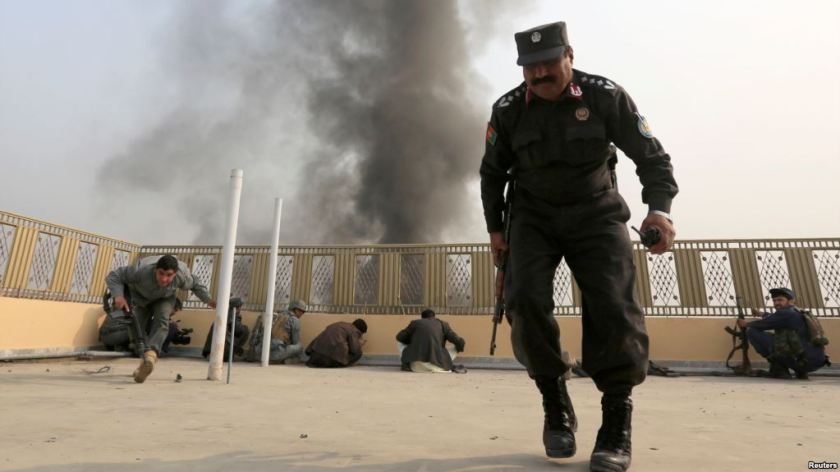
ATTACKING THOSE WHO SAVE OTHERS

Neal Pollard

It’s an unconscionable thought! Who would try to hurt and oppose those dedicated to saving lives? Places like Afghanistan seem more than a world away from us, where this week a yet-to-be-identified terrorist group conducted a suicide attack in Jalalabad that killed two and injured 14. While that sadly is a relatively small and minor attack in this war-torn region, it was the target that was so outrageously newsworthy. It was perpetrated against the international Save The Children organization. Volunteers and workers were there to provide aid and assistance to that society’s most vulnerable members, and they were attacked. How does this happen?

In Matthew 23:35 (cf. Luke 11:51), Jesus condemns the Pharisees as the murderers of God’s godly men from Abel to Zechariah. Essentially, Jesus was presenting a roll call of the righteous who were attacked because of their faithfulness. In one of Stephen’s final moments, he preached, “Which one of the prophets did your fathers not persecute? They killed those who had previously announced the coming of the Righteous One, whose betrayers and murderers you have now become” (Acts 7:52). Both Old and New Testaments reveal the Maker’s messengers who were attacked while trying to save others. The proverbial response of the hearers was to “shoot the messenger” (cf. Heb. 11:36-38).

Growing up a preacher’s kid, I saw my dad encounter some who attacked the messenger. Dad has always been a model of courage for me, willing to teach and preach even unpopular, but needed, subjects. Consequently, he endured both frontal and sneak attacks. Everyone who has sought to declare “the whole purpose of God” (Acts 20:27) has some appreciation for Paul’s warning that some “will not endure sound doctrine; but wanting to have their ears tickled, they will accumulate for themselves teachers in accordance to their own desires, and will turn away their ears from the truth and will turn aside to myths” (2 Tim. 4:3-4).

How one responds to such attacks is crucial! In the words to Timothy, Paul contrasts the attacker with the faithful proclaimer. He says, “But you, be sober in all things, endure hardship, do the work of an evangelist, fulfill your ministry” (2 Tim. 4:5). We’re taught “patient enduring” (2 Cor. 1:6; 2 Tim. 2:24), “not returning evil for evil or insult for insult” (1 Pet. 3:9), “bless those who persecute you; bless and do not curse” (Rom. 12:14; cf. 12:17-21), and “do not resist an evil person; but whoever slaps you on your right cheek, turn the other to him also” (Mat. 5:39).

As eternal aid workers, we operate by a different, higher set of rules (2 Cor. 10:4). We entrust ourselves to the One who will give us ultimate victory. Meanwhile, we cannot give up our cause—no matter what the threat or danger. Like Jesus, let us keep entrusting ourselves to Him who judges righteously (1 Pet. 2:23)!

8ad7fee4-9d99-4e89-b63f-286645809597_cx0_cy12_cw0_w1023_r1_s

The Tender Tears Of The Timeworn Travelers

Neal Pollard

I suppose I have met more than a few elderly people, including some professing to be Christians, who could be described as “crusty,” “crotchety,” “contrary,” and “curmudgeonly.” These no doubt spent decades developing such a winning personality. But one of the greatest blessings I have received as a member of the church and minister of the gospel is my association and friendship with “senior saints.” Through the years, I have discussed with them the subject of worship. The most frequent topic of that is how precious that public time of communing is to them.

A godly widow recently told me she has spent the last two years focusing more intently on concentrating more on the song service, reflecting on the words and their meaning. Songs she has sung for decades, through this exercise, have become almost like new songs to her. Another older woman, married to an elder, talked about how she finds herself much more apt to be tearful in worship these days. She’s almost embarrassed at how emotional the experience of worship is making her. An elderly man who was a longtime elder and recently passed on to paradise, struggled to pray, sing, or publicly speak in worship without being choked with emotion. I could fill pages of writing about other godly Golden Agers who treasure assembling to worship God. Their hearts are full and their emotions engaged. Their voices may be softened and broken by age, but their spirits are stronger than ever.

When I think of these faithful, aged Christians, I am reminded of Paul’s words: “Therefore we do not lose heart, but though our outer man is decaying, yet our inner man is being renewed day by day. For momentary, light affliction is producing for us an eternal weight of glory far beyond all comparison, while we look not at the things which are seen, but at the things which are not seen; for the things which are seen are temporal, but the things which are not seen are eternal” (2 Cor. 4:16-18).  Sometimes, the elderly are made scapegoats of alleged “lifeless” or habitual, but heartless worship. No doubt, there are likely Christians in that age range who struggle with and even fall prey to such (as there is in every other age category). But on the whole, these Christians have walked longer with God, know Him better, and value Him more than their younger counterparts. They are closer on the journey to the Father’s house and are anxious to see His face.

We are heirs of a heartfelt heritage handed to us by these holy hoary heads. To our seasoned brothers and sisters, we thank you for showing us how to walk with and love God as years turns into decades and the shadow of the grave looms larger. As we narrow the gap between our age and yours, we want worship and life in Christ to grow more precious to us, too. Thank you for your trembling lips, your tear-stained cheeks, and your tender hearts. They look great on you!

elderly-parent-e1448857831624

PREACHER FAN

Neal Pollard

Frankly, some preachers are or can be a pain! There are various reasons for this, but I would hasten to say that such are in the minority.  As I sit in our Future Preachers Training Camp listening to our teachers speak to the next generation of preachers, I am in admiration. Their passion, knowledge, experience, wisdom, and, knowing them, their character leave me in grateful awe. Others who have filled the pulpit or taught classes this week take their place alongside the others I mention.  Their work and life are incredibly noteworthy. While some would not use this word of them complimentarily, preachers are “special” men.

To go into this field of work requires some distinct traits:

  • A willingness to have your life on display
  • A desire to spend your life full-time in ministry
  • An understanding that some will not respect your occupation
  • A willingness to have people disagreeing with what you say, though you know it’s important
  • A humility to care and minister to others, even the difficult and unpleasant people
  • A willingness to enter a profession that may have an economic ceiling

The gospel preacher knows these and other circumstances may often exist, but he sees so many enriching aspects of the life of preaching. Soul-winning, serving, developing, aiding positive change, learning, and much more epitomize the fringe benefits available to a man who preaches the Word. Those wise enough to see this find these things more than sufficient to offset whatever perceived challenges accompany this life.

Watching tomorrow’s preachers absorbing, questioning, thinking, and working excites me. I’m thankful that they are able to find sound, qualified men to provide well-reasoned, Bible answers, but I’m as thankful they are interested and desirous of exploring this life. In a bad-news world, watching quality young men trying to stretch and grow themselves in leadership and preaching is some of the best possible news. Seeing works like preaching camps, schools of preaching, brotherhood activities featuring gospel preachers make me so thankful for men who dedicate themselves to this wonderful life. Please pray for every man who endeavors to aspire to and live this life. Each of us need God’s Word, wisdom, and strength to do this work adequately.

americana_wedding_the_preacher_2813852652429

Goose Hunting

Scott Philliips

A few years back I started goose hunting and I found out something very interesting about myself. I like it a lot! They are exciting to hunt, easy to harvest the meat, and they are delicious when I smoke them into jerky. Many of you probably don’t understand the challenge and excitement involved since most of the time you could just grab one off the street and throw it into your car. But out in the open, where it’s legal to shoot them, it can be a real challenge.

In order to get flying geese to come in for a landing close enough to shoot them, there are two basic tactics. One is decoys. Geese want to join up with other geese, and if they see some on the ground it tells them that it is probably a good area to feed and that it’s safe. In order to fool them, your decoys need to look real, and mine look real. Anytime I leave my spot and return, I spend an embarrassing amount of time sneaking up on my own decoys. The second thing you need is to sound like a goose. Your call needs to be authentic. It needs to get their attention to draw them into the kill zone.

Many of you have already connected the dots in my story. It’s so simple really. It’s a do-it-yourself lesson.  We need to be on guard as Christians so as not to be fooled or deceived by teaching that is not authentic, not the real deal. Teaching that may look and sound good, but will cost us our souls, can fool us.

But that’s not the lesson. I challenge myself and all of us to consider an even more sobering question. Have I become the decoy? Has looking and sounding like a Christian become enough for me? My calls are spot on. I can speak their language. My decoys look fantastic. They dutifully show up for every hunting trip. But they are not real, and they don’t move.

A real goose moves.
A real goose flies.
A real goose feeds.
A real goose is active all the time.
A real goose is busy being a real goose, all the time.

Read Matthew 25:34-36.

So are you, am I the real deal? It depends on what we do between “hunting trips.”

3387888544_9eae5ea589_b

[Originally from Scott’s “90 Seconds of Power” devotional at Bear Valley]

THE LITTLE GRAVES THAT HAVE NO NAME

Neal Pollard

Lance Corporal Francis Ledwidge, a 26-year-old Irish soldier, was one of 10 million people killed in World War I.He died July 31, 1917, in Belgium. He was a poet, and he wrote the following before the war:

And now I’m drinking wine in France, the helpless child of circumstance.
Tomorrow will be loud for war, how will I be accounted for?
It is too late now to retrieve a fallen dream, too late to grieve
A name unmade, but not too late to thank the gods for what is great;
A keen-edged sword,a soldier’s heart, is greater than a poet’s art.
And greater than a poet’s fame a little grave that has no name.
(Gilbert, Martin. The First World War, Holt & Co., NY, 1994, 353).

Ledwidge sounds neither devout nor decent, but his last stanza rings loudly. This poor, fallen man glorifies the soldier, prolific even in anonymity. Glory rather than shame is to be memorialized in an unnamed grave.

Greater far than those whose spirits departed on plains and beaches of Europe or Asia or even Canaan during Joshua’s days are those who lost their lives in service to God. In the great memorial of Scripture they are mentioned, but without their names. One day, in heaven, their identities will be known as the Lord reads the names of those written in His Book of Life.

The writer of Hebrews speaks about many such unnamed heroes of the spiritual war that endures generation after generation. Among those are unnamed prophets of valor (Heb. 10:32-34). Unidentified women are remembered for their faith (35).

Following them, the writer holds up the generic others–children of God persecuted and even killed (10:36-38). Together they form that multitudinous throng of witnesses in Hebrews 12:1. Under centuries of dust, sand and silt lie their unmarked graves. God does not even reveal their names to the reader. But they sacrificed and persevered in hope of eternal life. They gained approval through their active faith (11:39). They stand as an example and a motivation for Christians today (12:1).

Throughout the world there are scores of Christians toiling in obscurity. For every big-name preacher and high-profile teacher and widely known missionary, thousands of godly mothers are training their children to follow Christ and running their homes with grace and virtue (Ti. 2:5; Pr. 31). Without recognition, elders are praying for, shepherding, defending and feeding lambs in places as far away as India and Africa and as close as Indiana and Alabama. Hidden from the watchful pens of our sharp-sighted editors and authors are saints, as soldiers, fighting Satan without ceremony or earthly commendation. One day their bodies will fail and fall into graves, known only to family and friends, but unmarked in the graveyard of brotherhood greats.

Too, in the church, day by day great things are done by saints that never make the bulletin, announcements, or bulletin boards. Masked by their modesty, they brighten many lives by walking in the light. The elders, preachers, or deacons may never know so much of what they do, but God sees and will reward them. When they lay their armor down, they may sleep in an unmarked plot in the cemetery of church history, but with God they will have greater fame than those who etched their mark in the annals of the world.

So, fight (1 Cor. 9:26)!

german_military_cemetery_normandy_1

Jeremiah, The Persecuted Preacher

Neal Pollard

It was hard being a preacher in Jeremiah’s day. As thanks for his work, the weeping prophet endured the following:

  • He was led as a lamb to the slaughter (11:18ff)
  • His brethren dealt treacherously w/him (12:6)
  • He was confronted by false prophets (14:13)
  • His brethren cursed him (15:10)
  • He was hit, put in stocks and condemned (20:1ff)
  • His heart was broken (23:9)
  • He was seized and threatened w/death (26:8,24)
  • His teaching was opposed (28,29)
  • He was put in prison (32:2,3)
  • He was pursued (36:26)
  • He was beaten and imprisoned (37:15)
  • He was thrown into the dungeon (38:6)
  • He was bound in chains (40:1)
  • He was falsely accused (43:2)
  • He was taken to Egypt (43:6,7)

Remember, God called him to this work. Jeremiah was doing nothing wrong in his ministry; in fact, all of those things that happened to him came in “the line of duty.” The people, on the whole, never changed for the better after all the effort Jeremiah put forth in his ministry. Jeremiah never speaks of his work as enjoyable or rewarding, but it was essential and vital. Some estimate that his ministry spanned more than six decades! Whatever we call him, we do not use adjectives like “weak” or “wimpy.”

The life of preaching is a wonderful work. The preacher works with the best people in the world fulfilling the most profound purpose possible while working, ultimately, for the best Employer there is. The retirement plan is unbeatable! Helping people connect with salvation and helping the saved better connect with their Savior is extremely fulfilling. But, if there are job hazards (the minority of brethren who are difficult to deal with, sporadic job insecurity, being misunderstood, being subjected or having your family subjected to closer scrutiny, etc.), there is a reminder from Hilkiah’s son from Anathoth. Out of our own devotion to God, we will stay at it through thick and thin. Jeremiah wrote, “I have become a laughingstock all day long; Everyone mocks me. For each time I speak, I cry aloud; I proclaim violence and destruction, because for me the word of the Lord has resulted in reproach and derision all day long” (20:7-8). This man thought about quitting, but he couldn’t! He says, “But if I say, ‘I will not remember Him or speak anymore in His name,’ then in my heart it becomes like a burning fire shut up in my bones;

and I am weary of holding it in, and I cannot endure it” (9). I have watched my father, who has preached the gospel 53 years, have some “Jeremiah moments.” I have known so many gospel preachers who have walked in that prophet’s sandals. I have even experienced a few of the lighter trials Jeremiah records as happening to him.  But Jeremiah and his modern counterparts whom I have watched serve him faithfully provide a sterling example to me of what the man of God who preaches “looks like.” He’s tough, but tender-hearted. He’s loyal and loving. He’s gritty, but gracious. He’s courageous, yet caring. He will be fallible, but he must be faithful.

Preaching is, in my opinion, the best work in the world. For whatever bumps unique to the preacher traveling the narrow way, there are ten times the blessings. To my fellow friends in this fantastic fraternity, keep the tenacity of the tearful teacher of Judah! Stoke the fire in your bones (cf. 2 Tim. 1:6).

Dad in '64 an '16
My dad preaching in Artesia, MS, in 1964 (left) and preaching in Andrews, NC, in 2016 (right). 

Even When You’re Alone, You’re Not

Neal Pollard

If I have a favorite chapter of the Bible, it would have to be 2 Timothy 4.  Yes, I love the first eight verses, but that alone is not what cinches this chapter as dearest to me.  It’s Paul’s personal remarks starting in verse nine.  There’s his longing to see his spiritual son, Timothy.  Twice he implores Timothy to come see him (9, 21).  He’s in prison, persecuted for preaching the Prince of Peace. He longs for Christian companionship.  Then, he shares his dejection over the abandonment of certain fellow-workers (10). He wants to see cohorts with whom he has done spiritual battle (11). He has personal needs and wants (13). He warns Timothy of a spiritual troublemaker (14-15).  Then, he shares personal feelings of isolation and loneliness, a time when he needed a Christian brother by his side but had none (16).  Bold, risk-taking Paul, who would stand up to any opposition, the epitome of true manliness, was now in undoubtedly dire, dank conditions, the smell of squalor in the air.  Whatever he saw, heard, and felt as he wrote, Paul scratched out these words: “At my first defense no one supported me, but all deserted me; may it not be counted against them.  But the Lord stood with me and strengthened me, so that through me the proclamation might be fully accomplished, and that all the Gentiles might hear; and I was rescued out of the lion’s mouth. The Lord will rescue me from every evil deed, and will bring me safely to His heavenly kingdom; to Him be the glory forever and ever. Amen” (16-18).  These words aren’t the end of the letter, but they are the end of the matter!

This faithful Christian was deserted by men, but he felt God’s presence and power:

  • The Lord stood with him.
  • The Lord strengthened him.
  • The Lord spoke through him.
  • The Lord saved him.
  • The Lord was steering him.

You and I cannot fathom the price Paul paid for proclaiming Jesus. But even if we were ever to face privation, punishment and pain for our faith, what was true for this apostle will be true of us.  He promised to be with us always (Mat. 28:20) and never forsake us (Heb. 13:5). Even if you ever feel physically alone, you will have the spiritual assistance Paul speaks of in 2 Timothy 4.  Through it all, you can say with Paul, “To Him be the glory forever and ever. Amen!”

paulmosiac

“I Don’t Consider Myself Unfaithful”

Neal Pollard

An intelligent, independent young American man in his mid-20s showed up at the Siem Reap church building for mid-week services.  He not only grew up in the church, but he even attended a “Christian” high school and one of our brotherhood universities.  He is doing field research for an advanced degree in cultural anthropology, which brought him to Cambodia.  He is a decent, inquisitive person seemingly intent on bringing positive change to this world, but upon leaving his home state after graduating college he ceased association with the church.  When asked about his religious life, he said, “I don’t consider myself unfaithful, but I’m not attending the church right now.  I guess you could say I’m taking a break.”

Rather than being a “what’s wrong with young people is…” or “what’s wrong with the church is…” article, I want to think in terms of what faithfulness or unfaithfulness is.  Is it something we can gauge, and, if so, how?  Can we claim faithfulness but fail to demonstrate it?

The Bible speaks of the faithfulness of God, for example.  How do we know He is faithful?  Moses suggests we conclude such based on His work, ways, and attributes (Deut. 32:4). The psalmist points to His word and work (Psa. 33:4).  Faithfulness involved His working wonders and deliberately planning (Isa. 25:1).

In the same way, the Bible identifies faithfulness as something tangible and measurable, as visible as justice and mercy (Mat. 23:23), as demonstrable as love, joy, peace, patience, kindness, goodness, gentleness, and self-control (Gal. 5:22-23).  The very word refers to loyalty and trustworthiness (Utley, np).  In Galatians 5:22, it “describes the believer’s new relationship with people, especially believers” (ibid.).  In this list, it is more than trust or belief.  The other eight words indicate ethical qualities, so this should be interpreted as such, too.  In other words, being faithful is seen by how we live and what we do.  Can we be faithful to Christ and His church when we do not attach ourselves to a local congregation, provoking others to love and good works as a manner of habit (Heb. 10:24-25).  If we are not seeking to build up one another (1 Th. 5:11) or cause the growth of the body (Eph. 4:16), how is that not unfaithful?  Twice in the gospels, Jesus tells parables concerning faithfully accomplish our Christian responsibilities (Mat. 25:14-30; Luke 19:11-27). There could be no judgment and accountability without there being concrete ways to measure and determine faithfulness.

We do not get to define it for ourselves.  The Lord has already revealed what He considers faithfulness and unfaithfulness.  Ceasing to work for and worship Him, failing to encourage the spiritual family, and abstaining from such service as soul-winning and moral distinctiveness are tangible indicators that we have ceased from faithfulness.  Let us so live that in the end we can hear our Lord exclaim, “Well done, good and faithful servant” (Mat. 25:21,23).

Carl preaching at the mid-week service at Siem Reap church of Christ.