Deuteronomy: The Second Giving Of The Law (III)

On Possessing And Dispossessing (2:1-34)

Neal Pollard

After detailing the rebellion and unbelief of the nation in chapter one, Moses highlights aspects of the latter portion of their wandering in this chapter. He breezes through the first 38 years of their wandering (14), explaining that these 40 years were to purge Israel of the generation of the men of war who refused to obey God’s command under Moses to enter Canaan (16). Moses highlights how God completely took care of their needs throughout the wandering (7). But, the emphasis of this chapter seems to be multiple object lessons concerning the nations they encounter near the end of their journey, nations they have some relationship to and observations concerning God’s care for them and the opponents these nations overcame. 

First, there are the Edomites (4-8a, 12). These descendants of Esau (Israel’s brother) have a healthy fear of Israel (4), so God tells them not to provoke them, attack them, or try to take their land (5). This was Esau’s promised land (5). Instead, they were to buy food and water from Edom, trusting God to help meet their needs (6-7). Heathen inhabitants possessed the territory before Esau’s descendants drove them out (12). Moses writes, “dispossessed them and destroyed them from before them and settled in their place.” The Edomites served as a pattern and example to Israel (12).

Second, there are the Moabites (8b-11).  These are the descendants of Lot, Abraham’s nephew. The same instructions are given concerning the territory of these people. Israel is to refrain from harassing them or provoking them to war (9). This was territory promised to Moab (9). However, like the giants Israel saw in spying out their promised land, the Moabites had a people as great, numerous, and tall as the Anakim (11). The Moabites called them Emim, and they apparently displaced these fearful folks. 

Third, there are the Ammonites (19-23,37). Between his mention of Moab and Ammon, Moses reminds the people that their faithless counterparts, these people’s parents, had God against them to destroy them. He doesn’t explicitly mention why here, but we know from numerous accounts that it was their lack of faith. As the new generation heads toward Canaan, they encounter Ammon. They hear the same instructions as concerning Edom and Moab (19). Again, the Ammonites faced giants like the Anakim (Num. 13:33) who the Israelites were too fearful of.  Moses emphasizes the Ammonites courage, even doubling back to Edom to make the point with Israel that Ammon displaced the Rephaim, “A people as great, numerous, and tall as the Anakim, but the Lord destroyed them before them. And they dispossessed them and settled in their place, just as He did for the sons of Esau, who live in Seir, when He destroyed the Horites from before them; they dispossessed them and settled in their place even to this day” (21-22).  In verse 23, he seems to give another example of a people, the ancestors of the Cretans (Caphtorim), who came to the land of a people, the Avvim, and destroyed them and lived in their place. That would be Israel’s task regarding Canaan.

Fourth, there are the Amorites (24-36). This enemy forms a sort of military exercise and preparation for the conquest. First, God tells them that they would defeat and displace them (24). Israel has grown into a massive, young, and vibrant nation, and people everywhere feared them to the point of dread, trembling, and anguish (25). The king of the Amorites, Sihon, king of Heshbon, is asked to sell food and water to Israel and allow safe passage through their land as the Edomites, Moabites, and Ammonites had done (26-29). But God used this to harden his heart, that Israel might see God’s deliverance as they obeyed His command (30). In fact, God said, “See, I have begun to deliver Sihon and his land over to you…” (31). Israel fights and God delivers (32-33). Israel “utterly destroyed the men, women and children of every city. We left no survivor. We took only the animals as our booty and the spoil of the cities which we had captured” (34-35). What a transformation of attitude! They could report, “there was no city that was too high for us; the Lord our God delivered all over to us” (36)!  This land would eventually become part of the territory of Reuben and Gad (Josh. 13:15-27). 

Moses is still reviewing the events of the wandering, settling now on the more recent past. But, notice that God is using these inferior, unchosen nations–their ethnic cousins–to show them what courageous action coupled with divine favor could produce. He also clarifies that these territories were not their land of promise, but areas to pass through on the way. He gives them a taste of what the conquest would be like, enabling their victory over the Amorites.

Sometimes, we can learn from the people around us to possess the courage, conviction, and tenacity we need to have in pursuing our God-given tasks (Luke 16:8)! They should never outdo us in their pursuit of their goals and purposes. We also need to be reminded that this world is not our home; we’re just passing through (Mat. 6:19-21; 1 Jn. 2:15-17)! May we never mistake this world for the world to come. Finally, our small victories here are all part of our endeavor to gain the greatest victory there is (1 Jn. 5:4)! 

Rational Faith

Gary Pollard
  1. Universal constants (ie. truth) exist. They must, or civilization would not be able to sustain itself. 
  2. Only one religious system has a flawless narrative from beginning to end: Christianity. The collection of sacred writings we call the bible is uncanny in its preservation and authenticity. No other ancient document has ever held up to academic scrutiny like the bible has. 
  3. While no organization is perfect, none have positively impacted the planet like Christianity has. Not even close. No civilization has been as functional as those which have been built on Judeo-Christian principles. Literacy is as wide-spread as it is because of the bible. 
  4. Evidence for the existence of a higher power is everywhere. If the bible — which contains a supernaturally infallible narrative — claims that the God we serve is that higher power, it is only rational to serve that God. 

“Faith is what makes real the things we hope for. It is proof of what we cannot see. God was pleased with the people who lived a long time ago because they had faith like this. Faith helps us understand that God created the whole world by his command. This means the things we see were created by something that cannot be seen” (Hb 11.1-3). 

We were not there 2,000 years ago when Jesus walked the earth. We were not there when he created the earth. We were not there when he came back to life. We were not there to witness any miracles. 

But what has been left to us is a series of compelling proofs, such as the complexity and order of the universe from the cosmic scale to the microscopic scale. We have a collection of ancient documents which have been preserved to a degree that no other ancient documents have, and which contain no narrative contradictions. We have a system of belief that, when followed properly, is the most functional way to live. We will not see with our own eyes until Jesus returns. Until then we are satisfied with the evidence we have, and we are confident in who God is and that he exists. This is the very definition of faith. 

Deuteronomy: The Second Giving Of The Law (II)

Why They Wandered In The Wilderness (1:1-46)

Neal Pollard

Interestingly, Moses begins the book of Deuteronomy by giving the date, location, audience, and reason for writing. He gathered all Israel in the portion of the wilderness in the land of Moab, on the first day of the 11th month of the 40th year of their wandering. He writes that with his first address to the people he did so to “expound this law” (5). In order to give a detailed explanation of the law, he chooses to review exactly how they came to be in their current predicament. 

A Rejected Mission (6-25). Moses starts his review at Mt. Sinai, where God told them to go and take possession of Canaan (6-8). To mobilize and care for a people so numerous–at the suggestion of his father-in-law (Ex. 18)–wise and experienced men were delegated to judge any grievances and issues among the people (9-18). When they arrived at Kadesh-Barnea in the hill country of the Amorites (19-20), they glimpsed their promised land (21). Moses admonished them, “Do not fear or be dismayed” (21b). The people devised the plan of sending spies into Canaan to bring back produce and a report of what they found in the land, which Moses approved (22-25). What he did not approve was their evaluation. 

A Rebellious Men (26-33). Moses says that despite acknowledging that the land was good, they were rebellious and unwilling (26). They grumbled (27). The spies spread fear into the hearts of the people (28). They were shocked and afraid (29). They did not trust God, despite His faithful leadership and protection (30-33). An objective as ancient as Abraham, the very target they aimed at upon their exodus from Egypt, was now shunned. They let emotions overshadow their God-given purpose. For this, God calls them an “evil generation” (35). 

A Recompensing Maker (34-46). Moses tells us how God felt about their distrust and disobedience. Not only was He angry with the nation (34), He would be angry for Moses during the wandering (37; Num. 20:12; Deut. 3:26; 4:21). God took an oath against them, a sobering image to consider (34). That generation was forbidden from entering Canaan (35,40), with the exception of Caleb who “followed the Lord fully” (36) and Joshua who would succeed Moses (38). Their children, whom they used as an excuse for disobedience, would grow up and go do what they lacked the faith to accomplish (39). Hearing this, the people suddenly mustered their courage and attempted to take the land. But God had withdrawn His help, and the people were chased as if by bees and “crushed…from Seir to Hormah” (41-44). Again, they were being  rebellious and presumptuous (43). They wept to the Lord, but He would not listen to a people who had stubbornly rejected His Word (45). They were consigned to circle around Mount Seir for the duration of their wandering (2:1ff). 

This new generation needed to know exactly why there were in the wilderness. They needed to know the way to leave the wilderness and to take the promised land. They needed to be more intimately acquainted with the God who had preserved them these 40 years, to trust Him as He led them in the conquest to come. They needed to come face to face with the faults of their fathers, to avoid repeating the deadly cycle. To go forward, it is often helpful to remember the past. We do not have to be enslaved by it, but we must be educated by it. Therefore, the wilderness experience will be retold by Bible writers throughout the Old Testament and even reviewed in the various genres of New Testament literature: the gospels (John 3:14; 6:32), history (Acts 7:44), and the epistles (1 Cor. 10:5; Heb. 3:8,17). In fact, Paul said God wants us to learn from this generation how not to live (1 Cor. 10:11). Moses is trying to do that with the next generation, to get them to see where their fathers had fallen short. 

If The Gospel Isn’t Working

Dale Pollard
The longest train ever recorded in history was the Australian BHP Iron Ore. The cars behind it stretched approximately 4.6 miles. To provide some mind-boggling perspective here's what one train-fanatic wrote, 

“Driven by a single driver, the line’s 99,734-ton and 682-car train was able to carry 82,000 tons (181 million pounds) of iron ore. The Australian BHP Iron Ore can fit about 24 Eiffel Towers…The weight of this train being the same as about 402 Statues of Liberty.”

Trains are impressive heavy-haulers, but only under the right conditions. On the tracks they’ll whistle while they work but once they’re derailed— they only whistle. Trains don’t work without tracks.

Paul would make an interesting appeal to the saints who met at the infant church family in Thessalonica. He asks that they pray for the powerful gospel to have a straight path so it could move quickly. His exact words were,

“pray for us, that the word of the Lord may run swiftly and be glorified…”

2 Thess. 3.1b

In a simple yet inspired prayer request a practical and profound implication steps out of subtlety— Prayerlessness will hinder the furtherance of the gospel.

Based on this text, the content of congregational prayers may be in need of careful inspection. Reevaluating your evangelistic ministries, online presence, visibility in the community, advertising efforts, kingdom expenditures, and even the dynamics the worship service— all must fall below the prayer line on the priority list.

While Paul was writing to the Thessalonians, God was writing to the rest of us. He reminds us that this request should ring in the prayers of His congregations today. The written petition by itself informs the modern church that this is something that God is willing and able to do for us, He would just have us ask. The powerful gospel needs prayer— like a train needs tracks.

A 21st century church member may occasionally think

The gospel doesn’t seem to be as convicting in my community. It works just fine in other parts of the world, and it worked well in the past— but not so much here and now.

More Reasons Can Be Found

Here: James 4.2-3
Here: Matthew 21.22
And Here: Ephesians 6.19-20


———————————
Quote, (A-z-trains.com)

Deuteronomy: The Second Giving Of The Law (I)

Background And Introduction

Neal Pollard

It is majestic. It is Messianic. It is a masterpiece of literary genius, even among the inspired books of the Bible. Delivered by an aging Moses as Israel stands at the cusp of Canaan, it is full of preaching and persuasion. The book is material that is necessary for the next generation, who had survived forty years in the wilderness, to ready themselves for what God had prepared for them. As James Smith puts it, there was a new generation, new land, new dangers, new prospects, new challenges, new duties, and a new leader about to emerge (478). 

There are 34 chapters, 958 verses, and 28,461 words in this book. The book’s name comes from the Septuagint (Greek Old Testament) and literally means “second law.” It actually goes deeper and further applies the original law given in Exodus to the previous generation. Deuteronomy has been called “Moses’ farewell address.” The Hebrew title comes from the first line of the book–אֵ֣לֶּה הַדְּבָרִ֗ים (“these are the words”). It is written in the plains of Moab east of the Jordan River in 1406 B.C., the last year of the period of wandering.

Try to go to far without reading a command, promise, or warning. Moses’ life’s work has been to get these people into the land God promised Abraham He would give to them. He knows he will not physically finish that job, but the law-giver was trying to ready them for life on the other side of the Jordan River in their new home.

There are different ways to divide the material of the book of Deuteronomy. One can see it as three individuals sermons, a shorter one (ch. 1-4), a long one (ch. 5-26), and a last, shorter, and summarizing one (ch. 27-34). The theme of each sermon is “obedience.”  Griffith Thomas sees it as giving the necessity of obedience (the Law of God), the motive of obedience (the goodness of God), the standard of obedience (the word of God), the incentive of obedience (the faithfulness of God), and the alternative of obedience (the justice of God)(166). These sermons may have all been delivered in the same day, and the timespan of the whole book is measured in weeks. 

Alternately, one could see the book as centering around the idea of “covenant.” God initiates the covenant, Israel receives the covenant, and the book of Deuteronomy contains the recording of the covenant. As such, the book gives the character of God, the character of Israel, and the nature of their relationship. Regarding God’s character, the book reveals Him as Elector of Israel (26:5-9), Redeemer of Israel (many places including 3:24-29), Defender of Israel (ch. 2,7,31), Benefactor of Israel (32:15-18), and Judge of Israel (ch. 7, 30,32-33)(cf. Merrill, NAC, 47). 

Kline Meredith observes that Deuteronomy reflects “vassal treaties” of their time, consisting of six parts: (1) preamble (1:1-5), (2) historical prologue (1:6-4:43), (3) general stipulations (5:1-1132), (4) specific stipulations (12:1-26:14), (5) divine witnesses invoked, and (6) blessings and curses (ch. 27-28)(Treaty Of The Great King, 1963). 

One other way to break down Deuteronomy would be to see it as looking back (ch. 1-4), looking up (ch. 5-26), and looking ahead (ch. 27-34). 

There are no new characters introduced in Deuteronomy, but a total of 15 characters already introduced are found in this book. They include God’s chosen, but also God’s enemies. Yet, the focus is upon the nation as a whole and their responsibility to hear God’s Word and do it. Their obedience would cause divine blessings. Their rejection would cause divine curse.

Themes to look for include the land, remembering, blessings, repentance, ethical and moral purity, listening, and loving God. Key words include all (264), today (59), statutes (29), sons (74), see (33), people (86), live (35), heart (46), earth (34), covenant (27), and eat (59). This is not exhaustive, but helps us get some idea of what the book is about and the material it covers. 

Let us drink deeply of this divine discourse, making application as we see how God longs to interact with His chosen people. 

Genesis: These Are The Generations (LII)

Of Burials, Begging, Blessings, And Bones (50:1-26)

Neal Pollard

The book of Genesis ends with the death of two major characters. Actually, Jacob’s death is found in the last verse of chapter 49, but the discharge of his body in covered in this chapter. The very book of Genesis will end with the death of Joseph. In between, we observe some interesting details.

Israel Is Honored (1-14). What a stark contrast that the nation named for him would be dishonored and abused soon after, during the lifetime of Moses. But, when Jacob (Israel) had died, Joseph honored him with emotion (1) then embalming (2). This process is what many of us have become familiar with as mummification. “Embalm” is a word meaning to make spicy or to ripen, but the lengthy process of 40 days suggests more than the local funeral home does today (3; see note below for more). Joseph and his brothers honor him by making the trek to Machpelah to bury their father in the family cemetery. Even the Canaanites honor him and rename the place of the sons’ mourning, noting, “This is a grievous mourning for the Egyptians” (11). Later Canaanites would not be so sympathetic toward Israel. 

The Brothers Are Frightened (15-18). Thinking perhaps that their father was a buffer between themselves and Joseph’s resentment, they send a messenger to attempt their self-preservation. In the message, they remind Joseph of their father’s charge to forgive them for their sin against him (16-17). They seem to continue to live with the guilt of their violent betrayal so many years before (17b). They offer themselves as slaves, if he will preserve their lives (18). 

Joseph Is Forgiving (19-21). Their plea makes him weep (18). Joseph has laser-sharp perspective on all that has transpired. First, he indicates that God had and would administer justice according to His will (19). Second, he acknowledges their evil against him, but also that God was at work through even such actions to bring about great good, preserving many people alive (20). Then, he pledged to provide for them and their children, speaking words of comfort and kindness to them. If you ever seek a model of what true forgiveness looks like, reread this section of Genesis. 

Life Goes On (22-26). Moses punctuates this epic, inaugural Bible book by showing the happy, full life Joseph lives. We often think of Joseph, the young man or in the prime of his life. But, Genesis ends with Joseph, the grandfather, great-grandfather, and even great-great-grandfather. He tells his brothers he is about to die, but makes them swear that they would carry his bones out of Egypt (25). Why was this an indication of his faith (Heb. 11:22)? Perhaps because he would not be carried out for 360 years, after the periods of bondage, wandering, and conquest occur (Josh. 24:32). 

Mathews notes that Jacob and Joseph are the only two biblical persons who were embalmed (931). He also adds this interesting highlight to the fact that the divine purpose was being unfolded through the generations of men that lived and died. He writes, “Joseph and Joshua are the bookends of Israel’s sojourn in Egypt. The mention of ‘Egypt’ as the final word of Genesis prepares the way for the events that follow in the Book of Exodus. Although the promise to the patriarchs was not yet fulfilled, and indeed appeared very far from ever being accomplished, the Book of Genesis is calling on the reader to take up the faith of Joseph in the promises made to the Fathers” (ibid.). 

Such basic themes form a fitting end to this great book. It is appointed unto men once to die, and then the judgment (Heb. 9:27). All the living know they will die (Ecc. 9:5). As long as we’re in these bodies, we’re tempted by fear and anxiety. Sometimes, the cause is self-inflicted. We agonize over the guilt of our past. Life is blessed, not only by divine forgiveness but by those great human beings who reflect the Father by being forgiving. Extending forgiveness can make all the difference in the hearts of the guilty. Then, as long as life goes on, life will go on (Ecc. 1:4)! So it will be as one turns the page to Exodus. 

NOTE: “To embalm refers to the process used by the Egyptians to preserve the bodies of humans and some animals. The internal organs were removed and the body was dried out. Spices and oils were applied, and then the body was tightly wrapped with linen strips. Finally the body was placed in a decorated mummy case. Some of these procedures may be seen in paintings on the walls of Egyptian tombs. The reason for preserving Jacob’s body is that, being Joseph’s father, he is treated as a person of high rank. Moreover, the long trip back to Canaan with the body made it essential” (Reyburn, William David, and Euan McG. Fry. A Handbook on Genesis. New York: United Bible Societies, 1998. Print. UBS Handbook Series, p. 1104). 

Genesis: These Are The Generations (LI)

The Fate Of The Sons Of Jacob (49:1-33)

Neal Pollard

In this chapter, Jacob delivers his last address. At the end of it, he “drew his feet into the bed and breathed his last, and was gathered to his people” (33). His final words have to do with “days to come” (1). Reading the rest of Scripture, we can see fulfillment in the land promise and seed promise. From these sons will come the tribes of the nation of Israel (28), and from one of these sons, Judah (8-12), would come the bringer of peace, a king praised by his brothers. This would first be fulfilled by David and his descendants, then ultimately by the Messiah.

There are technical concerns about a variety of Hebrew words which are difficult to translate. Reyburn and Fry say, “Chapter 49 is considered by many as one of the most difficult in the entire Old Testament. Many lines in verses 2–27 are burdened with textual uncertainties. There are many places where the meaning of the Hebrew is obscure, and the ancient versions do not agree among themselves” (UBSH, 1074). None of these effect the overall message and are burdens the translators have borne very well. 

There is an interesting suggestion for why the brothers are listed in the order that they are, since it is certainly not strictly in birth-order. Mathews suggests that they are listed in chiastic order (870). I have defined a chiasm in four previous Lehman Learners (Days 23, 422, 557, and 653). My explanation in Day 422 is my most concise effort, that a chiasm is “a rhetorical or literary figure in which words, grammatical constructions, or concepts are repeated in reverse order, in the same or modified form.”  The sons seem to be “capped” by Jacob’s wives, Leah (13-15) and Rachel (22-27), while the middle sons are those born to Bilhah (16-18, 21) and Zilpah (19-20). There is no theological significance to putting the handmaids’ children in the middle of the list, if this is chiastic. Perhaps the chiasm was simply a memory aid. 

As to the content of the chapter, what can we learn and how can we apply it?

  • Reuben (3-4). Sin brings dishonor and strips us of our potential. Reuben had the esteem and honor of firstborn, but his lack of self-control cost him that “rank.” His impulsiveness led him to sleep with Rachel’s handmaid, in utter disregard for and disrespect of his father. The old adage is true, that sin will take you further than you wanted to go, keep you longer than you wanted to stay, and cost you more than you wanted to pay.
  • Simeon and Levi (5-7).  These two sons, born to Jacob by Leah, were full-blooded siblings to Dinah. She was the sister raped by Shechem (34:2). They were given to brutality against man and beast. They took vengeance into their own hands. They had disregard for life, and it cost not only their victims but also themselves. They lost their inheritance. Levi was given 48 cities throughout the land and Simeon’s descendants would be dispersed among the tribe of Judah (Josh. 19:1-9). Reuben was driven by lust, while Simeon and Levi were driven by wrath. Both wreak havoc. Who has not witnessed the devastation of someone’s out of control anger (cf. Eph. 4:26-27)? Proverbs repeatedly warns against such anger (12:16; 19:19; 22:24; 27:4; 30:33). 
  • Judah (8-12). After pronouncing curses on his first three sons, Jacob appears to bestow on Judah the customary privileges of the firstborn upon Judah. In that sense, his brothers would bow down to him (8). Yet, there is also prophesy of the royal line coming from his seed.  While there are multiple issues involved in interpreting these verses, all basically amalgamate into the consensus idea that this is first fulfilled in David and ultimately in the Messiah. Even Jews who reject Jesus of Nazareth widely accept that Jacob foresaw the Anointed One. To Judah would belong power, authority, and riches. The Lion of Judah, Jesus (Rev. 5:5), can rightly be described as “He who is the blessed and only Sovereign, the King of kings and Lord of lords, who alone possesses immortality and dwells in unapproachable light, whom no man has seen or can see. To Him be honor and eternal dominion! Amen” (1 Tim. 6:15-16).
  • Zebulun (13). His territory would mark the place where Jesus begins His ministry (Mat. 4:15-16; cf. Isa. 9:1). Unremarkable in most ways, his descendants would still have a part in the mission of the Redeemer. Even if your part is a small part, don’t despise it (cf. Zech. 4:10)! Every part is valuable (Eph. 4:16)! 
  • Issachar, Dan, Gad, Asher, and Naphtali (14-21).These would all have allotments in the northern kingdom when once it was divided later. Heroes would arise from them, like Anna from Asher (Luke 2:36). Despite their relative anonymity, they also received promises and blessings, too. They would have a part to play in God’s unfolding plan. 
  • Joseph (22-26).  Jacob highlights the nature and character of God in his lengthiest of blessings to his favored son. He is the Mighty One of Jacob, God Almighty, the Shepherd, and the Stone. He wants Joseph to connect his blessings to the source of all blessings, who is God. With every blessing and good thing that comes into our lives, we should be quick to give credit and glory to God (Js. 1:17).
  • Benjamin (27). Despite the relative smallness of their tribe, the Benjamites would be fierce warriors especially in the early days of the nation. The first king would be from his descendants. They would be deadly and brave. What a reminder to focus on what we have and not what we do not have in serving the Lord. 

With this, Jacob reiterates his desire to be buried in Canaan. He has projected the future of his sons, who would eventually through their descendants come to that land, too. We have the benefit of the next 65 books to help us see the power and foreknowledge of God in fulfilling His word through Jacob to them (and us)!

The Dangers Of Forgetting God In Prosperity (Deuteronomy 8:7-20)

Brent Pollard

“But that is the time to be careful! Beware that in your plenty you do not forget the Lord your God and disobey his commands, regulations, and decrees that I am giving you today” (Deuteronomy 8.11 NLT).

In today’s world, self-sufficiency and autonomy are highly valued. But Deuteronomy 8.7-20 reminds us of our reliance on a higher power. Moses used this passage to warn the Israelites before they entered Canaan, and it teaches a valuable lesson for individuals and nations: the dangers of forgetting God in times of prosperity.

Humans often overlook and take the natural world’s consistent and predictable patterns for granted. When we receive everything we require from the natural order, we may mistakenly believe our success and sustenance are solely due to our efforts or luck. We fail to recognize the divine orchestration underlying the natural order. This passage encourages us to look beyond the natural laws that govern our daily lives and recognize the divine hand that propels these laws forward.

Moving from direct divine provision in the wilderness to self-sustained agriculture in Canaan represents a spiritual journey. It depicts a shift from visible reliance on God toward a faith-based partnership. As we live, success may tempt us to forget that our progress results from working with divine will and instead take sole credit for our efforts. This forgetfulness can cause alienation from our spiritual source, arrogance, and a false sense of self-reliance.

Many civilizations rose to great heights throughout history but eventually collapsed when they abandoned divine principles. The text warns us that ignoring God’s role in our success leads to spiritual decay, which frequently precedes physical and societal decline. The Canaanites and Israelites serve as stark reminders of what awaits those who choose to live without acknowledging God’s authority.

In an increasingly atheistic society, where people prioritize “science” over spiritual beliefs, it is critical to acknowledge God’s presence in all aspects of our lives. Our achievements and the beauty and order we see in nature are not solely the result of human effort or natural laws but rather evidence of God’s grace.

As we navigate the complexities of modern life, Deuteronomy 8.7–20 reminds us of God’s omnipresence and benevolence. Remembering God during times of prosperity promotes humility, gratitude, and a sense of purpose. Let us strive to keep God at the forefront of our minds and recognize that every blessing, no matter how small or insignificant it appears, is a testament to God’s unfailing love and provision.

What’s the call to action? How can we apply the lessons from Deuteronomy 8.7–20? Take a moment to reflect on your own life. Are there any areas in which you may have overlooked God’s role? Try something as simple as keeping a gratitude journal to record God’s providence. Also, consider ways to work with God to bring about good in the world. Instead of waiting for adversity to remind you of your need for the divine, strive to live each day with a conscious recognition of God, who is the source of all your blessings (see James 1.17).

The principles outlined in Deuteronomy 8:7-20 hold significance for individuals and our communities, cities, and nations. In this secular and complex world, it is crucial to have a place where people can gather and celebrate their shared values, including faith. Coming together can cultivate wisdom, kindness, and cooperation in these spaces. Let us consider this timeless advice as a guide that reminds us that we cannot achieve true prosperity unless we are at peace with God, ourselves, and each other, not just in material terms.

Genesis: These Are The Generations (L)

Blessing Ephraim And Manasseh (48:1-22)

Neal Pollard

James Smith points out the nine things Jacob does in Genesis 48:

1) He told the story of God’s appearing to him at Bethel.

2) He adopted Joseph’s two sons as his own.

3) He reminded Joseph about his mother, Rachel’s, death.

4) He received his two grandsons.

5) He expressed amazement at God’s grace in seeing Joseph again.

6) He prepared for the blessing of the boys by crossing his hands.

7) He blessed Joseph in the person of the two boys.

8) He prophesies about the two boys’ future.

9) He willed to Joseph’s sons an Amorite sword and bow (the only reference to any war waged by Jacob).

(The Pentateuch, OT Survey Series, p. 224).

This is an excellent summary of the content of the chapter. What can we glean from this encounter that bears a lot of parallels to the encounter he had with his own father in similar circumstances when he stole Esau’s blessing?

Jacob is more theocentric than egocentric. Note how he acknowledges the significance of divine revelation in his past (3). He credits God for His blessings (4). He acknowledges God as the God of his fathers (15) and the guide of his life (15). He encourages Joseph to trust that God will be with him in following His plan (21). Remember how earlier in his life, Jacob relied on his own guile and craftiness. He encountered people, like his father-in-law, who ran a clinic on self-centeredness, and no doubt the object lesson did him some good. He had lived through decades of grief and sorrow, further refining him. Through his many ups and downs, his material prosperities and emotional disparities, Jacob had come to see his need of God through it all.

The book’s themes of blessings, descendants, and land continue. “Bless” (“blessing”) is a key word in Genesis, appearing 72 times in 61 verses. The importance of divine blessing is woven throughout the narrative of the book. “Sons” is found 367 in 302 verses in the book, factoring prominently in the genealogical emphasis of Genesis. “Land” (“earth”) appears 312 times in 252 verses in Genesis. How do they work together? God is responsible for blessing the descendants of His chosen people with a promised land. While we have to wait until the sixth book of the Old Testament to see that promise fulfilled, it was the stated, divine intention from as early as the twelfth chapter of the Bible. Notice how all those elements come together in verse four, as Jacob addresses Joseph: “and He [God Almighty, vs. 3] said to me, ‘Behold, I will make you fruitful and numerous, and I will make you a company of peoples, and will give this land to your descendants after you for an everlasting possession.” Do you see the blessing, descendants, and land? Jacob has Ephraim and Manasseh on his knee for this very purpose. He adopts them among his own sons, and they will both be allotted tribal inheritances. 

The younger is blessed above the older. God’s sovereignty will always prevail, and His choice will reign whatever choices His people make. Jacob supplanted Esau, but God chose Jacob over Esau (Rom. 9). Now, Jacob delivers the firstborn blessing to the younger son, despite Joseph’s overt displeasure. If God moves Jacob to do this, the text is silent about it. But that God approves of it is clear. In the unwinding history of the nation, Ephraim and Manasseh would be the chief tribes of what will become the northern kingdom when the nation divides. They would be more numerous and occupy more land in Canaan. Joseph is honored above his brothers will a “double portion,” having two of his sons in the place of two of his brothers (we see more about that in chapter 49). Among other things, this shows us that God’s power is not magnified more through the bigger, stronger, smarter, and like superiorities mankind may recognize. He exercises His power through choosing to do as He wills. Often, His ways shock and surprise us. As God would later say, “My thoughts are not your thoughts, nor are your ways My ways” (Isa. 55:8,9). 

Jacob will soon be dead. But the promises of God march on! As His people trust in and depend on Him, He is bringing them closer to the fruition of His purpose for them. May we remember that as we serve His Son today. God has a purpose for us and a promised land that awaits us as we faithfully serve Him. Each day we serve, we get closer to the fruition of His precious promises (2 Pet. 1:4). 

Defining Love

Carl Pollard

“Love is patient, love is kind, love does not envy or boast.” Many of us know exactly where this verse is found. 1 Corinthians 13, which is quite possibly the most well-known chapter in the entire Bible. When many people hear “love is patient, love is kind,” they start hearing wedding bells and think of a white dress. This profound chapter is all about defining true love, and Paul isn’t talking about the feeling you have when you want to marry someone. There is so much depth to this chapter and that is what we are going to dig into in this article.

True love is increasingly harder to find and practiced by few. So many are chasing a feeling that comes and goes with each moment. The love that Paul is talking about is agape love. This chapter is all about explaining why TRUE, sacrificial love is the greatest. Before we get into this chapter we need to understand why Paul is writing about love. The main reason for this letter is because the church at Corinth was an absolute mess. 

This congregation was filled with all kinds of sinful behavior, drama, and misunderstandings. Their behavior was a negative influence on others, and it was unacceptable before God. Chapter 13 was written so that these Christian’s would correct their behavior by practicing true agape love. 

The Corinthians were obsessed with spiritual gifts, especially the gift of speaking in other languages. Paul spends chapter 12 dealing with spiritual gifts in the church. They have a purpose, and ultimately they are for unity and glorifying God. God gave these gifts to help strengthen the church in its beginning stages. They were abusing their gifts, they were bragging about their abilities and acting like children. “Oh you only have the gift of wisdom? I have the gift of prophecy!” Some were bragging, others were trying to use gifts they didn’t even have! Like fake prophesying just to seem cool. Chapter 12 ends with Paul saying, “you can strive towards greater gifts, but there is a more excellent way.” That better way is having the gift of love. 

This is something EVERYONE can have. The love that Paul is speaking about is not the love of romance and warm fuzzy feelings. Paul is using the Greek word “Agape” which means self-sacrificing love. Agape love is behind all actions that put others before self. This is the love with which God loved us when He sent His Son (John 3:16). A love that does what’s difficult, because it is a choice. We are called to imitate this love. 

As Paul begins to describe love in chapter 13, he tells us that love is essential. “If I speak in the tongues of men and of angels, but have not love, I am a noisy gong or a clanging cymbal. And if I have prophetic powers, and understand all mysteries and all knowledge, and if I have all faith, so as to remove mountains, but have not love, I am nothing. If I give away all I have, and if I deliver up my body to be burned, but have not love, I gain nothing” (1 Cor. 13:1-3). These gifts that the Corinthians were obsessed with were meaningless if they didn’t have love. If you are speaking without love, it’s empty noise! Have you ever pulled a trailer that was empty? As you’re going down the road every bump and pothole sends it banging up and down. It makes a whole bunch of noise because it’s empty. No matter what our words contain, if they are said without love it’s just a load of nothing. 

It was the same for any other gift they had! Whether it’s prophecy, wisdom, or even faith, if there is no love they are irrelevant. This is why love is essential! The Corinthians failed to see the true purpose of the gifts. They didn’t use them out of love. Paul quotes Jesus when he says “faith to move mountains” (cf. Matt. 17:20). You could have faith to do the impossible, but again if you have no love it won’t do you any good. A faith to move mountains is great, but if you don’t have love your faith won’t do you any good. Faith, wisdom, or any other gift isn’t a sign that you’re a Christian, it’s LOVE!

If we’re not willing to deny ourselves for the sake of others, our religion is worthless. You could give everything you own to the poor, you could even be martyred for Christ, but again if you do it without love you’ve sacrificed for no reason. Everything that Paul mentions in verses 1-3 are good things! Tongues were good for the church at the time. Prophecy, knowledge, faith, all wonderful things. Sacrifice is good, but love is SO valuable, SO important, that apart from it every other good thing is useless. 

As Christians, we need to remember that love is essential. No matter what good thing you may do, if you don’t have love you might as well not do it. Agape love is hard to find, so be the one to sacrifice for others. Make choices out of love, speak with love, and live imitating the agape love of God!

Genesis: These Are The Generations (XLIX)

Famine Fatigue And Future Funeral (47:1-31)

Neal Pollard

To be forewarned of a seven-year famine is one thing, but to have to live through its harsh realities must be quite another. This famine is described as “severe” (4,20) and “very severe” (13), causing its sufferers to “languish” (13). It gets progressively worse, forcing the people to give the government all their money (14-15), then all their livestock (16-17), and finally themselves, their land, and a fifth of their anticipated produce (18-25) to survive these unrelenting conditions. Having their priorities shuffled, the citizens of Egypt were very happy simply to have food enough to survive. They tell Joseph, “You have saved our lives! Let us find favor in the sight of my lord, and we will be Pharaoh’s slaves” (25).

There is a contrast in Genesis 47 that will reappear when God sends ten plagues upon the descendants of these people in Moses’ day. Israel will thrive and prosper while the Egyptians are afflicted. After meeting with the Pharaoh, Jacob and his children are given the prime grazing area in the land of Goshen (1-10). The area is described as “the best of the land, in the land of Rameses, as Pharaoh had ordered” (11). Joseph ensured that his family was provided with food (12). While the Egyptians grew more impoverished and dependent, the status for Joseph’s family was different. We read, “Now Israel lived in the land of Egypt, in Goshen, and they acquired property in it and were fruitful and became very numerous” (27). Perhaps seeds of resentment and distrust were first sown here; at some point, they would boil over and bring bondage to Israel’s descendants.

The chapter ends with Jacob getting his affairs in order. He has reached the age of 147, 17 years after he had moved to Egypt (9). The narrative from verse 27 through 31 obviously covers the time after the famine. Jacob calls Joseph to him and makes his son swear to him that he would not be buried in Egypt (29-30). He wants to be interred in the cave of Machpelah with his grandparents and parents (23:17-20; 25:9-10; 35:29; 49:29-32; 50:13; Acts 7:16). That this latter request was driven by faith is established by the writer of Hebrews (11:21b). 

What relevance and significance can we draw from the narrative in chapter 47? First, it is comforting to know that the Lord makes a distinction between His people and others. As Moses will tell a later pharaoh, God would treat His people with favor “that you may understand how the LORD makes a distinction between Egypt and Israel” (Ex. 11:7). David writes, “But know that the Lord has set apart the godly man for Himself; The Lord hears when I call to Him” (Ps. 4:3; cf. Ps. 31:23). Under Christ, we are “a people for God’s own possession” (1 Pet. 2:9). It is powerful encouragement to know that we are redeemed and purified by God to Himself (Ti. 2:14)!

Further, we are reminded that God still provides in times of difficulty. Even for the Egyptians, though they lost so much materially, they had the necessities provided. During the most inhospitable conditions, the rule is as stated in Acts 14:17 that God does good and gives us “rains from heaven and fruitful seasons, satisfying your hearts with food and gladness.” Times may get hard, but He’ll provide food and covering (1 Tim. 6:7). He knows we have need of it (Mat. 6:32). So, Jesus counsels us, “Do not be worried…” (Mat. 6:25).

Finally, Jacob exemplifies a longing all of us should have. He was stuck in Egypt, but he longed to return to Canaan. He makes Joseph swear that he will carry his body back to the family cemetery upon his death (30). In his case, Jacob embraced the promise God had given to his grandfather, his father, and himself. Canaan was the promised land. He wanted his remains there! While this is no precedence for our physical burial practices, it reflects a mindset we should have. We often sing it. “This world is not my home, I’m just a passing through!” We may have to sojourn in this world for a time, but this is not home (2 Tim. 4:18; Heb. 11:16)! 

Genesis: These Are The Generations (XLVIII)

All Together Again (46:1-34)

Neal Pollard

The caravan noted in this chapter will make up 70 in Jacob’s household who will eventually blossom into the nation of Israel (remembering that this is the name God gave Jacob). Moses will revisit this in setting up the bondage period in Exodus 1:5, then review it at the end of his life in Deuteronomy 10:22, while Stephen in Acts 7:14 follows the Greek Old Testament (and Dead Sea scrolls) for the number 75. There are any number of ways to account for the slight disparity in numbers–like asking who was counted or omitted among the sons’ families or Joseph’s sons’ families or how many daughters besides Dinah Jacob had (37:35). The point of this chapter is to emphasize, one last time, the genealogical importance of a family central to the explanation of how the nation of Israel was formed and how the Messianic line was being formed, too. What else might we observe?  

Worship was the first order of business (1-4). The evolution of Jacob’s faith was such that he was compelled to offer sacrifice when he came to the significant place of Beersheba, where his father had built an altar (26:24-25). God reveals Himself to Jacob there and reassures him that this move to Egypt was in accordance with His will. He pledges His presence to Jacob and tells him of the peaceful future that awaited him. Though some of the variables in this situation differ from what we will encounter today, may it be suggested that worship still is powerful and transforming today. God, through His Word, is still revealing Himself to us today and reassures us with His promises and helps us see that our future will be punctuated by eternal peace. 

God’s foreknowledge was demonstrated and His promises fulfilled (5-27). In Genesis 15:13-14, God told Abraham that this was going to happen. Now, about 200 years later, it is occurring. Don’t miss that God tells Jacob’s grandfather, “Know for certain…” (15:13). Repeatedly, the Bible highlights that God keeps His promises (Josh. 21:43-45; 1 Ki. 8:56; 2 Cor. 1:20). 

Truly, God’s promise to Abraham was now being fulfilled (8-27).It is interesting to read what undoubtedly is Egyptian confirmation of the Genesis account of Jacob’s family’s travel from Canaan to Egypt. Wilkinson writes, “A scene depicted on the tomb of Chnumhotep, the near relative and successor of Osirtasen I., at Beni-hassan, represents a company of immigrants, apparently Shemitic in their origin, entering Egypt with their goods, as well as women and children, borne upon asses. Without affirming that this was the Egyptian version of the descent of Israel into Egypt, it may serve as a striking illustration of that event” (‘Ancient Egyptians,’ vol. i. p. 480, ed. 1878; et al). Just one generation after it was only Abraham, Sarah, and Isaac, 70-plus people, enumerated in this paragraph, are filing into Goshen. 

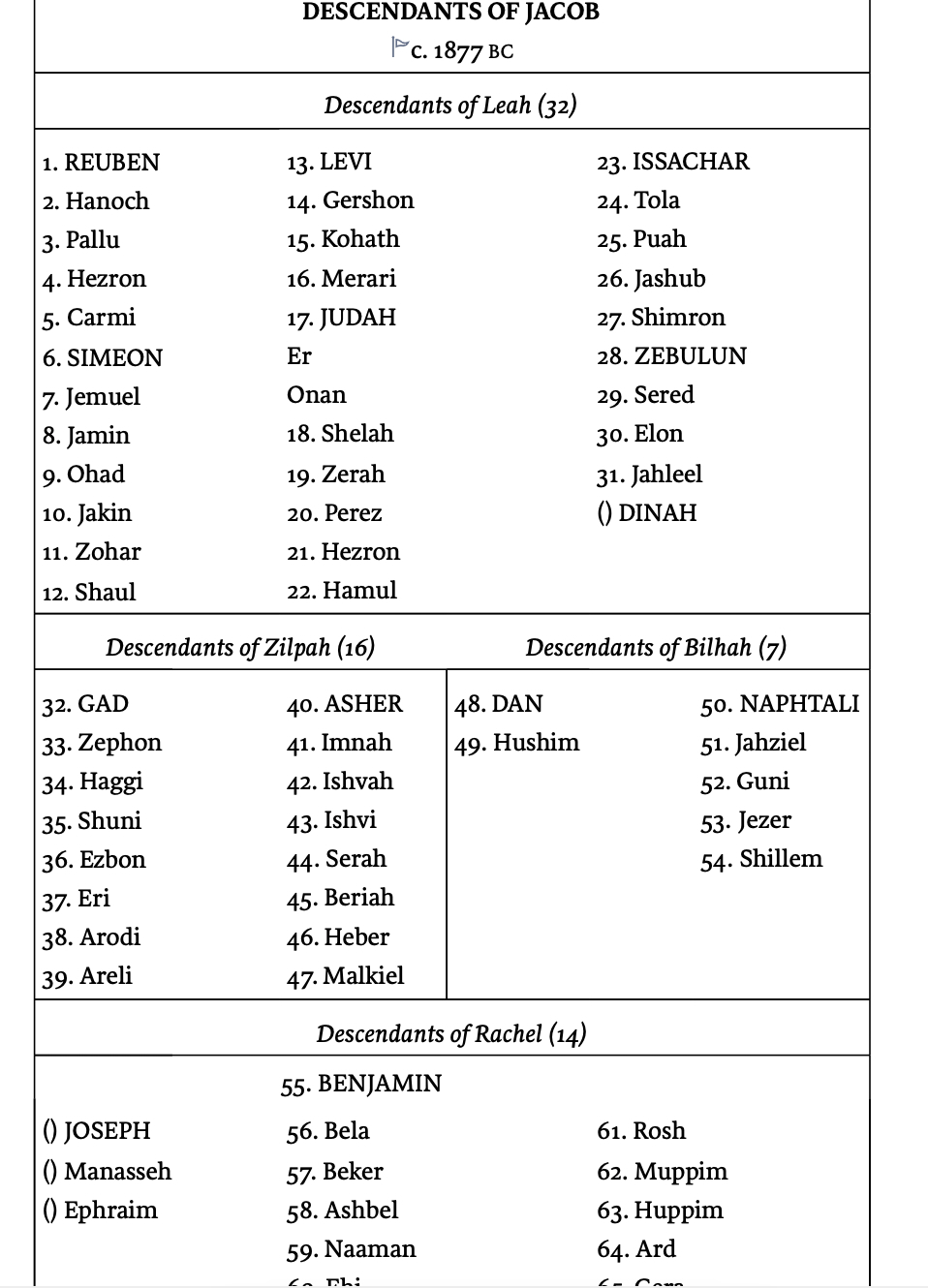
Once again, we are indebted to James Smith for his masterful charts. He gives a summary of the household of Jacob which settles in Egypt in the land of Goshen.

Screenshot

God provided a land of plenty for them to flourish in (28-34). While Canaan is called the land flowing with milk and honey and the destined possession of Jacob’s descendants, what a mark of God’s goodness to provide a place for them to burgeon into a people so numerous that Moses writes, “But the sons of Israel were fruitful and increased greatly, and multiplied, and became exceedingly mighty, so that the land was filled with them” (Ex. 1:7; cf. Ex. 1:12, 20). Goshen was that sector of Egypt where Joseph’s family is given to tend their vast herds of livestock. While we do not know exactly where Goshen is today, we do have clues. Jamie Banister says, “Clues to Goshen’s location are based on the description of the region, seemingly close to the Nile River, and the mention of Pithom and Rameses (Exod 1:11) as supply cities built by the forced labor of the Israelites who were living in Goshen. The general consensus is that Goshen was somewhere along the eastern part of the Nile Delta, probably in or near the Wadi Tumilat, a fertile valley connecting the Nile Delta east to Lake Timsah” (Barry, ed., Lexham Bib. Dict., np.). 

Does it not make us think of God’s goodness, giving every good and perfect gift (Js. 1:17)? Even in time of famine, His children have all they need to fulfill God’s purpose. That does not mean that following God always brings about material prosperity; we know from the whole of Scripture that it may bring tribulation (John 16:33). Yet, we do know God is at work to fulfill His purpose through those of us who serve and follow Him (Rom. 8:28). 

There is a foreshadowing of trouble to come is implied (34). There is a footnote at the end of the chapter, foreboding future events. Shepherds are loathsome to the Egyptians. That was the occupation of this family, and it would be of their descendants. At this time, the Pharaoh’s feelings of indebtedness to Joseph are recent, profound, and strong. But, later, it would not be the case (Ex. 1:8). While there would be additional reasons why later Egyptians would despise Israel (Ex. 1:10), this was an early one. 

The Flying Priest

Dale Pollard

Adeulir Antonio de Carli was a priest who became famous after strapping hundreds of helium filled party balloons together in an attempt to break a world record. The stunt was part of a fund-raising plan but it would end, predictably, in disaster. 

Before his flight the priest was being interviewed by a News outlet and on camera he’s informed about approaching bad weather. After hearing this he states, 

“There will only be good weather during my flight…” 

Moments later, the 41-year-old priest strapped himself to a seat attached to green, red, white and yellow balloons that hoisted him high up into the air.

He was reported missing some eight hours later after his final contact with port officials in which he had asked for assistance in using a GPS device that was tracking his coordinates. His final recorded words were, 

“I need to get in touch with the ground crew so that they can teach me how to use this GPS tracking device. It is the only way I will be able to transmit my latitude and longitude coordinates in order for them to know where I am.” 

The deceased Priest, Adeulir Antonio de Carli, was spotted in the ocean by a tugboat near the city of Macae, three months after he disappeared.

You’ve likely heard that the individual letters in the word Bible can be used as an acronym— “Basic Instructions Before Leaving Earth.” While perhaps this has become cliche, much like WWJD (What Would Jesus Do), there’s still much truth to be found in it. 

Paul tells Timothy that God’s Word is something which must be used properly. The Bible won’t be able to tell us where we are spiritually, or even how to get to our desired eternal location unless we know how to use it effectively. Why would anybody “take off” without knowing how to utilize such an important tool? If we don’t know how to apply the inspired Word in our lives then we’re hopelessly trying— like a high-flying priest. 

“All Scripture is God-breathed and is useful for teaching, rebuking, correcting and training in righteousness, so that the servant of God may be thoroughly equipped for every good work.”

2 Timothy 3.16-17 

Genesis: These Are The Generations (XLVII)

Reconciled (45:1-28)

Neal Pollard

Now, it was time. In fact, it appears that Joseph could no longer hold it back. All the emotion, all the years came flowing out in this moment of time. The days of contention with her brothers, the day in the pit, the years in the dungeon, as difficult as they were to endure, must now have seemed like a distant memory. In the entire narrative, this is probably my favorite chapter. Don’t you hate to see loved ones and dear friends at great odds with each other? Or those who have hurt loved ones and friends who refuse to make it right? So much water has gone under the bridge leading us to these touching moments.

Disclosure (1-3).

Joseph’s emotions are uncontrollable and he cries (1). He dismisses everyone but his brothers. His weeping could be heard all the way to Pharaoh’s house (2). Then, he said it! “I am Joseph! Is my father still alive?” (3). How many times since he had first seen them had he wanted to tell them, restrained only by his wisdom and perhaps the providence of God? 

Dismay (3-5).

While it may not have been divinely intended, I wonder if there’s a touch of humor in the brothers’ response? Joseph reveals his identity, “But his brothers could not answer him, for they were dismayed at his presence” (3). They are speechless! They believed him long ago dead, having rotted in some prison, abused by some taskmaster, or killed in the toil of a slave. But here he is before them. Of course, it was a sobering moment for them. The brother they betrayed had the power and backing of the powerful Egyptian nation behind him. Joseph beckons them to come near him, and he seeks to console them.

Discernment (5-8).

The brothers had been selfish, calculating, and without self-control. They had been wicked and sinful. What was Joseph’s perspective? He saw God in all this. Four times in his answer, Joseph credits God: “God sent me before you to preserve life” (5), “God sent me before you to preserve a remnant” (7), and “it was not you who sent me here, but God” (8; see his instructions in verse 9, too). Oh, for a heart, a mind, and a maturity to see life through Joseph-shaped glasses! To see my challenges, setbacks, adversities, and trials as the tools God uses to accomplish His purpose (Js. 1:2-4)! How that transforms tears into triumphs!

Directions (9-25).

Joseph urges the brothers to go back home without “delay” (9). He tells them where they will live, in the rich pasturelands of Goshen. He directs them to tell his father the power and position he had in Egypt. After all the weeping, embracing, and catching up with them, Pharaoh learns the news and rolls out the red carpet for Joseph’s family. He offers the best of the land (20), then Joseph lavishes them with many gifts. He heaps Benjamin with an extraordinary measure of goods and garments and his dad with extravagant gifts (23). Interestingly, he admonishes them not to quarrel on the way (24). The brothers comply!

Delight (26-28). 

Jacob is given the news and reacts like the brothers. He was stunned and in disbelief (26). But when he was shown evidence of the truth of their news, we read, “the spirit of their father Jacob revived” (27)! Something he thought was impossible was now the prospect before him. He would see Joseph again!

For all the dysfunction and missteps of this household, the beauty of unity rises like cream to the top! How it reminds me of God’s family today. While it is better to never have strife (1 Cor. 1:10-13), it is beautiful to see the humility, the spirit of forgiveness, the penitence, and the fruits of repentance that brings us back together again! When self is surrendered for the good of a brother or sister (Phil. 2:3-4), God is glorified and His work progresses. It is worth repeating: “Behold, how good and how pleasant it is for brothers to dwell together in unity!” (Psa. 133:1).

“This Book Is Valuable”

Neal Pollard

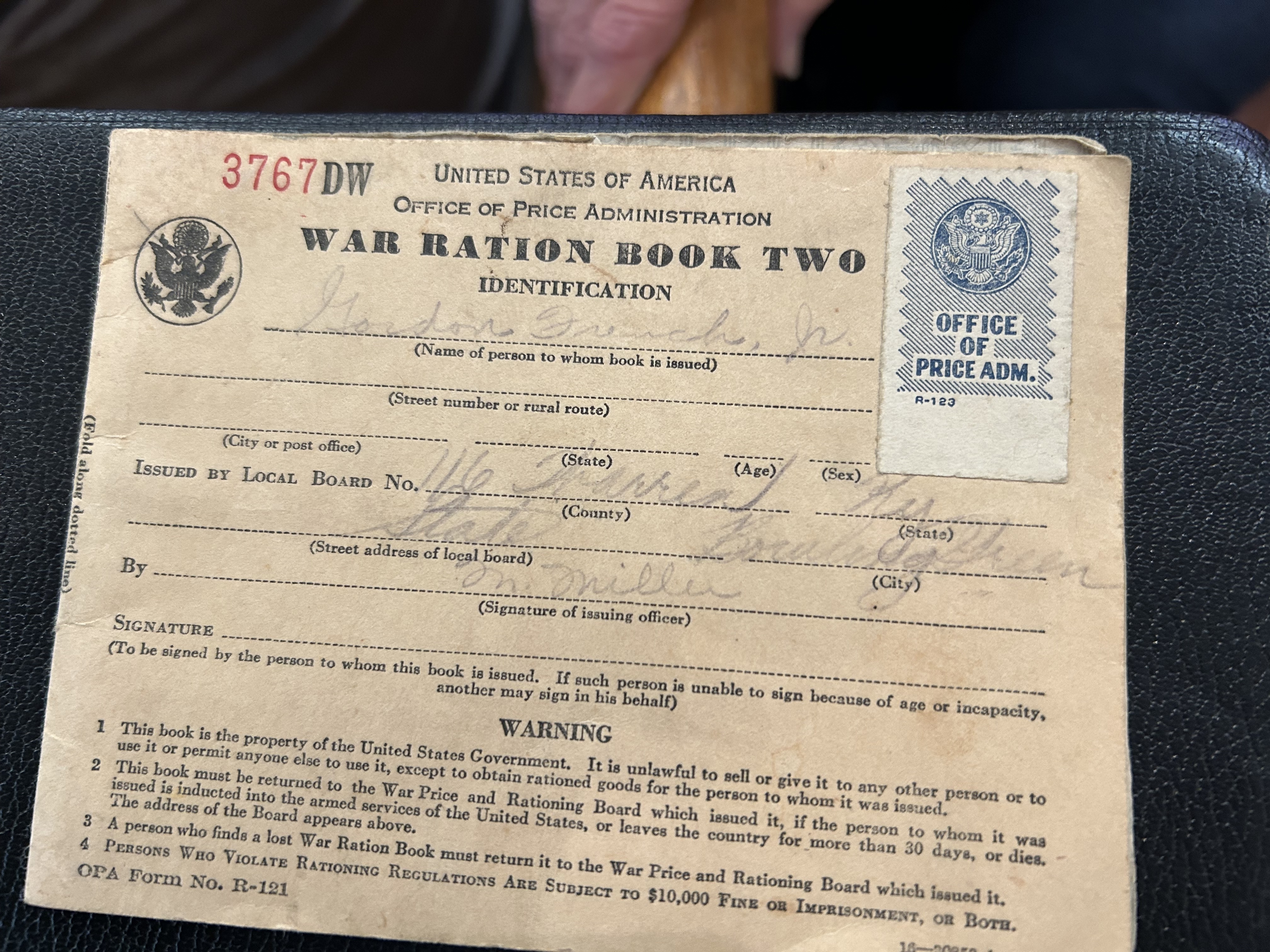
Not long ago, visiting two of our wonderful members, Dorothy and Buster French, we talked about everything from politics to family to farming and their memories growing up. Somehow, talk shifted to their memories from youth growing up during World War II. Times were difficult and Americans had to make sacrifices, doing without. This sweet couple had tangible proof of that sacrifice in a ration card they had kept from Buster’s father. 

Families and households had to limit their purchase of common goods, like gasoline, butter, sugar, and canned milk (https://www.nps.gov/articles/rationing-in-wwii.htm). This allowed the government to divert needed supplies and manufacturing to goods and supplies needed to prosecute the war overseas. What I found most interesting of all was the explanation on the back of the ration book. It included the following statements:

  • “This book is valuable. Do not lose it.”
  • “Detailed instructions concerning the use of this book…will be issued from time to time.”
  • “Do not throw this book away…”
  • “You may be required to present this book…”

The last paragraph was an admonition for the bearer to do his or her part. A failure to follow the rules, they said, “helps the enemy.” The book carried the weight and authority of the Government Printing Office and was dated 1942.

It’s so hard for us, even in the volatile economics conditions of the past few years–including a disruption in the supply chain–to fathom what ordinary families endured for a half a decade or more. But the exhortations on the back of that book can be timelessly applied to the most important book of all.

Whether or not we have a favorite, well-worn copy of it, but the Bible is most valuable and its message and content cannot be lost as a lamp to our feet and light to our way (Ps. 119:105). God designed for us to have detailed instruction, “from time to time,” given concerning its use. He calls it preaching (Acts 2:42; 20:7; 1 Cor. 1:21). Figuratively speaking, morally, ethically, and doctrinally, we must never throw this book away (Ps. 50:17). Peter reminds us that we may be required to present this book to anyone who asks (1 Pet. 3:15)!

I could not help but think, God’s written word must be the most valuable resource in our lives. It supplies everlasting food and gives us access to more than consumable goods. It is to treasured above our “necessary food” (Job 23:12). 

So many in the Buster and Dorothy’s generation (and their parents’) have contributed much good and the prosperity so many of us enjoy today. Things like their honest participation on the Homefront through means like rationing are example of why. We can bless our world today by being Christians who treasure the Book of books and put it to use in our lives! 

Genesis: These Are The Generations (XLVI)

Passing The Test (44:1-34)

Neal Pollard

Is Joseph simply a bitter, power-hungry, and vengeful man, sadistically piling cruelty upon cruelty in payback for his brother’s wickedness so many years before? Even some commentators think so.  However, let us thoughtfully reflect on what has unfolded. 

Subjected to the unrelenting favoritism of their father, Jacob, for Joseph, coupled with the knowledge of his dreams, they treacherously sell him into slavery and deceive their father. Years later, through the famine, he is able to see them all once again (reminding ourselves the brothers do not recognize Joseph). They have changed. The test in chapter 44 proves they are not the same men who sold him into slavery.

Joseph sets and springs the trap (1-13). Not only does he put their money in the sack with their grain, but he puts his silver cup in the mouth of his youngest. After they leave, he pursues them with his house steward and his men. The steward is told to accuse the men of treachery, and the brothers are confident in their innocence. They even pledge death to the guilty, further pledging to be slaves if the cup is found among them. Yet, when the cup in found in Benjamin’s sack, they tear their clothes and return to the city with the Egyptians.

Joseph reprimands them (14-15). First, they bow before him again (14). Joseph asks them what they have done, adding, “Do you not know that such a man as I can indeed practice divination?” How will they respond?

Judah confesses their sin, then presents an eloquent case (16-34). At the outset, Judah sees this turn of events as divine punishment (16). They are ready to be as they made Joseph to be–slaves (16)! Joseph gives them the opportunity to abandon Benjamin. They could do so with full justification, since the cup was found in his sack. But, they will not. Why? Their father. Judah mentions him 15 times in giving their defense. They know he will be devastated. In addition, their youngest brother. Judah begs to take his place (33). They are no longer the brothers who wantonly sold their brother. Even given a legitimate opportunity, they will not leave Benjamin defenseless. 

This is all Joseph needed to know, as we will see when we keep reading into chapter 45. But, let us make some closing observations. First, it is wonderful that people can and do change. These men had some sinful baggage in their background. Yet, in the crucible of trials, they had been refined. They demonstrated their change with godly sorrow (13; 2 Cor. 7:10), confession (16), and an attempt to demonstrate fruits of repentance (16ff). Furthermore, we appreciate the preciousness of brotherly love. In this account, we appreciate it in its absence, but we also do when it is once again shown. The Hebrews writer urges it, saying, “let [it] continue…” (13:1). The Psalmist praises it (133:1). The church is strengthened by its presence and decimated in its absence. 

Genesis: These Are The Generations (XLV)

Return To Egypt (43:1-34)

Neal Pollard

Sometimes, necessity and hardship trump more sentimental concerns. That is what happens surrounding the events of Genesis 43. The reader already knows this famine will persist for seven years, so Jacob was only delaying the inevitable by not sending his sons back to Egypt with Benjamin in tow. The family needs grain to survive. Thus, we arrive at the circumstances of this chapter. 

The necessity of their returning (1-2). “The famine was severe in the land” (1). Jacob tells his ten sons to return to buy a little food because they had finished the grain (2). Things appear urgent!

The conditions of their returning (3-10). The sons remind their father of “the man’s” (i.e., Joseph’s) stipulation. Do not come back without the youngest, Benjamin. Jacob is irritated with the sons for disclosing the boy’s existence, but the sons’ reasonable defense is that they could not have known what he would propose (6-7). Judah sets the condition that he would bear blame forever if they failed to bring back Benjamin (8-9). 

The consent for their returning (11-15). Jacob begrudgingly agrees, but wishes to placate this official with copious gifts, produce detailed in verse 11. Additionally, they were to take back double the money plus the money that was in their sacks as a sign of their integrity (12). Notice how in the passage of time Jacob has grown more dependent and trusting in God. He expresses faith in God’s might, compassion, and providence, while resigning himself to God’s sovereign will (14). 

The effect of their returning (16-34). First, Joseph is satisfied to see the safety and good condition of his only full-blooded brother (16). Second, Joseph summons them to his house (16-17). Third, the sons are afraid. They fear that they will be made slaves, ironic because they had sold Joseph into slavery and because their descendants would be slaves in this very land. Fourth, they are reassured by the house steward that their God was responsible for their money returning with them, as he had all their money. Fifth, Simeon is returned to them. Sixth, they and their animals enjoy the fruits of hospitality and prepare to eat. Seventh, Joseph inquires about their father and asks about Jacob’s youngest son. Notice how the brothers, not once but twice, bow down to him (26,28). Eighth, Joseph excuses himself overcome by emotion, regains his composure and returns to their company. Finally, each is served according to local custom (serving Joseph first, then the brothers, and then themselves “because the Egyptians could not eat bread with the Hebrews, for that is loathsome to the Egyptians,” 32). Each is also seated in exact birth order, causing wholesale astonishment. Joseph took portions to them from his own table, giving Benjamin five times more than they received (34). The meal is full of feasting and merriment. 

Joseph is not quite ready to end the charade. He has one more test for them, which we will see in chapter 44. It is quite clear that not only had Jacob’s faith matured, but their character had also been refined in the intervening years. Reflect upon how God uses trouble (the famine) to accomplish His purposes (bringing the family back together, encouraging the sons of Jacob to repent, and readying Abraham’s descendants for becoming a nation). 

Genesis: These Are The Generations (XLIV)

The Famine (41:50-42:38)

Neal Pollard

Chapter 41 ends with Joseph ensconced in his position of high authority. He has Asenath for his wife, and the two have twins. Joseph names them Manasseh and Ephraim, both symbolizing divine triumph over his betrayal and affliction. The year after their births, the famine he foresaw occurs. Egypt felt the severe pinch of this, but so also did the rest of the known world. Moses tells us that the famine spread over all the earth, and it was severe in all the earth (56-57). We read that the land was famished and the people cried out to Pharaoh for food, and he in turn directed them to Joseph (55). 

Word that Egypt had storehouses of grain spread to neighboring countries. One of those countries was Canaan, where Jacob hears of it (1). He directs his sons, all but Benjamin, to go buy grain there (3). One can almost envision a caravan moving south along the trade route down to Egypt with unified purpose (cf. 5). The moment of truth came when Jacob’s sons came before “the lord of the land,” Joseph, and “bowed down to him with their faces to the ground” (6; 37:7-10). Joseph recognizes his brothers, but they do not recognize him (8). 

He speaks harshly to them, accusing them of being spies (9-16). He puts them in prison for three days, to test them. Consider the judgment of Kenneth Mathews, who writes, “This charge was a means of determining the character of his brothers, not personal retaliation. Eventually, he will put them in the same situations they once had faced and failed: the imprisonment of a brother and monetary gain (Simeon) and the opportunity to rid themselves of a rival (Benjamin)” (NAC, Vol 1B, 777). 

They plead their innocence of the spy charge, but when they stand before Joseph three days later they openly confess their guilt over their mistreatment of the brother they do not realize they are standing before (21-22). The presence of an interpreter leads the brothers to believe this Egyptian lord cannot understand their words (23).  When Joseph hears their sorrowful confession, he turns away and weeps (24). Their deal was to leave one brother behind in prison until they could bring back Benjamin to help prove the truth of their story and save their lives (24). Joseph directs the Egyptians distributing the grain to fill their sacks and return their money, giving them provisions for the journey back to Canaan (25). 

They depart with their sacks, but without Simeon. At some point, one of the brothers opens his sack and sees the money inside (27). The brothers tremble, seeing this as divine judgment because of their mistreatment of Joseph so many years before (28). Back in Canaan, they recount their experience in Egypt with their father. They tell how the ruler spoke harshly to them and even detained Simeon until Benjamin could return with them to prove his existence. Jacob is overwrought with fear, anxiety, and foreboding. Reuben pledges his sons’ lives to vouch for the safekeeping of Benjamin, but Jacob refuses as he cannot bear the thought of losing Rachel’s lone remaining child (38). 

What is at the heart of these events? Why did Joseph treat his brothers this way, if not purely for revenge and spite? They do not recognize him and he is not minded to reveal his identity. So, he wants information about Jacob and Benjamin, but he also wants to test whether or not his brothers had changed over these several years. One commentator (Strassner, 161-162) suggests that Joseph had forgotten his brothers (41:50-51), but not forgiven them (ch. 42). His brothers were guilty, but not forgiven since they hadn’t properly dealt with their sins. Jacob had neither forgotten (36) nor forgiven, the latter since he was unaware of what his sons had done. Instead, his sin was in anointing a new favorite in the place of the one who thought was dead. 

Remember how dysfunction had ruled this family for a few generations now. Joseph has risen above much of this, being refined in the fires of trial and being of purer character. But the ravages of family sin run deep and wide. As we appreciate the trustworthy providence of God playing out through these events, let us also be encouraged to work to spiritually strengthen our families. Strong families are the backbone of strong churches and strong societies. There is so much we cannot influence in this world, but we have more control in the family environment than anywhere else. May we give prayerful thought to our example, our priorities, our integrity, and our faith! Through this, we can break destructive cycles and build homes of strength which honor and please our God! 

More Than Sorry

The Profound Gift Of Propitiation

Brent Pollard

Consider a scenario in which you accidentally crash your friend’s car, causing him to become upset. You could apologize and offer him your vehicle to make things right, hoping to repair your friendship. This overture is similar to what the term “propitiation” means but on a much broader scale.

Imagine God as a close friend and ourselves as those who have made a mistake. Sometimes, we may do something wrong, which creates a gap between us and God, much like when friends become angry. However, what is remarkable is that God loves us so much that He sent His Son, Jesus, to solve this problem. He didn’t do this by giving something to God but by becoming the solution Himself (John 3.16; 1 John 4.10).

Jesus never committed any wrong, yet He willingly chose to take the punishment meant for us and expressed the most heartfelt apology for everything that anyone has done or will do. It was more than just saying sorry; it was about reconciling our relationship with God. This outcome is what we mean by “propitiation”: Jesus took our place to restore our relationship with God (Romans 3.23–25, 1 John 2.2).

Let’s go back to the car story. If you accidentally damaged your friend’s car, you could try to compensate for it by fixing or compensating him. But what if your friend said, “It’s alright, I forgive you, and let’s work together to repair the car”? This response is similar to what God did for us but on a much grander scale. God did not only forgive us, but He also made it possible for Jesus to reconcile us to Him. By doing this, He demonstrated His immense love for us, even though we continue to make mistakes (Romans 5.8).

Thanks to Jesus, God doesn’t hold our mistakes against us. He welcomes us with open arms as if nothing ever happened. This result is not because we fixed things ourselves but because Jesus did (Colossians 1.19–22). We can again be close to God and be His friends because Jesus has made things right between us and Him.

So, “propitiation” is a complex word that describes how Jesus helped restore our friendship with God by taking our place, even though He was innocent. It shows how much God loves us and wants us to return to Him despite our sins (Romans 5.10–11; 1 John 4.10). 

When we understand the concept of propitiation, we realize that Jesus willingly bore the weight of our sins on the cross. His sacrifice satisfied God’s righteous anger and justice, ensuring God’s reconciliation with us. Our past mistakes no longer define us, but by the grace and forgiveness God extends to us through Jesus. It is a testament to God’s boundless love for us, allowing us to turn away from our sins and forge a close relationship with him again.

Genesis: These Are The Generations (XLIII)

Joseph And The Pharaoh (41:1-49)

Neal Pollard

What do you know about Zaphenath-paneah? More about him near the end of today’s study. The chapter begins with the Egyptian Pharaoh, who has two peculiar dreams. This happens “two full years” after two of his servants had had dreams. Now, he, like them, needs to know what this was about. 

THE CONTENT OF THE DREAMS (1-7). Pharaoh has two dreams. In the first, seven fat cows come out of the Nile grazing on grass. Then, seven ugly, gaunt cows come out of the Nile and eat the seven fat cows. Understandably, this wakes up the Pharaoh! When he goes back to sleep, he dreams that seven plump, good ears of grain come up on a single stalk. Then, seven thin and east wind-scorched ears, sprouting up after the other, swallows up the plump ears of grain. Because we have Genesis 41, we know what the dreams mean. But, without the context of divine revelation, this would be utterly stymying. 

Consider this helpful, historical insight into the significance of the Nile to the spiritual life as well as physical and economic well-being of Egypt: “The Nile water system was the most conspicuous feature of Egypt’s geography and the primary source of the country’s economic and social stability. The Nile was deified in Egyptian religion (god Hap or Hapy when Nile in flood), and the appearance of the cows from the river may have suggested to Pharaoh a close connection to the gods. Pharaoh’s state was responsible for maintaining the irrigation of the river system, distributing land grants, gathering taxes, and storing grain. Despite the success of natural irrigation and human engineering (dams, canals), high and low Niles occurred, producing famine and its ill effects on society. Significant inundations delayed the planting season that subjected tender sprouts to the cyclic hot winds…that produced drought and famine” (Matthews, NAC, 755). So, these dreams would have been full of significance for the Pharaoh, and having no idea what they meant was obviously dismaying (8). 

THE COMMUNICATION OF THE DREAMS (8). Straightaway, Pharaoh is on a mission to understand the meaning of his dreams. Like Nebuchadnezzar, he summons the bright minds of the kingdom to him to interpret them (Dan. 2:2,27; 4:7). As it would be so much later in Daniel’s day, no one could interpret the Egyptian monarch’s dreams. 

THE CONSEQUENCES OF THE DREAMS (9-49). There are at least five, pivotal occurrences as the result of Pharaoh sharing his dreams.

First, Joseph is remembered by the cupbearer (9-13). Whatever held the cupbearer back for two years, he fully recounts the prison experience with Joseph where he interprets his dream and the dream of the chief baker. This Hebrew youth had the very ability that Pharaoh desperately sought. 

Second, Joseph is freed from prison and brought before Pharaoh (14-15). In fact, he is rushed before the king, shaved and adorning different clothes. Pharaoh then begins dialogue with Joseph. 

Third, Joseph interprets the dreams (16-32). As he did with the servants in Genesis 40:8 and as does Daniel (Dan. 2:30), Joseph credits God for the ability to interpret dreams (16). How this spirit lived in so many of God’s great messengers! As Paul later puts it, ” Not that we are adequate in ourselves to consider anything as coming from ourselves, but our adequacy is from God” (2 Cor. 3:5). While Joseph demonstrates a supernatural ability here, the attitude behind it is timeless. Every good thing we accomplish for God, we need to remember the humility of Joseph, Daniel, and Paul. It is not us, but the God who is at work in us!  Joseph explains that both dreams point to one event, a coming famine. That there were two dreams is simply confirmation of the swiftness and certainty of its fulfillment. 

Fourth, Joseph is promoted to second in command of all Egypt (33-44). Joseph counsels the Pharaoh to find a competent person to prepare for the impending famine. After Joseph outlines a specific, thorough plan of action, Pharaoh sensibly appoints Joseph to be that person (38)! Notice that Pharaoh is being influenced by this Hebrew young man, with the Egyptian giving God credit for revealing the information (39). 

Joseph is promoted to ruler over Pharaoh’s house (40), the Egyptian people (40), and the whole land (41). To symbolize that authority, Pharaoh gives Joseph his signet ring which signified his authority (42; Est. 3:10; 8:2ff; Hag. 2:23). The linen and gold necklace was further indication of his power, a bestowal that would also be utilized in later empires like Babylon (Dan. 5:29). He is given the second chariot (think “Air Force Two” today) and the people were to “bow the knee” at his appearance (43). He is fully authorized to act on behalf of the Pharaoh (44). What a dramatic change from the stricken 17-year-old languishing in the pit where he was put by his brothers. Or the mistreated servant banished to an Egyptian jail because of the lies of a scorned woman. 

Finally, Joseph is appropriated into Egyptian culture (45-49). He is given an Egyptian name (Zaphenath-paneah)(45), a prominent Egyptian woman for his wife (45), and the daily task of administrating and overseeing the plentiful years Egyptian began to enjoy (46-49). He gathered all the stores and stored them! Now 30 years old, he is not only entering the prime of life but is primed to change the world!

As we struggle with the difficulties of our present circumstances, we cannot see what the future holds. We may be tempted to give up, to let go of our rope of faith. Joseph reminds us that our story is not yet written! Trust God to be with you in your betrayals and your prisons. He will not forsake nor leave you (Heb. 13:5-6)!