Fan The Flame

Carl Pollard

A few months ago, we were at Walmart, and they had their charcoal grills on sale. I jumped on the opportunity and immediately put it to work when we got home. Salmon, burgers, more salmon and burgers – something about a charcoal grill just makes the meat taste so good. If you’ve ever used a charcoal grill, you’ll know that there’s a good bit of prep time involved. You pile up your charcoal, soak it in lighter fluid, light it, and wait a good 20 minutes. Once the flame is gone and the coals are gray, it’s time to cook.

One evening a few weeks ago, I decided to use the grill. It was pretty cold out, but when you get the craving, you don’t care how cold it is, you light up the grill. I did everything as I normally would and started cooking once the coals were gray. Except this time, they quit cooking after only a few minutes. Turns out, in cold weather, charcoal doesn’t last as long. So, what do you do? With half-cooked salmon, you don’t want to start the process all over and wait another 20 minutes. I, of course, did the wrong thing and just sprayed a bunch of lighter fluid and burned everything to a crisp.

Little did I know, that event is a perfect illustration for what Paul says in verse 6: “For this reason, I remind you to fan into flame the gift of God, which is in you through the laying on of my hands.” Timothy’s charcoal was going out, and what happens when your faith grows cold? You lose the impact you have on others, you lose the joy of salvation. Paul says, “I want you to fan the flame.” True faith, like a roaring fire, can be felt and seen. The words used for “fan the flame” mean to rekindle, revive, to begin again.

To keep the flame alive, we need to:

1. Stay strong in our walk with God. When our time spent with God is pushed to the back burner, that is when our faith grows cold. Fellowship with God is our connection to the source of the fire.

2. Stay strong in our walk with the family of God. When time spent in fellowship is neglected, we fail to help fan each other’s flame.

3. Stay strong in worship. Worship should be intimate and personal, a reflection of our love for God.

4. Stay strong in study. It is impossible to stay on fire for God and not spend time in the word of God. Like Jeremiah, God’s word is the very fire in our bones, and if you want to keep that fire burning, study the word.

When fear threatens to ruin your faith, rekindle the flame.

Zealotry in the Bible: A Biblical Perspective On Passion And Devotion

Saturday’s Column: Brent’s Bent

Look up “zealotry” on Google. What do you see? Google mainly presents definitions from different dictionaries, including Merriam-Webster and Oxford. In a nutshell, these trusted sources say that zealotry is the same thing as fanaticism. It’s concerning. It was fanaticism that resulted in the Holocaust. It does not always follow that zealotry does so. Even though zealotry may be passionate, moral principles still drive it.

To an outsider, zealotry may appear to drive one to extremes. As an example, consider Phineas. When the daughters of Moab enticed the sons of Israel to “play the harlot” with their god, Baal Peor (Numbers 25.1ff), God sent a plague that killed 24,000 Israelites. Phineas taking a spear and driving it through Zimri the Simeonite and Cozbi the Midianite in flagrante delicto is the only thing that calms God’s rage.

What about our example, Jesus? According to John 2.13–17, Jesus made a scourge of cords, flipped tables, and drove the money changers out of the Temple on His first Passover of His public ministry. The followers of Jesus recalled Psalm 69.9, which begins, “For zeal for Your house has consumed me” (NASB1995). Would we accuse our Lord of fanaticism?

Zeal is an intense devotion to a cause or belief, but it doesn’t always mean acting excessively or fanatically. On the other hand, fanaticism is an extreme or irrational devotion to a cause or belief, often to the point of being unable to tolerate different points of view or being willing to do harmful or violent things to promote their ideas.

Zealots can often keep a balanced and nuanced view of their cause or belief, recognizing that there are other valid points of view and that their beliefs are not the only truth. On the other hand, fanatics tend to think that you cannot question their beliefs, and they may not want to or be able to see different points of view.

Zealots may go to extreme lengths to further their cause or belief, but they do so with a sense of moral and ethical responsibility. On the other hand, fanatics may be willing to act unethically or immorally or use violence or fear to get their point across. 

But it’s also important to know that zealotry, like any strong belief, can be harmful when used without knowledge. When someone is passionate about their ignorance, bad things can happen. Think about Saul of Tarsus. Before he became the apostle Paul, he was a zealous church persecutor (Philippians 3.6). So you need a balance of passion and moderation to make positive changes and show agape love.

We must be zealous for the gospel. Peter stated that we must obey God rather than man (Acts 5.29). Do we have the guts to take decisive action when the situation demands it? Our zeal does not cause us to behave as Phineas since we live under the New Covenant. God is reserving His wrath for the sinner (Romans 2.5). God also gave the civil government the sword to punish the evildoer (Romans 13.4). Our mission is to rescue people from the fire (Jude 1.23).

Jesus rebuked the church in Laodicea for not being “hot” or “cold” in their faith. Because they were not fully committed to Him, Jesus said He would reject them. Jesus tells these lukewarm brothers and sisters, “Therefore, be zealous and repent” (Revelation 3.19 NASB1995). If you need to rekindle your zeal, listen to our Lord’s advice and repent your apathy and indifference.

If, on the other hand, you are afraid of being labeled a zealot, remember that you are in good company since Jesus’ contemporaries recognized His zeal. You don’t have to worry about your zeal becoming misplaced fanaticism as long as your diligence allows you to use God’s word competently (2 Timothy 2.15). If you are steadfast in your fellowship with other brethren, they will stir you up to love and good works (Hebrews 10.24–25). And for lingering concerns, God tasks us with casting all our cares upon Him (1 Peter 5.7).

Brent Pollard

“The Frozen Chosen”

Monday’s Column: Neal At The Cross

pollard
Neal Pollard

Recently, in discussing some extremes on matters like the Holy Spirit, grace, and emotion in our worship services, a brother said that a friend of his referred to churches of Christ as “the frozen chosen.” The man was part of a religious group we’d call “charismatic,” and he had attended the worship of one of our congregations which he apparently found stoic and lifeless. We chuckled at the nickname, but it stuck with me.

It is likely that this man found it strange and lacking to have singing without a band, preaching and worshipping without ecstatic utterances and tongue-speaking, and even members seated and without raised hands. We’d rightly point out that the New Testament specifies singing and that adding mechanical instruments is unauthorized (Eph. 5:19; Col. 3:16), that tongue-speaking belonged to the infancy of the Lord’s church as a means of communicating the gospel to other languages (Acts 2:6-11) and, though a means of proving apostolic truth at that time, was regulated and said to be inferior to other spiritual gifts even in the first-century (1 Cor. 14:1ff). We’d show that it was done away (1 Cor. 13:8-12). We’d talk about the need for decency and orderliness (1 Cor. 14:40). Our comedic observer could be charged with holding to some extreme views.

I don’t know about you, though, but I don’t want to be characterized as being at the other extreme. It hurts to think that I convey a “frozen chosen” persona in worship or in the exercise of my Christian life. Worship that is lifeless, rote and repetitive, that’s so predictable that you can engage in it on auto-pilot, that evidences no emotion–joy, intensity of feeling, enthusiasm, etc.–is not the antidote to our religious friend’s brand of religion. While none of us can read each other’s mind to gauge depth of feeling (or lack thereof), cues like body language, facial expressions, hearty engagement, and the like are noticeable by their absence as much as their presence. Ask song leaders what they see on the faces of those seated before them. Ask preachers the same. Ask members what kind of intensity and interest they perceive in the preacher and song leader. 

We’re not the worship critics or the audience of worship. God is. But as we engage in worship that is according to truth, we need to examine the spirit of it (John 4:24). We do not have to be “Holy Rollers” to avoid the other extreme. As those redeemed from sins which would eternally condemn us, shouldn’t we have melted hearts which overflow with gratitude, praise, and passion? Shouldn’t such be obvious to those who visit our assemblies? Be present, with mind and body. Be involved, from beginning to end. Be engaged, inside and out. I want anyone who is watching my worship (and Christian life away from worship) to at least think of me as the “thawed awed” or, hopefully, the “fervent servant.” I do not want to be part of the “frozen chosen.”

ice-beard

Lessons Learned At The Stadium

Neal Pollard

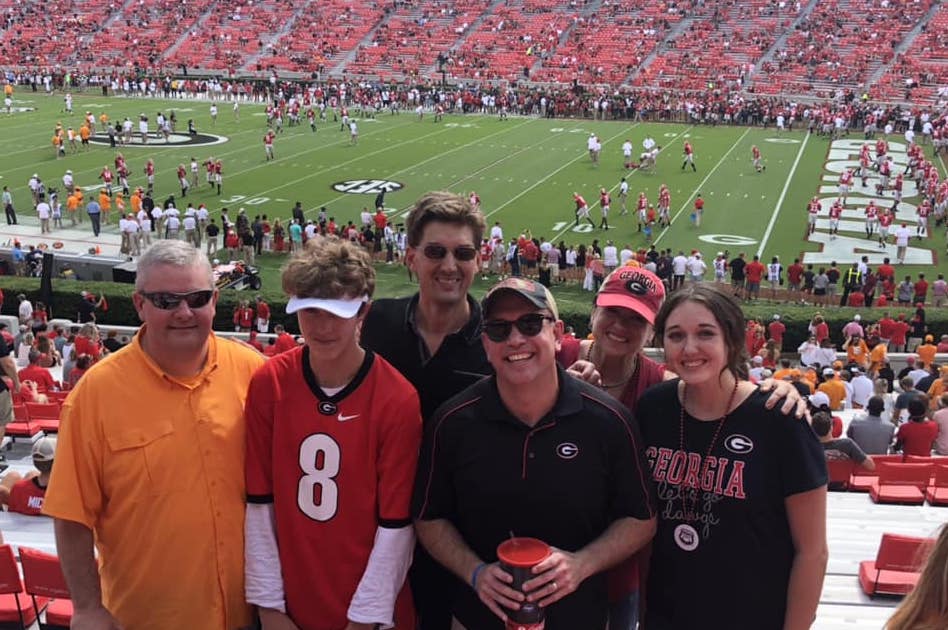
Corey Sawyers and I decided a few weeks back to go to the Georgia-Tennessee game at Sanford Stadium in Athens, Georgia, this past Saturday. Thanks to various reward programs and good deals, we were each able to do it all for less than a discount airfare. We were gone about 24, action-packed hours. We even were able to connect with the Shillidays, who had the same idea as us and made the trip from Colorado to Georgia. It was a lot of fun and we made some great memories. While there, especially in the several hours we were at the stadium, several things occurred to me that I would like to share.

  • People get emotionally invested and passionate about what they love.
  • Diverse individuals can unite around a common cause.
  • We sacrifice (time, inconvenience, effort, money, and voice) for what we truly care about.
  • We can be bold enough (vocally and visually) to let everyone know where we stand.
  • We may be too quick to forget past successes, but we’re also quick to forget past failures. 
  • With sufficient interest, we can endure discomfort (backless seats, extreme heat and humidity, and no elbow room).
  • We do not let lack of knowledge or understanding of a subject (like the rules and strategy of college football) to keep us from speaking up.
  • We tend to be proud of our history and heritage (coaches, players, broadcasters, past seasons), feeling a sense of connection or belonging through it.
  • Despite aforementioned unpleasantries and sacrifices, most remain willing to do it again in the future. 
  • We can quickly build a bond with likeminded people, even strangers, out of a common love.

It’s easy to see the comparisons and contrasts between our Saturday experience and trying to be a Christian in our world today. Obviously, I am not disparaging going to ballgames and having a good time. It’s great fun! But, it always reminds me of my need to exhibit greater commitment and zeal for the only thing that matters eternally. My prayer is that, in every way it can be measured, my heart, mind, soul, and strength will be most invested in loving the Lord, His church, and the lost. It also makes me aware of the vast potential in every person, properly directed, to seek first the Kingdom of God! How many, adequately exposed to God’s will and His offer of salvation, will wholeheartedly embrace and share it? Seemingly, the numbers are staggering! May we be enthusiastically about the Lord’s business. 

Bear Valley at Sanford Stadium
Bear Valley crew at Sanford Stadium shortly before kickoff.

“What’s Your Passion?”

Neal Pollard

Most of us, repeatedly throughout our lives, get asked or ask ourselves the question, “What’s your passion?” The word, defined as “a strong and barely containable emotion,” is one we may use for ourselves but one as likely to be used by others to describe us. Thanks to social media, we can see people’s interests, hobbies, and diversions whenever we choose. They post pictures, make comments, and talk about them with great frequency. However, there are some people whose focus is so intent on some topic that their emotion spills over. If anyone else brings it up, they cannot refrain from jumping in “with both dogs.” Yet, they themselves are always finding and sharing relevant material that supports or upholds their views. Maybe it’s guns (for or against), race (black, white, or hispanic), politics (R or D), illegal immigration (for or against), or some equally charged issue. Have you ever noticed someone whose passion seems to be for being argumentative and disagreeable? Passion is unmistakeable.

Not only through social media, but through my every social interaction, my life is declaring what my passion is. Those closest to me are best equipped to reveal what that is, but everyone who is exposed to me for any period of time can figure it out. What a sobering thought! I know what I would want that to be. Paul said, “For I determined not to know anything among you except Jesus Christ, and Him crucified” (1 Cor. 2:2). In Philippians 3:10, he simply says, “I want to know Christ—yes, to know the power of his resurrection and participation in his sufferings…” We have the corpus of Paul’s inspired writings, and it is filled with his expressing that passion. We have eyewitnesses to his ministry, especially Luke, who verify that this is what drove him and ignited his passion.

A lot of people know that I enjoy dark roast coffee, all things Georgia Bulldogs, running, peanut butter, traveling, and my family, but do they see passion for Christ in my life? I don’t get to say what my passion is, simply by thinking about what it should be in some moment of reflection. It is what my life shows that it is. When all is said and done, what will have been the great passion of my life? What about you?

coffee_beans_closeup

Desire That Bubbles From The Heart And Falls From The Lips

“To see the dull indifference, the negligent and thoughtless air that sits upon the faces of a whole assembly, while the psalm is upon their lips, might even tempt a charitable observer to suspect the fervency of their inward religion.” This quotation was from a man who observed lethargy and unenthusiastic engagement in congregational singing. He decried a lack of apparent passion and zeal for God and spiritual things in this act of worship that is meant to be profound and transforming. The observer, as far as is known, was not a New Testament Christian, but he was responsible for giving us “Joy to the World,” “When I Survey The Wondrous Cross,” and over 500 more hymns. He complained about the lifeless hymns being sung in his day, and his father, who would be jailed for dissenting from the Church of England, challenged him to come up with a solution. All those hymns, which he started writing in adolescence, was his answer. Isaac Watts can be considered an expert on religious hymns, and he revolutionized congregational singing for especially English speakers. The fact that we still sing some of his hymns demonstrates that.

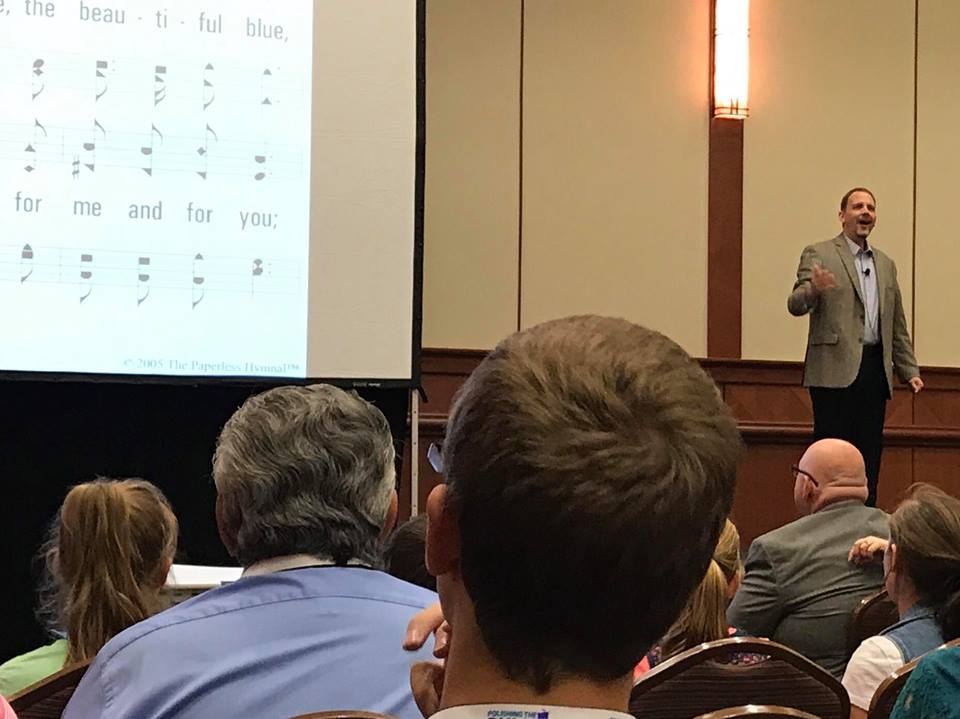
But, his observation in later life about indifference, negligence, and thoughtlessness from  those presumably worshipping is a fair challenge to each of us. Especially when we are singing songs so familiar to us, which we know by heart, we must guard against lips that say one thing and hearts which do not necessarily reflect those words. Is it possible to sing about Jesus’ death on the cross or God’s great love or the amazing hope of heaven or an examination of my Christian life and commitment without reflecting and contemplating? Could I be thinking about something while singing something else? The gamut might run from empty religion to understandable distraction, but we must challenge ourselves to keep our hearts and minds on the words and meaning of those psalms, hymns, and spiritual songs (cf. Col. 3:16; Eph. 5:19).  Let us cultivate desire in the heart that bubbles from the lips as we praise God and encourage one another in our song service.

21034730_1137559296377060_1380004993605666831_n
Andy Baker leading a group in singing (photo credit: John Moore)

Are You “Boiling Over” Or Just “All Wet”?

Neal Pollard

The word translated “zealous” is from the Greek word zero (Dzay-lo-o). It is found 17 times in the New Testament. It means to “burn with zeal; to be heated or to boil, whether with envy, hatred, anger, or to be zealous in the pursuit of good; to desire earnestly, to strive after, busy one’s self about” (Thayer 271). It is found in both the positive and negative sense:

  • Negatively–Acts 7:9; 17:5 (“became jealous”), 1 Corinthians 13:4 (“jealous”), Galatians 4:17 (“eagerly seek”), James 4:2 (“envious”)
  • Positively–1 Corinthians 12:31 (“earnestly desire”), 1 Corinthians 14:1,39 (“desire earnestly”), 2 Corinthians 11:2 (“jealous”–with a godly jealousy), Galatians 4:18 (“eagerly sought”–in a commendable manner), and Revelation 3:19 (“be zealous”).

(The object of the zeal and the attitude it describes
determines whether it is an acceptable emotion or not.)

We have all known people who are prone to boil over with jealousy and anger. They seethe. They grit their teeth. They explode! They are just like that unattended pot on the stove, and they usually leave an even bigger mess. They are proving that there is something underneath them leading to such “outbursts of anger” (Gal. 5:20).

We also know people who always seem enthusiastic about serving the Lord. They are effervescent. They have an infectious smile and positive attitude about almost everyone and everything. They are eager to serve and help. They go the extra mile. They seem genuinely thrilled to be able to engage in spiritual service, no matter what it is! Guess what? They are proving that there is something underneath them leading them to be “zealous of good works” (Ti. 2:14).

Both vessels, boiling over, impact the church. Both have influence. Yet, one is using his or her passion constructively, but Satan is using the other destructively. What lights your fire? Is there one underneath you? Let it be an earnest desire to build up the Kingdom! This is one instance where a “watched pot” needs to boil–boil over with enthusiasm for serving Christ!

water_at_boil

Enthusiasm Is Contagious!

Neal Pollard

Have you seen The Weather Channel’s Jim Cantore video where he is ebulliently exulting over the thunder snow he witnesses and knows to be captured by his cameraman?  The YouTube video montage where he is on camera for six lightning strikes says it all.  At one point, he implies that he’d rather experience this weather event than win the $500 million lottery.  The enthusiasm is transparent and honest.  You can’t help to feel excited about what he’s excited about because he so enthusiastically expresses it.

Being a Christian is not necessarily a non-stop fist-pumping, mountain-top experience.  The late Wendell Winkler used to say that there are not very many mountain-top or valley days but that most were “in between.”  He called it “the glory of the ordinary.”  What we do on the ordinary days is what typically makes the bigger impact.  However, the genuine enthusiasm of Christians is certainly contagious!  Some of the best church leaders I have known have known how to inject others with zeal.  Other words are “passion,” “desire,” and “excitement.”  If this is artificial and contrived, it is eventually detected. True enthrallment for pursuing the will of God, though rare, leaves its mark far and wide.

What should fire our enthusiasm?

  • A baptism
  • A wayward Christian being restored
  • A well-delivered, challenging, and biblically accurate lesson
  • A demonstration of decisive, godly leadership
  • A challenge to growth or involvement
  • Godly conviction from our youth
  • Hearing of a good work within our brotherhood
  • Singing in worship
  • A sound idea for church growth
  • The dedication shown by a spiritual brother or sister

Challenge yourself.  Ask, “What gets me excited?”  If the Georgia Bulldogs were to ever win the National Championship again, look out world!  I’d give those around me a “Jim Cantore” moment.  My honest prayer is, “Lord, help my greatest passion and enthusiasm be reserved for the things that will endure after the heavens and the elements burn and melt” (2 Pet. 3:11).  Let’s get excited about serving Jesus and doing His will!