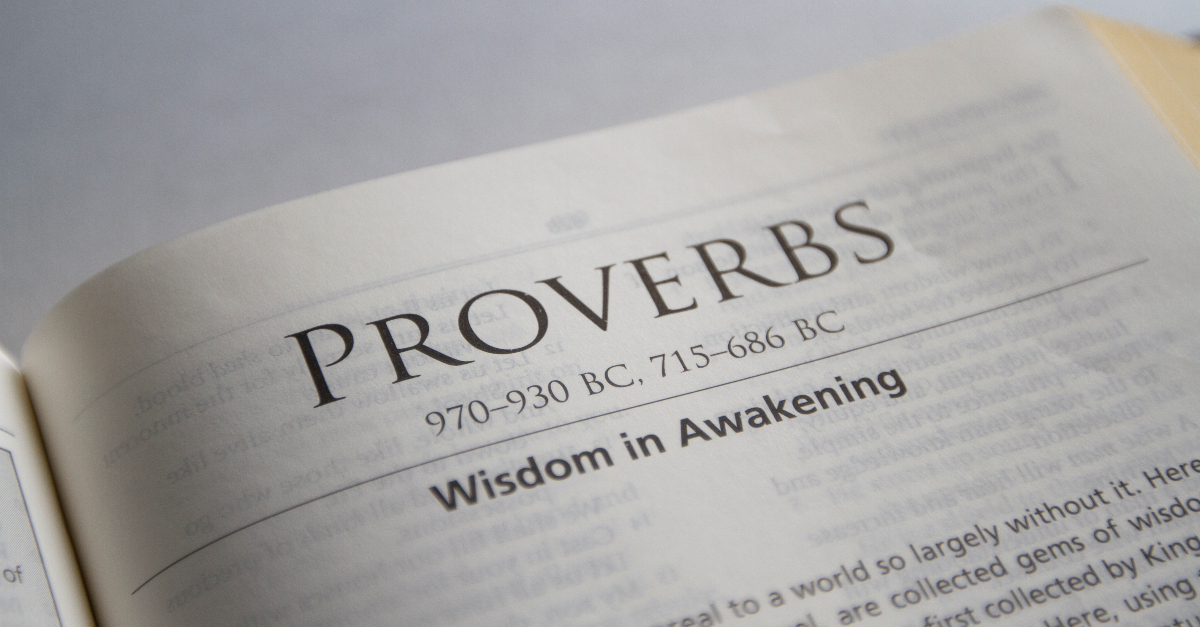
Advice From The Aged

Dale Pollard

“Those who respect the elderly pave their own road toward success.” – African Proverb 

God doesn’t tell us to listen to the elderly because they’re often right, but because they also have more experience being wrong. Solomon’s work of Ecclesiastes will attest to that. 

Every Tuesday the senior Tompkinsville church family members gather at the church building for a Bible study. The class is made up of some of the greatest examples of elderly faithful servants that the brotherhood has to offer. Their wisdom and life experience is invaluable and taking advantage of that, the question was posed– 

“What would you tell yourself if you could talk to yourself back in High School?” 

Here are some of their answers…

K: “Make your circle of friends larger. Be friends with everybody. You’ll thank yourself later in life because it’s always beneficial to know more people.” 

J: “Be able to think past the next week. Your choices will affect your future. Choose your friends wisely, and don’t try so hard to fit in. Make sure your closest friends are members of the church.” 

M: “Raise your kids in the church and emphasize the importance of going to worship. If they stray away when they get older, there’s a greater chance that they’ll return. Just ensure that they know how important it is so that they’ll always know where they need to be. Make your kids go to worship.” 

G: “Seek the truth while you’re young. I wasn’t a member of the church in high school and I wish I hadn’t waited so long.” 

K: “If you think you shouldn’t— don’t.” 

J: “Develop a good Bible study routine while you’re young.” 

This wasn’t all they had to say, but there’s something powerful about listening to the wisdom of the elderly (especially in the church) because it solidifies the trustworthiness of Biblical teaching. How many mistakes would we have avoided if we were able to go back and talk some sense into our younger selves? 

“Stand up in the presence of the aged, show respect for the elderly and revere your God.”  Leviticus 19.32 

LESSONS FROM SAUL’S FALL

Dale Pollard

Saul had a bright future full of potential. When we first read of him he’s portrayed as a likable underdog who doesn’t see his own potential. He even stated that he’s just a nobody from the small insignificant tribe of Benjamin (1 Sam. 9.17-21). God anoints him as king and like every anointed king that we read of in the Old Testament, he influenced the nation’s relationship with God. In hindsight, we’re able to see God’s wisdom. A judge who spoke on behalf of God would carry out God’s will. A king would always be more susceptible to various forms of corruption with the great power given to him. No matter how the rulers would live their lives, good or bad, we can learn much. Sadly, Saul is one of those kings who taught us how not to live. Here’s a list of the many spiritual dangers we should avoid today. 

Saul’s Seven Deadly Sins 

I SAMUEL 

  1. The sin of lacking patience – 13.8
  2. The sin of excuse-making – 13.11, 12; 15:15, 20, 24 
  3. The sin of half-hearted service – 15.1-26 
  4. The sin of Glorifying self – 15.12
  5. The sin of fearing men rather than God – 15.15, 24 
  6. The sin of desiring forgiveness from man rather than God – 15.25
  7. The sin of jealousy – 18.6-9 

While there are other mistakes and shortcomings that lead to Saul’s physical and spiritual demise, we can be strengthened by them. His failures serve as warning signs and that’s exactly why they’ve been recorded in the only book God ever wrote. 

Are You Vexed?

Tuesday’s Column: Dale Mail

The tsunami traveled at a speed of about 200 miles per hour across the Pacific Ocean. That massive wave would kill sixty one people in Hawaii, one hundred and thirty eight in Japan, and thirty two in the Philippines. This Chilean earthquake which occurred on May 22, 1960, may be the largest earthquake ever recorded. 

The word “vexed” is an old Latin word meaning “to quake/rumble” and although Latin isn’t the language that the Old Testament was written in, the Old English word was used by scholars when translating Ecclesiastes 1.18. 

“For in much wisdom is much vexation, and he who increases knowledge increases sorrow.”

At first glance, it may seem like Solomon is discouraging one from pursuing knowledge— but the message is a lot deeper.

Some have taken the view that Solomon is speaking of an earthly knowledge. It’s true that the sort of knowledge the world offers isn’t going to bring you the kind of fulfillment that the wisdom God provides. The world’s understanding lacks the answers to major questions which are essential to our spiritual health. Where did we come from? What’s the purpose of life? What happens when we die? Is this all there is? Earthly wisdom will either provide one with answers with holes, answers that are depressing— or no answers at all. 

However, God’s wisdom can bring much vexation as well. 

With God’s wisdom you come to understand that the majority of people on earth aren’t pursuing Him. You discover that most people live their lives in a way that grieve Him. That sort of understanding also brings you closer to that God. When the Lord is upset, troubled, angered, frustrated, or vexed, then his faithful are going to feel similarly. 

With much of God’s wisdom, comes much vexation. With much of the world’s wisdom, there’s much vexation. The question we should ask, is why do we want our souls to be troubled? You can be fulfilled and troubled at the same time because with God, there’s always a light at the end of the tunnel. 

Dale Pollard

“Hi-Ho, It’s Off To Work I Go”

Friday’s Column: Brent’s Bent

Brent Pollard

The book of Proverbs contains helpful “dos and don’ts” for the gainfully employed working-age child of God.  

Do (For Employees).  

  • Develop the skills that will earn you the notice of your boss or customer base (Proverbs 22.29). 
  • Work diligently to earn a promotion (Proverbs 12.24). 
  • Profit by your industry, not grand schemes that never reach fruition (Proverbs 14.23). 

Do (For Employers). 

  • Be a planner (Proverbs 21.5). 
  • Encourage the input of others (Proverbs 15.22). 
  • Though not micromanaging, be aware of everything happening within your purview (Proverbs 27.23-27). 
  • Champion the rights of your workers (Proverbs 29.7). 
  • Treat your employees so well that they will love you (Proverbs 29.21). 
  • Show your employees what is in it for them to work well (Proverbs 16.26). 

Don’t (For Employees). 

  • Don’t be lazy because you will irritate your employer (Proverbs 10.26). 
  • Don’t be a slacker (Proverbs 18.9). 

Don’t (For Employers). 

  • Don’t be oppressive (Proverbs 28.16a). 

I would be remiss if I did not address the 800-pound gorilla in America’s living room in closing. Our workforce has lost interest in working. Thus, they cannot profit from Solomon’s sage wisdom provided previously. 

It is a biblical expectation that all of God’s children of working age will work for someone else or as their own boss (2 Thessalonians 3.6-12). God is good, sending rain on the righteous and unrighteous (Matthew 5.45), but He only promises Providence to those who seek His kingdom and righteousness first (Matthew 6.33). Such a person seeking God should be obedient to His commands, including those concerning the necessity of work. Furthermore, even if not for himself, a person should want to care for his family because failure makes him worse than an infidel (1 Timothy 5.8).  

In November 2021, the US Chamber of Commerce conducted a poll. 8% of those polled said they would never work again! At the time of publication, more than half of those surveyed said they were not actively looking for work. And this is not a problem for young people. The respondents ranged in age from 25 to 45+. People said they hoped to change industries or were awaiting the allure of a large signing bonus. Despite media reports, theBureau of Labor Statistics shows little has changed.  

It’s anecdotal, but I know of two local businesses that closed because no one showed up. Both were restaurants, even if they were not technically in the same industry (one is fast food and, thus, considered food and beverage, and the other is hospitality industry). I’ve previously discussed this issue in this forum, but it persists. There are still desperate burger joints offering above-minimum-wage pay for a guaranteed 40-hour week, and people aren’t applying. How is this possible? 

These indolent who expect others to look after them cannot expect even God’s children to feel compassion for their self-inflicted plight. As Paul tells us, “The one who is unwilling to work shall not eat” (2 Thessalonians 3.10 NASB).     

“My Huckleberry Friend” 

Friday’s Column: Brent’s Bent

Brent Pollard

Having a friend that we can confide in and rely on for sound advice is invaluable, but we should be picky about who we choose as friends. Solomon says, “The righteous person is a guide to his neighbor, But the way of the wicked leads them astray.” (Proverbs 12.26 NASB). 

Thus, we will begin with those negative characteristics Solomon says one should avoid when befriending people. Do not befriend: 

  • A gossip (Proverbs 20.19). 
  • The short-tempered (Proverbs 22.24-25). 
  • Drunks and gluttons (Proverbs 23.20-21). 
  • The “unsteady” (Proverbs 24.21-22). [To fully understand this, you may need to check the Hebrew. For example, in one translation, a person “given to change” may join “rebellious officials” in another. This difference is because the Hebrew “shanah” implies repetition (“to repeat, do again”). So, Solomon speaks of those not willing to grow from their mistakes or have fickle loyalties. Hence, such people are unstable in their ways.] 
  • Liars (Proverbs 25.18). 
  • The untrustworthy (Proverbs 25.19). 
  • The inconsiderate (Proverbs 25.20). 
  • The violent (Proverbs 1.10-19). 

Those whom Solomon says to befriend comprise a shorter list. Befriend those: 

  • Who display wisdom (Proverbs 13.20). 
  • Who will point you in the right direction (Proverbs 13.14). 

In addition to telling us who to befriend and who to shun, Solomon gives us wisdom about how we can be better friends with others. This wisdom begins with telling us to avoid certain disruptive practices.  

  • Don’t repeat everything you hear (Proverbs 17.9). 
  • Avoid senseless arguments (Proverbs 14.14). 
  • Don’t overstay your welcome (Proverbs 25.17). 
  • Don’t intrude on others’ arguments (Proverbs 26.17). [Solomon likens this to yanking a dog’s ears.] 
  • Don’t call mistakes and misdeeds a failed attempt at humor (Proverbs 26.18-19). [“I was joking!”] 
  • Don’t gossip (Proverbs 26.20). [Look up Socrates’ three filters: Is it true? Is it good? Is it useful?.] 
  • Don’t be cranky (Proverbs 26.21). 
  • Don’t be inconsiderate (Proverbs 27.14). 

According to Solomon, then, these are the causes of discord among friends. It may be difficult to recover a friend’s trust if they have lost faith in us. Solomon warns, “An offended friend is harder to win back than a fortified city. Arguments separate friends like a gate locked with bars” (Proverbs 18.19 NLT). Solomon, though, advises those of us who have harmed our relationships. If we need to repair a friendship, we must: 

  • Get our relationship right with God, and then others will change their perspective of us (Proverbs 16.7). 
  • Be slow to anger (Proverbs 15.18, cf. James 1.19). 
  • Not speculate (Proverbs 18.13). 
  • Not quarrel (Proverbs 20.3). 
  • Speak gently (Proverbs 15.1). 
  • Speak less (Proverbs 10.19). 
  • Be loving (Proverbs 10.12). 
  • Offer honest criticism instead of flattery (Proverbs 28.23). 

Yes, correctly applying God’s wisdom can ensure that we enjoy the blessings of good friends in this life. And there is a blessing in a friendship that Solomon reminds us of in Ecclesiastes 4.9-12: 

“Two are better than one because they have a good return for their labor. For if either of them falls, the one will lift up his companion. But woe to the one who falls when there is not another to lift him up. Furthermore, if two lie down together they keep warm, but how can one be warm alone? And if one can overpower him who is alone, two can resist him. A cord of three strands is not quickly torn apart.” (Ecclesiastes 4.9-12 NASB1995)  

Let us seek and be good friends with one another. 

The Only Thing We Have To Fear Is…The Lord

Friday’s Column: Brent’s Bent

Brent Pollard

Following the arc featuring the “story” of Lady Wisdom and Ms. Folly, we notice a stylistic change in the book of wisdom, ostensibly collected by King Solomon. Beginning in chapter ten, King Solomon wields a shotgun and pelts us with wisdom’s birdshot. Manufacturers make birdshot by packing numerous steel or tungsten balls into a cartridge. The steel balls scatter when fired. This design increases the likelihood of striking a flying bird and keeps game fowl from being completely obliterated by the shot.  

So, beginning with Proverbs 10, the reader is confronted with numerous truths that do not form a cohesive narrative like Lady Wisdom and Miss Folly but are practical words of wisdom that enrich life. As a result, it is often best to approach the rest of Proverbs as a topical study. “The fear of the Lord” is an excellent place to start our topical overview of Proverbs. Solomon defined fear of the Lord as the beginning of knowledge and wisdom (Proverbs 1.7; 9.10). 

As with the word “fool,” the Biblical definition of “fear” is not what one typically associates with the term. I oft tout Webster’s original 1828 dictionary since it often frames words within a Biblical context. Here is Webster’s subentry for the word “fear.” 

“In scripture, fear is used to express a filial or a slavish passion. In good men, the fear of God is a holy awe or reverence of God and his laws, which springs from a just view and real love of the divine character, leading the subjects of it to hate and shun every thing that can offend such a holy being, and inclining them to aim at perfect obedience. This is filial fear 

I will put my fear in their hearts. Jeremiah 32.39. 

Slavish fear is the effect or consequence of guilt; it is the painful apprehension of merited punishment. Romans 8.15. 

The love of God casteth out fear 1 John 4.1.”  

(https://webstersdictionary1828.com/Dictionary/Fear)  

Regarding the beginning of knowledge and wisdom, we understand that this is because we respect and revere God. We acknowledge His authority and thus trust His knowledge and judgment. Beyond its role in enlightening us, the fear of the Lord will accomplish other positive things as well. 

We will hate evil. (Proverbs 8.13). 

One cannot truly despise evil without also cherishing good, and just as an aversion to wrongdoing motivates people to turn away from it, so does a desire to do what is right in God’s eyes. In this context, “fear of the Lord” refers to the essence of religious practice. 

We will prolong life. (Proverbs 10.27) 

Mature individuals can recall numerous cases of the wicked whose lives were cut short and ended due to their evil actions—fatalities caused by drunk drivers, robbers who police have shot, adulterers killed by cuckolded husbands, etc.            

We have strong confidence and a fountain of life. (Proverbs 14.26-27) 

The traps of death include not only the pitfalls and dangers of our current lives on Earth but also the unfathomable terrors of the “second death.” James Moffat translated the Scriptures in 1929 and rendered the passage: “Reverence for the Eternal is a fount of life; it shows how to avoid the nets of Death.” He capitalized the “d” in “death” to show that it was eternal condemnation. 

The fear of the Lord will prompt us to depart from evil. (Proverbs 16.6) 

No matter how well done, mercy and truth cannot save people from sin unless genuine repentance and a change of heart toward God’s will accompany them. People refrain from doing bad things because they are afraid of the Lord, and this fear affects them. Those with holy fear and reverence for God in their hearts will not sin against him. 

We will have a satisfying life, spared from much evil. (Proverbs 19.23) 

According to this verse, the only way to be “satisfied” is to fear and serve God. On the tomb of William Rockefeller in New York’s Tarrytown Cemetery, there is a quote from Augustine that reads, “Our souls, O God, were made for Thee, and never shall they rest until they rest in Thee.” Men will never find happiness elsewhere, no matter how hard they try. Only in Jesus Christ can we find the fullness of life that God provides. 

We will enjoy riches, honor, and life! (Proverbs 22.4) 

This verse, which discusses humility and reverence for God, sums up several of the principal lessons of Proverbs. In addition, it provides a concise overview of the fundamental requirements for human survival on this planet. 

True religion, as demonstrated by “the fear of the Lord.” is synonymous with humility. The signs of humility are being dependent on God, having a low opinion of oneself, surrendering one’s will, and convincing ourselves of sin. They are all summed up in the phrase “the fear of God,” which is the source of all virtues and blessings: riches, honor, and life. 

We deprive ourselves of God’s wisdom and knowledge treasures when we do not fear the Lord. We will tempt fate and let ourselves get corrupted by mingling with evil. Our refusal to listen to God’s word will likely shorten our lives (e.g., suffering sexually transmitted diseases if we do not heed His Word on sexual relationships). We will not come to know God’s love, which provides assurance and confidence in salvation. We are not motivated to repent or turn to God when we sin! We will not be inspired to “work out our salvation.” This outcome from lacking the fear of the Lord sounds dreadful.  

To be truly wise, we must first learn to fear the Lord. Let us understand this fear, appreciate it, and incorporate it into our lives as God’s children! 

The Showdown Between Wisdom And Folly

Friday’s Column: Brent’s Bent

Brent Pollard

Solomon takes two primary approaches in the first nine chapters of Proverbs to encourage us to become wiser. First, Solomon assumes the role of a father instructing his sons to heed his sage counsel (Proverbs 1.8; 4.1). Second, Solomon uses the personification of wisdom as a woman to provide his students with something tangible to follow (Proverbs 1.20; 8.1).  

Regarding this latter approach, Solomon even provides a foil to Lady Wisdom in the personification of folly. So, those who want to become wise have someone to follow and avoid. We have seen Miss Folly wield her influence over men and women in chapters one through eight, nearly coming out of the shadows in the form of the adulteress in Proverbs 7. Yet, in Proverbs 9, Miss Folly comes out into the open to extend her competing invitation alongside Lady Wisdom’s offer. 

Wisdom and Folly compete for the same audience. They both desire to receive the companionship of the naïve and those lacking understanding (9.4). There is no need to compel the righteous or wise as they will already want to be in the companionship of Wisdom (9.8-9). But Wisdom opens her house and has her servants invite people to her feast (9.1-6). 

Wisdom is a gracious hostess. She has a great house with seven pillars. In terms of the identity of these pillars, is it a coincidence that our Lord’s half-brother uses seven adjectives to describe the wisdom from above in James 3.17? If not, the pillars of Wisdom’s house are purity, peace, obedience, industry, impartiality, and sincerity. Indeed, these qualities are not inconsistent with the wisdom Solomon encourages others to possess. And entry into Wisdom’s house multiplies one’s days and adds years to their life (9.11). 

Wisdom does more than send out her servants to garner the most attendants. Instead, she calls out to the people from a high vantage point above the city. Lady Wisdom is proactive in her approach, demonstrating her genuine concern for people. But despite how admirable her actions are, one realizes that she must be passionate because her enemy can accomplish much more while doing less. 

Miss Folly ensures others can see her (9.14), but she does even get up out of her seat. As I read about Miss Folly’s approach, I could not help but think of a prostitute’s solicitation. For example, if one visits Amsterdam’s red-light district, he sees sex workers standing in store-front windows as if on display in lingerie, smiling and flirting with the passersby. Yes, if someone walks through the red-light district, he knows what he wants. I believe Miss Folly likely realizes this as well. 

One has to put forth no effort to remain naïve. The wisdom-averse can continue to scoff and act wickedly (9.7). However, this one believes Miss Folly when she says, “Stolen water is sweet; And bread eaten in secret is pleasant” (9.17 NASB1995). In other words, Miss Folly requires no discipline from her guests. They do not have to reform themselves or strive to do and be better.  

Miss Folly would be nothing more than a nuisance if it weren’t for her boisterousness attracting the attention of even those attempting to keep their paths straight (9.13-15). But, as Christians know, the alternative to the “strait gate” and narrow way is that colloquial “highway to hell” (Matthew 7.13-14). Solomon warns us that Miss Folly’s houseguests end up in the depths of Sheol (9.18). That is reason enough to avoid Miss Folly and attend Lady Wisdom’s feast. 

We must choose which invitation to accept. We will listen to Lady Wisdom, who has done a lot of planning and always keeps her promises. Or Lady Folly, who promises much but delivers nothing? The choice should be obvious.   

The Dream Team

Tuesday’s Column: Dale Mail

Dale Pollard

Proverbs 1.8-9 

“My son, hear the instruction of your father, And do not forsake the law of your mother; For they will be a graceful ornament on your head,
And chains about your neck.”

  • Hear: More than just the process of hearing words spoken. The idea is to do something with the valuable information given, i.e., follow it. 
  • Instruction of your father: Just like ignoring proper building instructions/blueprints leads to an unstable house, ignoring wise instruction from the older and more experienced will lead to an unstable life. 
  • And do not forsake the law of your mother: Solomon emphasizes the importance of God’s design for the family. It’s the duty of both father and mother to provide wisdom (James 3.17) in the form of instruction (Prov. 4.13, 8.33, 10.8, 10.17, 12.1, 19.20). 
  • For they will be a graceful ornament on your head and chains about your neck: Training a child to fear the Lord begins with teaching children to have a proper fear (respect/reverence) of their parents and their seniors. For additional motivation, Solomon includes the maturing child’s reward. The ornaments and chains represent an upgrade in social status. As a general rule, godly teaching in the home, when combined with a willingness to hear— leads to financial and social success. 

“Honor your father and your mother, that your days may be prolonged in the land which the LORD your God gives you.” 

– Ex.  20:12

“Children, obey your parents in the Lord, for this is right. Honor your father and mother, that it may be well with you and you will live long on the earth.” 

– Eph. 6:1-3

She Who Must Be Heard

Friday’s Column: Brent’s Bent

Brent Pollard

A woman is again the embodiment of Wisdom in Proverbs 8. And we find language similar to what we saw earlier in Proverbs 1.20-23: Wisdom desires to be heard by men (8.3-4). Not unlike other women, Wisdom craves attention and acknowledgment. However, Wisdom isn’t shy about raising her voice to get people’s attention. 

In contrast to the harlot in the previous chapter (Folly?), Wisdom does not play coy. Instead, she chooses to be in the spotlight. As a result, she is the center of attention. She perches herself on the rise overlooking the gateway to the city below (8.3). Wisdom does not want to be heard by a select few; she wants to be heard by everyone, whether the sons of men (8.4) or the fools (8.5). She hopes to impart wisdom to anyone open to hearing it. 

Wisdom gives us praiseworthy and righteous counsel (8.6), words of truth and righteousness (8.7-8), and a straightforward and virtuous way of thinking (8.9). The benefits of wisdom are priceless, far exceeding the value of any material possession (8.10-11). 

Thus, Wisdom implores everyone to listen so that she may impart her excellent knowledge. But even if that weren’t impressive enough, verse 12 shows that she is wise, knowledgeable, and has good judgment. Consequently, Wisdom hates conceit, lust, and evil because she respects God (8.13). That’s why she’s a reliable source of guidance, wisdom, and resolve (8.14). 

Wisdom delights in providing these things to everyone, including those to whom God has given earthly authority. Wisdom will bestow riches, honor, righteousness, justice, and wealth on those who love her (8.15-16). She makes it possible for kings, princes, nobles, and judges to rule justly (8.17-21). 

Wisdom testifies that she was God’s companion even before He made the world. Therefore, she existed before the cosmos (8.22). So, according to Solomon, Wisdom is eternal (8.23). Indeed, Wisdom is “older than dirt” (8.26), existing before the oceans, mountains, and hills (8.24). So, Wisdom was present to see the Lord at work, creating the universe. Wisdom saw God create the heavens and the world (27-29) and stood beside Him as a master craftsman, rejoicing in His creation (8.30-31). 

Those who are open to Wisdom’s advice will prosper (8.32). Therefore, instead of disregarding her message, we should listen to her advice and act wisely (8.33). Those listening to her with care will be blessed (8.34a). They’ll sometimes have to wait for her (8.34b), but she’ll bring those who are patient new life and the Lord’s favor in return (8.35). However, those whose sins bring dishonor to her suffer spiritual damage (8.36a).  

Those hating Wisdom demonstrate a desire to die (8.36b). This mindset means that people who like death will get what they want. Thus, wisdom implores us to listen to her so that she may impart wisdom, knowledge, truth, and righteousness; and endow our lives with wealth and glory, especially as the Lord bestows.  

To quote Wisdom:  

“Blessed is the man who listens to me, 
Watching daily at my gates, 
Waiting at my doorposts. 
For he who finds me finds life 
And obtains favor from the Lord.” 
(Proverbs 8.34-35 NASB1995) 

Do You Want A Fireproof Life?

Friday’s Column: Brent’s Bent

Brent Pollard

In Proverbs 6, Solomon offers five items of advice. These five protective measures encompass everything from financial decisions to sexual purity. 

In verses 1-5, Solomon advises his sons not to take on someone else’s debt. Please remember that this is not a reference to the compassion God expects from His people. This guidance isn’t even about assisting a family member in need. The crucial distinction occurs in the second verse. According to Solomon, this is an example of speaking before thinking. The victim fell into a trap he created with his own words. One can only speculate why someone would make such a hasty pledge. It could be for appearances or because you believe the other person will do something good for you in the future. 

This warning makes me think of what Paul told the young preacher Timothy. “Do not lay hands upon anyone too hastily and thereby share responsibility for the sins of others; keep yourself free from sin”  (1 Timothy 5.22 NASB1995). We should remember that if we praise someone before we know what kind of person they are, they may hurt our reputation if they turn out to be less than good. “Guilt by association” is something that a lot of people think is true. Think about the damage that someone else’s debt can cause. If they don’t pay, you’ll be on the hook for a debt you never owed in the first place! The person who doesn’t do what he needs to do could ruin your finances. 

Solomon says to go immediately and ask the other party to remove you from the pledge. It would be best if you didn’t go to sleep until the other person lets you out of the promise. Solomon even says that if you have to, you should beg. Then, even though it’s unpleasant, you deliver yourself like a prey escaping the hunter. (This part of Proverbs 6 makes me want to talk about the “entitlement mentality” and how helping others isn’t always best for their personal growth, and how they should live within their means, but I’ll be good and stay on task.) 

In verses 6 through 11, we are told not to be lazy. In this passage, Solomon tells us to look at the ant. Solomon praises the ant’s tenacity in the absence of a leader. Even though ants have a queen and use pheromones to talk to each other, this doesn’t change Solomon’s point. If you’ve ever watched ants, you know that they don’t need taskmasters to watch over them all the time. The ants take charge. Whatever the queen tells them to do, they do it right away. The bigger ant doesn’t crack his whip to make the smaller ones work harder. Even the Greek Aesop noticed this, using an ant as the main character in one of his stories. The ant worked hard to prepare for winter, while the grasshopper (originally a cicada) preferred to play. When winter came, the ants were happy, but the grasshopper came to ask for food. (It’s important to note that the ant showed no kindness in the early versions of the story. The grasshopper, or cicada, got to “reap what he had sown.”) 

Again, the New Testament has a cousin to our text. Paul tells the people of Thessalonica that people who don’t work shouldn’t be allowed to eat (2 Thessalonians 3.10). Laziness creates poverty. Solomon says that if one is “twiddling his thumbs,” poverty appears as a “vagabond.” As an American, I prefer to use the term “hobo” rather than “vagabond” because it conjures a more familiar image for my fellow citizens. I don’t know if hobos still exist today, but there were many of them during the Great Depression. Trains took these (mostly) men all over the country. They would never “hit a straight lick with a crooked stick.” They even made a hieroglyphic language that they left for other hobos. These symbols told you which houses would give you food, which would share food in exchange for work, and which places would give you food if you talked about religion. (In some respects, I cannot help but compare this to the recent “Great Resignation. The hobos decided to take advantage of the economic downturn to abandon society. In some ways, the same is true of those who choose not to report to work after COVID-19 disruptions.) 

In verses 12–15, Solomon tells us to look out for bad people. Solomon says you can find “tells” about these people if you look for them. Most of the time, we use the word “tell” in the context of poker. If someone gets a good hand, he might make a specific face. In the same way, other players know when he has a good hand. The same is true for his facial expressions or body language when he gets a bad hand. The wicked’s body language may show they want to do bad things. Their offensive language can also show who they are. As another implication, tells can also be used to talk to a partner. For example, a bad guy might communicate to a partner how to best ambush you. Solomon has already said we should avoid these situations at all costs.  

Now we get to the part of Proverbs 6 that most of us know: the seven things that God hates (6.16-19). These sins are interesting because they start in the heart and take over the sinner’s actions. A haughty expression means more than just arrogance. It means that a person thinks he or she is better than others. And if he is better than other people, his will comes first. Even his whims are more important than what you need. So, his pride, shown by his eyes, comes out in his lying tongue. People who lie do it to get the upper hand in a situation or avoid getting in trouble if caught. See how arrogance leads to lying! Because people often tell lies to save their necks, the sinner shows that he cares more about himself than his neighbors. So, if he has to shed the blood of innocent people to help his cause, he will.

Once a sinner gets to this point, he plans to do bad things and is willing to put in whatever effort is needed to make them happen. After that, he will tell any lie, even if it means lying about someone else. Lastly, this sinner is ready to ruin other people’s relationships to get what he wants. You’ve probably heard that all seven of these sins were done by those betraying Christ, giving Him to the Romans. It shouldn’t be a surprise. Can you think of Caiaphas? He said that Jesus should die instead of the entire nation of Israel (John 11.47-53; 18.14). Caiaphas, Judas, and the religious leaders of the Jews all do things that are on the list of seven things that God hates. It may take more thought to put the pieces together, but I’m sure other sins will follow the same pattern (e.g., abortion). 

The remainder of Proverbs 6 is devoted to sexual immorality. We’ve already said that young men like the thrill of new experiences that a “strange woman,” like a prostitute or an adulteress, can give them. Solomon spends some time here explaining why adultery is the more expensive of the two encounters. Although he does not condone illicit relationships with prostitutes, adultery is worse than those relationships. Adultery is a sin against God, the lawful spouse, the adulterous woman, and oneself. Prostitution is a sin against God, the prostitute, and oneself. (Paul says in 1 Corinthians 6.18-19 that sexual immorality is a sin against oneself. We don’t always think of ourselves as people who could be hurt.) “Can a man take fire in his bosom and his clothes not be burned?” (6.27). Of course, this is not true. Any sexual sin will hurt him. 

But the young man pays a different price for his extramarital sex. Most English translations use awkward language in verse 26, making it hard to understand what Solomon meant. “…for the price of a prostitute is only a loaf of bread, but a married woman hunts down a precious life,” says the English Standard Version. In other words, a meeting with a prostitute is a transaction, meaning one exchanges goods or money for “services.” Solomon says that the prostitute will only cost you a loaf of bread, by comparison. But how can you make things up to the man whose wife you slept with? Sadly, the answer is that you cannot. The Law said that if the young man stole property, he had to pay back the total amount. But he can’t compensate for what he stole by sleeping with another man’s wife. Maybe this is why God made adultery a crime punishable by death in the Law. 

In chapter seven, Solomon warns his sons about “Lady Folly.” We’ll look at this chapter again next time, Lord willing. 

Illustration from Aesop’s “Ant And The Grasshopper”

The Parable Of The Lost…Hen?

Monday’s Column: Neal At The Cross

Neal Pollard

Five hens were safely back in the coop, but one would not go back inside. When the man and his wife tried to coax her back in, she began darting left and right and back and forth. The closer the couple came to her, the more frantic she grew. She darted away from her house toward the woods. When the man went after her, she flew over the fence and deeper into the neighbor’s woods. The man and his wife went inside their home and waited. Later, the hen was back outside the coop. Her sisters were pacing inside their run and she was trying to go head first through the small square of the welded wire to join them. The man and his wife herded her into the corner where the coop meets the run. The man caught the frantic hen as she tried to fly away. As he held her and tossed her inside the coop, she squawked and wailed the whole way. A few minutes later, she was mindlessly and meekly scratching and pacing with the rest of the girls. 

It was tempting to let her go, to conclude that she asked for that. But, we thought about the feed and care that has gone into her, the fact that she is just about ready to start laying eggs, but also the humane aspect. There are so many predators on or near our place–foxes, raccoons, snakes, hawks, coyotes, a bobcat, and even an occasional long-tailed weasel. We also have seen the carnage that befell a Green Egger in this current flock. So, we did not give up on Pearl. She’s safely home and doing the things hens do, scratching, pacing, eating, and so forth. 

I could not help but think how often I act like Pearl. My Father has given me so much. He supplies my every need (Phil. 4:19), and then some! He takes care of me (Mat. 6:25-32) and has my best interest at heart. He has invested more into me than I can possibly comprehend (John 3:16). Yet, so often I fail to trust Him and even run away from Him in favor of my own, misguided way (Prov. 3:5; 14:12). When I go astray and get into harmful predicaments, I reveal a rejection of His wisdom in favor of my own folly. I don’t have near the excuse of a chicken. Despite journal articles outlining the spatial capacities, very basic arithmetic capacities, complex communication system, and complex emotions of chickens, the most generous assessment is that they are, at best, of average intelligence in the animal world and not remotely comparable to humans. Of all God’s creation, only we are made in His image (Gen. 1:26-27). Only we were valuable enough to Him that He devised a plan to save us from our sins. 

Why would I run from Him? Why would I evade His care and His guidance? Why would I protest and fight His efforts to help me and bring out my best good? While the parable in Luke 15 and the 23rd Psalm are about sheep rather than poultry, the reminder is spot on: “He makes me lie down…He leads me…He restores my soul…He guides me in the paths of righteousness” (Psa. 23:2-3). He is with me, He comforts me, He generously provides for me, and He heals me (Psa. 23:4-5). The Bible helps me see the big picture, to see beyond the desires of the flesh and the perceived need of the moment. God wants me to trust Him and follow His way. May I be “smart” enough to know that and never run away! 

An update from this afternoon: Pearl is on the nest!

Acquire Wisdom, Keep Your Heart Pure

Friday’s Column: Brent’s Bent

Brent Pollard

Solomon begins chapter four by recalling his childhood and his parents’ lessons about living a godly life. Then he sets a good example for his students, addressing himself as their father. We understand this in the context of Timothy and Titus being Paul’s sons. However, this non-familial relationship does not preclude affection between teacher and student. On the contrary, Paul carried that burden for all the Christians under his tutelage (cf. 2 Corinthians 11.28). 

Solomon tells us that wisdom and understanding are commodities that we can buy and sell (cf. Proverbs 23.23), similar to the “pearl of great price” mentioned in Matthew 13.46. As a result, our spiritual father leaves wise words to the student as a valuable heirloom. The main idea in Proverbs 4.6 is that proverbs are the way to become wise. Solomon once said that the beginning of wisdom is the fear of the Lord. Solomon now instructs us on the first step we should take. Acquire. It is that simple. You must first identify wisdom. We’ve already accomplished this task by recognizing God’s Word as our primary source and our godly parents as our secondary source. (Tertiary sources are only permitted if they closely parallel the primary source.) Then you must go to any length to obtain it, even if it means selling everything we own (cf. Matthew 13.44-46). 

Lady Wisdom will make you look good as a reward for your efforts (4.8-9). In his book, His Needs, Her Needs: Building an Affair-Proof Marriage, Willard F. Harley identified affection as a woman’s number one need. 1 Now, I understand that we can only anthropomorphize wisdom so far, but since Scripture depicts wisdom as a lady, we can see that she shares some characteristics with the fairer sex. One of the characteristics shared by Lady Wisdom and human ladies is the wish to be desired. That is analogous to affection in this context. Those who have read Harley’s book understand that the point is that couples can protect their marriages by meeting each other’s needs. When a husband shows affection to his wife, she gives him what he most desires from her. In this case, the young man’s affection for Lady Wisdom prompts her to lavish him with her beauty, which is essentially the third manly need identified by Harley (i.e., an attractive spouse). 2 

The path of wisdom leads to enlightenment, whereas the path of righteousness adheres to what is good and right. If the young person continues on this path, he will not have to worry about getting lost or walking in the dark. He will not stumble and fall over an unexpected obstacle if he flies along his path. Nonetheless, Solomon issues a warning. He warns young men not to cross the course of the wicked. In verses 14 and 15, notice the expressions “do not enter,” “do not proceed,” “avoid it,” “do not pass by it,” “turn away from it,” and “pass on.” You’ve probably heard the phrase “evil never sleeps.” In verses 16 and 17, Solomon frames it in this manner. If one goes near the sinful path, he will encounter people who will not rest until they have done evil. And these shady characters are only out to corrupt you. So your options are binary (4.18-19). You will take either the lighted or the dark path. You can only find wisdom along the illuminated way. 

Our Proverbs study has already discussed how obeying God leads to a longer life. Under Moses’ Law, this indeed means that they did not have their lives cut short by the death penalty, which God instituted for many offenses. Disobeying your parents? That’s a stoning! But we’ve also seen that sin can have physical consequences, some of which Solomon will discuss in the next chapter. However, wisdom is similar to physical nourishment. You cannot survive by eating infrequently and skipping meals most of the time. Wisdom is something that the student must constantly strive for. As an ileostomate and diabetic, doctors and nutritionists frequently advise me to divide my three daily meals into six smaller ones, with snacks in between. We must approach wisdom in the same way. We can say we don’t have time to read the Bible or listen to God’s Word, but we know that’s an excuse. We can find minutes throughout the day to read, study, and pray rather than being overwhelmed by a full plate three days a week for a couple of hours. 

And we must guard our hearts as well (4.23). “Heart” does not refer to the organ that circulates blood but the location of our intellect, feelings, and will. Beliefs influence a person’s moral conduct, actions, attitudes, and goals. As a result, it should come as no surprise that Jesus later tells us that what comes from our hearts can defile us (Mark 7.20). We must practice self-discipline now that we are aware of the truth. Proverbs four’s final verses address training our heart, mouth, eyes, and feet. Why were those parts chosen? Consider how each is vulnerable to the devil’s three temptations: lust of the flesh, the lust of the eyes, and the boastful pride of life (1 John 2.16). 

However, by exercising “thought-control,” we take the first step toward being morally correct and honest. Is this why Paul tells us to focus our thoughts on certain things? (According to Philippians 4.8) This training will keep us on the path and out of the ditches. We must walk forward with our eyes straight ahead. Looking ahead implies that we will not allow sensual, earthly, selfish, or material temptations to cause us to lose sight of the true goal and focus on other things. Furthermore, we will only find extremism on both sides. So, like Josiah, we must follow God’s path without deviating to the “Left or Right” ( 2 Chronicles 34.2).    

In chapter five, Solomon discusses the dangers of giving in to the body’s desires. We’ll look at this next week if the Lord allows. 

Sources Cited 

1 Harley, Dr. Willard. “His Needs Her Needs List.” His Needs Her Needs, His Needs Her Needs, www.hisneedsherneeds.com/his-needs-her-needs-list.html

2 Ibid 

Come Receive Your Wisdom at Jehovah’s School

Friday’s Column: Brent’s Bent

Brent Pollard

“This chapter is one of the most excellent in all this book, both for argument to persuade us to be religious and for directions therein,” Welsh Nonconformist theologian and commentator Matthew Henry said of Proverbs 3.1 I agree that it is a practical chapter. And a couple of verses of this section land on my toes. However, Proverbs 3 contains surprises for everyone, such as one verse that tells us that Jehovah has a school. This phrase is used in verse 11 by Lutheran commentators Karl Keil and Franz Delitzsch. 2 

I’ve seen different plans for Proverbs 3, but the one I like best right now is to divide the chapter into 8 points. Lady Wisdom tells her students to do the right thing first (1-4). Next, she advises students to believe in God’s plan (i.e., Providence; 5-10). The student is then told by Lady Wisdom not to look down on the “school of Jehovah” (11-12). After that, Lady Wisdom will offer a discourse about the practical applications of wisdom in our lives (13-26). Then, in verses 27 and 28, Lady Wisdom tells people not to put things off. (There go my toes!) Lady Wisdom then tells students to love each other and be patient, and then she tells them not to feel sorry for bad people who get what they deserve (29-32). Finally, lady Wisdom ends by comparing the house of the wicked to the home of the humble and wise (33-35). 

However, those who do the right thing will avoid many pitfalls into which the foolish repeatedly fall. Sin can have both natural and long-term consequences. Sexually promiscuous people are at risk of contracting a disease. A car accident may kill a drunken driver. When a curious teen tries illicit drugs for the first time, he or she may overdose. Those who do the right thing will avoid these scenarios. Those who do good will also have peace of mind. Their conscience does not interfere with their sound sleep. They also have peace because they have a good relationship with God. Before I go, I’d like to make one more point. Doing the right thing gives someone a sense of purpose (Ecclesiastes 12.13-14). That certainly adds to the quality of life. 

Lady Wisdom advises us to put our trust in God’s plan (i.e., Providence). Following God’s plan leads to our greater industry and avoiding the previously identified pitfalls. Lady Wisdom says wealth results from working in concert with God’s Providence, as opposed to the prosperity gospel’s teaching that faith alone can produce wealth. We trust God for the increase, but we contribute by working. Unlike those who make rash plans, we pray for God’s will to be done (cf. James 4.13-16). We have faith in God’s wisdom. 

We are now at the text portion where Lady Wisdom enrolls us in the “Jehovah’s school.” Interestingly, this passage shows that Keil and Delitsczh change God’s “chastisement” to His “school.” According to their understanding of Hebrew, the word in the original text means “taking one into school.” 3 But isn’t that in line with what God says about His correction elsewhere in the Bible? He corrects us through His love for us to share in His holy nature and bear righteous fruit (Hebrews 12.1-13). Of course, God could let us go without discipline, but that would not be in our best interests. 

Lady Wisdom describes the practical benefits of wisdom obtained through diligence after we enroll in Jehovah’s school. On a much smaller scale, the person willing to apply himself or herself can receive the same information God used to create and sustain the cosmos. No, our wisdom will never be as great as God’s (Isaiah 55.8-9), but it can be significant enough to serve as a badge of honor. Wisdom, once established, also provides a peaceful life. It’s worth noting that Solomon mentions peace twice in Proverbs 3. We could say that wisdom makes life easier, which leads to peaceful outcomes. 

When you’re feeling overwhelmed, what do you do? Anxiety and fear fill your heart. Those thus afflicted shut down and cannot process rational thought, and there is no peace. I jokingly referred to this phenomenon as “panic logic” to my speech therapist. In other words, one loses reasoning and follows the first impulse that comes to mind. I told her about when I stepped into a fire-ant bed as a kid. The ants were already halfway up my leg and stinging when I realized what I had done. My rescuer was watering his garden when he ran over to me with the garden hose. Rather than spraying my legs with water and sending the ants flying, as would have been more logical, he began swatting them away with the hose itself—what a way to add insult to injury. So, I had to contend with stinging ants as well as stinging blows from a rubber hose. A person who follows Lady Wisdom not only has peace of mind because of his relationship with God, but he can also keep his cool in worldly dealings because he “knows stuff.” It’s no surprise that wisdom is valuable! 

And now we come to the part of Proverbs 3 that I need to remind myself of daily. Lady Wisdom instructs us not to procrastinate by using a benevolent illustration. If we are in a position to act and have the resources to do so, we should act immediately. Why? It is because we are easily distracted. Remember how Joseph predicted in Genesis 40 that an imprisoned servant would return to serve the pharaoh as a cupbearer? Joseph requested that the cupbearer communicate his plight to the pharaoh since he had his ear. But the cupbearer managed to forget Joseph. Was it because he was a bad guy? No, not necessarily. We can get caught up in the minutiae of life and lose sight of our responsibilities or promises. Or, if it is a matter of money, it vanishes (Proverbs 23.5). You may intend to assist someone with his financial burden “tomorrow,” but tomorrow arrives with an illuminated check engine light. So, whenever the opportunity arises, do good (Galatians 6.10). 

Outside of the example of benevolence, how does this relate to the overall procrastination problem? When given a deadline or promise to do something, it is easy to become distracted by other things or waste resources, such as time. As someone who has written many term papers in the final hours before they are due, I can tell you that procrastination is not a good idea, even if you claim that you need the adrenaline rush to finish projects! 

At the end of the chapter, our other lessons from Lady Wisdom in Proverbs 3 now flow together. Solomon says God gives people what they deserve and sometimes uses men in His Providence. As a result, we can be blessed by others while also becoming a blessing to others. We should maintain good relationships with others and avoid arguing with anyone without justification. When we come across someone who is suffering as a result of his foolishness, we are to leave him alone. That may appear harsh, especially considering Jesus came to seek and save the lost (Luke 19.10). However, God explains it to us by making it clear what He means when He speaks of the fool. Remember that a fool is someone who lacks moral character. As a result, a fool is rebellious and stubborn. When people rejected the message, Jesus told His disciples in the limited commission to shake the dust from their sandals and walk on (Matthew 10.14). So, we preach the Gospel to the world (Mark 16.15-16), but we recognize when it devolves into throwing pearls before swine or giving holy things to dogs (Matthew 7.6).  

Finally, there is a clear distinction between these two paths. Those seeking wisdom live in homes where God’s grace has healed their wounds and declared them righteous. The foolish scoffer will live in the filth of his own dishonorable home. God will laugh when he sees his house. Are you paying attention to Lady Wisdom? Do you refrain from disparaging Jehovah’s school? All the decisions you make today and the effort you put in to become wise will make all the difference. 

Sources Cited 

1 Henry, Matthew. Commentary on the Whole Bible (Complete). Biblestudytools.com, Salem Media Group, www.biblestudytools.com/commentaries/matthew-henry-complete/proverbs/3.html

2 Keil, Karl, and Franz Delitzsch. Keil & Delitzsch Commentary on the Old Testament. Worthy.Bible, Worthy Ministries,www.worthy.bible/commentaries/keil-delitzsch-commentary/commentary-on-proverbs-3

3 ibid 

Important Benefits From God’s Wisdom

Friday’s Column: Brent’s Bent

Brent Pollard

In the first chapter of Proverbs, Lady Wisdom was shouting at the crowd in the town square. From our last article, we know that she was looking for simpletons, mockers, and fools to warn about what would happen if they didn’t listen to her advice. In Proverbs 2, we meet another set of three people, but these are servants of Lady Folly who are ready to lead people down the path to eternal damnation. But first, we are told to find wisdom once more. 

Lady Wisdom is not always in plain sight. If she were, you wouldn’t have to dig sometimes to find her, just like a miner who digs precious metals and ores out of the ground. One can, thankfully, also cry for her (2.3-6; cf. James 1.5). Crying is a good way for a baby to get food (1 Peter 2.2), and it works just as well for people who are hungry and thirsty for righteousness (Matthew 5.6). God will not only feed us, but He will also tell us what to do to please Him.  

Lady Wisdom also helps people deal with their neighbors fairly and correctly (2.9). She shows us what God’s justice looks like so we can do the same thing when dealing with others. This example is critical because people don’t always see things as God does. But her advice is also helpful when dealing with risks posed by others. God’s wisdom, which Lady Wisdom represents, is great because it acts as a shield and watchman (2.7-11). 

But here is where our triplet comes in. We have a perverse guy, people who walk in the dark, and the adulteress (2.12ff). God’s wisdom is helpful because it tells us more than just what to avoid. It gives us what we need to do. So, when our triplet comes, we know how to send them away. This wisdom comes from letting God’s word into our hearts, where it guides us. As David said, “Your word I have treasured in my heart, That I may not sin against You” (Psalm 119.11 NASB1995). 

But we must do more than say no to evil. We must take charge of being good. How does that happen? When you don’t hang out with bad people, you hang out with good people instead (2.20-21). Paul told the Corinthians that the people they hung out with could change their morals (1 Corinthians 15.33). Lady Wisdom helps you tell the difference between good and bad people so you can be a good judge (Matthew 7.20). 

The end of Proverbs two is a warning. Those who aren’t looking for Lady Wisdom or calling for her will be led astray by our trio. Once a person is lost, God will take them out of His garden like he would a dead branch or tree. No one wants this to happen to them. In the meantime, let’s also remember what Jesus said about seeking, asking, and knocking:  

“Ask, and it will be given to you; seek, and you will find; knock, and it will be opened to you. For everyone who asks receives, and he who seeks finds, and to him who knocks it will be opened” (Matthew 7.7-8 NASB1995). 

Wisdom Calls, Can You Hear?

Friday’s Column: Brent’s Bent


Brent Pollard

Last week we noted that one has two reliable sources of wisdom: God and one’s parents. However, we might alter this slightly to include the adjective “godly” to describe our parents. If one’s parents are not godly, then they cannot offer much in the way of wisdom. Everything else is a tertiary source of wisdom. This truth invites harmful consequences for the one listening to the wrong source of wisdom. Solomon warns that sinners seek to seduce you with their words (Proverbs 1.10-19). 

But what do we mean by “sinner”? We have in mind those who habitually sin, not just those who have yet to enter a covenant relationship with God. In other words, these individuals make no pretense of doing good or being righteous. Solomon’s example seems extreme to us since we have a blood-thirsty gang willing to kill to plunder others’ property. How could anyone be seduced into committing an act God hates (Proverbs 6.16-19)? Unfortunately, it is not as difficult as you might think. 

Adolph Hitler remains an easy illustrative target because he is so infamous. However, during an economic depression, Hitler rose to power, promising a return to prosperity. Hitler convinced the Germans that only the Jews stood between them and their restoration. Hitler was charismatic, and he had helpers like Joseph Goebbels, able to package his message for easy consumption. How many otherwise “good” Germans turned a blind eye to atrocities committed under the pretense of creating the thousand-year reign of the Third Reich?  

When Patton discovered the atrocities committed at Buchenwald, he brought the locals into the concentration camp to see what had happened there. Some still feigned ignorance, but one eyewitness at the time declared that one could smell death in the air even outside the camp. “Death” has an unmistakable smell. Visitors to the concentration camps of Europe have told me that the scent lingers today. It is inconceivable that they didn’t know that something nefarious happened behind the locked gates of Buchenwald.   

I’ve watched enough documentaries to note how many older Germans living during that time say that Hitler had them under a spell. And some of the Hitler youth have struggled to adjust to the post-war world. But today, it is common for Germans to refer to the events of the Second World War as the liberation of Germany by the Allied Forces. In other words, contemporary Germans see the period of Nazi rule as an occupation even though the citizenry widely supported Hitler at that time. 

But what of a “softer” despotism? We have U.S. politicians parroting the Marxist ideology of redistribution. (“From each according to his ability, to each according to his needs.”) And younger generations are quick to point out the disparity between the salary of the CEO and the employee, even though the CEO may have blood and sweat equity invested in his business and that no job would exist for the employer without him. And there is this disconnect between those desiring that we plunder the “rich” and redistribute to the “poor” and the “foot soldiers” willing to “Occupy Wall Street.” The latter may be ready to commit violence to achieve revolutionary goals, but those sympathetic are likewise content to stay silent as the rabble fights. Lest we forget, the failed economic ideology of Karl Marx has never worked anywhere it has been tried. Furthermore, it has given us men like Josef Stalin and Mao Zedong, who have killed far more of their citizens than even Hitler did of the Jews.  

It is much easier to follow a multitude to do evil than we care to admit. Thus, Moses warned against such (Exodus 23.2). It is a matter of companionship. As Paul warns, if we surround ourselves with evil people, it will corrupt our good morals (1 Corinthians 15.33). On the other hand, if we tolerate the presence of evil, we will discover its shared nature with yeast that permeates the dough into which one introduces it (1 Corinthians 5.6). This cascading effect is one of the reasons a church must practice discipline when needed (1 Corinthians 5.1ff).  

Lady Wisdom’s call stands in stark contrast (Proverbs 1.20-33). But, like the effort required to enter the narrow way (Matthew 7.13-14), one must be determined to hear her voice over the noisy crowds (1.21). Lady Wisdom is especially desirous to grab the attention of three groups: simpletons, mockers, and fools. Simpleton sounds derogatory but means that one is gullible. Aren’t the gullible especially vulnerable to the misinformation supplied by the tertiary sources of earthly wisdom? Indeed. And it is not necessarily a matter of ignorance, but lack of experience making them simpletons.  

Mockers, also called scoffers, are those flouting God’s authority. As with the simpleton, this does not mean one is stupid. Instead, a mocker chooses to be such by his disposition. Like the pharaoh to whom Moses spoke, mockers ask, “Who is God that I should hear His voice?” (Exodus 5.2) Finally, we have the fool. As we have said previously, “fool” has nothing to do with intellectual capacity. A biblical fool is a morally deficient person despising wisdom and discipline. Thus, the fool is “happier” living without the intrusive “advice” of a Creator God. 

But as Lady Wisdom warns, her unheard pleas will become a calamity for those refusing her counsel. And on that day, not only will she not be an advocate at one’s side, but she will join the chorus of laughter at their downfall (1.26). Lady Wisdom sounds cruel, but truthfully, she is just a strict teacher. She knows that one eats the fruit of his own way (1.31, cf. Galatians 6.7-8). Thus, she leaves you to your own devices. And the isolation one feels when facing the consequences of his actions is not even abated by the knowledge that God’s grace is available to forgive. The fallen one wishes he could call on Lady Wisdom but realizes that all she can tell him now is, “I tried to tell you.” 

David illustrates this feeling of loneliness in facing the consequences well in Psalm 51. Do you recall his misery? He could feel the separation between himself and God. He cried out to God to restore the joy of his salvation (Psalm 51.12). As recompense, David would then teach others (Psalm 51.13). We might add that bargaining is a noted process of grief. David was grieving. It mattered not that David knew God could forgive him because he still felt that loneliness that began when Nathan pointed the finger at him and said, “You are the man!” (2 Samuel 12.7). Lady Wisdom was absent from David. Even if present, all she could have done was remind him of what he had done wrong. 

Today, Lady Wisdom still calls. Can you hear her? You may have to strain to listen to her over the world’s noise. But do not spurn her invitation lest you share the fate of the simpleton, mocker, and fool. Instead, hear her offer of security and peace of mind (1.33) and accept her counsel.   

Reliable Sources That Boost Your Wisdom

Friday’s Column: Brent’s Bent

Brent Pollard

Last week, we looked at our syllabus for Wisdom 101. Professor Solomon has outlined the aims of our course. And now, Solomon will introduce us to the “texts” we will be studying. The primary “text” will come as no surprise to the believer. That source is God (Proverbs 1.7). But there is also a secondary “text’ that Solomon encourages us to study. We will examine this more in a moment. 

Wisdom begins with the “fear of the Lord” (1.7). That fear is the primary text. But what do we have in mind when we say “fear?” It cannot mean that God causes an unpleasant emotion making us apprehensive to approach Him. If God were scary, how could we entice another to listen? In their commentary, Old Testament scholars Carl Friedrich Keil and Franz Delitzsch give a superb definition. Fear is a “reverential subordination” to God.1 In other words, when you recognize the superiority of God, you stand in awe of Him. Who better to learn wisdom from than the One you admire? You should desire to hang on His every word. God, for His part, is glad to impart His wisdom to us. As James reminds us, if we ask Him, He will generously give us wisdom (James 1.5). 

Yet we know not everyone esteems God highly. Those disrespecting God are called “fools” (1.7). But by calling them fools, we are not suggesting that such people lack the intellectual capacity for growth. Rather “fool” demonstrates their disposition. In the original Hebrew, the word translated as “fool’ is “evil.” No, not our English word, evil, but a word transliterated as such from the Hebrew language. Hebrew scholars Francis Brown, S.R. Driver, and Charles A. Bridge observe that the word always denotes one is “morally bad.”2 Confirming this interpretation is the Septuagint version of the Scriptures. The 70 or so Jewish scholars translating the Hebrew Scriptures into Greek used the word “asebēs” for “fool.” That Greek word means “impious.”3 Thus, one who is impious (i.e., morally bad) despises wisdom and instruction. Such foolish persons might echo the pharaoh who asked, “Who is God that I should listen to Him?” (Exodus 5.2). So, if we were to cite a secular maxim to explain this part of our proverb, it might well be that “you can lead a horse to water but cannot make him drink.”   

Yes, God can boost your wisdom, but you must desire to sit at His feet, develop a relationship with Him, and learn from Him those words leading to eternal life (John 6.68). But since I used the plural form of source in our title, you know there must be at least one other source. Indeed. You have probably heard of Wikipedia. Wikipedia is essentially an encyclopedia that anyone can edit. It is supposed to be an unbiased source of information, but a quick perusal of hot-button topics often reveals the bias of Wikipedia editors and publishers. At best, though, Wikipedia is a tertiary source of information. The word “tertiary” is from the Latin tertiariesmeaning “of or containing a third.”4 So tertiary is a fancy way to say that Wikipedia provides third-party information (i.e., information twice removed from its source). But what sources come before the tertiary one? The educational field gives us a clue by using the terms “primary” and “secondary” when describing its schooling. Primary is the category coming first and takes youth through to the age of 12, or 14, depending on the country. Following primary education, a child enters secondary education. Secondary schools will see the child through graduation from high school, the highest level of compulsory education. From there, a young person may elect to pay for “post-secondary” education in college or university.  

So, for the believer, God is the primary source of wisdom. And though we can learn wisdom elsewhere, before listening to those tertiary sources of wisdom, Solomon reminds us of our secondary source of wisdom in Proverbs 1.8. “Hear, my son, your father’s instruction, and do not forsake your mother’s teaching.” Note that God makes parents the secondary source of wisdom. Hence, parents become the secondary “text” for Wisdom 101. Recall the first institution created by God in Genesis 2.18-24. That institution was the home, the family.  

Despite causing great harm to the family by signing the so-called Great Society Legislation, Lyndon Baines Johnson nevertheless stated that “the family is the cornerstone of our society.”5 Indeed, Johnson’s “reforms” helped break the home. He bolstered single-parent households and turned birthing children out of wedlock into a cottage industry. The State stepped in to fill the vacancy left by the absent parent, and education became the responsibility of the public-school educator. This innovation was never the intention of God.  

Solomon was aware of the Law given to Moses. Fathers were to instruct their children at every opportunity (Deuteronomy 6.1-8). What we observe today in our society is that which played out countless times in Old Testament history. First, you would have a faithful generation that failed to impart wisdom to the next generation. God’s people would then enter a decline, followed by apostasy. God would then punish them using the military might of their pagan neighbors until they repented and cried out for mercy. Finally, God would bring a deliverer who would lead the people into a new righteous era. This period would persist until a new untaught generation arose, and the cycle would begin again. 

Though we are not a theocracy, righteousness still exalts a nation (Proverbs 14.34). And this democratic republic is buoyed by the faith of its citizenry. As a result, we have noted prosperity resulting from periods of “goodness” (e.g., the post-WWII boom). And times of difficulty that seem to result from times of “excess” (e.g., the “Roaring Twenties” and the Great Depression). One wonders where we are within our cycle of apostasy and renewal when he hears news stories of public-school teachers confusing children about being oppositely gendered or talking openly about their perverted lifestyles. There is a significant disconnect between what parents would teach their young and what some teachers teach in schools. That was, at least, one blessing from the COVID pandemic shutdown. Parents overheard what teachers were teaching their children and would have none of it.  

So, what happens when you have children who do not have a trustworthy secondary source of wisdom (i.e., parents)? Tertiary sources step in and instill man’s wisdom, which arises from man’s dark heart (Romans 1.21ff). The children worship the creature rather than the Creator. And these progenies ignore all authority: God, parents, and even the civil government (Romans 13.1ff). There can be no substitute for the wisdom mom and dad are to instill. You cannot even delegate instruction over to the faithful brethren of the church. The Bible school teacher can be a trusted tertiary source, it is true, but he or she does not have the amount of time with the child given by God to parents. Christian parents must stop abdicating God’s role in their children’s lives.  

And the result from having the proper primary and secondary source for wisdom? Wisdom becomes one’s attractive accessory, like a graceful wreath upon one’s head or a necklace around their neck (Proverbs 1.9). We observe this in Peter and John. We trust the secondary wisdom imparted to them by their parents was adequate but take note of the primary wisdom they received spending time with Jesus. As they stood before the Sanhedrin, the Jewish leaders noted the confidence with which they spoke. They concluded these men had been with Jesus (Acts 4.13).  

So, what are the reliable sources you have that boost your wisdom? First and foremost, it is the fear of God. The second source is the godly instruction you receive from your parents. But wherever you are in your journey to find Lady Wisdom, whether one who is still learning from his parents or who may soon be the secondary source of wisdom for a child or grandchild, remember the words of our Lord to those feeling deficient. “Ask, and it will be given to you; seek, and you will find; knock, and it will be opened to you. For everyone who asks receives, and he who seeks finds, and to him who knocks it will be opened” (Matthew 7.7-8 NASB1995).   

Sources Cited 

1          Keil, Carl Friedrich & Delitzsch, Franz. “Commentary on Proverbs 1”. Keil & Delitzsch Old Testament Commentary. https://www.studylight.org/commentaries/eng/kdo/proverbs-1.html. 1854-1889.   

2          “Strong’s Hebrew; 191.” Brown-Driver-Briggs Hebrew and English Lexicon, Unabridged, 2006, biblehub.com/hebrew/191.htm.   

3          “Strong’s Greek; 765.” Thayer’s Greek Lexicon, 2011, biblehub.com/greek/765.htm 

4          “Tertiary English Definition and Meaning.” Lexico Dictionaries | English, Lexico Dictionaries,www.lexico.com/en/definition/tertiary.  

5          Johnson, Lyndon B. “Lyndon B. Johnson Quote: ‘the Family Is the Corner Stone of Our Society.”.” Quotefancy, Quotefancy, quotefancy.com/quote/1017793/Lyndon-B-Johnson-The-family-is-the-corner-stone-of-our-society

Wisdom 101’s Syllabus

Friday’s Column: Brent’s Bent

Brent Pollard

I doubt I’ve ever fully appreciated the book of Proverbs more than now as I’ve undertaken the task of teaching it in a Bible class. The reason for this, I suppose, is that I always viewed Proverbs as a group of wise sayings that one could visit and choose from as you might items on a buffet. “Yes, I will take a side of the ‘virtuous woman’ with ‘train up the child,’ please.” But it is an anthology about wisdom whose contributors include Solomon, Agur (Proverbs 30.1), and King Lemuel (Proverbs 31.1). Moreover, we know scribes during the reign of King Hezekiah took proverbs attributed to Solomon and added them at that later date (Proverbs 25.1). So, the book of Proverbs came together over an extended period. Yet, we know that by the time scholars translated Proverbs into Greek for its inclusion within the Septuagint, it was in its present form.  

Despite being an anthology, the compilers have done a marvelous job fleshing out two “characters.” One character, whom we must pursue, is “Lady Wisdom.” The other character we are to shun, “Lady Folly.” (Is she Lady Wisdom’s doppelgänger in the original sense of that word? An evil counterpart?) The ultimate form of “Lady Wisdom” is King Lemuel’s mother, the woman of virtue. However, there is a question about whether this woman is real, like Bathsheba, if Lemuel is a pseudonym for Solomon or a metaphor for the woman who embodies all Lady Wisdom’s traits. Solomon’s section treats his audience as a son, so we get the idea that Lady Wisdom is like that ideal woman for whom a young man should pine. How much more thrilling, then, when one catches a glimpse of the beautiful Lady Wisdom as she calls out in the streets or lifts her voice in the square (Proverbs 1.20). It is evident that the authors don’t anthropomorphize wisdom with every usage of that virtue, but enough to conceptualize wisdom as God’s companion, His daughter, perhaps, with whom we must also associate ourselves.  

Given this elaborate backdrop, the first six verses of Proverbs 1 strike me like a collegiate syllabus. Professor Solomon enters the classroom and passes out his plan for the material he will cover during his course. Wisdom 101. It is a level one class since it is  “To give prudence to the naive, To the youth knowledge and discretion” (1.4 NASB1995). So, there are no prerequisites for this “class.” Even so, enlightenment is granted even to the more learned by the assistance of the one giving them wise counsel (1.5). But the authors outline their intentions. Their “purpose is to teach people wisdom and discipline, help them understand the insights of the wise…teach people to live disciplined and successful lives, and to help them do what is right, just, and fair” (Proverbs 1.2-3 NLT). After one has learned the basics, he will “receive guidance by exploring the meaning in these proverbs and parables, the words of the wise and their riddles” (Proverbs 1.5-6 NLT). 

I will be honest with you. I didn’t always pay attention to the syllabus when I was a student earning my degree. I’d hear my classmates talking about a due research paper. When I protested that the professor had said nothing in class about a term paper, my friends pointed me back to the syllabus, where the professor had given details of the assignment in black and white. My previous problem of not appreciating the book of Proverbs likewise extended from my failure to read Solomon’s syllabus in the first chapter. It is not just a collection of pithy sayings. God introduced me to the most remarkable woman whom I could ever hope to meet. And if I play my cards right, I will make her my companion also. Along the journey, I will become a better person and, subsequently, a better person to others. Eventually, I will even stand in a position to help guide others through life. Not bad for a book of poetry.    

The Wandering Albatross

Tuesday’s Column: Dale Mail

Dale Pollard

Did you know? 

  1. The wandering Albatross is the biggest flying creature on earth today. 
  2. It’s lifespan can be over 60 years. 
  3. They can go years without ever touching the ground. 

Did you know? 

Many people today haven’t decided that God is the answer to the void we have in our lives. For this reason, James will give us the following instructions to help us in our prayer lives. 

He writes, 

“But when you ask, you must believe and not doubt, because the one who doubts is like a wave of the sea, blown and tossed by the wind.” James 1.6 

God wants His children to trust Him, and He is ready to reward the evidence of our trust in Him. 

The Evidence 

We show God our faith in Him in two major ways based on this verse and its original context. 

  1. God’s where we go when we need wisdom (verse 5). 
  2. We’ve decided and are convinced that God is the answer by praying to Him without doubting His ability to aid us. 

Unlike the albatross that wanders for years without touching the ground, we’re not commanded to drift through the air without landing. We’re expected seek out the truth, land, and stay there. 

Maybe you’ve wandered off and you’re starting to see the signs. Signs like constant panic, unrest, anxiety, and feeling a loss of control. These can all point to a spiritual problem that you’re no longer grounded.

 God is always the answer and we can prove to Him that we believe this truth by letting Him take the lead. 

via Pixabay

When The Devil Bites

Tuesday’s Column: Dale Mail

Dale Pollard

Tasmanian devils are named for their chilling shrieks that can be heard when the sun goes down on the island of Tasmania. The sound of the devils crying in the night reminded the early colonists of the mythical hellhounds. Despite their terrifying calls, these creatures aren’t as much of a danger to humans as they are to themselves. Not so long ago a vicious cancer began killing these animals and the cause of the disease was a mystery. As scientists began to study them, they discovered that the cancerous tumors were self-inflicted. It’s not uncommon for the Tasmanian devils to fight and bite one another over a carcass or the rights to a female. A devil’s ears will burn a bright red color when they become upset but by lashing out at one another they further their own extinction. The bites they inflict on one another are likely to develop into the mutating cancer that will grow until they succumb to the disease itself, or starvation. You won’t see the ugly side of these animals in Looney Tunes, but there are some valuable lessons to be learned from this. At times we can be guilty of destroying one another through gossip or complaining and, sadly, the church isn’t immune to this disease. It’s no wonder that God warns us about the dangers through His New Testament authors. 

Consider the following verses: 

“Do not complain, brethren, against one another, so that you yourselves may not be judged; behold, the Judge is standing right at the door.” James 5.9 

“But if you bite and devour one another, take care that you are not consumed by one another.” Galatians 5.15 

“We should not test Christ, as some of them did—and were killed by snakes. And do not grumble, as some of them did—and were killed by the destroying angel.” 

I Corinthians 10.9-10 

While there’s much to be said about the damage that the tongue can inflict, it’s more productive to discuss solutions to the problem. Ironically, it’s a lack of productivity that often spawns gossip and complaints. As the old adage goes, 

“When there’s nothing to see and do, there’s much to hear and say.” 

Sadly, the darker side of closeness, history, and intimacy can be the breeding ground of gossip. The wounds inflicted and the trust that’s broken can be difficult, if not impossible, to repair. A song we teach to small children should be modeled by adults. 

O be careful little ears what you hear

O be careful little ears what you hear

For the Father up above

Is looking down in love

So, be careful little ears what you hear

O be careful little tongue what you say

O be careful little tongue what you say

For the Father up above

Is looking down in love

So, be careful little tongue what you say

Three Ways To Fight The Bite

  1. Avoid being a spreader. It will build your integrity and trustworthiness. 
  2. Make it a point to speak highly of the person being slandered. 
  3. Offer biblical solutions instead of contributing to the gossip. This assumes the person spreading the gossip is genuinely concerned about the person(s) they’re talking about. Have they confronted the subject of their gossip (Matt. 18.15-20)? If they’re unwilling to act but willing to talk— avoid them. 

On the last night of His life Jesus prayed the following, 

“I pray also for those who will believe in me through their message, that all of them may be one, Father, just as you are in me and I am in you. May they also be in us so that the world may believe that you have sent me.” John 17.20-21 

If unity was on the mind of the Savior even as He faced the cross, it must be important. 

Unity: without it there’s pain but with it there’s unlimited power. 

via Flickr (credit: Mike Prince)

12 Truths You Can Hang Your Hat On

Tuesday’s Column: Dale Mail

Dale Pollard

In every chapter of Ecclesiastes you can expect at least two kinds of verses. At least one verse will make you wonder what Solomon is talking about and one verse will hit you in a profound way. As it turns out, humans haven’t changed that much over the years and our current experience of life share many similarities. Here are twelve amazing truths found in this book. 

1.4-8 

Some things never change. 

2.24-25 

Pleasing God will bring you more joy than chasing the things that bring momentary pleasure. 

3.9-11 

God has given us a desire to know the future. Because of this, we understand that while we don’t know the future we’re better off serving a God who does. 

4.9-12

It’s by design that we can accomplish more with help. God can do more with us when we are team players. 

5.19-20 

There’s joy to be found in hard work and that too is by design. Satisfaction is a natural feeling produced by the work of our hands. 

6.6

If you don’t find joy in life then life will drag on and feel slower. 

7.13-15 

When life is good, enjoy it. When life is hard— remember that it’s like that for everybody. Ups and downs are part of living. 

8.16-18 

This world is not just but don’t let that fool you into thinking that God isn’t just. We can’t understand how God’s mind operates in every circumstance. 

9.11-12 

Not everything happens for a reason! God might have a hand in any event, Satan may have something to do with it— or maybe it’s all a coincidence.

10.8-15 

Every job has it’s dangers but wisdom can make a job run smoother just as a sharp knife can make a task easier. 

11.7-8

It’s good to be alive! It’s nice to see the light from the sun. You should enjoy the life you live with eternity on your mind. 

12.11 

You can put your trust in any wisdom and teaching that comes from God. 

Each chapter of Ecclesiastes is filled with wisdom and life changing words. Our world needs to spend more time studying this inspired collection of truth. 

Dead Sea Scroll 109 (Ecclesiastes, commons image)