You’re approaching a teeny-tiny town. As you do, there’s a weird tickle in your nose. Your face contorts, your neck cranes, your eyes close, and an obnoxious glass-shattering sneeze explodes from your very soul. It’s over in a couple of seconds and you’re left shaking, but you’re fine. Wait, now where’s the town? It was so itty-bitty– you missed it.
Syene is just like that. It’s mentioned only once in scripture and if you’re not paying attention, your eyes cruise past it. Today we call this small region– China. Maybe you’re not familiar with Syene, but there’s a high probability that you’ve heard of Asia.
Now that you know what to look for, put your peepers on this.
“Behold, these shall come from afar, and behold, these from the north and from the west, and these from the land of Syene” (Isa. 49.12).
The China hypothesis is based on two primary clues found in the text:
Directional clues
In Claudius Ptolemy’s 2nd-century work, Geographia, “China” is placed on the easternmost edge of the known world through two regions:
Serica (North)
Sinae (South)
Linguistic similarities
In ancient Hebrew Sînîm is phonetically similar to the Latin Sinae and the Sanskrit Cīnah (ancient names for the Chinese people).
Cool Notes:
Even the Chinese Union Version of the Bible translates Syene as the Kingdom of Qin, the dynasty that first unified China way back in the day (aprox. 860 BC).
The ancient Chinese have a flood legend and the main character’s name is Nuwa. Sounds a lot like Moses! Wait, no- Noah!
The Miao people of southern China have an oral tradition involving a global flood where a couple named Nu-ah and Gao-bo survived. Once again, Bible readers know exactly who they’re talking about.
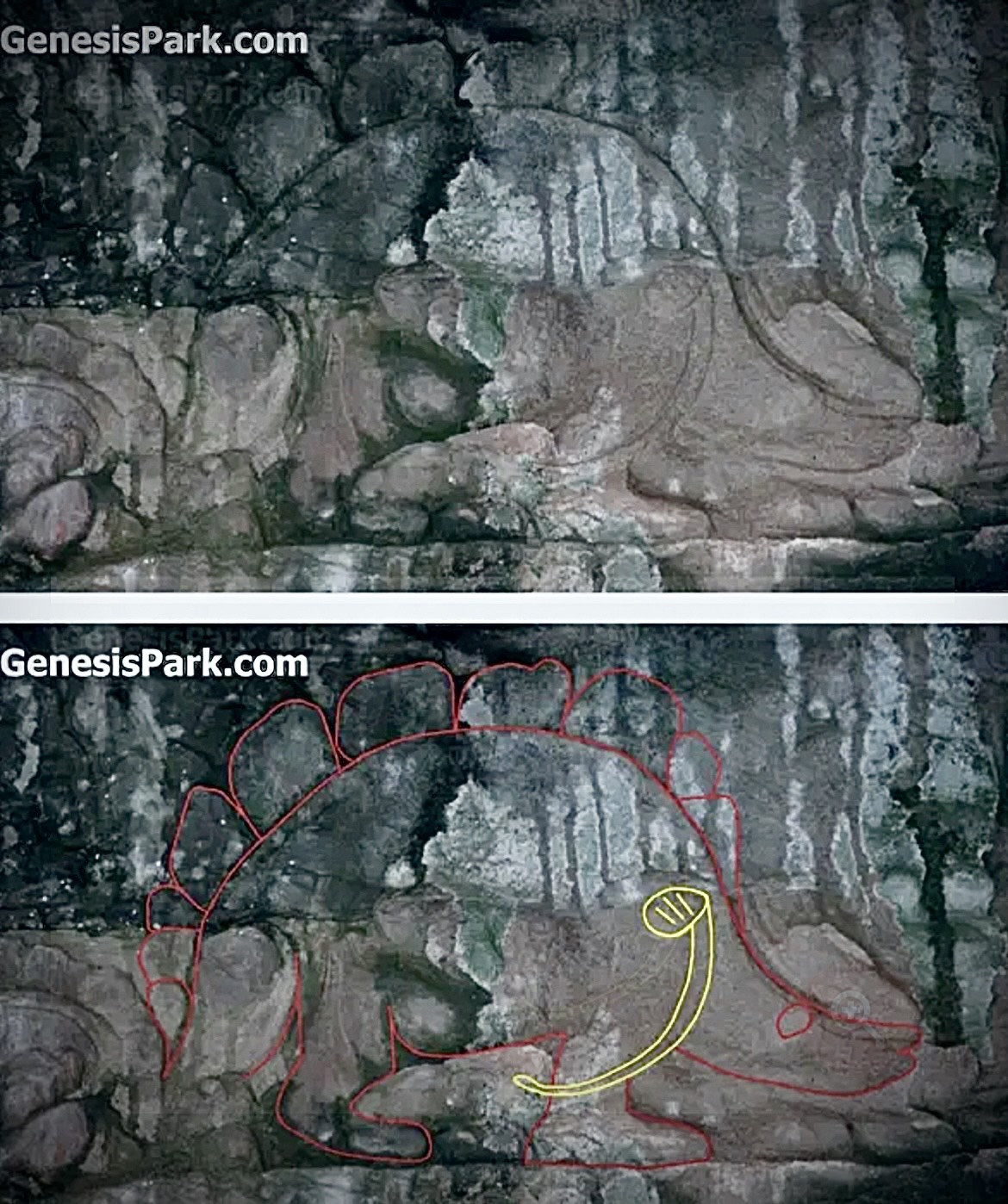
A carving on a temple wall shows an animal with a row of vertical plates along its back, sharply resembling a Stegosaurus. Some arguments have been levied against this claim but they’re hardly worth covering as most, upon seeing it, know exactly what’s being depicted. It’s not a porcupine.
Dale Pollard
The Ta Prohm Temple Stegosaurus
Location: Angkor, Cambodia
A carving on a temple wall shows an animal with a row of vertical plates along its back, sharply resembling a Stegosaurus. Some arguments have been levied against this claim but they’re hardly worth covering as most, upon seeing it, know exactly what’s being depicted. It’s not a porcupine.
In addition to that well-known stegosaurus carving, the existence of a second, lesser-known relief can be found in the same complex. This carving is larger and more eroded but the features of a stegosaurian dinosaur are clear enough. A bulky body, dorsal plates, and tail are easily made out— along with something else. Interestingly, the head appears elongated and slender in comparison to the first making it more realistic, but it’s what’s on the head and neck that you’ll find amazing.
An unusual feature around the neck shares uncanny similarities to a bridle or harness— suggesting domestication. The work that could (hypothetically) be done with an animal of that size is fascinating to think about. Perhaps it could even explain the massive amounts of stone which were moved to complete the temple it was carved into. Many don’t realize that the volume of stone used at the Angkor Wat complex is greater, proportionally, than even the largest pyramid on Giza plateau in Egypt. But back to the stegosaurus bridle. The evidence is mainly that it mirrors other carvings around Ta Prohm depicting bridles on horses, elephants, and oxen in the same manner.
The Triceratops Rider
Location: Acambaro, Mexico
A clay sculpture depicting a human figure riding a Triceratops was discovered in 1944. This piece is part of a larger collection of around 33,000 ceramic figurines near Acámbaro, Guanajuato, Mexico, by a German man named Waldemar Julsrud.
In the 1950s, Professor Charles Hapgood investigated the site and supported the idea that the artifacts were genuine. Apparently, thermoluminescence dating was done in the 1960s and 1970s (don’t ask me how that works) and the results indicated that the figurines might have a pre-Columbian origin.
Could it be that the mainstream evolutionary timeline is that blatantly false? The author obviously believes that to be the case. Humans and dinosaurs walked the earth at the same time. While some were predators that our ancestors feared (Job 40-41), it seems that some were also tamed and used in a ways not unlike the ox or horse. Could you imagine?
What does an ancient oriental custom have to do with time management and the appreciation of the preciousness of time? No one can make the connection like Brent. Read more and be challenged by his unique perspective.
Reflections Beneath the Cherry Blossoms on Time, Purpose, and Eternity
Brent Pollard
In a poem, a twelfth-century Buddhist monk named Hoshi Saigyo stated that the cherry tree, or Sakura, only had one problem: it caused people to gather. Saigyo was undoubtedly referring to the ancient practice of hanami, which translates as “flower viewing.”
Indeed, people have gathered to view the lovely sakura blooms since at least the Heian period (794–1185 AD). Regarding motivation, the Japanese value the ephemeral quality of all flowers, especially cherry blossoms.
Each year, the Japanese Meteorological Corporation releases a calendar that estimates the bloom dates for sakura, reflecting Japan’s cultural reverence for impermanence. While the residents of Japan’s northernmost climes, such as Hokkaido, usually have to wait until the end of April or the first of May to see sakura flowers, people in Okinawa come together as early as mid-January to view the hikanzakura—also known as the Taiwan cherry—blossoms. Outside of the cherry trees gifted from Japan within the Tidal Basin of Washington, D.C., or the same variety of cherries planted in sufficient numbers for Macon, Georgia, to host the International Cherry Blossom Festival, one wishing to emulate the practice of hanami might well substitute another flowering tree, such as the plum or dogwood.
Some Japanese are so committed to hanami that they will travel throughout Japan’s 47 prefectures to catch the various cherry blossom spots. As for what hanami entails beyond the camera, one brings all the accouterments of a ground picnic: blankets and bentos (lunch boxes). Should you wish to participate in the celebrations, please be advised that some locations are so popular that people camp out early to secure a prime viewing spot. The most beloved of these blossoms is the Somei Yoshino, or Yoshino cherry—a variety whose pale petals are as fleeting as they are breathtaking.
In Japanese culture, the cherry blossom season marks the beginning of numerous significant life transitions. Since the academic and fiscal years begin in the spring, sakura is often associated with new responsibilities, personal growth, and the transition into adulthood—a theme not unlike the “season for everything” described in Ecclesiastes 3. It is common in Japanese films or anime to show two characters—possibly destined lovers—meeting beneath the cherry trees, their encounter tinged with beauty and impermanence as delicate pink petals fall around them. Such moments may seem mystical, but they reflect a more profound truth: Life moves quickly, bringing opportunities we must seize or let slip away. For Christians, this symbolism echoes the call to live purposefully and steward each season well—particularly those that signal the beginning of new responsibilities or callings.
The well-known Latin phrase carpe diem, meaning “seize the day,” may serve as a fitting analogy for the Japanese passion for flower viewing. Those of us in Christendom can better understand this concept through the eyes of the wise King Solomon. In Ecclesiastes 9.10, Solomon says, “Whatever your hand finds to do, do it with all your might; for there is no activity or planning or knowledge or wisdom in Sheol where you are going” (NASB95).
In other words, as the beauty of the sakura flower is fleeting, so too are our lives (see James 4.14). Though perhaps unspoken, the practice of hanami reminds participants of the impermanence of life, teaching us to hold what we have with reverence. In this way, hanami reflects a deeply rooted Zen sensibility that embraces transience not as a cause for sorrow but as an invitation to be fully present. For those of us shaped by Christian thought, this quiet awareness harmonizes with the wisdom of Ecclesiastes: that life, though brief, is to be lived with purpose, gratitude, and wholehearted devotion (see Ecclesiastes 12.13-14).
Given this potentially upsetting truth for some, it is clear how important it is to manage our time effectively. In the context of Ephesians 5.15-17, the Apostle Paul suggests that we make the most of our time by walking—or acting—wisely. Moses tells us in Psalm 90 that we are likely to live 70 years, but if we are strong, we may live to 80 (Psalm 90.10). Even so, there is no guarantee. Each of us has a set appointment with death (Hebrews 9.27) unless God’s will allows the second coming of Christ to occur first.
Thus, would you hoard the Gospel’s sacred treasure? How quickly could you overcome procrastination if you knew tomorrow would never come? How soon would you mend your broken relationships? Would you remain silent in the face of the wicked’s schemes? The questions linger—sobering, urgent, and real.
Indeed, the words of Laura E. Newell from the hymn “As the Life of a Flower” ring true: “As the life of a flower, as a breath or a sigh, so the years that we live as a dream hasten by; true, today we are here, but tomorrow may see just a grave in the vale, and a memory of me.”
Juliana Koepke was 17 years old when she boarded a flight with her mother and 90 other people in Lima, Peru, on Christmas Eve, 1971. The plane had a terrible service record and her father urged his wife and daughter to wait for a better one, but they wanted to be reunited for Christmas. That was the disposition of the airline and flight crew, too. So they pressed on, even as severe weather stood between them and their arrival at Iquitos. A lightning strike broke the plane apart, ultimately killing every crew member and passenger except Juliana. She survived a fall of 10,000 feet, landing in the Amazon Jungle still strapped to her seat.
She suffered a broken collar bone, deep gash in her arm, an eye injury, and a concussion. The near-sighted Juliana lost her glasses and one of her sandals. She then walked through the dense Amazon Jungle for 10 days and finally found shelter in a hut that night. Local fishermen found her and took her by canoe to civilization. She used the survival skills her parents had taught her since early childhood and combined it with her sheer will to survive. Now 70 years old, she continues her parents’ work of biological research to this day in the same jungle where she survived the crash. There were things she had no influence over that helped her survive the initial crash, and the help of others was indispensable to her survival. But being saved from death, she didn’t give up until she was ultimately rescued.
Don’t you think our circumstances are similar, in a figurative sense? We didn’t influence God’s eternal plan of salvation, but we can benefit from it. We will not be saved without the influence and assistance of others along the way. But being saved from death, we can and must endure to the end (2 Tim. 2:12; Heb. 10:36). If we do, we will experience an eternal rescue. God wants to rescue every one of us from spiritual death (Gal. 1:4). But He won’t save us without our cooperation!
In Belfast, Ireland, in the Spring of 1909, approximately 20000 workers began construction on a ship for the White Star Company of which U.S. mogul J.P. Morgan was a major stockholder. This vessel was designed to be bigger and better than anything currently out there on the market. When completed three years later, it would measure an impressive 10 decks high and three football fields long.
This ship was named the RMS Titanic and was lauded worldwide for its grandeur. Superlatives such as opulent, luxurious, elegant, lavish, grand, and elegant were used to describe it. Ticket prices ranged from $35-$4300. It could accommodate 1500 passengers and 750 crew members.
On April 10, 1912, it set out on its maiden voyage from England to New York. Within three hours, the bow was submerged and chaos ensued as people were scrambling to get on one of the 16 lifeboats or four collapsible boats. Only one ship, The Carpathia, responded to distress signals in those early morning hours and it picked up as many Titanic passengers as possible. The rough waters and frigid temps made survival difficult.
By daybreak on April 15, 1912, the world was waking up to news of the worst maritime disaster in history. The New York Times headline read: “Saved–866 Probably Drowned–1254.” In the days that followed, final estimates recorded 32% survivors and 68% fatalities.
I would imagine that 99% of the 2200 souls onboard the Titanic thought they were totally safe before the iceberg pierced the right side of the hull just below the waterline. How many of the 2200 were spiritually prepared for possible death? How many of us are?
If there were to be a newspaper headline following Judgment Day, which column do you want your name? Saved or lost? I think of the Book of Life somewhat as a headline. Revelation 20:12-13 says that those whose name is not written there are cast into a lake of fire. Matthew 7:13-14 tells us about the broad gate that leads to destruction or the narrow gate that leads to life.
Later, in Matthew 7:21, it tells us that not everyone who thinks they are going to heaven will enter the kingdom, but those who do the will of the Father. Jesus says in John 14:6, “I am the way, the truth, and the life. No one comes to the Father except through Me.” We are not promised tomorrow, but we do have the here and now.
God offers each of us a “lifeboat” like no other with His Holy Word. It is up to us and our free will if we will accept His invitation and desire for us to be part of His heavenly home. The good news is each of us, as long as we have breath, have the ability to “write” our final headline of lost or saved. 2 Peter 1:10 tells us to make our calling and election sure, whether the need is to get into our heavenly lifeboat or adjust our life vest.
Each Year towns and cities all over the country participate in New Year’s Eve parties and parades. One in particular is called the Tournament of Roses parade. Several years ago one of the floats that had entered in sputtered and died right in the middle of the parade. Turns out it was out of gas. The whole parade was held up until someone ran to get a can of gas. The amusing thing was this float belonged to the “Standard Oil Company.”
Despite its vast resources the float still ran out of gas. Even though Christians have access to almighty God, if we don’t dedicate our lives to Him, we will run out of Power.
It doesn’t matter who you know, it matters what you do. Someone once observed that a wasted life is really nothing more than a collection of wasted days. As God gives us life, each one of us starts the new year with the same number of opportunities—365—that we can choose to either use and invest in eternal things or allow to drift by without taking advantage of the gift we have been given.
The difference between those who succeed and those who fail is not found primarily in talent but in diligence and effort. And so the question we should constantly be asking ourselves is, “what are we doing with this new year?” Biblical Christianity requires growth. If who you are now (January 11th) is the same as you were last January, something must change!
God expects us to grow, and if we aren’t growing we have become complacent. So what will we do with this new year? We have the resources, we have the opportunities, so what’s stopping us?
I believe what happens to many of us is we don’t know where to start. We want to be better so we make a plan to read the Bible through in a year. Then we hit Leviticus and it goes out the window. We resolve to pray more and our lives get so busy we forget. We have got to better ourselves since we know it must be a priority, but what are some ways we can be better in 2024?
I’m glad you asked! Here are 6 ways to be better in 2024 from Philippians 4:1-9. Chapter four is where Paul brings everything to a point. Every example, every command, every prayer and request has been said in anticipation of this chapter. Paul desires nothing more than unity for this church at Philippi. He used Timothy, Epaphroditus, Christ, and himself as examples of humility and service because that is what it takes to be united as a body.
Paul gives us ways we can be better as individuals and as a church family:
Stand firm (1)
Work Together (2-3)
Be Joyful (4)
Learn To Be Gentle (5)
Pray More (6-7)
Control Your Thoughts (8-9)
Make this new year a time of growth as a Christian. Let’s be better!
Gunnar Garfors is the youngest “hobby traveler” to have visited every country in the world. He’s written a book about it, entitled 198: How I Ran Out Of Countries. I have not read the book, but his website offers a very interesting article on The 25 Least Visited Countries in the Whole Wide World. Guess which one is least visited. He tells us, statistically, it is Nauru, a Pacific island country with no capital and no armed forces. It is 8.1 square miles in size, having only 10,000 inhabitants. They have the world’s highest level of type 2 diabetes and the highest obesity rate in the world (97% of men and 93% of women are overweight or obese). It has no seaport and no daily news publications. Perhaps some or all of these factors lead this country to be most frequently avoided by travelers, but somebody has to own that distinction (read more here: Independent UK, BBC, and Gunnar Garfors). Perhaps none of these facts inspire you to work to help Nauru lose its notorious tourism distinction.
Robert Frost wrote his famous poem about the two roads which diverged in a yellow wood. He took the one less traveled by, and that made all the difference. It appears he may have actually stood before such a fork, but he used the experience to speak metaphorically. We can all appreciate this figurative choice. We must choose a path in life, and the one we choose does make all the difference!
Jesus uses such a metaphor to describe the way of life we choose on this earth. He says, “Enter through the narrow gate; for the gate is wide and the way is broad that leads to destruction, and there are many who enter through it. For the gate is small and the way is narrow that leads to life, and there are few who find it” (Mat. 7:13-14). In this familiar passage, He gives us multiple reasons why we should take His way.
Its aim (“leads to life”).
Its alternative (“leads to destruction”).
Its autonomy(it is a road each one chooses to “enter through”; it is not arbitrarily chosen for us).
Its assumption (one must choose between these two, and no other, ways).
Its accessibility (it can be “entered” and “found”).
Its attainability (Jesus says “few” find it and not “none” find it).
Its associability (one is not absolutely alone, for there are “few” rather than “none”).
Jesus compares our brief time on this earth with a road trip. We are not fated to stay on the broad way, but we are not unconditionally guaranteed a spot on the narrow road. As Frost surveyed the two paths and made his choice, so must we. Jesus says we make this decision daily (cf. Lk. 9:23). And our choices determine which path we are traveling. Be deliberate and prepared for this arduous journey that terminates all too quickly. The right choice is the one less taken and most avoided, but take it anyway!






 The Preacher Pollard Blog