The argument is often made that biblical writers ripped off much older myths and adapted them for a monotheistic faith. The problem with this is that, while creation order and chaos are indeed reflected in many of these legends, that’s basically where the similarities end.
Gary Pollard
“Chaoskampf” is a prominent theme in the myths of Babylon, Egypt, Canaan, Greece, and even the Norse sagas. It’s also in our Bible, but with obvious differences. In the Babylonian tablets collectively called the Enuma Elish, creation begins with a great battle. Marduk defeats Tiamat, a sea goddess who represents chaos. He fashions the heavens and the earth from her remains after defeating her in battle. In Canaanite myth, Baal battles Yam, the sea god, also a symbol of chaos. In Egyptian stories, Ra must overcome the serpent Apep every night—a coiling monster of darkness and disorder (and don’t forget Osiris/Seth). In Norse mythology, at the edge of the world lies Jörmungandr, the world serpent, who they said will one day rise in Ragnarök, the day of final chaos. In Greek mythology, the Titans battle the Olympians and the victors reorder the destroyed world.
The pattern is the same: a divine being, representing order and stability, faces the chaos of the sea, often personified as a serpent. Genesis 1 is greatly simplified and much cleaner — “In the beginning God created the heavens and the earth. The earth was formless and empty, and darkness covered the deep waters. And the Spirit of God was hovering over the surface of the waters.” The great patriarchs were raised in these traditions: Abraham was from Ur of Babylonia, and Moses was raised and educated in Egypt. Asaph wrote, “With your great power you split open the sea and broke the heads of the sea monster. Yes, you smashed the heads of Leviathan and left his body for the animals to eat. You make the springs and rivers flow, you make the rivers dry up. You control day and night. You made the sun and moon. You set limits for everything on earth, and you created summer and winter” (Ps 74).
The argument is often made that biblical writers ripped off much older myths and adapted them for a monotheistic faith. The problem with this is that, while creation order and chaos are indeed reflected in many of these legends, that’s basically where the similarities end. Unlike other cultures, whose myths are all about cosmic battles between gods, Moses and Asaph speak of the unchallenged power of the God who tamed the seas and chaos with just his words.
Revelation ties this theme up nicely. John says, “Then I saw a new sky and a new earth. The first sky and first earth had disappeared. Now there was no sea. And I saw the holy city, New Jerusalem, coming down from God, down from the sky.” The detail about the sea might seem out of place, but it’s not. “Sea” was often synonymous with chaos, violence, death, and fear. It was personified as a great enemy that had to be defeated. On New Earth, tehom — chaos, the abyss, Tiamat, Leviathan, the sea — is finally gone forever.
Three quick things:
Chaos is nothing to panic over. We serve the God who calmed the seas with a word (Mk 4).
God can and does bring order from chaos. Our life might feel “formless and void” but God will ultimately bring order and beauty (Rom 8).
God has already won — the sea is on borrowed time, Leviathan has lost.
The Sahara desert is one of the driest places on the planet, but the fossils of large aquatic creatures were found buried beneath the sand. In the late 19th century, the paleontologist Othniel Charles Marsh made some interesting remarks regarding the remains of the Hydrarchos; a large serpentine monster found near Cairo, Egypt, by Albert Gaudry, in a place dubbed The Valley of Whales.
This region also happens to be one of a few places speculated to be near Job’s homeland— Uz.
During one of his many colorful descriptions to the public, Marsh allegedly speculated that the remains of Hydrarchos could be linked to the creature mentioned in the book of Job— the Leviathan. It should be noted that he may have also made the same claim about other fossil remains and that this was commonly done during a period referred to as “The Bone Wars.” It should also be noted that other specimens of the Hydrarchos were found around the same period in North America as well.
It wasn’t long before the identification of the fossil remains were put under scrutiny and the reptile classification that was originally assigned to Hydrarchos was changed and it was moved into the whale family.
This change didn’t come about because the specimen had been studied closer and a blowhole was found; the change in its classification was far more trivial. They figured its teeth were more like those of a whale and less reptilian in nature. Yet, when you look at the teeth and compare them to a whales you run into a few challenges.
First, a whale can have a variety of different teeth depending on the kind. Some whales use their “teeth” as a filter for krill while others, like the orca, use their teeth in a more shark-like fashion. Secondly, the teeth of the Hydrarchos not only appear reptilian but even modern paleontologist suggest that it used its teeth like a Mosasaur— an extinct aquatic reptile.
In short, whales don’t all have the same teeth and some don’t really have teeth at all. However, crocodiles and monitor lizards and other examples of dinosaurs have teeth just like or very similar to that of the Hydrarchos. It seems to be a weak reason to change classification, at the very least.
One might assume that Othniel C. Marsh was a religious paleontologist since he drew biblical parallels, but that’s perhaps the most interesting part. Marsh was an early proponent of Darwin’s hypothesis of evolution— yet he still made the comparison.
The exact identity of the Leviathan isn’t known and this article isn’t an attempt to convince the reader of that either. It’s simply to showcase an example of a creature that closely resembles the one detailed by God in Job 41.
“Who can strip off his outer garment? Who would come near him with a bridle? Who can open the doors of his face? Around his teeth is terror.”
V.13-14
Of course, many don’t need a fossil to believe that a creature that God said existed is true. Leviathan was real. The question is— did we find it?
For some strange reason cultures all over the world have long had an obsession with snakes. Of all creatures in the animal kingdom to worship, the serpent certainly doesn’t make logical sense for a plethora of reasons. The Bible opens with the craftiest beast of creation tempting the woman and successfully bringing about the destruction of mankind. The serpent didn’t have a great track record but somehow managed to become a god that was loved by thousands not long after the flood. We find cultures all over the world who at one point dedicated their entire lives to strikingly similar serpent-like gods.
If we were to look at these eerie similarities through a biblical lens, things begin to make sense. Even though the consequences of that first sin led to death and the entropy of all things, the serpent was still crafty enough to lead the human race to fall. It’s not clear why the snake became a prominent early global symbol but one doesn’t need to stretch the imagination too much in order to develop a convincing theory.
Satan still roamed the earth– Adam and Eve were merely his first victims.
COMPARATIVE SERPENT MYTHOLOGY
Assyria
Ningishzida (Sumerian: 𒀭𒊩𒌆𒄑𒍣𒁕NIN-G̃IŠ-ZID-DA, meaning “Lord [of the] Good Tree”) was a Mesopotamian deity of vegetation, the underworld and sometimes war. He was commonly associated with snakes. Like Dumuzi, he was believed to spend a part of the year in the land of the dead. It’s worth noting that the Sumerian legends sprang up in ancient Mesopotamia— which is where the Genesis account originated.
South America
Quetzalcóatl, Mayan name Kukulcán, (from Nahuatl quetzalli, “tail feather of the quetzal bird [Pharomachrus us mocinno],” and coatl, “snake”), the Feathered Serpent, one of the major deities of the ancient Mexican pantheon.
Ancient Rome
Glycon (Ancient Greek: Γλύκων Glýkōn, gen: Γλύκωνος Glýkōnos), also spelled Glykon, was an ancient snake god. He had a large and influential cult within the Roman Empire in the 2nd century, with contemporary satirist Lucian providing the primary literary reference to the deity.
Norse Legend
In Norse mythology, Jörmungandr (Old Norse: Jǫrmungandr, meaning “huge monster”), also known as the World Serpent (Old Norse: Miðgarðsormr), is a sea serpent, the middle child of the giantess Angrboða and Loki.
India
Shiva is also known as Nageshwar, meaning lord of the snakes. There are temples dedicated to Shiva across the country.
In the eastern religions of Hinduism, Buddhism and Jainism, a mythological semi-divine race known as the naga (Sanskrit for “serpent”) took half-human, half-cobra form—although they could shift shapes to fully take on one or the other. The Hindhu god Brahma was said to have banished the naga to their underground kingdom when they overpopulated the earth.
North America
Many old native tribes in America worshipped a horned serpent creature and evidence of this is not only found in oral traditions that have been passed down for thousands of years, but also seen in paintings on rocks in New Mexico, Utah, and Alabama.
Among Cherokee people, a Horned Serpent is called an uktena. Anthropologist James Mooney, describes the serpent creature:
“Those who know say the Uktena is a great snake, as large around as a tree trunk, with horns on its head, and a bright blazing crest like a diamond on its forehead, and scales glowing like sparks of fire. It has rings or spots of color along its whole length, and can not be wounded except by shooting in the seventh spot from the head, because under this spot are its heart and its life. The blazing diamond is called Ulun’suti—”Transparent”—and he who can win it may become the greatest wonder worker of the tribe. But it is worth a man’s life to attempt it, for whoever is seen by the Uktena is so dazed by the bright light that he runs toward the snake instead of trying to escape. As if this were not enough, the breath of the Uktena is so pestilential, that no living creature can survive should they inhale the tiniest bit of the foul air expelled by the Uktena. Even to see the Uktena asleep is death, not to the hunter himself, but to his family.”
Africa
Nehebkau was an Egyptian god depicted as half serpent and half man. Egyptian reliefs and figurines show snakes walking upright like a man, upright with wings, and even as a man with the head of a snake.
Commonly worshipped in the Egyptian 2nd dynasty of ancient Egypt, also known as the Remesside period. Nehebkau has been documented as being worshipped since aprox. 1900 BC— about the time Abraham and Sarah entered Egypt for the first time.
Mamlambo is one of the many gods mentioned in South Africa and Zulu mythology, the “goddess of rivers”, described as a large snake-like creature. There have been several eyewitness accounts of this massive serpent through the years but no tangible evidence.
Europe
Eglė the Queen of Serpents is one of the best-known Lithuanian fairy tales with many references to Baltic mythology.
SERPENTS & ARCHEOLOGY
Serpent Mound Ohio
The Great Serpent was an alleged source of spiritual power that a widespread pre-Columbian culture could call upon to aid them in hunting and even to curing illnesses. In Adams County, Ohio, you can find the largest surviving effigy mound in the world, and it takes the shape of a serpent. From a land based perspective the site doesn’t look like much, but from the air a massive 1,348 foot long snake reveals itself.
The Shaman Staff
In the 1950s a group of ditch diggers on the shores of Rautajarvi Lake in southwest Finland uncovered something unusual— a wooden staff carved into the shape of a serpent. The 4,400-year-old artifact was discovered in a wetland, and is believed to be an ancient shaman’s staff.
A Mysterious Mask
In Mexico at the site of the Pyramid of the Sun, archaeologists dug a 380-foot-long tunnel in the 1930s. In 2011, anthropologists used this tunnel to reach the mother-rock at the bottom of the shaft. There, they discovered a rare cache of treasures including three serpentine human figurines, and an emerald green serpentine mask.
WALKING-SNAKE FOSSIL
Scientists widely accept that snakes originally began with two legs then evolved over millions of years (so they say) and grew two more. There’s no fossil evidence for a four legged snake, but the skeletal remains of a two legged snake have been found. It’s been dubbed Tetrapodophis. A Yale PhD candidate, Daniel Field states that early snakes were, “…stealth hunters and nocturnal. With two small hind legs complete with ankles and toes…”
THE ISHTAR GATE
The Ishtar Gate in Iraq is an enormous burnt-brick gate which loomed over the main thoroughfare of ancient Babylon. It has depictions of hundreds of lions, bulls, and a strange looking four legged snakelike dragon. Interestingly, the back legs of the serpent have claws— just like the fossil of the Tetrapodophis. According to the Mesopotamian Museum of Art, the dragon represented the Babylonian god, Marduk.
EXTRA BIBLICAL REFERENCES
Herodotus casually mentions that there were snakes that would fly from Egypt every year from the Sinai wilderness (Herodotus 2.75-76). This may strike fear in the heart of any snake-fearing person, but it sure is interesting.
Marco Polo would also write in his travel log about flying venomous “birds” as well as snakes of gigantic proportions as he explored Asia. It could be that ancient eye witness reports of flying snakes of the ancient world were pterosaurs. Biblical categorization of animals and our modern binomial nomenclature are different. In Genesis, all creatures dwelling in the oceans were created on the same day and called fish. That includes whales, which we place in the mammal family since they breathe air. The Hebrew word for fish is the word “dag” but it could be used to describe a water dwelling reptile or mammal as well.
SERPENTS IN SCRIPTURE
Snakes on Fire
The Bible records several strange serpents and one passage in particular is especially fascinating.
In the book of Numbers there’s an account that’s made many readers scratch their heads as they wonder what these fiery (possibly flying) serpents are (21:6-9) which God sent to plague the Israelites.
Some have suggested that perhaps the strange description is of a particular kind of venomous snake. Others have made the observation that the Hebrew word for serpent here (Saraph) could be symbolic to indicate their color since it means “burning ones.” Interestingly enough there are bronze colored serpents around today in Australia that are incredibly poisonous. Perhaps there’s something to this based on the Lord’s instruction to Moses to fashion a serpent made of brass. Of course this description could also literally be taken to mean snakes which either breathed fire, or were somehow on fire. God was, after all, punishing people who had complained of their miraculous meals of manna.
The Great Serpent Connected to the Leviathan
“In that day, the LORD will punish with his sword— his fierce, great and powerful sword— Leviathan the gliding (fleeing) serpent, Leviathan the coiling serpent; he will slay the monster of the sea” (Isa. 27.1)
“And he laid hold of the dragon, the serpent of old, who is the devil and Satan, and bound him for a thousand years;” (Rev. 20.2)
The Serpent Defeated In The Battle of Heaven
“The pillars of the heavens quake, aghast at his rebuke.
By his power he churned up the sea; by his wisdom he cut Rahab (Leviathan) to pieces.
By his breath the skies became fair; his hand pierced the fleeing serpent” (Job 26.11-13)
The Horned Serpent
“Dan shall be a serpent in the way, A horned snake in the path, That bites the horse’s heels, So that his rider falls backward” (Gen. 49.17)
Likely referring to the horned viper which lives in the Sahara desert. Its name comes from two prominent scales protruding behind its eyes that resemble horns.
Interesting conversations with godly people are some the best ways you can stir your desire to get into His word more. Studying the Bible will always bring to the surface questions we didn’t even know we had— along with the answers to the most important questions you could ask. Here’s an idea. Find somebody with a wealth of Biblical knowledge and create a shared note on your cell phone or computer. If there’s something on your mind or something you’d like to know more about, it helps to have another brain working to help you get to the bottom of it. It’s also a great way to keep you thinking about Biblical subjects! Below is a portion of a shared note that my brother and I have had for months now (Gary’s input is italicized and correspond with the numbers you see). Thoughts On The Serpent
The serpent was crafty and could walk. Why this animal? Its craftiness seems to be linked with its intelligence (1). When the subject of possession is brought up, demons typically come to mind. The possessor of the serpent (2) seems to change form once again as Satan is described as “walking about on the earth” (Job 1) and traveling to the pinnacle of the temple (Matt. 4.5). Satan’s mobility had improved since the removal of his serpentine legs (3). Could it be that he was never a serpent from the beginning? What if he merely chose the animal for reasons unknown, and used his intelligence to utilize this particular creature’s capabilities. If the serpent changed his form to the Leviathan, then that would be a logical explanation for his mobility in Job (4). A mighty beast, with unnatural intelligence (5) that humans couldn’t tame. This would also explain how humans are able to dominate and tame all animals (Gen. 1.26-28) but weren’t able to tame the beasts in Job.
(1) Rev 12.9; 20.2
(2) Satan is always portrayed as a serpent…except when he isn’t (i.e., cursed to crawl in Genesis, walking in Job 1 & 2, flying in synoptic gospels at temptation of Jesus, moving tactically in I Peter). I have to think that, like the angels, he had the ability to project his consciousness into non-sentient beings (i.e., no free-will override), or disguise himself as humanoid (II Cor 11.14; Gen 3.18; Heb 13.2). We know very little about who/what satan really is, but because he was a fixture in God’s entourage before banished to earth, I have to assume he was a watcher of some kind.
(3) A curse that improves mobility is no longer, by definition, a curse.
(4) God specifically names Leviathan as the pinnacle of his non-human creation. He would not have extolled leviathan if its characteristics were synonymous with the accuser in Job 1, 2. This would also imply a duality of personhood never attributed to satan (i.e., existing as two entities simultaneously). Since this predates Jesus’s arrival by probably 4500 years, satan is likely still in the accuser position in God’s entourage. This would make him a powerful cosmic being with the same abilities other watchers enjoyed. When he became the ruler of planet earth, his power was “chained” or throttled (II Cor 4.4; Eph 2.2; Lk 10.18; Rev 20.1-15).
(5) I was unable to verify the leviathan’s unnatural intelligence, but Job does describe its unnatural strength.
Happy studies! I hope this inspires you to begin your own interesting conversations.
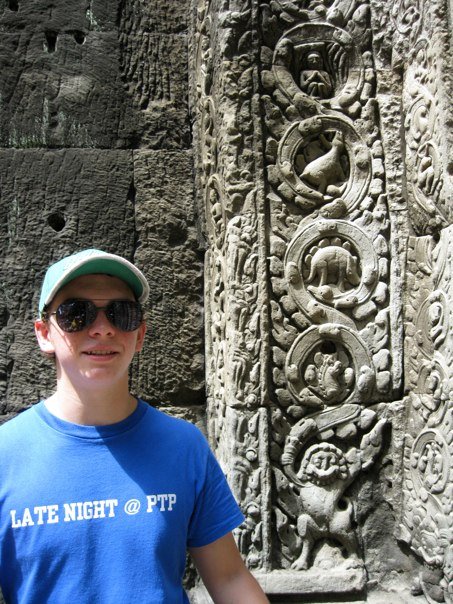
I have been to the Ankgor Wat temple complex, near Siem Reap, four times. It’s a fascinating tourist attraction, but there is one carving, among literally thousands, that stands out above the rest. It is found at Ta Prohm Temple. The temple was built between the late-1100s to early-1200s by King Jayavarman VII and dedicated to his mother. Today, it is “shrouded in dense jungle” and “fig, banyan, and kapok trees spread their gigantic roots over stones, probing walls and terraces” (tourismcambodia.com). “It took 79,365 people to maintain the temple including 18 great priests, 2,740 officials, 2,202 assistants, and 615 dancers” (ibid.). But it’s that stone carving that it most unforgettable. One particular trip, which I made in 2009 with two elders, three deacons, and my oldest son, Gary, stands out in my mind.
I asked our guide, hired out by the Kazna Hotel in Siem Reap and of the Buddhist faith, what he thought this particular creature was. He said he had no idea what it was and added, “They must have had a really good imagination.” The question such a response raises is, “How did they know to imagine that?!”
Well, a group from Canada was following close behind our group of seven from Denver, Colorado. A son asked his father for an explanation of the carvings on the pillar, and dad replied with some authority, “Son, that was their version of a geological timetable.” Of course, it begs the follow up, “How did 12th-Century Khmer people, well before Darwin and others planted their geological seeds, know of such a timetable?” Furthermore, this “timetable” looks nothing like anything you will ever see in a textbook–a man above it and a monkey below it. Based upon what fossil evidence did they create their carving? There must have been hundreds of fellow “explorers” viewing these temple ruins with us in the few hours we were there. Some of the fascinated people spoke in languages I cannot understand, but body language was pretty telling. Others, Americans, British, Australians, and Canadians, all seemed to see that carving for what it most apparently was. No one said, “That’s a rhino or pig.” They called it a Stegosaurus.
How many other similar discoveries await reclamation from jungle vegetation, archaeological excavation, and geographic exploration? In the different disciplines of science and history, man uncovers gems like Angkor Wat’s Ta Prohm from time to time. Such clear, incontrovertible evidence from a time before our modern “war” between evolutionists and creationists begs to be examined with unprejudiced eyes. While some may never change their mind regardless of how many items are offered into evidence, I believe that there are a great number of people out there who are honestly, objectively looking for truth. The Stegosaurus at Ta Prohm near Siem Reap, Cambodia, might be the item that convinces many!
Gary standing next to the column. Notice what/who else is in the carving with the Stegosaurus.






 The Preacher Pollard Blog