Part 1: Moral Clarity in an Age of Antiheroes

To accurately understand Isaiah 5.20 against the backdrop of modern moral ambiguity, it is crucial to comprehend its original historical and literary context…

Brent Pollard

Text: “Woe to those who call evil good, and good evil; Who substitute darkness for light and light for darkness; Who substitute bitter for sweet and sweet for bitter!” — Isaiah 5.20

Expository Background: The Context of Isaiah 5.20

To accurately understand Isaiah 5.20 against the backdrop of modern moral ambiguity, it is crucial to comprehend its original historical and literary context. The prophet Isaiah shared his prophecies during the reigns of Uzziah, Jotham, Ahaz, and Hezekiah, a timeframe of around 740–686 BC. Concurrently, the kingdom of Judah experienced both material prosperity and a concerning spiritual decline.

The Literary Structure of Isaiah 5

Isaiah 5 opens with the famous “Song of the Vineyard” (vv. 1–7), in which God compares Israel to a carefully tended vineyard that produced sour grapes instead of the anticipated good fruit. The vineyard represents the chosen community, whereas the wild grapes symbolize their moral decline, despite being bestowed with plentiful spiritual blessings.

Following this parable, Isaiah announces six “woes” (vv. 8–23) that clearly illustrate how Israel has produced these “wild grapes.” Each lament tackles a particular transgression that had become prevalent in Judean society:

  1. An insatiable craving for acquiring land and possessions (vv. 8–10)
  2. A state of intoxication coupled with a lack of spiritual enthusiasm (vv. 11–17)
  3. Intentional misconduct and ridicule of the sacred (vv. 18–19)
  4. Labeling what is evil as good and vice versa (v. 20)
  5. Excessive pride and unwarranted confidence (v. 21)
  6. Corrupt authority and injustice (vv. 22–23)

The Specific Context of Verse 20

The fourth woe (verse 20) is essential in this list, underscoring its significance. The Hebrew phrasing employs four parallel clauses that form a chiastic, or mirrored, structure:

  • A: “those who call evil good”
  • B: “and good evil”
  • B’: “who substitute darkness for light”
  • A’: “and light for darkness”

This literary device underscores the significant shift in moral standards that occurred in Judean society. The messenger does not reflect accidental ethical ambiguity but rather an intentional and systematic inversion of the divine order established by the Creator.

Historical Circumstances

Archaeological evidence and scriptural records suggest that the land of Judah faced significant social unrest in the eighth century. While wealth increased and an elite class emerged, many people suffered from poverty and oppression. The political alliances of that era required concessions to the customs and beliefs of non-believing nations.

Crucially, in Judea, society developed complex justifications for actions that clearly violated divine laws. The wealthy justified their mistreatment of the poor as vital for economic growth. Religious leaders conformed to local customs to maintain political ties. Social elites altered moral standards to fit their personal goals.

Isaiah 5:20 specifically highlights the changing perspectives on morality within both intellectual and cultural contexts. The Hebrew verb amar, meaning “call,” suggests more than just a personal viewpoint; it denotes an authoritative pronouncement—key individuals were reshaping society’s moral discourse.

Theological Principles for Application

Several hermeneutical principles enable the legitimate application of Isaiah 5:20 to modern contexts:

  1. Divine moral standards are universal: The distinctions upheld by Isaiah testify to God’s immutable nature. What God deems wicked in one age remains wicked throughout all ages.
  2. Patterns of Betrayal in the Covenant: Though we do not belong to ethnic Israel, the New Testament recognizes the church as Israel’s spiritual counterpart (Galatians 6:16; 1 Peter 2:9).
  3. The Influence of Culture on Moral Understanding: Isaiah’s message targets the broader evolution of societal ethical standards, making his warnings perpetually relevant.
  4. The Weight of Leadership Endures: Isaiah’s woes address influential figures who shaped public values. Today, spiritual leaders bear a similar responsibility.


Noah’s Ark And Nisroch

Dale Pollard

The Bible doesn’t say that Noah’s ark landed on Mount Ararat in Turkey, it states that the ark came to rest on the “mountains1 of Ararat” (Gen. 8.4). Ararat is a region which is nearly in the middle of Armenia, between the Araxes and the lakes Van and Urumiah (2 Ki. 19:37; Isa. 37:38) and it’s  called by the Armenians Araratis even today.Some sources say that the ark is somewhere in the surrounding region, like The Book of Jubilees, which makes the claim that the landing location is on Mount Lubar.The very best guesses can be narrowed down by investigating the reliability of the original sources since there are many other mountains that are said to be the resting place of one of the most fascinating mysteries; lost to time or buried by nature. 

There’s a bizarre and interesting link that’s allegedly connected to one of the most famous Assyrian kings mentioned in the Bible. The loud and proud Sennacherib successfully campaigned against seven cities on Nipur, today known as Mt. Judi, on a rampage before his attack on Jerusalem. To commemorate the victories he raised nine stone panels near the top of the mountain and one located at its base. The inscriptions on the stone panels reveal the ego of Sennacherib as he describes himself as “the great king, the mighty king, king of the universe, king of Assyria, and the exalted prince!” He goes on to describe himself as an ibex, spurring on the charge up the mountain, through gullies and mountain torrents and reaching the highest summits. The impression one gets from his inscriptions is that he ventured all over the mountain to destroy those seven cities. The inscription happens to be eerily similar to what God said about him through the prophet, Isaiah (Isa. 37.23-25). Friedrich Bender visited Mt. Judi in 1954 and obtained wood samples from an object that some believe to be Noah’s Ark below the summit.4 This location also happens to be near some of the inscriptions that were left by Sennacherib’s masons. 

The Bible’s account of the Assyrian King’s death is brief but says, 

“And that night the angel of the LORD went out and struck down 185,000 in the camp of the Assyrians. And when people arose early in the morning, behold, these were all dead bodies.

Then Sennacherib, king of Assyria went to his home and lived at Nineveh. 

And as he was worshiping in the house of Nisroch his god, Adrammelech and Sharezer, his sons, struck him down with the sword and escaped into the land of Ararat. And Esarhaddon his son reigned in his place” (2 Kings 19.35-37). 

The Babylonian Talmud commentator expounds on this by stating,5

“Sennacherib went and found a beam from Noah’s ark, from which he fashioned a god. He said: This beam is the great god who delivered Noah from the flood. He said: If that man, referring to himself, goes and succeeds, he will sacrifice his two sons before you. His sons heard his commitment and killed him…this interpretation is based upon the etymological similarity between neser, the Hebrew term for beam, and Nisroch, the god that Sennacherib fashioned from a beam.”

The leading theory and argument against this claim that Nisroch is an idol carved from a beam stolen from the ark is worth noting as it might be due to a simple scribal error. The short version of the argument states that some of the Hebrew letters that make up both Nimrod and Nisroch look similar to one another, so a mistake could have been made. Outside of a possible mention in the Bible, an Assyrian god that goes by Nisroch doesn’t show up in any Assyrian texts. However, if the word Nimrod were the true intentions of the biblical scribes, that doesn’t make the passage any less interesting. 

————————————————————————————————-

1Ararat a region and not a mountain. Schroeder, Thes. Ling. Arm. p. 55. 

2Araratis, “the curse reversed: precipitation of curse”

3CF. Jubilees VIII.21 

4Bender’s samples are far from conclusive and even challenged by other creationist. 

5Babylonian Talmud: Tractate Sanhedrin, folio 96a. Sennacherib inscribed his own image and an account of his ascent on the side of Mount Cudi (Judi). 

Sennacherib’s death is the first time that the Bible mentions “Ararat” again since the account of Noah. 

Isaiah: Trusting The Holy One Who Rules The World (XXXIV)

“What Have They Seen In Your House?” (39:1-8)

Neal Pollard

Isaiah appends an event to the end of his historical interlude which also appears almost verbatim in 2 Kings 20:12-19 and is referenced in 2 Chronicles 32:31. The latter historical book says, ” Even in the matter of the envoys of the rulers of Babylon, who sent to him to inquire of the wonder that had happened in the land, God left him alone only to test him, that He might know all that was in his heart.” The event involves the emerging empire of Babylon, whom their king, Merodach-baladan, sends envoys to visit Hezekiah.

The reception (1-2).  Scripture says the envoys came on a good will mission and Hezekiah received them gladly. Hezekiah showed them everything, his treasure house, all that was in his store houses, and, in fact, “There was nothing in his house or in all his realm that Hezekiah did not show them” (2b). It is hard to interpret Hezekiah’s action as anything other than pride, a display of all that his nation possessed under his reign. Isaiah is going to show Hezekiah the futility of such self-reliant trust.

The rebuke (3-7). Isaiah begins by questioning Hezekiah about what happened. The king reports to the prophet, then Isaiah asks his quotable question, “What have they seen in your house?” (4). Hezekiah says these envoys had seen everything. This prompts the prophetic warning that some day this nation, Babylon, would carry all that is in his house back to their country along with his descendants. They would even be made eunuchs there (6-7). Nothing would be left! Hezekiah’s prideful heart contributed to the future consequences that would be visited on his people. 

The response (8). Hezekiah’s reaction is really baffling. Was he being smug, was he giving God glory, or was he expressing thanksgiving at God’s goodness? Perhaps he is humbled by Isaiah’s message from God that these men he gladly welcomed and showed off for would some day be the means whereby his people would be taken into captivity. 

It is a pretty compelling application to ask ourselves the question that Isaiah asked Hezekiah. What do others see in our house? Do they see parents who look to God rather than possessions, status, and the like? Is that reflected in our choices, making Him a priority as we make our home a place where His Word is the unmistakable foundation and where our actions reflect that we are led by the truths found in it? If we decide poorly, we will negatively impact the generations that follow us. Let’s make our homes a haven where God and His will are clearly trusted and relied upon! 

Isaiah: Trusting The Holy One Who Rules The World (XXXIII)

Learning From Hezekiah’s Prayer (38:1-22)

Neal Pollard

The events of Isaiah 38 are recorded in 2 Kings 20 and 2 Chronicles 32:24. But these events seem to take place before the invasion of chapter 37 (see vs. 6), perhaps to show a contrast between Sennacherib’s failure and murder as he trusts in false gods and Hezekiah’s success and recovery as he trusts in the Holy One who rules the world. The chapter begins with Hezekiah being sick and at the point of death, Isaiah coming into his presence and saying, “Thus says the Lord: Set your house in order, for you shall die, you shall not recover” (1). Rather than accept that this was the final verdict, Hezekiah prays (2). 

  • His prayer is humble (3)–“Please, O Lord.” A correct view of self and our limitations and God and His limitlessness leads to this kind of prayer!
  • His prayer is bold (3)–“Remember how I have walked before you in faithfulness and a whole heart, and have done what is good in your sight.” How audacious to pray such to an all-knowing God! Could I pray that?
  • His prayer is emotional (3)–“Hezekiah wept bitterly.” He had reached the end of himself and reached up desperately to God.
  • His prayer is powerful (5)–The Lord sends word to Hezekiah through Isaiah: “I have heard your prayer; I have seen your tears.” Could there have been sweeter words for this king? What did James say? “The effective prayer of a righteous man can accomplish much” (Js. 5:16b). God assures him that He will add 15 years to his life (5) and deliver him and the Jews from Assyrian invasion (6). God gives Hezekiah a sign to know that He would favorably answer (7-8). 
  • His prayer is grateful (9-20). Isaiah records the beautiful writing of Hezekiah after God heals him. While not a part of the prayer in verse 3, it is addressed to God and reflects on the prayer. He tells us more about what he prayed, and the theme is predominantly gratitude and thanksgiving. After viewing his life as desperate and hopeless before God’s intervention (10-16), he acknowledges God’s greatness and goodness. “It was for my welfare” (17). “In love you have delivered my life…” (17). “You have cast all my sins behind your back” (17). His concluding summary? “The living, the living, he thanks you, as I do this day; the father makes known to the children your faithfulness” (19). As an added note, his prayer is trusting. He confidently ends, “The Lord will save me…” (20).

Isaiah had brought the king word of God’s favorable response and what He wanted Hezekiah to do (21). This is a bad chapter break, ending with Hezekiah’s follow-up question, “What is the sign that I shall go up to the house of the Lord?” (22). Chapter 39 gives the rest of the story and the end of the historical interlude involving Hezekiah. 

Isaiah: Trusting The Holy One Who Rules The World (XXXII)

The Climax Of The Assyrian Threat (37:1-38)

Neal Pollard

So much of the first part of Isaiah has built toward the realization of this threat. Assyria was the subject of the prophet’s inspired warnings, even when the prophets and priests were not listening. Now, with the righteous king Hezekiah on the throne and trusting God, His moment of deliverance has come with which He will show His weak and wayward people that He is trustworthy even when they are not.

THE PRESSURE (1-13). Assyria intensifies its intimidation campaign by reiterating its threats in written form. After the oral threat is relayed to Hezekiah and they convey to Isaiah the distress and disgrace of it all, the prophet reassures him through his message to his envoy that all will be well. Meanwhile, the Rabshakeh reunites with the Assyrian king, Sennacherib, where the latter composes the letter which is dispatched to Hezekiah. Hezekiah takes it and spreads it before the Lord (14). This is undoubtedly the lowest point for the holed up people of Judah, bracing for a deadly siege. The more powerful Assyrians, ravaging nations and now cities within their territory, is on the doorsteps of Jerusalem and the temple. 

THE PRAYER (14-20). Hezekiah acknowledges God’s power as Creator (16), His compassion and deliverance (17), His inclination for justice (18-19), and His ability to save (20). It is full of pleading, as the king calls God “O Lord” five times in these five verses, in addition to “God” three times. It is full of pleas, like “incline,” “hear,” “open your eyes,” “see,” and “save.” It is a call for God to vindicate Himself. The king’s heart and emotion are on full display, as is his total dependence. It is an incredible, if brief, prayer.

THE PROPHESY (21-35). It is harrowing and horrific to imagine what it would be like to be Sennacherib. God turns the attention of His fury on the wicked king who thought to destroy His children! In essence, He says that the pagan potentate attacked Him in going after them (22-23). God noted his mockery and threats (24). He determined his destruction with perfect foreknowledge (24-27). He saw his wicked ways before Him and would turn him back from Jerusalem (28-29).  There is also a sign for Hezekiah and Judah; it “is not of the sort which comes before the event in order to create faith for the event, but rather after the fact to demonstrate that God was indeed at work” (Oswalt, NICOT, 664). When they saw Assyria retreat rather than invade, they would know that God did this (30-35). When they saw their life return to normal and prosperity, they would have opportunity to give credit where it was due. 

THE PUNISHMENT (36-38). The state of affairs change abruptly for Assyria and its ill-fated king. That very night, 185,000 soldiers of the Assyrians are annihilated by the angel of the Lord (36). Sennacherib slinks home, where he is promptly assassinated by his own sons in the act of practicing idolatry (38). Another son, Esarhaddon, takes his place. 

Isaiah: Trusting The Holy One Who Rules The World (XXXI)

The Invasion Of Assyria (36:1-22)

Neal Pollard

There is a historical interlude in this prophetic book, from chapters 36-39. 2 Kings 18-19 and 2 Chronicles 32 are parallel accounts, even filling in some details such as King Hezekiah’s capitulation to Sennacherib’s demand for tribute. The Assyrian king changes his mind and decides for invasion after receiving payment.

This chapter records the perspective and taunts of the Assyrian Rabshakeh (a royal official in their government whose name literally means “cupbearer” but whose role is obviously an important military position; Allen C. Myers, Eerdmans Bib. Dict., 870). He comes against the fortified cities of Judah after having taking off their brethren, Israel, into captivity in a devastating invasion (see 2 Kings 17). It is a frightening situation for Judah and Hezekiah, as they view this “great army” (2). There are several reasons for Judah to be intimidated and afraid.

First, they were greatly outnumbered. Their army numbered at least 185,000 (2 Ki. 19:35). These were vicious, victorious men who had overwhelmed every enemy they had faced.

Second, they were intimidating. The Rabshekah up to the wall around Jerusalem and begins speaking to the Jews there in their native tongue, Hebrew (11). He offers to make a wager with Judah to stake everything on a chariot race, knowing full well Judah was not close to being a competition (8). He contends that Judah couldn’t defeat even a single captain of his army (9).

Third, they were insulting. Not only did they insult Judah, but more catastrophically and foolishly, they insulted God. The Rabshakeh unknowingly compliments Hezekiah’s righteousness by pointing out the good king had removed the high places of worship which God disapproved of (meaning God was pleased with Hezekiah)(7). He equated Jehovah with the gods of the peoples they had already defeated (19-20). Speaking Hebrew rather than Aramaic was as insulting as it was intimidating. 

The Judean officials who received the Rabshakeh’s taunts brought word to Hezekiah. The next chapters reveal his response and Isaiah’s involvement. Hezekiah is handed a five-alarm crisis. It was no doubt bigger than him and left him with precious little to do in response. Have you been there, with your back against the wall facing an earthly enemy much bigger than yourself? It is tempting to resort to responses that do not honor God, but we learn much from Hezekiah in what follows. 

Isaiah: Trusting The Holy One Who Rules The World (XXX)

The Last “Woe” And The Magnification Of The Almighty (33:1-24)

Neal Pollard

Chapter 33 is the last of five “woes” (“ah” in the ESV). It focuses on Assyria’s destruction, the fulfillment of which we read about in chapters 36-39 in Hezekiah’s righteous, faith-filled stand against Sennacherib. This chapter contrasts the incredible fall of the Assyrians with the absolute exaltation of the Lord.

The preamble of the chapter (1) is a warning to Assyria that their days are numbered. They have ravaged, a “destroyer,” a “traitor,” and a “betrayer,” but now they will be destroyed. After this statement, Isaiah reveals what his people will say to the God they remember to trust and lean upon for rescue.

The prayer of Judah (2-6). Notice the contents of the prayer. It is a cry of help–“be gracious” (2). It is a pledge of trust–“we wait for you” (2). It is an expression of praise–“The Lord is exalted” (5). It is a grateful acknowledgement of His greatness–“he will fill Zion with justice and righteousness, and he will be the stability of your times, abundance of salvation, wisdom, and knowledge; the fear of the Lord is Zion’s treasure” (5b-6). When their enemy was removed from before their eyes, they could see God in His full splendor without any obscurities. 

The praiseworthiness of God (7-13). Before this hoped-for deliverance, Judah stared down the prospect of treachery and destruction from the hands of the Assyrian people they had petitioned nations like Egypt to protect them against. That was wrong and foolish. Gary Smith writes, “Four geographic locations are specified: Lebanon, the Sharon plains, Bashan, and the Carmel mountains. These are areas that were renown for their fertility and lush green trees and crops. Now these areas are withered and look more like a desert” (NAC, 356). Judah is languishing in fear and defeat. God says that, in such conditions, they will be better able to see Him in His true splendor–“Now I will arise,” says the Lord, “now I will lift myself up; now I will be exalted” (10). The contrast is stark! The Lord says, “Hear, you who are far off, what I have done; and you who are near, acknowledge my might” (13). 

The perspectives of the wicked and righteous (14-22). What about the sinners in Zion? They’re afraid and tremble (14). What about the righteous? They dwell on the heights with ample bread and water (16). But more importantly, the godly do not have willful sin blinding their eyes to God’s greatness. Not only will they see God in His beauty, they will see the land in its sufficiency, the disappearance of the Assyrian threat, the restoration of the place of worship, and the delivering power of God (17-22). 

The promise of the future (23-24). Despite the abiding threat at the time this is written (23a), things would change. Prosperity would return, sickness would recede, and redemption would be restored. Assyria was going down, and the people should see the goodness and mercy of God in the wake of it. 

185,000 Soldiers Killed By Angel

Dale Pollard

Account: Isaiah, 37:36-38; 2 Kings, 19:35ff; 2 Chronicles 32

A Serious Assyrian Threat: 

Sennacherib is on a campaign to control all routes across the Syrian Desert leading to the Mediterranean Sea. Assyria  had already carried the Northern Kingdom of Israel off into captivity and invaded the southern kingdom of Judah. 

Jerusalem is now under threat of attack and king Hezekiah sends his servants to the prophet Isaiah to ask for prayers on behalf of the people. Yahweh, through Isaiah, tells the people to not be afraid. For as unlikely as it seemed to the surrounded inhabitants of Jerusalem, their salvation would come in the middle of the night. 

“That night the angel of the LORD went out to the Assyrian camp and killed 185,000 Assyrian soldiers. When the surviving Assyrians woke up the next morning, they found corpses everywhere” (2 Kings 19.35).

Sennacherib Cylinder Evidence: 

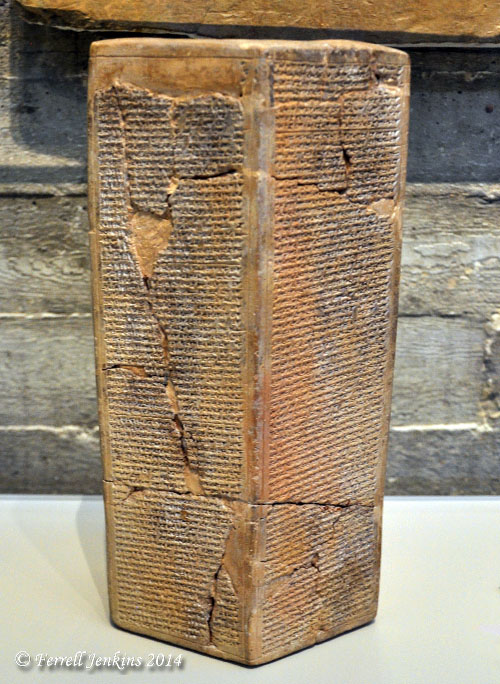
Sennacherib left behind a record of his campaign against Judea and it can still be seen in the British Museum today.

Here’s a translation of his inscription, 

“As to Hezekiah, the Jew, he did not submit to my yoke. I laid siege to 46 of his strong cities, walled forts, and to the countless small villages in their vicinity.  I drove out of them 200,150 people, young and old, male and female, horses, mules, donkeys, camels, big and small cattle beyond counting and considered  [them] spoils. Himself I made a prisoner in Jerusalem, his royal residence, like a bird in a cage.”

Sennacherib claims he conquered all of Judea except Jerusalem.  He also claims that he surrounded the city of Jerusalem with his army, and trapped Hezekiah “like a bird in a cage.” 

Curiously, that’s where he chose to end the story. To continue any further would mean to either fabricate or include a loss of such magnitude that it would tarnish the reputation of a proud Assyrian king.

Succeed In Everything

2 CHRONICLES 31

Dale Pollard

Hezekiah “prospered in everything” (2 Chron. 31.21) because…

HEZEKIAH WAS DETERMINED TO PUT GOD BACK WHERE HE BELONGED (v.2)

”Hezekiah assigned the priests and Levites to divisions—each of them according to their duties as priests or Levites—to offer burnt offerings and fellowship offerings, to minister, to give thanks and to sing praises at the gates of the LORD’s dwelling.”

HE DEDICATED HIMSELF TO SERVICE (v.3)

“The king contributed from his own possessions for the morning and evening burnt offerings and for the burnt offerings on the Sabbaths, at the New Moons and at the appointed festivals as written in the Law of the LORD.”

HE DEVELOPED HIMSELF AND OTHERS (v.4)

“He ordered the people living in Jerusalem to give the portion due the priests and Levites so they could devote themselves to the Law of the LORD.”

HIS DEVOTION WAS DESIRED BY OTHERS v.5-6) 

Israel gave generously until there were heaps of their offerings piled up. 

HE DIRECTED ALL THE GLORY TOWARD GOD (v.8) 

When Hezekiah and his officials came and saw the heaps, they praised the LORD and blessed his people Israel.

He Wasn’t Perfect But… 

What’s written about him in the summation of his life declares that Hezekiah was the last time Israel, or the world, would know a righteous king until Jesus appeared on earth (Matt. 1.10ff). 

“Hezekiah trusted in the LORD, the God of Israel. There was no one like him among all the kings of Judah, either before him or after him. He held fast to the LORD and did not stop following him; he kept the commands the LORD had given Moses” (2 Kgs 18.5-6). 

What Are You Showing?

Brent Pollard

The geopolitical landscape under Hezekiah, King of Judah, saw an increase in the threat from Babylon while Assyria’s influence declined. Hezekiah’s political interests and personal ambitions were intertwined to solidify his kingdom amidst evolving circumstances. When he recovered from a severe illness, envoys from Babylon, a rising power seeking to weaken Assyria, visited him. Overwhelmed with relief and eager to impress his potential new allies, Hezekiah made a critical error.

The scripture recounts in 2 Kings 20.13, “Hezekiah listened to them, and showed them all his treasure house, the silver and the gold and the spices and the precious oil and the house of his armor and all that was found in his treasuries. There was nothing in his house nor in all his dominion that Hezekiah did not show them.” (NASB95) This act of pride had serious future consequences, as the prophet Isaiah sharply points out in Isaiah 39.4 by questioning Hezekiah, resulting in a prophecy of doom for his lineage and nation.

This passage emphasizes the importance of being careful with what we disclose. It encourages us to consider the consequences of our actions, which can affect not only our own but also the fate of the community.

The Dangers of Pride and Showing Off

Hezekiah intended to gain political favor by displaying his kingdom’s wealth, but he also revealed a more profound spiritual issue that the Scriptures emphasize: the danger of pride. The Parable of the Rich Fool in Luke 12.16–21, in which a man obsessed with wealth plans to build larger barns to store his crops only to die the same night, reinforces this New Testament message. Like the rich fool, Hezekiah’s pride in his treasures arose from prioritizing material security over spiritual faithfulness.

When displaying our possessions, achievements, or abilities, we must consider whether they serve a greater purpose or feed our ego. Self-reflection is critical to avoiding arrogance and conceit.

Wisdom in Confidentiality

Hezekiah’s strategic error stemmed not only from his pride but also from his failure to anticipate the consequences of his disclosures. Jesus advised such individuals not to “give what is holy to dogs, and do not throw your pearls before swine, or they will trample them under their feet, and turn and tear you to pieces.” (Matthew 7.6 NASB95) Protecting valuable things, whether spiritual beliefs or important assets, is essential.

The principle of caution prompts us to be careful when sharing information. Sometimes, it is preferable to keep things private to protect ourselves and our communities from potential harm. This wisdom, rooted in scripture, encourages us to consider the possible impact on the larger community before sharing information.

Consequences Extend Beyond the Individual

Isaiah’s prophecy reveals a fundamental biblical truth: our actions have a long-term impact on our descendants and community. The exile of Judah’s elite to Babylon, which Isaiah predicted, exemplifies how Hezekiah’s decisions had severe and long-term consequences. This interconnectedness of fate resonates with Paul’s assertion in 1 Corinthians 12.26, “And if one member suffers, all the members suffer with it; if one member is honored, all the members rejoice with it.” (NASB95)

Acting community-mindedly requires us to consider how our decisions affect others.

Hezekiah’s encounter with the Babylonian envoys underscores the significance of humility, discretion, and foresight in our social dealings. As we navigate life’s complexities, it is critical that we embody these virtues and only show others what honors God and promotes communal well-being. It is imperative to heed Hezekiah’s missteps and aim to make choices that glorify God and enrich future generations. Integrating foresight and wisdom into our daily choices empowers us to enhance our lives and contribute to a brighter world.

What Kind Of “Man” (Or Woman) Are You? (Proverbs 28)

Neal Pollard

The proverbs in Proverbs 28 are still part of the collection of those transmitted during the reign of King Hezekiah well over 200 years after Solomon’s death. They are filled with warnings and instructions, many of them similes. In this chapter, Solomon speaks of various types of men both good and bad.

“A poor man” (3, 6, 11,15). The poor man is not always painted sympathetically, nor is he always approved by God. Solomon mentions the audacious poor man who oppresses other poor people as being a destructive rainstorm (3). But the poor man who walks in integrity is said to be better than the crooked-acting rich man (6). Solomon praises the one who looks after the poor (8). A poor man with understanding is wiser than a rich man wise in his own eyes (11). God condemns wicked rulers who trample over the poor (15). A stingy miser bequeaths poverty to his descendants (22). Giving to the poor does not impoverish a person, but the one who turns his eyes away from the poor is cursed (27). 

“An evil man” (5). This man is also referred to as “wicked” (1,4,12,15, 28), a synonym of evil meaning one who is guilty of a crime and deserving punishment. This evil one is unpleasant and malignant in God’s eyes. In Proverbs 28:5, they are depicted as being as far from God as possible such that they do not understand justice. Keeping with that contrast, law-abiding people fight against the wicked (4). People avoid wicked rulers (12,28), and with good reason (15). Yet, the wicked are full of instability and insecurity (1). Even their prayer is an abomination to God (9). 

“A rich man” (6,11). While the book of Proverbs makes clear, as does the rest of Scripture, that being rich is not inherently evil or wrong, that state of being often comes with caveats and warnings. Paul says, “But those who desire to be rich fall into temptation, into a snare, into many senseless and harmful desires that plunge people into ruin and destruction” (1 Tim. 6:9). Jesus taught, “It is easier for a camel to go through the eye of a needle, than for a rich man to enter the kingdom of God” (Mat. 19:24). He says it is hard for a rich man to enter the kingdom of heaven (Mat. 19:23). In keeping with biblical teaching in other places, Solomon, one of the wealthiest men who ever lived, speaks from experience. Wealth can easily be abused or misused. He can easily trust in himself (11). Several statements about the poor in this chapter show the danger to those who trust in their riches. As Solomon writes, “A stingy man hastens after wealth” (22) and “a greedy man stirs up strife” (25). 

“A faithful man” (20). This man is literally one who is full of faith, steady, trustworthy, honest, and dependable. He is a blessed in his ways. He walks in integrity (18). They fear the Lord always (14). “The one who keeps the law is a son with understanding” (7). They are among the righteous (28). He is not exempt from wrongdoing, but he is faithful to confess and forsake it (13). If he is rebuked (23), he will respond wisely and appropriately.

Character is built thought by thought, decision by decision. It is not dramatic. While there may be defining moments that stand out, it is mostly subtle and gradual. Each one of us is becoming some kind of man or woman, moving in one direction or another. Jesus says it most dramatically, that we are traveling on one of two roads leading to one of two eternal destinies (Mat. 7:13-14). We are not what we wish, hope, or intend to be. We are the product of our choices. God wants us to consider carefully and be faithful (Rev. 2:10).