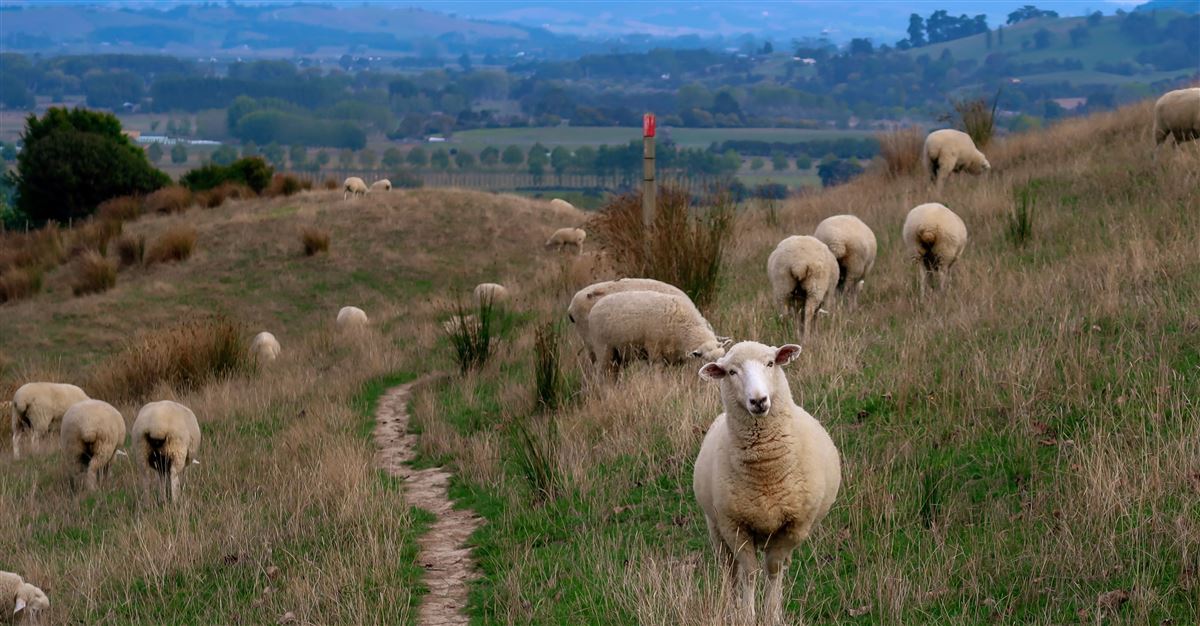
The Shepherd Loves His Sheep

Growing up, our parents would sing us a song with the words, “the Shepherd loves His sheep, and God loves me.” That song has been stuck in my head ever since I started studying John 10.

Carl Pollard

Growing up, our parents would sing us a song with the words, “the Shepherd loves His sheep, and God loves me.” That song has been stuck in my head ever since I started studying John 10. 

In John 10:11, Jesus says, “I am the good shepherd. The good shepherd lays down his life for the sheep.” This metaphor reveals our deep need for His guidance and care, as Scripture compares humanity to sheep—creatures often lacking in wisdom, strength, or direction. For the most part, being called sheep isn’t necessarily a compliment. Notice a few attributes about sheep that are shockingly similar to mankind: 

Sheep are notorious for their lack of direction. An example of this is a 2005 incident in Eastern Turkey, where 1,500 unattended sheep plummeted off a cliff, with the first 400 dying and the rest saved by their bodies breaking the fall. Like sheep, we often follow misguided paths or peer pressure, blindly stumbling into danger without the Shepherd’s guidance. Isaiah 53:6 reminds us, “All we like sheep have gone astray,” underscoring our need for Jesus to lead us.

Sheep are also defenseless, unable to fend off predators effectively. Similarly, we are spiritually vulnerable without Christ’s protection. Matthew 9:36 describes the crowds as “harassed and helpless, like sheep without a shepherd,” highlighting Jesus’ compassion and our need for His safeguarding presence. As Christians, we find strength in unity, sticking together under His care.

Sheep can become “cast down,” stuck on their backs and helpless until the shepherd intervenes. We, too, face moments of being spiritually or emotionally “cast,” unable to rise without Jesus’ help. Isaiah 40:11 assures us that He gathers His lambs and gently leads them, offering restoration when we’re down.

Sheep recognize their shepherd’s voice, a trait we’re called to emulate by spending time with Jesus to discern His guidance (John 10:27). Unlike sheep, we often struggle to listen, distracted by the world’s noise. Additionally, sheep aren’t built to carry heavy burdens, and neither are we. Psalm 55:22 encourages us to cast our cares on the Lord, who sustains us.

Finally, sheep are valuable, prized in biblical times for their resources. Jesus sees us as infinitely precious, sacrificing His life for us (Matthew 25:32). We are also called to embody the innocence of lambs, pure and righteous, rather than the destructive independence of goats.

As sheep, we are directionless, vulnerable, and burdened without the Good Shepherd. Yet, in His care, we find guidance, protection, and purpose. 

Will you run to the Good Shepherd and follow His voice today?

Sheep, Love The Shepherds

Tuesday’s Column: Dale Mail

blond man with goatee smiling at camera with blazer on
Dale Pollard

Though scripture doesn’t say, you can be sure David’s sheep had no idea how lucky they were to have a shepherd like him. They were just sheep after all. How could they fully appreciate the extent that David went to in order to keep them safe? Before this begins to sound ridiculous, let’s remember that at least two of David’s sheep were carried off in the jaws of a lion and a bear. When the terrified bleating of an unfortunate sheep is heard by the shepherd, he sprints after the wild animal knowing all the while— it’s just a sheep. It’s just one sheep! Nevertheless, David strikes the predator and saves the sheep (1 Sam. 17.34-35).  

What made David a good shepherd? It certainly wasn’t his stature. The average male of his day stood around five feet tall. He was also the youngest of his family and often unappreciated (1 Sam. 16.11,17.29,33). It was David’s heart and not his height that made him exceptional. He was a natural shepherd of sheep, and of people. 

David is sent by his father, Jesse, to deliver bread for his brothers who are among Saul’s army. When he arrives on scene everyone, including the king, is afraid and unwilling to take a stand against the arrogant Goliath. But before the giant warrior from Gath meets the shepherd boy from Bethlehem, a few more giants will be faced. 

The first giant was the giant of degradation. 

David’s own brother, Eliab, would greet him with two belittling questions that would make a lesser man feel sheepish, but not this shepherd. Eliab asks, “why have you come down here? And who is watching the few sheep?” David’s brother doesn’t think he belongs among warriors and that he is only capable of handling a small number of dumb animals. 

The second giant was that of accusation.

In the same breath Eliab would accuse and insult David three different times. He claims, “I know how conceited you are and how wicked your heart is. You’ve only come to watch the battle.” How wrong he was and how dare he insult such a godly man! It’s interesting to note that David had an answer to each of these questions and accusations, but never attempts to defend himself. His father sent him, that’s why he was there. He was there to deliver nourishment for this dear brother who had, no doubt, worked up an appetite doing absolutely nothing. No retaliation or snarky remark would escape from the shepherd’s mouth because nothing like that was in his heart (Matt. 12.34).

The third giant David would conquer would be the towering giant of indignity.

He didn’t shame his brother and he didn’t let his brothers shaming keep him from shining. 

Shepherds put up with a lot, don’t they? Good shepherds really put up with a lot. Faithful god-fearing elders within the Lord’s church all over the world are faced with giants more often than they should. Sometimes the giants they face are their own sheep. How easy it is to make confident accusations against them, to question their intentions, hearts, and capabilities. That unpaid servant of God is more often than not the first one to come running when the bleating of a wayward member is heard. When we find ourselves in the clutches of our various trials, they attempt to pry us out. At times they earnestly pray over and take on burdens that aren’t theirs to carry. Faithful elders will find themselves in a position where they could make the sheep feel shame, but choose to save the feelings of others because that’s what a good shepherd does. It’s not their height, it’s their heart. The sheep need to love their shepherds, because the shepherds love their sheep!

Bragging On The Shepherd

Tuesday’s Column: Dale Mail

image-e1601983688162

Dale Pollard

 
Have you ever been in the habit of praying the same prayer over and over again?
You’ve said that prayer as a child and it’s so familiar to you that it just rolls off the tongue. It can seem robotic and maybe this is how we read Psalm 23.
 
Many of us know this Psalm and can quote it quickly— the words fly past our lips. The author, David, practically writes this Psalm like a young boy bragging about how awesome his Father is. Let’s look at this Psalm from his perspective.
 
He says that the Shepherd is always there to protect him, lead him, restore him, and He’s concerned with his needs. He’s nothing without God, and God inspires David to articulate his view of Him.
 
Do we think of God in this way? Some might feel ashamed of Him because standing  up for Christ means saying something or doing something that makes us uncomfortable from time to time. You don’t see that in David. He’s bursting with pride because to him that relationship with the Shepherd is like no other. Today let’s humbly bow in thanksgiving and praise the perfect shepherd.

Elders Who Shepherd

Monday’s Column: Neal at the Cross

IMG_1922

Neal Pollard

There was a problem with the shepherds of Ezekiel’s day. They tended to their own needs, but not the flock’s (34:2-3). There were tangible needs and problems, but these shepherds sinned by omission (34:4). The sheep were scattered and these shepherds did not work to get them back or save them from predators (34:5-6). Then, God through Ezekiel utters these harrowing words: “Behold, I am against the shepherds, and I will demand My sheep from them and make them cease from feeding sheep” (34:10). 

In the New Testament, Paul tells the elders of the church at Ephesus to “be on guard for yourselves and for all the flock, among which the Holy Spirit has made you overseers, to shepherd the church of God which He purchased with His own blood” (Acts 20:28). Guard the flock, watch over the flock, and shepherd the flock. What a weighty work! To be on guard means “to be in a continuous state of readiness to learn of any future danger, need, or error, and to respond appropriately” (Louw-Nida 332). An overseer has the responsibility of seeing to the spiritual safety and proper conduct first of themselves but also of those they watch over (Arndt 379). The idea of shepherding indicates care, concern, love, provision, relationship and intimacy, knowledge, and familiarity (see Kittel et al 902ff). These lexicographers who define what Bible words mean give insight into what elders are to be like as they do this crucial work. Isn’t it incredible and encouraging to see spiritual, albeit inevitably imperfect, men who “aspire to the office of overseer” (1 Tim. 3:1)?

Yesterday is a day I’ll never forget. We tagged along with three elders and their wives as they went around to 26 houses of members of our congregation. Exercising due caution under the current medical crisis, they nonetheless drove to see members young, old, and in-between. They visited with, sang to, and prayed for so many face to face, delivering Dana’s delicious baked goods. Seeing their enthusiasm to do this and watching the genuine joy on their faces as they served and ministered was a blessing that will stoke my spiritual fire for a long time to come. 

But, that’s just what I got to see. I’m not seeing the other times they’ve done this. I’m not there as they’re making so many phone calls to everyone. Over the weekend, they met together for several hours to strategize about a reopening and communication plan not just to get back to “normal” but to thrive and grow as we go into the future. Another of the elders has since spent hours piecing together that plan to provide clear communication to the church. 

All of them work full-time jobs and are hard workers. All of them have families to love and care for. All of them have hobbies and interests. But, all of them have Christ in the center of their hearts and lives. That last fact is what drives them to know about, care about, and reach out to the sheep. 

Thank God for the many churches who are being shepherded through unprecedented times like these by engaged, concerned, and involved shepherds. Church growth, doctrinal soundness, examples of Christ-centered living, and so much more depend on elders who shepherd. Will you take the names of your shepherds to the throne of God each day, imitate their faith, and assist them in their work? They are a vital part of God’s plan to touch and transform eternity! 

elders
Only ten in this group picture!