
TRUTH: FROM CONFUSED TO CONVICTED

Tuesday’s Column: Dale Mail

blond man with goatee smiling at camera with blazer on
Dale Pollard

If you were to flip on the TV and watch a news channel, it can quickly become frustrating. Channels like CNN will often say something entirely different than FOX or vice versa. What’s actually true? Who can we trust? What should we believe? 

Just when your mind begins to become convinced of one thing, you hear or see something that changes your thinking once again. This creates the skeptic, the double-thinker, and the cynic. 

Since a variety of propaganda will always be pushed and those personal agendas will always be hidden, it’s more comforting than ever to read and soak in pure unadulterated truth. So, here are some of those truths we can count on that our found in the Bible. 

  1. God is real and His message to mankind can only be found in every inspired word written in the scripture (2 Tim. 3:16-17). 
  2. The scriptures teach mankind the means by which we are saved and added to His church. God adds us through our action- based belief, repentance, and immersion (Acts 2:42ff, Titus 1:5-11). 
  3. Christians must live faithfully and in accordance to His instructions (1 Peter 1:15). 
  4. The faithful can only truly worship by following the pattern which is demonstrated by the 1st-century church and Apostolic examples (1 Tim. 2:8-15). 
  5. The Bible teaches that one day everyone will walk through the door that leads out into eternity. Whether or not we are lost or saved as we pass through that door will be the determining factor that dictates where our final destination will be (Rev. 20.12).
  6. It’s our Christian duty to ensure that others are aware of this spiritual reality (Matt. 25:46, Ecc. 12:7, 1 Jn. 1:7). 
  7. God can’t lie and every word He wrote is true (Ti. 1:2; Ps. 119:160). 
  8. It’s our responsibility to study His message because it’s the only thing that matters. 

These truths will never change. They are a constant you can count on and we’ve only scratched the surface. It’s crucial that every follower of Christ is convicted and well versed in His Word. This is where and how we find peace and direction. The Bible is the only source that we can rely on  100% and that’s something that’s increasingly hard to find today. 
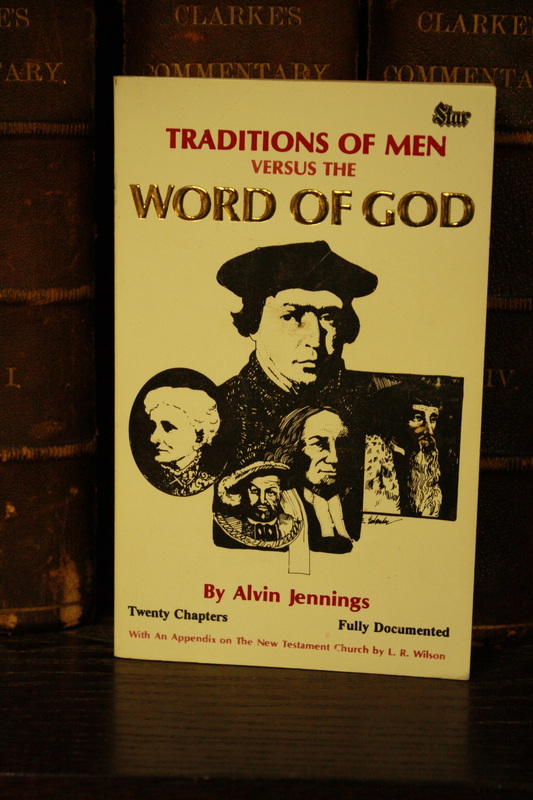
Traditions Of Men Versus The Word Of God

Neal Pollard

For as long as I have been preaching, I have had at least one copy of the Alvin Jennings’ book bearing the title above. The book was originally printed in 1972, but it has been reprinted several times. Jennings clarifies the way he uses the word “traditions” in his title. Rather than the sense of being a writing handed down from God (2 Th. 2:15; 3:6; 1 Co. 11:2), he used the word to refer to “religious laws and traditions originating from the minds of men and handed down orally and/or in printing from generation to generation” (iv.). He rightly points out that such traditions were condemned by Christ (Mat. 15:2-3,6; Mark 7:3,13; Col. 2:8; 1 Pet. 1:18; Gal. 1:14). Some of the problems with these traditions were that they got in the way of obedience to what God commanded, caused negligence regarding and the setting aside of God’s commands, enslaved one to something or someone other than Christ, and created a zeal that could lead to unhealthy consequences. The traditions Jennings examines substituted  false, human ideas for clearly revealed, divine truth. Anything that binds where God has not bound or gives permission where God doesn’t permit must be rejected. It’s a tradeoff with the gravest consequences (cf. Rev. 22:18-19).

However, I hope that as we strive to follow the pattern for New Testament Christianity we will be careful about elevating any tradition to be on a par with Scripture. There are some traditions we may choose to observe (or not):

  • Offering an invitation after every sermon
  • Having worship leaders, including the preacher, wear suits and/or ties
  • Women wearing dresses to church services
  • Songs or songbooks reflecting a particular time period (whether old or new)
  • Mandating a specific Bible version be utilized in the public assemblies
  • Choosing to have an evening assembly
  • Replicating the format of the morning assembly (in lieu of using the time for class, for example)
  • A particular order of worship (including whether the Lord’s Supper precedes or follows the sermon)
  • Offering the Lord’s Supper on Sunday evening
  • Any practice or tradition that arises from expedience or the realm of judgment, but that is not specifically mandated in Scripture

The church finds itself at a crucial crossroads. Undoubtedly, there is nothing new under the sun, but we do find ourselves at a unique place in cultural history. Since we live in an argumentative, rancorous atmosphere fueled by everything from cable news to social media, we should be careful to maintain a spirit of love and kindness whenever we sort through matters like these. We should never cherish non-binding traditions more than we do people. Those of us who are older and presumably more mature should consider carefully where and when we might compromise regarding matters not tied down in Scripture. More than that, we should foster rather than fear an environment that allows for such discussions to occur—without animosity or distrust. This will mean spending much more time developing our relationships with one another on the local church level (across generations). The better we know each other and the more we grow our love for each other, the better equipped we should be to sort through such things. Coupled with serious Bible study, this will hopefully sharpen our ability to distinguish between traditions and truth. May we have the grace to listen to each other without prejudice or minds already made up. Instead or ridiculing or caricaturizing the church in demeaning ways, let all of us “put on a heart of compassion, kindness, humility, gentleness and patience; bearing with one another, and forgiving each other, whoever has a complaint against anyone…” (Col. 3:12-13a). 

s702601590478870340_p115_i1_w533