As a Christian, the gospel you believed is not mainly about escaping hell, it’s about entering eternal life. Immortality is the center of our hope. From the beginning, God formed us for eternal life. The Tree of Life stood in Eden as a sign. Humanity was meant to live, and to walk with God without end (Gen 2:9). Sin broke that design and brought the sentence of death (Gen 3:22-24). Death became the doorway through which grace would one day lead us back to life.
And grace has come. Jesus Christ, the Resurrection and the Life, has “abolished death and brought life and immortality to light through the gospel” (2 Tim 1:10). When He rose, He unveiled the firstfruits of a new humanity, bodies raised imperishable, souls made whole, creation set free (1 Cor 15:42-49; Rom 8:21). The same power that raised Jesus from the dead is the down-payment on our own resurrection (Eph 1:13-14; Rom 8:11).
This is why the New Testament writers spoke with triumph. “Death is swallowed up in victory!” (1 Cor 15:54). The last enemy is defeated, not negotiated with.
What will this immortality feel like? Revelation gives us the clearest glimpse: God Himself will wipe away every tear. Death, mourning, crying, and pain will be former things, remembered no more (Rev 21:4). We will see His face (Rev 22:4). We will know as we are known (1 Cor 13:12). Every longing planted in us by the Creator, longings for beauty, for love, for purpose, for home, will be satisfied beyond imagination, yet never exhausted. Eternity will not be monotonous; it will be the ever-fresh discovery of the infinite God!
The world groans, our bodies weaken, our hearts break, but none of it is the final word. Christ has died, Christ is risen, Christ will come again. And when He appears, we shall be like Him, for we shall see Him as He is (1 John 3:2).
Until that day, let this joy shape everything. Work without despair. Love without fear of loss. Suffer without bitterness. Give without calculation. The clock is broken, the future is secure. We are headed toward a life where sin cannot diminish us, death cannot touch us, and God will be our everlasting light.
This is the joy of immortality: not just that we will live forever, but that we will live forever with Him, fully alive and fully home.
If I asked for a show of hands if you had at least one person in your life that you found difficult to love, some of us, if not all of us would have both hands and both feet in the air. There is no doubt that all of us have people in our lives that are “difficult to love.” This is a natural part of our lives and even more so as followers of Christ because we have different standard of “loving people” than what you find in the world.
I want to dive a little deeper than what usually talk about when this topic comes up. Usually, when he hear this topic, our minds selfishly start pointing blame at others. We may have thoughts like, “Well if they would just have the same opinion as me, everything would be better”, or “man I wish they would get their life together, they’d be a lot easier to be around.”
However, when we observe Matthew and Mark’s account of what Jesus says to the Pharisees in Matthew 22:36-40 and Mark 12:29-31, we find that when Jesus is asked “Which is the greatest commandment?” He says “You shall love the Lord your God with all your heart, soul, and mind. And the second is like it, You shall love your neighbor as yourself.”.
There is a greater context here, but I find it very interesting that when Jesus is asked this question, even though it’s coming from a Lawyer trying to test Him, of all the commandments, Jesus answers with these two. Obviously Jesus find these to be greatly important. First and foremost, you have to Love God. Second, you have to love your neighbor as yourself.
And if we do a little reverse psychology with the second commandment Jesus mentions here, you gotta love your neighbor. To love your neighbor right, you gotta love your neighbor as yourself. To love your neighbor as yourself, you gotta love yourself.
Webster defines the word difficult as -hard to do, make, or carry out; hard to deal with, hard to manage, overcome, or understand. Loving difficult people is……difficult, but loving yourself is a constant challenge. It’s a lifelong battle. If we were honest with ourselves, our disappointment and or disapproval of others originate with that of ourselves. The first step to loving difficult people. In fact, loving yourself is the first step to loving people in general.
Jesus gave us a reason to love ourselves, not in a selfish, prideful way, but in light of our salvation. Our salvation and hope should shine through in love for others. I believe if we study ourselves on a regular basis, cultivating that love that Jesus has shown us, it will bring forth a spirit of natural love for people, no matter how difficult they may be.
We all go through phases in life. Several of us have entered the same phase in life over the past few months with our families…
This phase that has challenged
our honesty,
our health,
our time & money,
it’s taken up space in our house,
it’s even challenged our marriage vows to a certain degree…”in sickness and in health, for better or worse.”
-Sourdough Bread-
All jokes aside, with every phase and experience in our life there is always a lesson to learn.
Just so everyone knows Ashley makes the BEST sourdough bread…now anyway!
When making bread:
You can have the greatest recipe.
Use the right ingredients and follow the directions perfectly.
But if we aren’t feeding that starter daily, which is the base of the bread, then the bread is not going to come out right.
It’s a living thing that needs to be fed everyday regardless of when we plan to use it.
Sometimes Ashley will take a “bread break”, put it in the refrigerator and doesn’t plan to use it for a few days…
It’s still living without being fed, for a while anyways, but it’s not as strong or good as it could be.
So how can we learn a spiritual lesson from sourdough bread?
We can say all the same things about our souls!
We need to feed our souls daily with reading our Bible, with prayer, with fellowship if we want to be and remain strong Christians.
Just because we know the recipe of salvation and have followed all the steps perfectly doesn’t mean that it just stops there.
Our souls are living and need feeding daily!
2 Peter 3:17-18– “beware lest you also fall from your own steadfastness, being led away with error of the wicked; but grow in grace and knowledge of our Lord and Savior Jesus Christ.”
Not reading the word daily can make us weak and unprepared for when wicked things creep into our lives.
Acts 17:11— “they searched the scriptures daily.”
1 Timothy 4:13– “till I come, give attention to reading, to exhortation, to doctrine.”
There are many verses in the Bible telling us to read it and use the scriptures every day.
There are verses we all know by heart and lean on all the time:
2 Timothy 3:16– “All scripture is given by the inspiration of God and is profitable for doctrine, for reproof, for correction and instruction in righteousness.”
It’s useful for us and for others.
2 Timothy 2:15- “Be diligent to present yourself approved to God, a worker who does not need to be ashamed, rightly dividing the word of truth.”
God expects us to work hard in knowing the scriptures and understanding them so we can grow and can teach others.
Hebrews 4:12- “For the word of God is living and powerful and sharper than any two-edged sword…and is a discerner of the thoughts and intents of the heart.
Being in the word, reading daily, feeding our soul the knowledge of God through His inspired writers will keep our hearts and lives on the right path! It will help us grow closer to God and to be ready to teach others about Him.
As it says in Deuteronomy 8:3, Matthew 4:4 “…man shall not live on bread alone, but by every word that proceeds from the mouth of God.” We need the meat of the word to keep our souls strong!
If you struggle with studying and being in the word, as I know I do and probably all of us do, then now is the time to make a change. Put out the distractions in life that keep you from it, try harder to read daily!
Nearly every culture in history hoped for immortality or rebirth or “the transmigration of the soul.” This is evident in the myths and stories handed down for millennia. Ancient Egyptians believed in Duat, the terrifying world of departed souls. Here, among other tests, the departed soul must verify that they’ve not committed certain sins (theft, murder, deceit, adultery, blasphemy, and 39 others). If they passed all of these tests, they believed they’d be reborn among the stars of heaven. Many other ancient cultures had remarkably similar beliefs, but we won’t go into these for the sake of word count.
The point is that everyone desired new life. We have it already! Jesus came to this earth when every major culture had a well-established, fully-developed…problem. What do we do after we die? Just about everyone believed we’d go to “heaven” (among the stars), but their views of life-after-death varied somewhat. Jesus — God in human form — gave a solution to this very well-developed problem: Himself.
We’re so far beyond this archaic conundrum. Colossians 3 tells us what God wants us to do now that we already have new life!
In 3.1-4, our new life means thinking about higher things.
In 3.5-9, our new life means getting rid of bad behaviors.
In 3.11-12, our new life means we have an identity that transcends cultural boundaries because our allegiance is to Jesus first.
In 3.12-17, our new life means we do everything we can to be at peace with each other and pursue a united spirit.
In 3.18-4.1, our new life means that we try to structure our homes and lifestyles in the most functional possible ways.
Our new life is hidden in Jesus. We are already immoral, and death is just the pivotal moment when the “seed” of this body becomes the fully-developed “plant” of a new, immortal body (cf. I Cor 15). Jesus and his inspired writers beautifully and simply answered the millennia-old questions asked by every culture prior to his arrival. We will meet him in the air. He will rescue us when earth is destroyed. We will live with him forever in a perfect new world. No other religion so boldly answers these questions, another evidence of Christianity’s divine origin!
Recently I had the privilege to attend the funeral of a godly man. Since he lived faithfully— it was a celebration. Funerals have a negative connotation with them but they’re really only all bad when the one who’s passed on did so outside of Christ.
You and I may wish for a longer life for ourselves and those we love but the ironic truth for the faithful Christian is this— the first to accept God’s decision of death is the one who died.
The faithful go to heaven and the lost do not. While we enjoy talking about and thinking about those who will and have been eternally saved, it’s just as important to remind ourselves of those who find themselves in the other camp.
It’s easy to forget that people are lost and maybe it’s because they’re easier to push to the back of our minds. It’s not a pleasant thought by any means and doing something about it tends to make us uncomfortable.
It hurts and it’s hard to become attached to anyone who isn’t living faithfully because they’re lost. That means they’re not going to heaven. Sometimes the lost pretend as if that’s not their reality by distracting themselves with the things that make them feel as if they’re not lost (Ecc. 2.24-25).
There’s a good chance that you know people who aren’t going to heaven and it’s even likely that you love people who aren’t. We’ve got to convince them to hear Jesus out— no matter what it takes.
What can we do?
We can simplify spiritual concepts so that people can understand a message that they desperately need to hear. Try to teach Jesus differently. Approach His will for their lives from different angles. How can Jesus help their marriage? Their children? Their addiction?
Please don’t let anything get in your way of going home. Don’t let friends and loved ones who aren’t living faithfully bring you down. Not only do you ultimately lose, but your loved ones outside of Christ have lost their greatest chance of coming into the Light.
Don’t ever lose hope. There may be unique and seemingly impossible odds stacked against you and your mission to convert the lost, but don’t put God in a human-sized box. Pray often and live in hopeful expectation.
“For those who live according to the flesh set their minds on the things of the flesh, but those who live according to the Spirit set their minds on the things of the Spirit.”Romans 8.5
In Denver it’s illegal to drive a black car on Sunday.
In Ohio it’s illegal to run out of gas.
In Alabama it’s illegal to drive blindfolded.
In Arizona it’s illegal for a donkey to sleep in a bathtub.
In Hawaii it’s illegal to place a coin inside your ear.
There are several laws that most have never even heard of and there seems to be no shortage of ridiculous laws that definitely have a good story for their origin. The Jews had over six hundred laws and would often debate over which commands and laws were superior over the others. Was there an ultimate law that reigned supreme?
Jesus would echo the words of Moses in Matthew 22.37-40 and according to the Son of God, the ultimate command is a summary of faithful living. So the entirety of our purpose in life can be summed up in this one sentence,
“you shall love the LORD your God with your— everything.”
If you love God with everything; every area of your life will be in submission to His will. Your mental power and your strength must be combined to serve Him in unison, and even Paul recognizes how much easier said than done that concept is. In Mark 12.22 Jesus wraps it all together by linking the heart, soul, and strength together. This trifecta of our being can be tamed with discipline and utilized as a powerful force against evil. This is the key to loving Him with our everything.
When it comes to that angry friend, it doesn’t take 1,000 of them to affect you. It only takes one.
That one friend that has those anger issues can rub off on you. Their mindset, their reactions, and their sin will all rub off on you and you will learn their ways. The word “learn” is the idea of teach. This friend will teach you his ways and you will become his student. There was a study done on the influence of domestic violence and what it can do to not just the spouse, but to the children.
The study went on to reveal that almost 70 percent of kids that grew up watching their father beat their mother ended up being abusive to their spouse later on in life.
We don’t always realize that we are being taught. We don’t recognize that we are a student to something that we never wanted to claim as our teacher. We must be careful of our friendship with this dangerous man, or this concern will become a reality, and we will imitate his actions and ways.
Proverbs 22:25 says, “…Or you will learn his ways And find a snare for yourself.” If you reject the command and ignore the concern mentioned in the previous verses, you will have to face the consequence. You will find yourself ensnared in anger. Genesis four shows us the consequence of anger. In verses 1-8, we are introduced to Cain and Abel. In this account we read that the anger of Cain caused his face to literally distort. This anger drove Cain to murder his brother. Now there have been times in the past that I’ve been mad at my brothers, but never angry enough to kill them. Cain’s anger had driven him to the point of murder. As a result, verses 10-14 show us that Cain’s life would never be the same again. Unchecked anger will ruin our lives, but more than that unchecked anger will ruin our soul.
The Better Health Channel did a study on the physical effects of uncontrolled anger which include:
Increased Anxiety
High blood pressure
Headache
Digestion problems, such as abdominal pain
Insomnia
Depression
Skin problems, such as eczema
Heart attack
Stroke
The Bible has done a study on the spiritual effect of anger, and side effects include
Murder
Eternal Punishment
And the loss of your Soul
The underground trains at airports and subways will run over and over all day. When many of them reach the end of the line you hear a voice that tells you it’s the last stop. Then the train starts all the way back over and does it again. With anger there is no starting over. The things you say and the things you do cannot be erased. Proverbs 28:13 tells us that the fool lets loose his anger causing irrepairable issues. Benjamin Franklin once said, “Whatever is begun in anger ends in shame.” Eskimo wolf hunters use a special technique to kill wolves. First, they coat a knife blade with animal blood and allow it to freeze. Then they stick the knife in the ground with the blade facing up. When a wolf smells the blood it comes over and begins to lick the blade with the frozen blood. The wolf continues to feverishly lick the blade faster and faster until just the bare blade of the knife is showing. The craving for blood is so strong that the wolf doesn’t even realize that his desire is being quenched by its own warm blood. The wolf is found in the morning next to the knife having killed himself because of his lack of self control. If we aren’t careful, the anger of our friend will become our own, and in the end it will cause the loss of our salvation.
Anger can affect so many areas of our lives. We can be angry at ourselves, we can be angry at others, we can even be angry at God. And this holds us back from our salvation.
If we are angry at ourselves for a past sin, the circumstances we were raised in, or the quality of our lives because of our own past decisions – this can hold us back from salvation.
If we are angry at others, a brother or sister at church, our parents or our friends – this can also hold us back from salvation.
If you’re angry at God, realize that He is the only One that can give you peace and cure you of that spiritual disease.
Don’t focus on the anger in your life, but on the love in Christ. The Love shown as men spit in His face. The Love shown as he was mocked. The Love as He was tied to a post, as He was scourged, as He carried His cross through the street. The Love shown as men drove nails through His hands. As they shoved the crown of thorns on His head…all of this and still He could look up at the Father and say, “Forgive them, they know not what they do.” If anyone had the right to feel anger – it was Him. The Son of God did not go through all of that so anger could eat us up.
Don’t let anger keep you from the peace and love that Christ has to offer. And don’t let anger strip you of experiencing eternal life with Him.
Eternity is a topic that many of us have heard taught many times. We have Sunday classes on eternity, and we hear sermons about heaven and hell. We learn about the life that comes after this one, but sometimes it doesn’t feel real. I’ve known about eternity for as long as I can remember, but I didn’t truly grasp this idea until later in my life. The extent of my knowledge was that heaven was where I wanted to go, and hell was for sinners.
It didn’t seem very real. I found myself thinking, “I have my entire life ahead of me, I’ll worry about it later down the road.” I saw eternity like any other young guy. It was a place that I knew was coming in the future, but failed to live with this knowledge in mind. Lately I’ve noticed a few things that need to be said.
Eternity is so much more than what I believed it to be. It can be an eternity filled with life, or an eternity filled with torment. John 5:24 says, “Truly, truly, I say to you, whoever hears my word and believes him who sent me has eternal life. He does not come into judgment, but has passed from death to life.” The Word of God has the ability to make our eternity be one that is filled with life and joy. But then we read verses like Romans 6:23 that say, “The wages of sin is death, but the free gift of God is eternal life” I can’t tell you how many times I’ve heard this verse before, but I was failing to grasp what Paul is really saying. We deserved punishment. We were lost and consumed with sin, and we should’ve been punished for what we had done. Instead of punishing us or giving us what we deserved, God offered us eternal life.
Paul describes eternal life as being a free gift. He uses the Greek word “charisma” which translated means “that which is freely and graciously given.” I have major trust issues when it comes to car dealerships. They say a bunch of words that they apparently don’t understand. Things like, “no interest” and “zero down” or “totally free.” But I have a hard time believing that something could be completely free with no strings attached. Eternal life was given to us. God wasn’t forced to do it. He wasn’t pressured into giving it, instead He chose to give it to us. No strings attached.
In the church, some have failed to see eternity for what it is; a place that is very real. It is a place that everyone will end up going to. If we live with eternity in view, we will begin to focus on what is truly important. Living with eternity in mind gives us the clarity we need to make the right choices, knowing that our actions will impact our final destination.
If we live with eternity in mind we will realize the importance of time. I’ve been preaching at the Hebron church of Christ in Grant, Alabama, for two years and it feels like I just moved here. Every year seems to slip away faster than the one before it. James 4:14 tells us that our life is a vapor. We weren’t meant to be here forever. When I was younger I failed to see how quickly life will pass by. Without eternity in mind we won’t see each day as an opportunity to share the Gospel or a chance to tell the world about a loving God that longs for everyone to be saved. We would find ourselves spending less time on the insignificant.
As a teen I was horrified at the thought of hell. And while hell is still very real, the longer I live, the less I fear hell, and the more I long for heaven. I long for the day when I will be in the presence of God. I long for the day when God will give me a comfort and peace so powerful that it will completely remove all sorrow and pain. I long for heaven because I’ll never have to say a painful goodbye, but instead I’ll be with faithful and likeminded men and women for all eternity. The longer we live the more pain and heartache we go through. The stronger our desire becomes to be with God in that perfect home. Life has a way of changing our outlook on eternity. Let life’s issues be the motivation to reach eternity, and not the reason we lose eternal life.
Poor Pluto. First it’s a planet and then it’s not anymore. It has become the Rodney Dangerfield of our solar system. In an award-winning move that probably did not make the “sub planet” feel better, “plutoed” was selected as the Word of the Year by the American Dialect Society in Anaheim, California, a little over a decade ago. The word means “to demote or devalue someone or something.”
Do you ever feel “plutoed”? Do you feel like people don’t appreciate you like they should? You may get that feeling on the job, when you’re working harder than anyone else and somebody else gets the credit, the promotion, and the attention. You may get that feeling in your marriage or in the home, whether you’re the husband, wife, parents, or children. You may even sometimes feel “plutoed” by the church. Maybe you feel that your difficulties or problems are being ignored. You might think your contributions or ideas are not taken seriously enough. I’m sure elders, deacons, preachers, Bible class teachers, their spouses, along with everyone else, has to deal with that “plutoed” feeling periodically.
Will you remember a few things? First, remember the value God placed on your soul by sending Jesus to die to save it (Gal. 2:20; Eph. 1:7). Second, remember that God’s system of rewarding is on His time and His terms, but He will not let faithful service go unnoticed or unblessed (Mat. 6:4,6,16; 1 Tim. 5:25). Third, remember that you are valuable because of who you are, a child of God (1 Pet. 2:5,9; Rev. 1:5-6). Finally, remember to focus on helping everyone around you feel valued. It’s the way you want to be treated (Lk. 6:31). It’s the right and Christ-like way to acts (Acts 10:38). And, there may be somebody out there sorely in need of being “de-plutoed.” Think about it! Appreciate the value you and others have because of the God who made it all and owns it all.
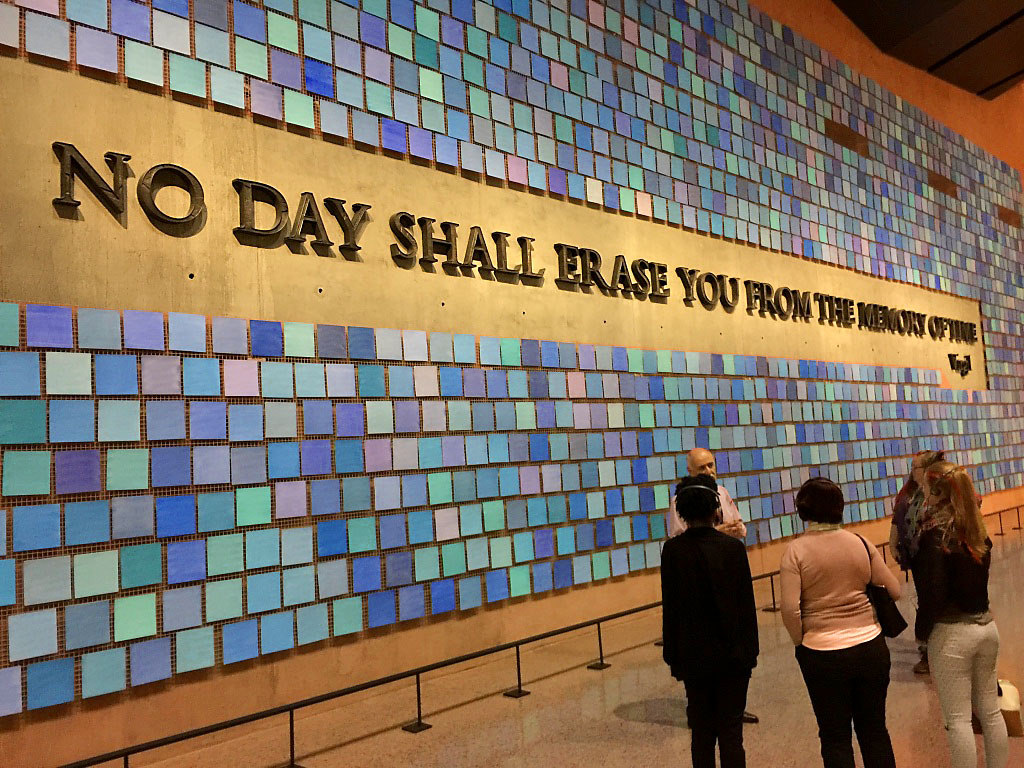
Today marks 16 years since the most infamous and iconic attack rocked our collective consciousness. Each year, there is a solemn ceremony conceived in such wisdom and executed with a poignancy that never abates. That is the reading of the names of those who died in the 911 Attacks in New York, Pennsylvania, and Washington, D.C. The soft music playing behind the readers accents the mood, punctuated by every reader mentioning the name of a family member they lost that fateful day. September 11th resonates with us so deeply because it was an attack on our country, but also because of the death of each and every individual who perished that day. Behind each name are family members, memories, joy and sorrow. Each person, in such a dramatic, untimely way, was taken from time into eternity. God loved and loves each one with an infinite, eternal love and wanted each one to be saved. Christ gave His life to provide salvation for each one. The Bible was written for the benefit of each one. The Lord’s church was meant to pursue and teach each one.
Though each individual is numbered among such a large group, around 3,000 of them, each one means more than the whole world (Mat. 16:26). This touching memorial is a tribute to the overall value of human life. It reminds us that we are surrounded by individuals all possessing an eternal soul. Everyone you see today is heading toward eternity. Each one will either hear “well done” or “depart from me” (cf. Mat. 25:31ff). What is said about God’s attitude toward those victims specially remembered today is true of every person we meet and see today.
May we have our hearts stirred by the sobriety of that truth. May we never lose sight of our urgent responsibility to share the message of Christ with the people in our lives. As moving as the ceremony that occurs each year in New York City on September 11th, we really cannot imagine what the Day of Judgment will be like. Each person who ever lived, including you and me, will hear our name called (cf. 2 Cor. 5:10). As important as our own name is, every name is important. Let us pray that this realization will propel us to tell the best news of human history and help someone find the only way, truth, and life.
The New Oxford Online Dictionary defines trajectory as “the path followed by a projectile flying or an object moving under the action of given forces” (n/p). The term is used of everything from ammunition to astronomy, but in its figurative sense can be used to speak of the law of sowing and reaping or cause and effect. There appears to be three elements to this definition: the path, the object, and the action of given forces. Apply this to a person’s life and the discussion becomes eternally serious.
The path: Jesus teaches that there are really only two paths to take, “the broad way” and “the narrow way” (Mat. 7:13-14). Some have given no thought as to which road they are taking. Others convince themselves they are on the narrow way when an honest, objective look reveals it to be the other way. Some change roads, for good or bad. However, we cannot successfully argue that we are not on a path leading somewhere, whether the destination is “destruction” or “life.”
The object: Friend, the object (projectile) in this path of trajectory is the individual. It is you and me. We are moving closer to eternity every day and to some eternal destination. God created a never-dying soul within us (Mat. 25:46; Ec. 12:7). As it was with the rich man and Lazarus (Lk. 16:19-31), we will lift up our eyes in either Abraham’s bosom or in torment. That soul was precious enough to God to pay the highest price to ransom it (John 3:16), but we may choose to give it away by allowing the trajectory of our life to miss the intended target (cf. Mat. 16:26).
The action of given forces:We are not helpless regarding this, but force implies pressure, resistance, and influence. The decisions we make, the people we allow to have prominence, our choices, what we prioritize, and what values we establish become the forces moving us to the destination. It’s not what we say is important, what we know is right, or what we intend to do. It is seen in our attitudes, words, and actions.
The earlier we figure this out, the sooner we will make it our aim to do everything we can to head in the only right direction. We can change paths, but the longer we are aimed the wrong target the harder we make it on ourselves to change course. This is true with finance, physical health, occupation, marriage and family, but nowhere are the stakes as high than as concerns our eternal destiny. Let’s give thought to the trajectory of our lives and be sure that where we are heading is where we really want to go.







 The Preacher Pollard Blog