“This Book Is Valuable”

Neal Pollard

Not long ago, visiting two of our wonderful members, Dorothy and Buster French, we talked about everything from politics to family to farming and their memories growing up. Somehow, talk shifted to their memories from youth growing up during World War II. Times were difficult and Americans had to make sacrifices, doing without. This sweet couple had tangible proof of that sacrifice in a ration card they had kept from Buster’s father. 

Families and households had to limit their purchase of common goods, like gasoline, butter, sugar, and canned milk (https://www.nps.gov/articles/rationing-in-wwii.htm). This allowed the government to divert needed supplies and manufacturing to goods and supplies needed to prosecute the war overseas. What I found most interesting of all was the explanation on the back of the ration book. It included the following statements:

  • “This book is valuable. Do not lose it.”
  • “Detailed instructions concerning the use of this book…will be issued from time to time.”
  • “Do not throw this book away…”
  • “You may be required to present this book…”

The last paragraph was an admonition for the bearer to do his or her part. A failure to follow the rules, they said, “helps the enemy.” The book carried the weight and authority of the Government Printing Office and was dated 1942.

It’s so hard for us, even in the volatile economics conditions of the past few years–including a disruption in the supply chain–to fathom what ordinary families endured for a half a decade or more. But the exhortations on the back of that book can be timelessly applied to the most important book of all.

Whether or not we have a favorite, well-worn copy of it, but the Bible is most valuable and its message and content cannot be lost as a lamp to our feet and light to our way (Ps. 119:105). God designed for us to have detailed instruction, “from time to time,” given concerning its use. He calls it preaching (Acts 2:42; 20:7; 1 Cor. 1:21). Figuratively speaking, morally, ethically, and doctrinally, we must never throw this book away (Ps. 50:17). Peter reminds us that we may be required to present this book to anyone who asks (1 Pet. 3:15)!

I could not help but think, God’s written word must be the most valuable resource in our lives. It supplies everlasting food and gives us access to more than consumable goods. It is to treasured above our “necessary food” (Job 23:12). 

So many in the Buster and Dorothy’s generation (and their parents’) have contributed much good and the prosperity so many of us enjoy today. Things like their honest participation on the Homefront through means like rationing are example of why. We can bless our world today by being Christians who treasure the Book of books and put it to use in our lives! 

Jesus Is Better (II)

Gary Pollard

Humans have a tendency to project their own weaknesses onto others. We are all guilty of this. Sometimes that carries over to our prayers — can Jesus forgive me, even with how I’ve failed him over and over? Sometimes we find it hard to forgive others, so we may assume Jesus feels the same when we beg his forgiveness. We’re only forgiven to the extent that we forgive others, but it seems we (that includes me) project our human weakness onto Jesus. 

Jesus is still human, but perfect. He’s human, but at God’s right hand. He’s human, so he understands and feels for our weakness. “We have a better high priest, one who understands our weakness, even though he never sinned.” Jesus gets it! It must’ve been a miserable few decades in a constant war with himself. He was tempted every single way that we are, but never made a mistake. 

How many people do you know who are tempted by everything? Most of us have a few weaknesses, and those are hard enough to manage. But imagine being tempted by every single thing that had ever or would ever tempt a human! Jesus understands, even though he never sinned. That’s our perfect high priest! He can say to the father, “I understand how difficult [your temptation here] is to face.” 

Jesus is better because he knows what we go through, he’s experienced it all, and he never once made a mistake. He didn’t do that to make us feel inadequate — though we are all inadequate by ourselves — but to help us when we fall. Jesus is better because he’s a high priest who can empathize with every human on the planet, and he lives to do just that for us! 

The Plan Is Perfect, But The Church Isn’t

Tuesday’s Column: Dale Mail

Real cowboys from the American frontier, both the good guys and the bad guys, had no interest in the big, bulky Stetsons that everyone associates with them. Contrary to our more modern cowboys, the most popular headgear among 19th century gunslingers was the bowler, sometimes called a derby.

Many people have an idea in their minds of what the church looks like, but it just might be the case that the image doesn’t match scriptural teaching. 

The “church” in the Bible is a singular, unified group of God’s people spread out across the globe in the form of multiple likeminded congregations. Though the people are God’s— they’re still people. People have problems. The difference between His family and the world, though, is that there’s a solution and a hope for His own. 

When New Testament Christians claim that there’s one church they don’t mean there’s only one group of people who have all the answers and can do no wrong. They simply acknowledge the Biblical truth that God made plans for only one church and that plan had been in motion before the creation of the world (Eph. 3.10-11). 

The New Testament is largely made up of letters that were written to correct and admonish our natural human tendencies. When these things are left unchecked and unbridled they produce more pain and destruction, which can clearly be seen all around us. For most, the product of sin is self-evident but the power of the Savior isn’t— and that’s where the church comes in. The main function of the church is to seek, save, and keep the saved saved. This is done by walking, speaking, and acting like Jesus. The form and function of  His family is simple because God’s goal is to save as many as possible (Jn. 3.16-17). The New Testament church is meant to be the hands, feet, and mouth of God. The church is to work, walk, and speak only the things He would and that’s only possible if a group of people are living by His instruction. Since God only wrote one book, there’s only one manual. Since following the instructions will produce one church family then there’s only one church. In the same way you can assembly an entertainment system wrong by incorrectly following the plans, you can also assemble the church wrong. There’s a right way and there’s a wrong way and one needs only to reference His instructions to be certain. 

Dale Pollard

Seven Horns And Seven Eyes (Revelation 5)

Tuesday’s Column: Dale Mail

Dale Pollard

By the time we reach Revelation chapter five John is writing in greater detail all of the glory unfolding in the throne room of God. The door to heaven was opened and the revelator was called through it by the trumpeting voice of the Lord. The theories and wildly different views on the book and it’s meaning for the modern Christian seem to become more prominent in this chapter as well. Let’s briefly work our way through some of the challenging sections. 

Seven Seals 

First, in the opening lines we read of a scroll with writing on the front and back. This seems to indicate that there was much to be revealed as scrolls were typically written on one side only. 

Some have taken the seven seals to mean seven different scrolls, but the text only indicates one scrolls with seven wax seals holding it together. 

Over the years scholars have debated the contents of the scroll, but Jesus could break the seals (5.3-4). While there are several opinions about what was contained on the scroll, it’s best seen as the final will for the affairs of the universe. As vague and frustrating as that may sound, there’s simply no textual evidence to assume otherwise. In ancient Rome it was common to have government wills and classified documents protected by seven seals. To open such an important scroll required a high ranking individual. 

A Mighty Angel 

Calling out in a loud voice the angel asks, “who can open the scroll?” John begins to weep. If this mighty angel is searching for someone worthy, surely there’s not another who could possibly open it. 

The Lamb With Seven Eyes & Seven Horns 

The lamb which is representing Christ here is depicted as having features not normally seen on these animals. Seven eyes, which symbolize God’s all seeing eye. Then there are the seven horns, representing God’s ultimate power. The number seven was God’s number and it represents perfection and completion. The seven spirits, then, indicating the fullness and completeness of God. 

Who can open the seals? Only Jesus with His perfect power and foresight is able to open this one. Revelation is the great revealing of Christ, and Christ is the only One able to reveal it’s secrets. 

The book in it’s entirety has a message from God for us, but we must be sure to understand His revelation— not man’s. 

Lessons We Learn From Jesus’ Temptations

Monday’s Column: Neal At The Cross

img_5670

Neal Pollard

Jesus knew temptation. The writer of Hebrews makes that point about Him in assuring us He, as our High Priest, knows just what we are going through in this life (2:18; 4:15). His suffering allows Him to sympathize. I am comforted to know that He understands, since He is like me (Heb. 2:17). Luke (4:1-13) records this significant and pivotal moment in Jesus’ life before He begins His public ministry. It gives me necessary insight into who Jesus is, and it helps me fight the common battle against the enticements of my flesh, my eyes, and my pride.

TEMPTATION STRIKES THOSE IN A HEALTHY RELATIONSHIP WITH GOD. To be clear, temptation strikes “every man” (Heb. 4:15). But, sometimes we conclude that it’s not so bad or so frequent for the spiritually strong. Here is the perfect Son of God, described as full of the Holy Spirit and led by the Spirit (1), who encounters the tempter (2). Being spiritually strong can help make navigating temptation easier than it is for those who live according to the flesh (Rom. 8:5-14), but no one was closer to God and more spiritually healthy than Jesus as He walked the earth. How helpful to consider Paul’s warning here: “Therefore let him who thinks he stands take heed that he does not fall” (1 Cor. 10:12). 

TEMPTATION STRIKES IN PREDICTABLE AREAS. John classifies temptation into three major categories: “the lust of the flesh and the lust of the eyes and the boastful pride of life” (1 Jn.2:16). Methodical Luke lists Jesus’ temptation in that very order (cf. Mat. 4:1-11). The serpent, approaching Eve, must have appealed to these very areas at the beginning (Gen. 3:6). The devil does not have to get more complicated than that because these avenues are overwhelmingly effective for him. Though this and other passages reveal the Evil One’s intentions and efforts, we are fully accountable for how we respond to temptation (Jas. 1:13-15). We must take responsibility for how we handle temptation. 

TEMPTATION STRIKES WHEN WE ARE VULNERABLE. Jesus has gone an unfathomable 40 days without food when He encounters the devil (2ff). The devil goes straight for this susceptible area. Think back to times when you haven’t gotten proper rest, you faced stress and pressure, you were sick or felt poorly, and other trying times. These can easily become doors we open to sin. All of us will experience physical and emotional weakness. We must be aware that these lead to spiritual exposure. 

TEMPTATION CAN MAKE US CALL WHAT WE KNOW INTO QUESTION. Twice, the devil uses conditional statements to try and create doubt. First, he says, “If You are the Son of God” (3). He called Jesus’ identity into question. Then, he says, “if You worship me” (7). He seeks to get Jesus to question His loyalty. It was not a matter of what Jesus intellectually knew, but Jesus dwelled in the flesh (John 1:14; Heb. 2:14). Be aware that temptation will cause us to question things we know, too. That includes our exalted identity and our true motivation.

TEMPTATION IS THWARTED BY AN OMNIPOTENT TOOL. Jesus wins His battles with the devil and temptation by leaning on truth. There are 86 quotations of Deuteronomy (the second giving of the Law of Moses) in the New Testament, and Jesus quotes this book in reference to each of the devil’s temptations (8:3; 6:13; 6:16). Proper knowledge and handling of Scripture help even when enemies of truth, even the devil, try to misuse Scripture against us (as he does with Jesus, misapplying Psalm 91:11-12). Scripture is God’s own weapon, given to us not to cut and maim others but to fight off temptation and fend off the biggest threats to our faith and soul (Heb. 4:12; Eph. 6:17). 

It is wonderful to contemplate a day in which temptation will be permanently past-tense (cf. Rev. 21:1ff; 1 Cor. 15:55-58). Until then, we benefit so much from seeing how Jesus coped with the bane of temptation. It also helps us appreciate what He endured in order to give us salvation. 

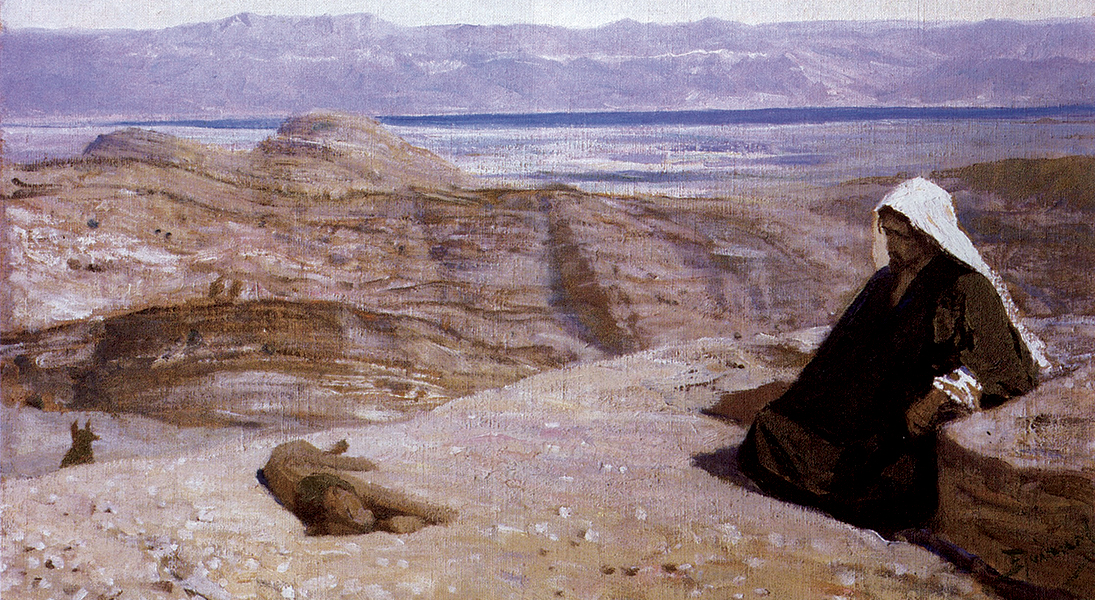
Vasily Polenov (1909), “Christ In The Desert”

Love And Fear

Thursday’s Column: Captain’s Blog

carl-pic

Carl Pollard

 
How many Christians are afraid of the judgment day? Maybe we are worried we haven’t done enough, or maybe we are thinking of a specific sin that would keep us from entering heaven? It is also a possibility that we may just be plain scared of everything that will take place on that day. 1 John 4:18 is one of the most comforting verses in Scripture. It tells us that if we are a faithful Christian there is no reason to be afraid.
 
“There is no fear in love, but perfect love casts out fear. For fear has to do with punishment, and whoever fears has not been perfected in love.” – 1 John 4:18
 
While this verse can very easily be taken out of context, the true meaning should give us hope and comfort. John tells us three important fact concerning the Christian and judgment day.
 
Love = No Fear
 
“There is no fear in love, but perfect love casts out fear.” This love is strong enough to calm our fears concerning the day of judgment. But what is perfect love? When we hear the word perfect we think of taking something flawed and making it flawless in every way. Does this mean we need to have a love that is flawless in every way? This word perfect is teleos which is defined as “attaining an end or purpose; complete.” This word is best illustrated like this, if your flashlight batteries die and you need 2 AAA, it doesn’t matter if you have an unopened box of AA’s. The used AAA’s in your TV remote are perfect for the job.
 
Our love is complete and perfect when we abide in God. Love cannot cast out our fear of the judgement day if we are loving the wrong things. Our perfect and complete love can cast out fear when we abide in the ONE who is, and always will be, the author and perfecter of love. Perfect love that is found in the Christian who is wholeheartedly abiding in the Creator has no reason to be afraid of the judgment day.
 
Punishment = Fear
 
One of the worst phrases you can hear as a kid when you get in trouble is, “just wait till your father gets home.” The thought and anticipation of punishment brings about fear and dread. 1 John 4:18 says, “For fear has to do with punishment.” The fear we may feel concerning the judgment day stems from the punishment that might come upon us. And it is only right that we should fear the punishment of hell, a very real place that is saved for those who have chosen to do nothing about their sin problem. The thought of hell should scare us. It is a place that will forever torment the souls of those who are lost. Fear has to do with punishment, so will we be punished on the judgment day?
 
Punishment equals fear, but there’s good news for those in Christ. We have NO reason to fear the judgment. The judgment day will be a day of reward for faithful Christians. There is no fear of punishment because God has promised us a place in heaven with Him.
 
Fear = Imperfect Love
 
“There is no fear in love, but perfect love casts out fear. For fear has to do with punishment, and whoever fears has not been perfected in love.”
 
If we are afraid of the judgment this could mean several things about our Christianity:
  • Fear shows us that we have room to grow (Our love hasn’t reached its designed end with God)
  • Fear can reveal a possible lack of faith (maybe we are afraid because we doubt the words we read in 1 John 1, or revelation 21?)
  • Fear exposes the sin in our lives (if there is sin in our lives that is continuous and habitual we SHOULD be afraid)
 
With these facts in mind we should take this verse and use it to shape our attitude concerning that day. Let the love of God change the way we live. Let the love of God influence our decisions and actions. Let the perfected love of God give us confidence on the day of judgment.

8 Interesting Facts About The Bible

 Tuesday’s Column: Dale Mail

dalejanelle2021

Dale Pollard

  1. The Bible was written by 40 different writers. 
  2. The Bible was written from 3 continents: Asia, Africa, & Europe.
  3. It was written in 3 ancient languages: Hebrew, Aramaic, & Greek. 
  4. The original manuscripts making up the cannon contain 611,000 words. 
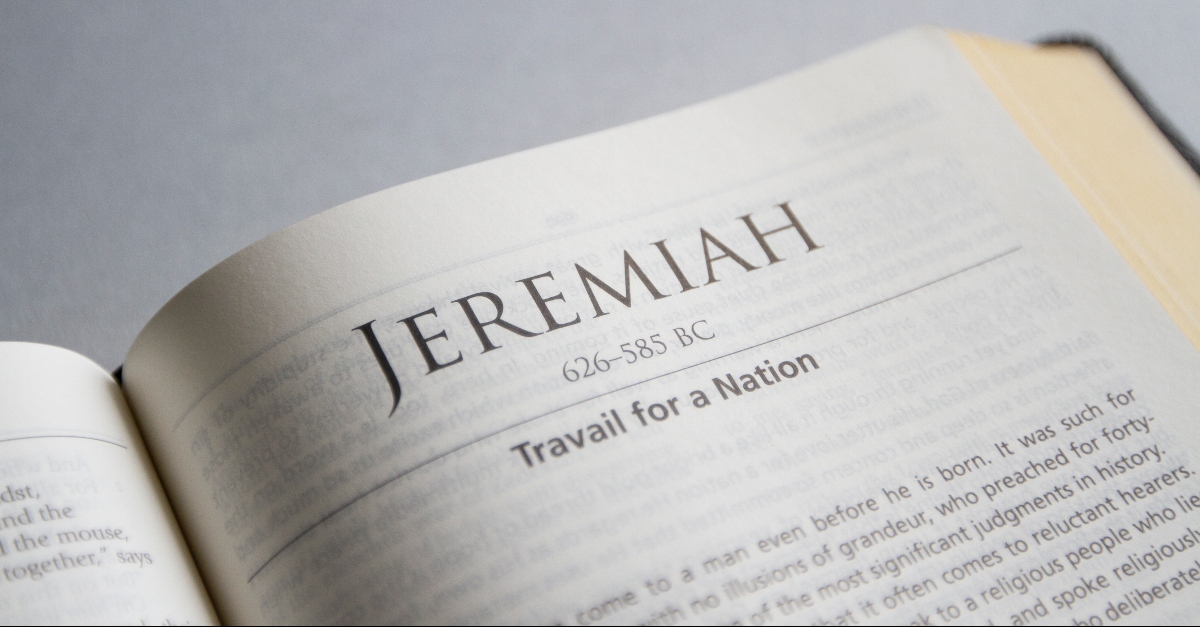
  5. The longest book is Jeremiah. 
  6. The shortest book is 3rd John.
  7. The Bible contains around 185 songs. 
  8. The Bible records around 21 dreams.  

The Bible is more than just fascinating trivia, it’s the only book that God ever wrote. Let’s make sure we’re spending time in His Word daily. 

SOME GREAT TRUTHS ABOUT GOD


Neal Pollard

• He Is Omniscient, Yet Optimistic (Jer. 26:3).

• He Knows Us Better Than We Know Ourselves And Still Is Not Willing That Any Should Perish (2 Pet. 3:9).

• He Sees Our Stingy Tendencies, But He Still Gives Freely(Rom. 8:32; Eph 1:6).

• He Knows We Can Be Faithless, But He Is Still Faithful (2 Cor. 1:18; 2 Tim 2:13).

• We Keep Track Of Others’ Wrongs, But God Can Forget (Heb. 10:17).

• We Procrastinate And Delay, But God’s Patience Still Waits (So Far) (1 Pet. 3:20; 2 Pet. 3:15).

• In A World With Too Much Impersonal Care, He Personally Cares (1 Pet 5:7).

• When We Feel Ignored By Others, He Sees Even Minute Details (Matt 10:29-31).

• In A World Of Fickle, Fading Love, His Lovingkindnesses Never Cease (Lam. 3:22).

• People Forget The Help, Favors, And Gifts We Give Them, But God Is Not Unjust To Forget Your Work And The Love You Have Shown In His Name (Heb. 6:10).

• Though Others May Abandon You, He’s Coming Back To Claim His Own (John 14:3; 1 Thess. 4:16-18).