
Lukewarm Christians

Carl Pollard

This past week we had some miserable cold days here in Kentucky. In fact, with windchill just the other night I saw negative 10 on the thermometer! There is such a huge contrast between summer and winter. The world goes from green to brown.

Trees go from grown out to bare. And the temperature goes from hot to cold. Those are two very different things, hot and cold. But if you mix them together, you get lukewarm water. There are some Christians in scripture who are called lukewarm and trust me, it isn’t a compliment.

The first few chapters of Revelation are addressed to 7 different churches. Each congregation had some problems they needed to take care of, and in chapter 3:14-22 we read of the church in Laodicea. The letter to the church at Laodicea is the harshest out of the 7 churches in Asia Minor. In fact, from the very beginning we read that this church is spiritually dead. 

V. 14-15, “To the angel of the church in Laodicea write: The Amen, the faithful and true Witness, the Beginning of the creation of God, says this: 15 ‘I know your deeds, that you are neither cold nor hot; I wish that you were cold or hot.” 

Jesus knew what they had been doing as a church, He knew their deeds. Notice that He says they are neither “cold nor hot.” This church was lukewarm. Because of their lukewarm faith, they are condemned. Revelation 3:16, “So because you are lukewarm, and neither hot nor cold, I will spit you out of My mouth.” 

Hot water can purify, sanitize, and can be used to bathe. Cold water is refreshing and good for drinking. Lukewarm water can do none of these things. It is useless! The church at Laodicea understood this analogy better than anyone. To the north several miles was Hierapolis which was a city known for its hot springs. You could bathe in hot water, it was good for aches and pains, you could disinfect and clean with it. To the south of Laodicea was Colossae. It was known for having cool, clean water that was refreshing and perfect for drinking. Laodicea however drew its water from a spring 6 miles away, and by the time it flowed through the aqueduct to their city the water was disgustingly lukewarm. Certain historians described the water there as “nauseating to drink.” 

And this was God’s reaction to the church there. Not good for anything. Not cool enough to drink, not warm enough to bathe. God’s response, He spewed them out of His mouth. The church made Him sick. 

A lukewarm church, an attitude that was manifested by their deeds. Vs. 17, “Because you say, ‘I am rich, and have become wealthy, and have need of nothing,’ and you do not know that you are wretched and miserable and poor and blind and naked.”

Laodicea was known for its wealth. Apparently this attitude found its way into the church. They felt as though they needed nothing! They were convinced they had it all. But this couldn’t be further from the truth. Jesus says, “little do you know that you’re wretched, miserable, poor, blind and naked.” 

If Christ isn’t in our life, we have wasted our time. No amount of wealth can give us what we truly need; forgiveness. If we have become lukewarm, God has no need for us. Let’s be genuine in our faith, let’s be excited to work in God’s Kingdom! 

Laodicea was given a chance to answer the knocking savior (20), and we are too. 

Let’s let Him in!
The “Nothings”

Neal Pollard

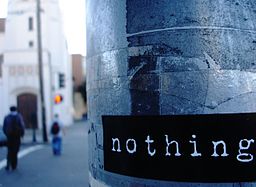
What the child is always doing, despite evidence to the contrary (“nothing”). What is wrong with one’s spouse who sits nearby, quietly and tightlippedly fuming (“nothing”). What the interrupted person was going to say (“nothing”). The word which defines itself is “nothing.” The Bible teaches, “For if anyone thinks he is something when he is nothing, he deceives himself” (Gal. 6:4).

Those low in self-esteem think of themselves as nothing. Children and spouses who are constantly told so think of themselves as nothing. Those not as wealthy as their friends or neighbors often conclude themselves to be nothing. Those unrecognized for their accomplishments can feel like they are nothing. But the inspired apostle refers to some who think themselves to be something who are actually “nothing.” The Bible makes mention of that arrogant family, The “Nothings.” They are a haughty, proud, self-involved, earthly-minded crew.

Meet The Nothings.

There Are The “Good For Nothings.” Jeremiah introduces them. He says, “This evil people, which refuse to hear my words, which walk in the imagination of their heart, and walk after other gods, to serve them, and to worship them, shall even be as this girdle, which is good for nothing” (Jer. 13:10). They were unaware of problems they had. They were evil, spiritually deaf, selfish, and idolatrous. He compares them to a good for nothing, straight from a hole in the ground, dirt-soiled belt!

No one is inherently worthless, but we can choose a lifestyle that is wicked, lukewarm, or indistinct (cf. Mat. 5:13). Christians, by our distinctive nature, are of great value to God (1 Pet. 2:9). Yet, by surrendering our Christian influence, we can become “good for nothing.”

There Are The “Brought To Nothings.” After referring to the danger of making decisions based solely on human reasoning, Jeremiah prays that God will not bring him to nothing (Jer. 10:23-24). God will rename some the Brought to Nothings, those who believe man’s ideas over God’s facts. Paul warns that God will “destroy the wisdom of the wise, and will bring to nothing the understanding of the prudent” (1 Cor. 1:19; Isa. 29:14). The wisest and most scholarly man who discounts God’s Word will be a regretful member of the Brought To Nothings someday.

There Are The “Need Of Nothings.” These are the overly comfortable, spiritually out of shape members of the Nothings clan. They live their lives saying, “I am rich, and have become wealthy, and have need of nothing,” and they do not know that they “are wretched and miserable and poor and blind and naked” (Rev. 3:17). They aren’t really bad people, but they aren’t all that good either. They’re just quite satisfied with what they have done for Christ, which isn’t all that great and not too bad. They merely yawn through their spiritually lives, only occasionally stirring from spiritual sleep (cf. Eph. 5:14). They half-heartedly do just enough to deceive themselves into thinking they’re pleasing the Lord.

Unrelated to these Nothings are some good folks, like the Ashamed In Nothings (Phil. 1:20), Terrified By Nothings (Phil. 1:28), Anxious For Nothings (Phil. 4:6), and the Wavering In Nothings (Jas. 1:6, KJV). But the Nothings family mentioned above are black sheep in God’s family. No one should want to “take after” them.

256px-nothing_is_nothing

HOW TO MAKE GOD SICK

Neal Pollard

When speaking of God’s attributions and actions, the Bible often resorts to a literary device called anthropomorphism (where human characteristics or behaviors are attributed to God—“the hand of God,” “the eyes of the Lord,” etc.).  But, there is one personification that’s absolutely terrifying.  Jesus utilizes it in describing the spiritual condition of Laodicea. He says, “I know your works, that you are neither cold nor hot. I could wish you were cold or hot. So then, because you are lukewarm, and neither cold nor hot, I will vomit you out of My mouth” (Rev. 3:15-16). Some translations, knowing “vomit” is felt to be too strong and graphic to the sensitivities of some readers, have gone the more antiseptic route by translating it “spit.”  But the Greeks had a word for the phrase “spit out” (you find that word translated in John 9:6, Mark 7:33, and Mark 8:23).

It has been said that what makes God sick often is what makes our culture tick. When you look at the Laodiceans, they were guilty of the following:

  • Indifferent to mission (Rev. 3:15-16).
  • Incorrect in self-analysis (Rev. 3:17).
  • Insensitive to need (Rev. 3:17).
  • Impenitent (Rev. 3:19).

Certainly, the world is blind to God’s purpose for their lives, is numb to its true spiritual condition, and is deaf to the biblical plea to repent and depend on God and His will. But these words are directed to Christians as a warning to us.  Our mission is to engage in the work He has us on earth to do, which is not to accumulate wealth, indulge in fleshly pleasures, and pursue the honor and praise of this world. Our need for God’s strength and help every step of the way must drive us to depend on Him and repent of a lack of zeal for and involvement in the work He has called us to do as Christians.

When we get so wrapped up in this world that we ignore His mission, when we get so conditioned to rely on our assets and attributes that we ignore His power, and when we get so hard-hearted that we ignore His grace and forgiveness, we make God sick.  No matter how you look at that, the very thought is just chilling! He loves us, pleads with us, and wants to reward us (Rev. 3:19-22). But that requires us to live differently from those ancient Laodiceans. We must let Scripture properly diagnose our spiritual condition or it will make God sick.