“You’ve Got Mail”

I began preaching full-time in 1992 in a small west Alabama town near the Mississippi border. It was one year before Tim Berners-Lee released the code that became the world wide web, allowing images, video, and audio to be transmitted from servers to computers using existing phone lines. This was more commonly called “dial up.”

Neal Pollard

I began preaching full-time in 1992 in a small west Alabama town near the Mississippi border. It was one year before Tim Berners-Lee released the code that became the world wide web, allowing images, video, and audio to be transmitted from servers to computers using existing phone lines. This was more commonly called “dial up.” For the first three years of my preaching, I typed up Bible classes and sermons (if I didn’t hand write them) on a Brother word processor (it was a typewriter/keyboard attached to a computer monitor). 

Let’s just say that the past 30 years have brought a lot of change in the world of technology. During the ’90s and ’00s, email was king and texting was a complicated, time-consuming, and less desirable alternative. In those days, AOL was the emperor of email. Using a modem (Google it), your computer would connect through the phone and AOL would greet you with, “You’ve got mail” (if you had email). A 1990s movie by that title will give more context to what it was like.

Did you know that dial up internet access is still available? About 160,000 households in America still use it. But on September 30, it will cease. A critical chapter of internet history will be relegated to the museum of technology’s past, like the rotary phone (Google that, too).

I appreciate a few ways this illustrates the work of the church today. First, some changes are desirable and necessary. We can embrace new ways of doing things God preserved in Scripture (Matt. 9:17). As our elders are fond of saying, “We will think outside the box, but inside the Book.” Most of us embraced fiber-optics and satellite, then found dial-up tedious and time-consuming. Old truths can wear new clothes, so long as the truths are not altered (cf. Rev. 22:18-19). See Power Point, newly-written, Scriptural songs and hymns, live-streaming, etc.

Second, while what man creates, invents, and innovates is ever-changing, God’s Word is all-sufficient, timeless, and essential (2 Tim. 3:16-17; Matt. 24:35). No discovery will make it obsolete or irrelevant. It shall stand forever, a rock that cannot be broken or weathered by time or trends (John 10:35). See women’s role (1 Tim. 2:11-15), baptism’s role in salvation (Matt. 28:18-20), the nature of marriage (Eph. 5:31), marriage, divorce, and remarriage (Matt. 19:4-9), etc. 

Third, we should tenaciously defend and fight for truth (Jude 3), but we should take a different tack with tradition. We certainly should not elevate it to be on a par with truth. We must not put it above the truth (Mark 7:6-9). We should not strain relationships and fellowship over matters not “tied down” in Scripture (Romans 14). See Bible translations, modest, but less formal, worship attire, order of worship, etc. 

160,000 households are clinging to dial up until the last possible minute, but then it will be gone. Let’s avoid that spirit when it comes to God’s Word and His work. Where change does not violate God’s will, let us hold it as a matter of indifference. Where the change does violence to it, may we be found nowhere near it! 

Three Things That Will Rebuild Healthy Communication

Internet technology in all its forms has become such a helpful aid in so many instances. But as with every blessing, Satan stands ready to use it to undermine relationships, destroy community and civility, and wield it to wreak havoc on our mental, social, and spiritual health.

Neal Pollard

In 2024, Jonathan Haidt, a social psychologist and professor at NYU, wrote The Anxious Generation: How The Great Rewiring Of Childhood Is Causing An Epidemic Of Mental Illness. While the book is written from a secular, evolutionary world view, it is incredibly insightful and masterfully observant of an extremely troublesome transformation many of us see happening in our world. An entire generation has reached maturity having known and used only smartphones and tablets, consuming the readily available and easily accessible contents of their virtual smorgasbord. This has radically reformed communication at the most basic levels.

Haidt points to four epidemic issues accompanying the mass retreat into the virtual world of a phone-based (versus real life) communication. Online communication is characterized by :

  • Being asynchronous–Not in real-time; Delayed (Building anxiety as one wonders why the other is silent or non-responsive)
  • Lack of embodied signals–Emojis and likes instead of facial expressions and body language (an inadequate substitution)
  • Performative interaction–Posts that perform, project perfection, and are artificial instead of honest, genuine intimacy.
  • Social comparison–Interaction built on comparison which devastates one’s own self-esteem and self-worth

In so many cases, we have lost the ability to communicate and build authentic relationships “here in the real world.” What Haidt suggests for Gen Z will actually help us all, from the oldest living generation down. This technological world, with all its benefits, has assaulted our communication skills.

Practice Face-To-Face Communication. Opt for the face-to-face, or at least the phone call, rather than relying on chats, text messages, and other communication that is not occurring in real time. Think of how much of what God has created us for in this world requires real-time interaction–evangelism, worship, marriage, childrearing, friendship, correction, etc. Biblical passages and principles assume the give and take of people in the same space talking and listening to each other. As the One who made us, He knows how we best operate (Eph. 4:29).

Put Away The Phone. It is simple and seems like eminently common sense, but because our phones are addictive (Haidt and others provide crushingly incontrovertible proof) we lean on them like crutches. Real-time, real connection requires full presence and complete attention to the person in front of us. Conversation and communication can be difficult and requires intentionality, at best, and the massive distraction of our devices fairly cripples our ability to courteously, thoughtfully value the one with whom we’re interacting.

Postpone Online Responses. My wife enacted a policy several years ago to answer social media messages only once per day, early each morning. Her logic is that before the advent of the internet, people had to wait for returned phone calls, snail mail letters, and face-to-face conversation. We’ve become such instant gratification junkies, wanting and needing to stay connected constantly. Ironically, we tend and nurture these virtual communications to the neglect of people we know well in our everyday lives. Do we have to answer those texts (all 50 of them) this very minute? Or can (should) it wait?

Internet technology in all its forms has become such a helpful aid in so many instances. But as with every blessing, Satan stands ready to use it to undermine relationships, destroy community and civility, and wield it to wreak havoc on our mental, social, and spiritual health. Perhaps investing in a bit of old-fashioned, real-life communication skills can help us stem the tide of our massive crisis in connection.

“Aliens”

Friday’s Column: Brent’s Bent

Brent Pollard

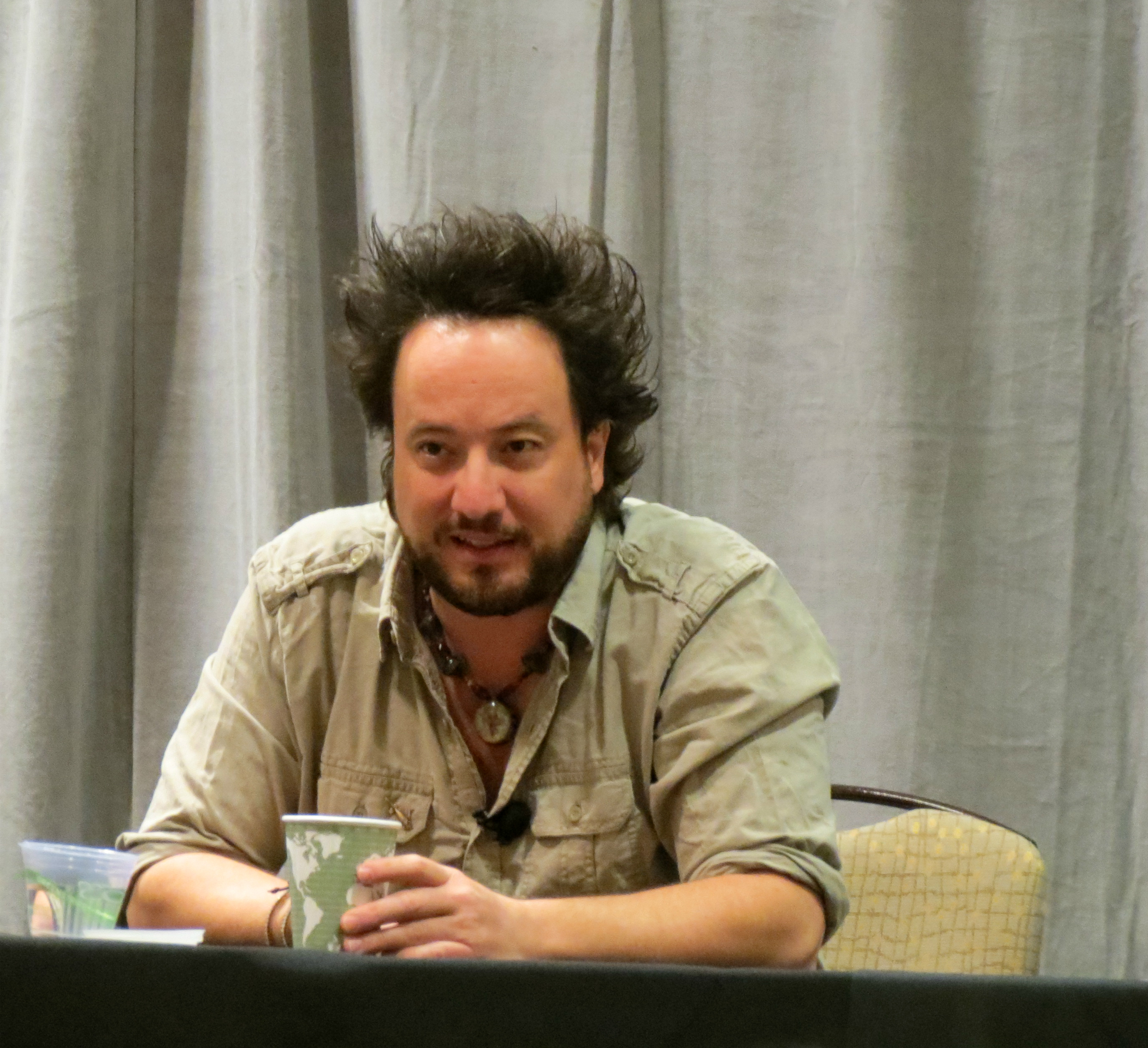
An older internet meme, originating in 2010, features Giorgio A. Tsoukalos from the History Channel’s Ancient Aliens program.1 As Tsoukalos believes ancient astronauts visited our planet in our distant antiquity, he often speaks enthusiastically about how such extraterrestrial visitors interacted with our remote ancestors. Hence, a screenshot of Tsoukalos from Ancient Aliens sporting his crazily coiffed hair and hands frozen in mid-gesticulation conveys the simple message to the viewer of “Aliens.” Another version of the meme, also featuring the same screenshot of Tsoukalos, reads, “I’m not saying it was aliens, but it was aliens.”  

What is the point of posting random pictures on the internet? Honestly, what is the purpose of any meme? The word “meme” derives from the Greek word “mimeme,” meaning something imitated.2 Without becoming too bogged down in explanation, a meme is a vehicle by which internet posters convey ideas. Then, others who identify with the message share it. In that simple act of reposting, one “imitates” the intent of the meme’s creator. When many people do this, we proclaim that the meme has “gone viral.” However, the power of the meme is that it will invoke a response so that even those angered by it will respond to it. For example, the “Aliens” meme is employed by those jokingly offering a Deus ex machina-type explanation for things to which we may or may not have the answers. How did ancient builders erect megalithic structures? Aliens. Who ate my last donut? Aliens. 

I cannot help but hear the voice of Giorgio A. Tsoukalos saying “aliens” in my head as I read headlines like this one from Yahoo!News: “How would humans respond to the discovery of aliens? NASA enlisted dozens of religious scholars to find out.”3 For some reason that escapes me, Hollywood has often speculated that the revelation of extraterrestrial life would destroy the faith of believers. You have likely seen such movies. There is typically some cabinet member telling the fictional President to keep things quiet lest the disclosure of the existence of extraterrestrials leads to chaos. By the way, rather than becoming terrified by the thought of aliens, the article suggests that religious people would most likely be better prepared to receive such visitors from afar. I agree with that conclusion. 

I cannot speak for other Christians, but I can say why I wouldn’t lose my faith in Jesus Christ because someone proves that the Roswell greys exist. First, my belief that God created everything that exists convicts me of the truth that if “aliens” also exist, God created them too. Genesis 1 details how God made the heavens with their inhabitants. A Christian realizes that, though the creation account mentions nothing about planets, the voice of God made Jupiter and Saturn, which are planets. Would it require more faith to believe that there could be one planet orbiting a star capable of supporting life in that sea of stars we see at night? No. Again, Genesis 1 tells us God created the heavens and the earth. It would be more a matter of what God has chosen to reveal to us. Deuteronomy 29.29 reminds us that God has only given us what He has revealed. The secret things belong to Him alone.  

Second, we ask what we can even understand about God apart from His Word. Isaiah 55.8-9 reminds us that the thoughts and ways of God are above our own. Science fiction author Arthur C. Clarke once stated what has since become known as one of Clarke’s Laws: “Any sufficiently advanced technology is indistinguishable from magic.”4 We might substitute the word “supernatural” for “magic.” The existence of aliens would not destroy my faith because I might ask whether the strange phenomena I was witnessing were not “aliens” but “heavenly visitors.” Maybe Ezekiel’s “wheel in the middle of the wheel” was a UAP (Unidentified Aerial Phenomena) (Ezekiel 1.4ff). Would it matter to you if God created the universe using advanced technology to which only He has access? Either way, He has the power to create and destroy us (cf. 2 Peter 3.12). 

Ultimately, all of this talk has more to do with scientists’ expectations regarding the recent launch of the James Webb Space Telescope.5 In addition to thinking they will see the Big Bang, scientists believe we might finally see those elusive extraterrestrials and life-sustaining planets. And why not? The government has even declassified reports about the existence of “Unidentified Aerial Phenomena.”6 Having said what I have about not having my faith shaken by the sudden revelation that there is other life out there, though, I find it more likely that each discovery reveals what we have known all along. God placed us in a particular spot within the cosmos to see His intelligent design and realize, yes, it had a beginning. It is not eternal. And one day, we will meet Him, Who created it all.   

Sources Consulted and Cited 

1 “Ancient Aliens.” Know Your Meme, Literally Media Ltd., 3 Dec. 2021, knowyourmeme.com/memes/ancient-aliens

2 “Memes | Psychology Today.” Psychology Today, Sussex Publishers, LLC,www.psychologytoday.com/us/basics/memes

3 Snodgrass, Erin. “How Would Humans Respond to the Discovery of Aliens? NASA Enlisted Dozens of Religious Scholars to Find out.” Yahoo! News, Yahoo!, 29 Dec. 2021, 21:42,www.yahoo.com/news/humans-respond-discovery-aliens-nasa-024208831.html

4 Jones, Andrew Zimmerman. “What Are Clarke’s Laws?” ThoughtCo, Aug. 26, 2020, thoughtco.com/what-are-clarkes-laws-2699067

5 Griffin, Andrew. “James Webb Space Telescope Latest: Alien-Hunting Spacecraft Unfurls on Its Way to Study the Universe.” Yahoo! News, Yahoo!, 30 Dec. 2021, 09:42, news.yahoo.com/james-webb-space-telescope-latest-144238287.html

6 Preliminary Assessment: Unidentified Aerial Phenomena. www.dni.gov/files/ODNI/documents/assessments/Prelimary-Assessment-UAP-20210625.pdf

“Nomophobia” 

Monday’s Column: Neal at the Cross

pollard

Neal Pollard

That’s not a typo for another popularly-used term.  It’s actually a “thing,” at least according to a 2010 study by the UK Post Office.  It is short for “no-mobile-phone phobia” (Tim Elmore, psychologytoday.com). There’s even a website called nomophobia.com, and they identify “the four fears of Nomophobia”—broken, lost, stolen, or useless smartphones. While that site operates “tongue in cheek,” there are a bevy of experts more than ready to talk about how this is an epidemic impacting especially youth in our culture.  University of Connecticut School of Medicine’s Dr. David Greenfield has done much work in this study. He points to the problem of a dysregulation of dopamine, “meaning that it motivates people to do things they think will be rewarded for doing” (clever, cutting, or flamboyant Tweets, posts, pics, etc.) and that it can foster people’s addiction to the internet and technology (Madeline Stone, businessinsider.com). Greenfield adds, “That feeling you’re going to miss something if you’re not constantly checking is an illusion — most parts of our lives are not relevant to our smartphones. What happens on our devices is not reflective of what happens in real life” (ibid.).  There are even digital detox programs, in the United States as well as other countries around the world.  Psychiatrist Dale Archer gives this advice, “Stop texting while you’re driving. Don’t take it into the bathroom with you. Have a rule not to use your phone when you’re with your friends. If you’re on a date, make a rule that you’ll both check your phone for a maximum of 5 minutes every 90 minutes. It’s all about setting simple rules that you can follow” (ibid.).

Amateur psychiatrists and specialists everywhere can quickly diagnose this condition in their spouses and significant others, their children, and their friends, but they may be myopic to their own inordinate practice (see every airport, doctor’s office, restaurant, etc.).  Addiction to, or at least habitual abuse of, smartphones and similar technology is simply the latest and a more obvious example of a long-standing human tendency.  Paul told Corinth, “All things are lawful for me, but not all things are profitable. All things are lawful for me, but I will not be mastered by anything” (1 Cor. 6:12). In context, Paul is beginning a discussion of the sin of fornication after having talked about Corinth’s generally sinful past from which they had been forgiven.  Paul’s desire was not to be “mastered” (ruled, reigned over, Louw 37.48) by anything.  He later writes about the self-mastery and discipline necessary to live the Christian life (1 Cor. 9:24-27).

Cell phones are just one possible impediment to this.  There are so many other possibilities we must keep aware of, things which can derail us from our purpose and focus in this life.  So many of them are fine in balance and moderation, but we can allow them to consume and even overtake us.  A fear of being without those things is only one of the attending problems.  Being ruled by anything or anyone other than Christ is the overriding concern.  We are all served well by looking carefully at the things in our lives and make sure we have no master other than Christ.