“And Yet I Will Rejoice”

Many Christians serve a “God of good times,” praising Him when life is easy. But the God of the Bible is bigger. When the fig tree fails, the vines are bare, and the fields are empty, will you get angry, give up, or rejoice?

Carl Pollard

Corrie ten Boom was born on April 15, 1892, in the Netherlands to a devout Christian family. Her father, Casper, ran a thriving watchmaking business. Their deep faith shaped their response to the Nazi occupation of the Netherlands during World War II. The ten Booms joined the underground resistance, transforming their home into a safe haven for Jews and others persecuted by the Nazis. Using a hidden room in their house, they saved countless lives. Tragically, in 1944, a betrayal led to their arrest. Corrie and her sister Betsie were sent to a concentration camp, enduring brutal conditions. Betsie died there, and their father passed away in prison. Corrie survived and later wrote, “There is no pit so deep that God’s love is not deeper still.” 

How could she say this after such devastating loss? Life often feels like a pit—barren, hopeless, empty. The prophet Habakkuk faced a similar pit in Judah, a nation crumbling under the threat of invasion. Yet, he wrote one of the Bible’s boldest declarations of faith in Habakkuk 3:17-19: though everything fails, “I will rejoice in the Lord.” Unlike most prophets who spoke for God to the people, Habakkuk spoke to God for the people, asking two questions we often wrestle with: “Why?” and “How long?” His story offers three vital truths for navigating life’s darkest moments.

The Reality of Fear (v. 16)

Habakkuk trembled when God revealed His plan: the Babylonians would bring judgment on Judah. “I hear, and my body trembles; my lips quiver at the sound; rottenness enters my bones; my legs tremble beneath me.” He knew destruction was certain—starvation, cannibalism, the ruin of Solomon’s temple, the end of his nation. The dread was so deep it made him physically weak. We’ve all felt fear like this—news of a tragedy, a diagnosis, or loss that shakes us to the core. Yet, Habakkuk chose to “quietly wait for the day of trouble” to come upon the invaders. God promised to judge the Babylonians and deliver His people, though not in Habakkuk’s lifetime. The Hebrew word for “wait” means to rest or settle down, like David’s soul finding rest in God (Psalm 62:1). Instead of letting fear consume him, Habakkuk anchored his heart in God’s promises. Can we trust God’s timing, even when we’re afraid?

The Choice of Joy (vv. 17-18)

“Though the fig tree should not blossom, nor fruit be on the vines, the produce of the olive fail and the fields yield no food, the flock be cut off from the fold and there be no herd in the stalls, yet I will rejoice in the Lord; I will take joy in the God of my salvation.” Habakkuk describes total ruin in an agricultural society—permanent crops like figs and olives gone, annual crops like wheat vanished, livestock dead. This wasn’t just financial loss; it was famine, hopelessness, death. Yet, he declared, “I will rejoice in the Lord.” Like Job, who praised God after losing everything, Habakkuk’s faith didn’t rely on blessings. Satan once questioned if Job trusted God only because of His gifts. Job proved his faith was real, and Habakkuk does the same. True joy, rooted in Christ, can’t be taken away. When life strips everything else, can we choose to find joy in God alone?

The Strength to Rise (v. 19)

“God, the Lord, is my strength; He makes my feet like the deer’s; He makes me tread on my high places.” Habakkuk found strength not in himself but in God. Spiritual maturity means refusing to rely on our own resources. God gave him “feet like a deer’s” to walk confidently in difficult, high places—places he’d rather avoid. I’m terrified of heights; anything over 6’5” makes me weak. But God equips us to go where we wouldn’t choose, strengthening us for the journey. Sometimes, God strips away what we depend on to make Him our only joy. Faith says, “The just shall live by faith.” Habakkuk knew God would either rescue him or allow his death, but even death is under God’s control. Are we willing to let God lead us to higher places, trusting His strength?

Habakkuk had questions, and so do we. But faith rests in these truths: God is too wise to make mistakes, too kind to be cruel, and always in control. 

A man once saw a butterfly struggling to escape its cocoon. Frustrated, he cut it open, only to watch it die, unable to fly. The struggle strengthens its wings, just as trials strengthen our faith. Many Christians serve a “God of good times,” praising Him when life is easy. But the God of the Bible is bigger. When the fig tree fails, the vines are bare, and the fields are empty, will you get angry, give up, or rejoice? “And yet, I will rejoice.” If you’re struggling to praise God, battling sin, or need to obey the gospel, trust His promises—they never fail. Let God lead you today.

185,000 Soldiers Killed By Angel

Dale Pollard

Account: Isaiah, 37:36-38; 2 Kings, 19:35ff; 2 Chronicles 32

A Serious Assyrian Threat: 

Sennacherib is on a campaign to control all routes across the Syrian Desert leading to the Mediterranean Sea. Assyria  had already carried the Northern Kingdom of Israel off into captivity and invaded the southern kingdom of Judah. 

Jerusalem is now under threat of attack and king Hezekiah sends his servants to the prophet Isaiah to ask for prayers on behalf of the people. Yahweh, through Isaiah, tells the people to not be afraid. For as unlikely as it seemed to the surrounded inhabitants of Jerusalem, their salvation would come in the middle of the night. 

“That night the angel of the LORD went out to the Assyrian camp and killed 185,000 Assyrian soldiers. When the surviving Assyrians woke up the next morning, they found corpses everywhere” (2 Kings 19.35).

Sennacherib Cylinder Evidence: 

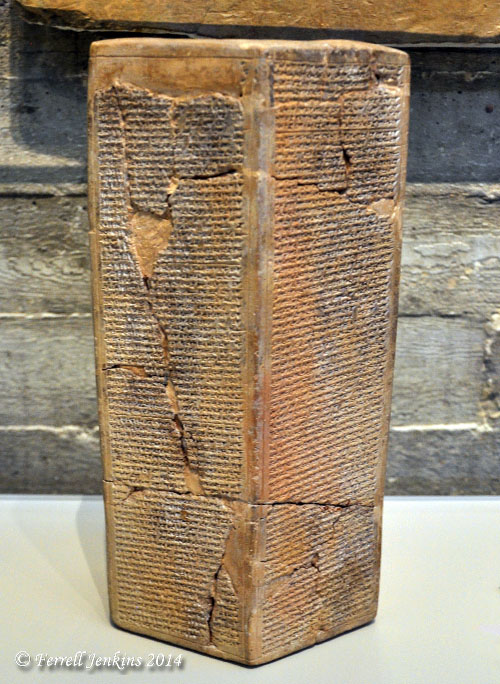
Sennacherib left behind a record of his campaign against Judea and it can still be seen in the British Museum today.

Here’s a translation of his inscription, 

“As to Hezekiah, the Jew, he did not submit to my yoke. I laid siege to 46 of his strong cities, walled forts, and to the countless small villages in their vicinity.  I drove out of them 200,150 people, young and old, male and female, horses, mules, donkeys, camels, big and small cattle beyond counting and considered  [them] spoils. Himself I made a prisoner in Jerusalem, his royal residence, like a bird in a cage.”

Sennacherib claims he conquered all of Judea except Jerusalem.  He also claims that he surrounded the city of Jerusalem with his army, and trapped Hezekiah “like a bird in a cage.” 

Curiously, that’s where he chose to end the story. To continue any further would mean to either fabricate or include a loss of such magnitude that it would tarnish the reputation of a proud Assyrian king.

Succeed In Everything

2 CHRONICLES 31

Dale Pollard

Hezekiah “prospered in everything” (2 Chron. 31.21) because…

HEZEKIAH WAS DETERMINED TO PUT GOD BACK WHERE HE BELONGED (v.2)

”Hezekiah assigned the priests and Levites to divisions—each of them according to their duties as priests or Levites—to offer burnt offerings and fellowship offerings, to minister, to give thanks and to sing praises at the gates of the LORD’s dwelling.”

HE DEDICATED HIMSELF TO SERVICE (v.3)

“The king contributed from his own possessions for the morning and evening burnt offerings and for the burnt offerings on the Sabbaths, at the New Moons and at the appointed festivals as written in the Law of the LORD.”

HE DEVELOPED HIMSELF AND OTHERS (v.4)

“He ordered the people living in Jerusalem to give the portion due the priests and Levites so they could devote themselves to the Law of the LORD.”

HIS DEVOTION WAS DESIRED BY OTHERS v.5-6) 

Israel gave generously until there were heaps of their offerings piled up. 

HE DIRECTED ALL THE GLORY TOWARD GOD (v.8) 

When Hezekiah and his officials came and saw the heaps, they praised the LORD and blessed his people Israel.

He Wasn’t Perfect But… 

What’s written about him in the summation of his life declares that Hezekiah was the last time Israel, or the world, would know a righteous king until Jesus appeared on earth (Matt. 1.10ff). 

“Hezekiah trusted in the LORD, the God of Israel. There was no one like him among all the kings of Judah, either before him or after him. He held fast to the LORD and did not stop following him; he kept the commands the LORD had given Moses” (2 Kgs 18.5-6). 

What Are You Showing?

Brent Pollard

The geopolitical landscape under Hezekiah, King of Judah, saw an increase in the threat from Babylon while Assyria’s influence declined. Hezekiah’s political interests and personal ambitions were intertwined to solidify his kingdom amidst evolving circumstances. When he recovered from a severe illness, envoys from Babylon, a rising power seeking to weaken Assyria, visited him. Overwhelmed with relief and eager to impress his potential new allies, Hezekiah made a critical error.

The scripture recounts in 2 Kings 20.13, “Hezekiah listened to them, and showed them all his treasure house, the silver and the gold and the spices and the precious oil and the house of his armor and all that was found in his treasuries. There was nothing in his house nor in all his dominion that Hezekiah did not show them.” (NASB95) This act of pride had serious future consequences, as the prophet Isaiah sharply points out in Isaiah 39.4 by questioning Hezekiah, resulting in a prophecy of doom for his lineage and nation.

This passage emphasizes the importance of being careful with what we disclose. It encourages us to consider the consequences of our actions, which can affect not only our own but also the fate of the community.

The Dangers of Pride and Showing Off

Hezekiah intended to gain political favor by displaying his kingdom’s wealth, but he also revealed a more profound spiritual issue that the Scriptures emphasize: the danger of pride. The Parable of the Rich Fool in Luke 12.16–21, in which a man obsessed with wealth plans to build larger barns to store his crops only to die the same night, reinforces this New Testament message. Like the rich fool, Hezekiah’s pride in his treasures arose from prioritizing material security over spiritual faithfulness.

When displaying our possessions, achievements, or abilities, we must consider whether they serve a greater purpose or feed our ego. Self-reflection is critical to avoiding arrogance and conceit.

Wisdom in Confidentiality

Hezekiah’s strategic error stemmed not only from his pride but also from his failure to anticipate the consequences of his disclosures. Jesus advised such individuals not to “give what is holy to dogs, and do not throw your pearls before swine, or they will trample them under their feet, and turn and tear you to pieces.” (Matthew 7.6 NASB95) Protecting valuable things, whether spiritual beliefs or important assets, is essential.

The principle of caution prompts us to be careful when sharing information. Sometimes, it is preferable to keep things private to protect ourselves and our communities from potential harm. This wisdom, rooted in scripture, encourages us to consider the possible impact on the larger community before sharing information.

Consequences Extend Beyond the Individual

Isaiah’s prophecy reveals a fundamental biblical truth: our actions have a long-term impact on our descendants and community. The exile of Judah’s elite to Babylon, which Isaiah predicted, exemplifies how Hezekiah’s decisions had severe and long-term consequences. This interconnectedness of fate resonates with Paul’s assertion in 1 Corinthians 12.26, “And if one member suffers, all the members suffer with it; if one member is honored, all the members rejoice with it.” (NASB95)

Acting community-mindedly requires us to consider how our decisions affect others.

Hezekiah’s encounter with the Babylonian envoys underscores the significance of humility, discretion, and foresight in our social dealings. As we navigate life’s complexities, it is critical that we embody these virtues and only show others what honors God and promotes communal well-being. It is imperative to heed Hezekiah’s missteps and aim to make choices that glorify God and enrich future generations. Integrating foresight and wisdom into our daily choices empowers us to enhance our lives and contribute to a brighter world.

Deuteronomy: The Second Giving Of The Law (XXIX)

The Blessings And Curses (28:1-68)

Neal Pollard

The end of the blessings and curses sermon is more brief on the former and more voluminous on the latter. This is not because serving God is more about threats and warnings than promises and enjoyment, but because in His love and foreknowledge God knew what was in man (Gen. 8:21). He has been seeing the heart of this people turn from Him during the 40 year wandering and He knew what lay ahead from the period of the judges all the way to the end of the northern kingdom and the 70 year captivity of the southern kingdom. 

But in both sections, the point is the same. Israel was to diligently obey and carefully do all that God commanded (1,15). To bring this point home, Moses specifies 14 blessings accompanying obedience (1-14) followed by 32 curses (16-48). Yet, the blessings were as powerful and the curses were dreadful. Moses describes the blessings as overwhelming (2), and “this vivid language portrays the blessings as living and active; for the second verb has ‘and take effect,’ and ‘and light on you.’ Perhaps something like ‘come and remain with you’ or ‘will always be yours'” (Bratcher and Hatton, UBS, 444). 

God wanted to bombard them with blessings that would stay and never leave. But note the conditional, “If you obey” (2). The blessings were not for Israel to selfishly consume in earthly pleasure, but to use as a tool in their keeping covenant with God. Every aspect of their individual and community life would be blessed (1-14). God establishes this with three “if, then” statements (2,9, 13-14). Moses punctuates the blessings portion with a reminder of how matchless God is compared to any rival (11-14).

But what if they breach their covenant with Jehovah? In minute detail, Moses speaks of the consequences of disobedience. With six conditional statements, noted in English with either “if” or “because” (15,20,45,47,58, and 62), God drives His point home. Contemporary documents, whether Hittite or early Assyrian treaties, follow the same formula of being heavily weighted toward the curses over the blessings. “The reason presumably (as here in Deuteuteronomy) was to underscore the seriousness of covenant violation by describing its consequences in long and graphic detail” (Merrill, NAC, 357). 

The last 20 verses serve as a warning, foreseeing a time in which Israel would indeed turn away and through disobedience place themselves under the weight of these curses (49-68). Notice that he actually precedes the prediction of captivity by writing, “Because you did not serve the Lord your God with joy and a glad heart, for the abundance of all things; therefore you shall serve your enemies whom the Lord will send against you, in hunger, in thirst, in nakedness, and in the lack of all things; and He will put an iron yoke on your neck until He has destroyed you” (47-48). He then proceeds to describe what that would look like. 

The enemy would eat their food and oil, drink their wine, besiege their cities, and cause severe famine reducing them to animalistic behavior (49-57). The Lord would cause plagues and diseases (58-62). They would be scattered among the nations, uncertain about their lives, corrupted in their worship, despairing of their living conditions, and desperate for survival (63-68). God could not have painted a grimmer picture, all in the hopes that Israel would take warning and never turn from Him. 

“God Is So Good”

Neal Pollard

You might notice over your heading of Psalm 107 that it begins “Book Five.” You also do not see David’s name over this psalm. There may be clues pointing to this being one of the later psalms, even after Babylonian Captivity (1-3). Many believe this was a song sung by Jewish pilgrims who sang it on their way to Jerusalem for one of the major feast days. It is full of parallelism, where the writer says the same thing two similar ways (nearly every verse contains this, except 3,12,26,34,37, and 40). 

But as we pay attention to its structure, it looks like it contains four main “strophes” (poetic stanzas).  Each strophe ends with the same chorus or refrain: “Let them give thanks to the Lord for His lovingkindness, and for His wonders to the sons of men” (8,15,21,31). It covers the full range of human distress and problems and God’s gracious response. We struggle, God delivers, and for that we should always be thankful! Truly, God is so good!

GOD IS GOOD WHEN WE WANDER (4-9)

Historically, we would think of the wilderness wandering or even being scattered by captivity. But this seems bigger than just one occasion. Whether we wander by sin, wander because of struggles and distresses, God is still so good to be our beacon and compass. He will help us find our way home, which should fill our hearts with gratitude. He can lead us back from any and every direction we have gone. 

GOD IS GOOD WHEN WE ARE OPPRESSED (10-16)

Sometimes our struggle is not of our own making and choosing. Sometimes, though, it is the result of our rebellion. Either way, when we face darkness and death, chains and misery, He brings us out and breaks us free. No one has to stay in spiritual prison. God offers freedom. That should draw our gratitude, He’s so good! 

GOD IS GOOD WHEN WE ARE HURTING (17-22)

He writes of afflictions and distresses, again some of which are self-inflicted and others which are brought upon us. It doesn’t matter which way it happens, God can heal our wounds. His word is medicine and He is the Great Physician. There is salvation and deliverance. 

GOD IS GOOD WHEN WE ARE IN DANGER (23-32)

Perhaps one of the most graphic illustrations of danger is of being storm-tossed at sea. Stormy winds and waves threaten to capsize us and expose us to the deep. We may at times feel like we’re hanging on by a thread, in desperation. 

This psalm makes me think of the hymn, “Does Jesus Care?” The writer brings up four different scenarios where we hurt or struggle, and we are reminded of how much He cares! There’s a good chance you are struggling right now or you have just been through struggle or are about to go through it. Please remember the goodness of God and His ability to help you through it.  But He hushes the winds and stills the storms. God is so good! 

The writer closes by speaking of all the ways God turns chaos into calm (33-43). He may not have mentioned your specific trial in this psalm, but he covered it. Remember, no matter what you face, He will bless you and help you through it all! No doubt, it will make you sing, “God is so good!”

Mixed Up Religion

Neal Pollard

Between 2003 and 2017, I have seen (or heard) lions in several places across northern Tanzania. Each time you see or hear one is truly unforgettable. They are fierce, fast, and powerful creatures. Each time, I have been grateful to have had the safety of an automobile to offer protection. 

In three trips to Israel, I have not seen or heard a lion. That’s because you can’t find one in the wild there today. But, after Assyria carries off Israel into captivity, they settled people from other nations into Samaria and the other cities of the northern kingdom. These newly-settled citizens did not fear the Lord, so He sent lions among them to kill some of them (2 Kings 17:25). They appeal to the king of Assyria to help them “know the custom of the god of the land” (26). The king of Assyria’s solution was to send a priest from among the exiled Israelites back into the land who lived in Bethel and taught the new inhabitants “how they should fear the Lord” (28). Sound like a feel good story of mass conversion, right? Well, not exactly.

The people, like the Athenians later in history (Acts 17:16-23), just added Jehovah to their list of gods. “They feared the Lord and served their own gods” (33). They had no history with and no grounding in the Law of Moses , so they continually violated His will and commandments (34-40).  “So while these nations feared the Lord, they also served their idols; their children likewise and their grandchildren, as their fathers did, so they do to this day” (41).

Mixed up religion is not just a problem of ancient times. It is alive and well today. What do people serve alongside Jehovah? The teaching and commandments of men, patriotism, tradition, money, culture, and more. They take elements of each and the end result is a watered-down, unacceptable substitute for true religion governed and guided by a reverent, informed knowledge of God’s Word. Syncretism is “the amalgamation (act of combining or uniting) or attempted amalgamation of different religions, cultures, or schools of thought.” Some world religions are syncretistic in nature. But, true religion–biblically defined–does not allow for anything mixed with it. In fact, the Bible defines true religion as “pure and undefiled” (Jas. 1:27). Worship is according to truth (John 4:24), and God’s Word is truth (John 17:17). 

God does not allow for watered down substitutes and self-customized religion. The only way to avoid that is to know what His Word says, and then do it (Jas. 1:21-25). Otherwise, our efforts are made in vain (Mat. 15:9). Mixed up religion condemns. The sage observation of Jeremiah ought to serve as our beacon of light: “I know, O Lord, that a man’s way is not in himself, Nor is it in a man who walks to direct his steps” (10:23). 

Got real close to this dude in Ngorogoro Crater, 12/7/17

Can These Dry Bones Live Again?

Tuesday’s Column: Dale Mail 

blond man with goatee smiling at camera with blazer on
Dale Pollard

Six hundred years before Christ would make His providential appearance, a righteous man finds himself in captivity. While exiled, Ezekiel was able to witness the spirit of God in a very intimate way (Ezekiel 1). Even so, he was still living under the thumb of the Babylonians like every other Israelite with him. While under these unideal circumstances though, he is privileged to see awe inspiring visions from God. Have you ever paid attention to the eerie sensations described throughout this book? In Ezekiel 1:4, the prophet feels a great and stormy wind on the bank of the river Chebar. The wind brings with it a massive cloud with fire flashing around it and a substance like glowing metal in the center of it. The wings of the creatures he saw (verse 24) made sounds like that of roaring waters. The voice of the Almighty was like the sound of a great army camp. What sights he was able to see! This great connection to God didn’t take away his pain or sorrow, though.

Chapter 19 is one long lament as Ezekiel cries over his hard-hearted Israelite brothers. Why won’t they listen to him? Even after Ezekiel performs some radical visual illustrations like eating his bread over dung and laying on his side for an entire year, they won’t respond to the “invitation.” How frustrating is that, preachers? God never abandons His faithful servant but His confused prophet is still left to wonder what God is going to do about the mess which makes up his reality. A familiar feeling for many faithful Christians today.  

Never underestimate the hand of the Almighty. This truthful statement can be pulled from Ezekiel 37, when the prophet is taken up and then placed in the middle of a dark valley. Ezekiel is surrounded on all sides by heaps of dry human bones and he’s probably wondering why in the world God has taken him to such a place. The text answers the question by asking a question. God speaks to Ezekiel and says, “Can these dry bones live again?” What an odd thing to ask. However, Ezekiel responds, “Only you know, oh Lord.”

It’s always when we’re deep in the valleys of life that we’re forced to answer the difficult questions about God’s abilities. When we’re surrounded by darkness, the question we have to ask is, “Does God have the power to see me through this?” If you remember, Ezekiel has become frustrated with the fact that Israel just won’t listen to him or Him. He’s lost hope in their ability to change— they’re just too far gone. However, God demonstrates to His prophet in a dramatic way that NOTHING is impossible for Him. 

He doesn’t bring the bones to life in the blink of an eye, but we know He could have. Instead, He allows Ezekiel to hear those bones rattle and to hear the sounds of fibers and flesh sticking together. He wanted to leave an impression on Ezekiel to demonstrate the might of the Almighty. Ezekiel had no idea how those bones came to life, but he knew one thing for certain. God did it. You may not understand why God has allowed you to enter your valley, but you can be certain that He has the power to see you through. You are standing on your two feet because God has given you the strength to do so. God has promised His faithful servants a heavenly light at the end of our tunnels and whatever God says— He will always accomplish (Ezekiel 37:14). 

 The Doom of Jerusalem 

Tuesday Column: Dale Mail

image

Dale Pollard

Have you ever been to a “show and tell”? Maybe it was in school and the teacher asked you to get up in front of the class and show a particular object and explain and talk a little bit about it. I remember as a child dragging my giant yellow dump truck to class and showing everyone how the scoop on the back worked. I was very proud of it and after the class I sat on the truck and rode it down the hill in the parking lot. 

Jeremiah’s “show and tell” was not nearly as lighthearted. Instead of bringing a toy truck to show the people, he brought a sword and began to shave his face with it. The hair that he shaved off was what has been left alive by the people. The point of him dividing it into thirds was to make a point. That one third are the ones that survived the siege. Then the few that survive will be taken off but taken care of by God. In Zechariah 13 we find out that the fire of destruction took care of the first third. This wasn’t a fire that was meant to refine them. 

When we look at accounts like these it should make us think. Why was that account there? It’s definitely for our learning, but what is it that we need to take away? I believe at least two lessons can be learned from this. The first is that God will keep His word. If God says that He is going to punish the wicked for their wickedness, then He will most definitely do so. The second lesson to be learned is that in all of this, we can clearly see God’s love. Did God have to take care of the remnant? We know from previous scripture that God wanted to destroy them all at one point and start over. God still cares for His people and He still saw them through their trials, despite what they had done to Him. As His children today we need to realize that even though God may not necessarily strike us down on the spot for rejecting Him, He still takes it just as seriously. God still feels the same about selfishness and a self-serving lifestyle. It’s an ongoing battle to put away those human desires that pull us away from God but it’s a supernatural force that allows us to remain close to Him. 

Mercy

Wednesday’s Column: Third’s Words

1C7A60F4-5581-47D0-BD3D-C752D2F0A072

Gary Pollard

On at least two different occasions, Jesus said, “Go and learn what this means: ‘I desire mercy and not sacrifice’” (Matthew 9.13; Matthew 12.7). It’s quoted from Hosea 6.6, but in multiple other passages God tells us that He prefers obedience over going through the motions of worship (Isaiah 1.11ff; Amos 5.21; Micah 6; Mark 7). 


This is NOT saying that worship is less important than obedience, since obedience causes us to worship. It does show God’s attitude toward those who claim to follow Him, but whose actions say otherwise. 
Listen to the force behind His words in Amos 5.21, “I hate, I despise your feasts, and I take no delight in your solemn assemblies.” Israel had adopted some religious and social misconduct. 


Do our actions cause God to wince at our worship? Israel was God’s chosen nation, but when they neglected to show mercy, justice, compassion, or faithfulness, God rejected their worship and sent them into captivity. 
So what kind of worship does God love? Obedience, mercy, pursuing good, showing compassion to those less powerful, integrity, justice, and being morally pure (Amos 5.11ff).