This One From Kathy Is Exceptional!

Kathy’s weekly reason to love the church (March 4)

Deuteronomy: The Second Giving Of The Law (I)

Background And Introduction

Neal Pollard

It is majestic. It is Messianic. It is a masterpiece of literary genius, even among the inspired books of the Bible. Delivered by an aging Moses as Israel stands at the cusp of Canaan, it is full of preaching and persuasion. The book is material that is necessary for the next generation, who had survived forty years in the wilderness, to ready themselves for what God had prepared for them. As James Smith puts it, there was a new generation, new land, new dangers, new prospects, new challenges, new duties, and a new leader about to emerge (478). 

There are 34 chapters, 958 verses, and 28,461 words in this book. The book’s name comes from the Septuagint (Greek Old Testament) and literally means “second law.” It actually goes deeper and further applies the original law given in Exodus to the previous generation. Deuteronomy has been called “Moses’ farewell address.” The Hebrew title comes from the first line of the book–אֵ֣לֶּה הַדְּבָרִ֗ים (“these are the words”). It is written in the plains of Moab east of the Jordan River in 1406 B.C., the last year of the period of wandering.

Try to go to far without reading a command, promise, or warning. Moses’ life’s work has been to get these people into the land God promised Abraham He would give to them. He knows he will not physically finish that job, but the law-giver was trying to ready them for life on the other side of the Jordan River in their new home.

There are different ways to divide the material of the book of Deuteronomy. One can see it as three individuals sermons, a shorter one (ch. 1-4), a long one (ch. 5-26), and a last, shorter, and summarizing one (ch. 27-34). The theme of each sermon is “obedience.”  Griffith Thomas sees it as giving the necessity of obedience (the Law of God), the motive of obedience (the goodness of God), the standard of obedience (the word of God), the incentive of obedience (the faithfulness of God), and the alternative of obedience (the justice of God)(166). These sermons may have all been delivered in the same day, and the timespan of the whole book is measured in weeks. 

Alternately, one could see the book as centering around the idea of “covenant.” God initiates the covenant, Israel receives the covenant, and the book of Deuteronomy contains the recording of the covenant. As such, the book gives the character of God, the character of Israel, and the nature of their relationship. Regarding God’s character, the book reveals Him as Elector of Israel (26:5-9), Redeemer of Israel (many places including 3:24-29), Defender of Israel (ch. 2,7,31), Benefactor of Israel (32:15-18), and Judge of Israel (ch. 7, 30,32-33)(cf. Merrill, NAC, 47). 

Kline Meredith observes that Deuteronomy reflects “vassal treaties” of their time, consisting of six parts: (1) preamble (1:1-5), (2) historical prologue (1:6-4:43), (3) general stipulations (5:1-1132), (4) specific stipulations (12:1-26:14), (5) divine witnesses invoked, and (6) blessings and curses (ch. 27-28)(Treaty Of The Great King, 1963). 

One other way to break down Deuteronomy would be to see it as looking back (ch. 1-4), looking up (ch. 5-26), and looking ahead (ch. 27-34). 

There are no new characters introduced in Deuteronomy, but a total of 15 characters already introduced are found in this book. They include God’s chosen, but also God’s enemies. Yet, the focus is upon the nation as a whole and their responsibility to hear God’s Word and do it. Their obedience would cause divine blessings. Their rejection would cause divine curse.

Themes to look for include the land, remembering, blessings, repentance, ethical and moral purity, listening, and loving God. Key words include all (264), today (59), statutes (29), sons (74), see (33), people (86), live (35), heart (46), earth (34), covenant (27), and eat (59). This is not exhaustive, but helps us get some idea of what the book is about and the material it covers. 

Let us drink deeply of this divine discourse, making application as we see how God longs to interact with His chosen people. 

She Strikes Gold Every Week…

Would you like five, tangible reasons why baptisms are so special?

One of my favorites…

In Case You Don’t Subscribe…

Excellent, as usual!

The Latest In Kathy’s Series…

This week’s reason is one of my favorites!

Heaven Or Not?

Neal Pollard

I have been seeing this 15-second commercial on TV recently. It is a picture of the sky above the clouds and the words, “When you die, are you going to heaven or not? You can know for sure. Heaven or not.net.” 

Purchasing commercial time is very expensive. Someone is dedicated, and the subject matter could not be more important! As an ’80s song put it, we are living in a material world. Many do not think deeply enough about what happens after this life. A website dedicated to the very subject had me hopeful.

Visiting the website, I was impressed with the number of Scriptures used and the effort to use the Bible for every single point made. They cover the biblical explanation for our origin, the reliability of Scripture, the problem of sin, the sacrifice of Christ, and the need of salvation. I say biblical because they cite Scripture in each of these subject areas.

Please believe me when I say that I want to endorse and commend this website. I do not know who is behind it, other than the site “God Life,” a well-put-together website full of resources. But there were at least two erroneous statements made which contradict what the Bible teaches.

First, they claim that we are born with sin. Introducing the problem of sin, they write, “That makes it (heaven, NP) a problem for us…because we sin. It is our heritage. We are born with it.” We are born into a sinful world. Eventually, every one of us make the choice to sin. Their next statement, Romans 3:23, is correct. But it is different to say that “all have sinned” and that we are all born with sin. Ezekiel 18:4,20 state the truth that the son does not “bear the punishment of the father’s iniquity.” Teaching that we are born in sin is communicating the false idea that we inherit Adam’s sin. We surely inherit a fallen world because of his choice (Rom. 5:12), but as surely do not inherit his guilt. Our guilt comes through our own accountability. A newborn or small child is not accountable.

Second, their suggested remedy for addressing our sin problem in order to go to heaven is one of the most egregious religious errors formulated by religious people: “the sinner’s prayer.” They urge the reader to pray, “Dear God…I know I have sinned against you. Please forgive me.
I receive Jesus…your only Son…right now as Savior of my life…having died to pay for my sins.
Thank you for forgiving my sins…and for my new life.I pray this prayer in Jesus’ holy name, Amen!” 

They are right to say that going to heaven means “you have to receive God’s gift of forgiveness and acceptance,” but wrong to suggest something that we have no biblical teaching or example for. The very first time Jesus was preached and the listeners asked what they should do, Peter could have given the counsel in the paragraph above. But he did not. He called for repentance and baptism (Acts 2:38), and those who gladly received the word did just that (Act 2:41). Please consider Mark 16:16, John 3:3-5, Acts 22:16, Romans 6:1-4, Galatians 3:26-27, Ephesians 4:4-6, Colossians 2:12, Titus 3:5, and 1 Peter 3:21. 

All these passages show us that receiving God’s gift of forgiveness and acceptance goes beyond saying a prayer. It requires doing what people did in the first-century, when the gospel began to be preached and people first sought to do what they were taught. We need biblical example and teaching to adequately answer these sincere people’s powerful question. 

Excellent article from my favorite writer…

Excellent Blog Series from my favorite writer!

Gifts…

Neal Pollard

  • Are sometimes wrapped as children (Psalm 127:3).
  • Are irrevocable (Romans 11:29). 
  • Are different, according to the grace given to us (Romans 12:6).
  • Are variegated (1 Corinthians 12:4).
  • Some (faith, hope, love–1 Corinthians 13:13) are to be earnestly desired above miraculous gifts (1 Corinthians 12:31).
  • Are to be earnestly, zealously desired (1 Corinthians 14:1,12).
  • Are spiritual and not to be neglected (1 Timothy 4:14). 
  • Are to be “kindled” (2 Timothy 1:6).
  • Are heavenly and “tasty” (Hebrews 6:4).
  • Are to be “employed” in serving one another (1 Peter 4:10).

As we enjoy presents from loved ones today, may we appreciate those which God has given to us to use for His glory and purpose. Above all, may we give thanks to God “for His indescribable gift” (Romans 5:15-16; 2 Corinthians 9:15).

MERRY CHRISTMAS FROM THE MAKERS OF POLLARD GREENS (Gary, Dale, Carl, Brent, and Neal)

Carl is far left, Brent is in green plaid, Gary is in black plaid, Dale is to his immediate right, and Neal is far right.

If The Foundations Are Destroyed…

Neal Pollard

Houses need foundations.  Economies must have foundations.  Certainly, one’s worldview must have sufficient foundation.  Jesus taught in Matthew 7:24-27 that not every foundation is equal. Building on an inadequate foundation leads to eternal ruin.

In Psalm 11, David speaks of foundations.  He writes, “In the Lord I take refuge;  How can you say to my soul, “Flee as a bird to your mountain; For, behold, the wicked bend the bow,  They make ready their arrow upon the string to shoot in darkness at the upright in heart. If the foundations are destroyed, what can the righteous do?” (1-3).  There are opposing forces trying to strike at our spiritual underpinning.  Through legislatures, entertainment outlets, science, philosophy, and sensual lusts, the wicked are trying to destroy that upon which we stand.   Satan is at war against the righteous (cf. 1 Pet. 5:8-9; Eph. 6:10ff).  He wants us to lose our faith and lose our souls.

David’s question is poignant!  What can the righteous do?  The answer is certainly not “nothing.”  We can’t go into hiding, wring our hands, or simply talk about what’s wrong with the world today.  When we have the power of the Everlasting God on our side, the better question is, “What can’t the righteous do? “

We teach and worship as we do because of the foundation.  We believe and live like we do because of the foundation (cf. 1 Cor. 3:11).  However, there are many matters that come along to try and shake our foundations, to try and make us falter or retreat.  We can be confident and sure of where we stand and why.  Others need to know and have that assurance, too! 

Light Of The World (Season 4, Episode 2)

Reaching Those Who Seem Unreachable

Easton White

In Matthew 28:19-20 Jesus commanded his disciples to go out into the world and preach the gospel to everyone that they came across. We as Christians should go and do the same, but sometimes we come across people that seem like they would never even pretend to listen. I would like to give three examples of these types of people, people who seemed like they might have gone out of their way to avoid the gospel, but became devoted Christians in the end.

For the first example, turn to Luke 19:1-10. In verse one Jesus came into Jericho to a large crowd trying to see him, and inside the crowd was a man named Zaccheus. Zaccheus was a short man who worked as a tax collector, and because of his position many people saw him as evil. In verse four Zaccheus tried to climb up a tree to get a better look at Jesus from above the crowd. In verse five, Jesus saw him and said, “ Zaccheus, make haste and come down, for today I must stay at your house.” As soon as Zaccheus heard Jesus talk to him, he was as excited as he could be. This tax collector, who had seemed to care only about money or gold, was eagerly coming up to Jesus. Everyone in the surrounding area had hated this man, but here he was standing in front of Jesus and repenting.

Another example is John 4, starting in verse 7, when Jesus’ disciples left to get food in Samaria. When a woman came to the well, Jesus asked her for a drink of water but instead she asked why a Jew was talking to a Samaritan. Samaritans were seen as lower people by the Jews because they were a mix of Gentiles and Jews which caused them to be looked down upon by full Jews. Instead of answering her question, Jesus answered in verse 10, “If you knew the gift of God, and who it is who says it to you, ‘give me a drink,’ you would have asked him, and he would have given you living water.” This confused the woman even more, and she wondered what kind of water Jesus was talking about, or where she could even start to look for it.

In verse 13, Jesus told her, “Whoever drinks of this water will thirst again, but whoever drinks of the water i shall give him will never thirst.” The woman was probably starting to think Jesus was crazy at this point. He was talking about how the water from the well will only last a little bit, but then he talks about this water that he has that will satisfy someone’s thirst forever. Regardless, in verse 15 the woman asked Jesus for the special water, but instead he told her to go get her husband. The woman had five different husbands at one point or another, but she told Jesus that she had no husband at all. When Jesus told her about this in verse 18, she was shocked, and couldn’t imagine how he could have known. The Samaritan woman called Jesus a prophet.

Jesus then told her in verse 21 up to 24 what his goal was, and when he finished, the woman said, “I know that the Messiah is coming. When he comes he will tell us all things.” In verse 26, Jesus finally told her that he was the Messiah, and afterwards the woman left everything she brought to the well, and ran into the city telling everyone she could about the person she had just met. This Samaritan woman, who was seen as less by others and had sinned by having multiple husbands, turned her life around after meeting Jesus, and decided to follow him by spreading word of him throughout the town.

The third example is in Acts 8, starting in verse 9. There was a sorcerer named Simon who was amazing people by doing magic and people thought that he had the power of God. Everyone in Samaria who had met him and seen what he had done thought he was some kind of prophet. Then, when Phillip came into town and began to preach, a lot of the people who believed in Simon turned toward God, including Simon himself.

After he was baptized, Simon decided to follow Phillip and see the miracles that he was doing. Simon saw all the miracles that the apostles were performing and in verse 18 he even tried to bribe the apostles to give him their power. Instead, Peter told him that he could not buy the power of God, and his heart was not in the right place. Simon had allowed his greed to take over and he needed to repent. In response to what Peter told him, Simon said in verse 24, “Pray to the Lord for me, that none of the things which you have spoken may come upon me.” Just as quickly as he had sinned, Simon instead decided to repent of what he had done.

The idea of all of this and how it ties together is that People can be different on the inside then the outside. People can be willing to listen to the word of God if they are given a chance. Not everyone will listen, but taking a chance on someone could make a big difference. This could even apply to the opposite, which includes people in the church who may not think that they could go out and spread the word, but they might be more capable than they realize.

Risk Is Inherent For Success

Neal Pollard

   When you sit down with a financial planner, they look at your age and try to help you determine how to reach retirement goals. Particularly younger clients are usually told to invest at least a fraction into new, small and foreign companies. These may be riskier, but they are key to successful investing. When you find that special someone with whom you think you want to spend the rest of your life, you become keenly aware of risk. You risk rejection by making your feelings known. You put your heart at risk for disappointment, betrayal and hurt. But, think of the payoff for taking such a risk! Marriage can bring greater bliss than one would think possible on this earth. When facing a job change or relocation, that is a scary proposition. Will it be a failure, a flop and a frustration? One never knows, but often the risk is rewarded with renewal, growth and challenge. Risk is inherent for success.

   For the church to succeed and grow, it must take risks. It must risk displeasing some people in order to please and obey the Lord. It must risk financially, stretching and challenging itself through ambitious contribution goals. It must risk emotionally and socially, when its members strive to reach out to lost souls and face potential rejection. It must risk in these same ways to reach out to other members in an attempt to build relationships needed to make a church close and strong. Yet, those who take the risk find the results rewarding and gratifying. Do we believe that God blesses those who are willing to risk themselves, their pocketbooks, their hearts and lives for the good of the Kingdom?

   Look at Barnabus and Saul (Acts 15:25-26). Their risk paid off in greater service to Christ. Look at Prisca and Aquila (Romans 16:4). They “risked their necks” for Paul. Why did they do this? Not just for the gratitude of other Christians, but also for “eternal life” (Romans 2:7). Epaphroditus risked his life for the Philippi church of Christ (Philippians 2:30). It was to bring him honor and bring the church reward in righteous giving (29-30). Churches willing to take risks for the Lord will succeed and they will also be personally blessed. Are you willing to take that risk?

Power, Leadership, and the Consequences of Human Desires

Brent Pollard

In 1215, the English nobility threatened to use force if King John did not sign the Magna Carta, which limited the monarch’s authority. We herald this document as a crucial step towards constitutional democracy. It laid the foundation for protecting individual rights and the rule of law. Before the Magna Carta, the monarch had unchecked power and could make decisions without limitations or accountability. It was the era of the “divine right of kings.” The Magna Carta challenged this concept and established that even the monarch was subject to the law.

In 1 Samuel 8, the Israelites asked Samuel to appoint a king to rule over them, despite God’s warning that a king would take away their freedoms and rights. Since they expressed a desire for a king, Samuel sought guidance from God on how to proceed. God told Samuel they could have a king but that when they cried out for relief, He would not answer them (1 Samuel 8.18). Even so, the Israelites said, “No, but there shall be a king over us, so that we also may be like all the nations, and our king may judge us and go out before us and fight our battles” (1 Samuel 18.19–20 NASB).

After the Israelites established a monarchy, they experienced a gradual erosion of their freedoms and rights. Kings had the power to impose taxes, conscript soldiers, and make decisions without consulting the people. This centralized authority often led to abuses of power and a lack of accountability. Additionally, the Israelites’ dependence on a human king shifted their focus away from God and placed greater trust in human leadership, which ultimately had negative consequences for their spiritual well-being.

Consider what the prophet Jeremiah said of King Jehoiakim:

And the Lord says, “What sorrow awaits Jehoiakim, who builds his palace with forced labor. He builds injustice into its walls, for he makes his neighbors work for nothing. He does not pay them for their labor. He says, ‘I will build a magnificent palace with huge rooms and many windows. I will panel it throughout with fragrant cedar and paint it a lovely red.’ But a beautiful cedar palace does not make a great king! Your father, Josiah, also had plenty to eat and drink. But he was just and right in all his dealings. That is why God blessed him. He gave justice and help to the poor and needy, and everything went well for him. Isn’t that what it means to know me?” says the Lord. “But you! You have eyes only for greed and dishonesty! You murder the innocent, oppress the poor, and reign ruthlessly.” (Jeremiah 22.13-17 NLT)

Jehoiakim is an excellent example of what the kings of Israel and Judah had become. And God kept His word and did not heed their cries. Instead, He allowed them to suffer the consequences of their actions. As God warned through Isaiah, “They will pass through the land hard-pressed and famished, and it will turn out that when they are hungry, they will be enraged and curse their king and their God as they face upward” (Isaiah 8.21 NASB95).

What lesson can we learn from Israel as it emerged from the period of the judges when every man did what was right in his own eyes? Trying to impose our will upon God can harm us. Hence, “Be careful what you wish for.” Supposedly, that expression originated with Aesop’s fable “The Frogs Who Wished for a King.” But the plot of that tale is similar to the account in 1 Samuel, with the frogs asking Zeus to give them a king. In response, Zeus initially gave them a log. When they complained, Zeus gave them a crane, which gobbled many of them up.

Jesus taught us to pray that the Father would do His will in our lives (Matthew 6.10). He also set an example by surrendering his will to the Father in the Garden of Gethsemane (Luke 22.42). The latter meant that Jesus would offer His life on the cross (see Philippians 2.5-8).

In reflecting upon these historical and biblical narratives, we are reminded of the enduring lesson that desires for earthly power and authority, when unchecked and pursued without heed to moral and divine principles, can lead to unintended and dire consequences. The Magna Carta, born out of the need to limit unchecked royal power, is a testament to establishing legal and moral boundaries on leadership.

Likewise, the story in 1 Samuel 8 and the subsequent experiences of Israel and Judah are cautionary tales about the potential pitfalls of pursuing human kingship without due consideration of the divine will. The consequences of their insistence on having a human king ultimately led to oppression and spiritual decline.

In light of these lessons, we are encouraged to approach our desires and aspirations with humility, seeking alignment with higher principles and the divine will, as exemplified by Jesus’ prayer for God’s will to be done. As Christ’s selfless act on the cross demonstrates, giving up our will for a greater cause can result in outcomes that honor God and the welfare of humanity.

Bible Land Tours (Mediterranean)(V)

Neal Pollard

Today was the first day for all but one of our 56 members to be in the country of Turkey. We will make two stops in this country. Ephesus, from which we have just left, and Bodrum on Sunday. I knew I wanted to see the city of Ephesus, not far from the modern city of Kusadasi, but I had no idea how exciting and enriching the day would be. We had an outstanding guide, a man, Cenk, in a Muslim-majority nation who considers himself a Christian and whose working knowledge of the Bible was pleasantly surprising.

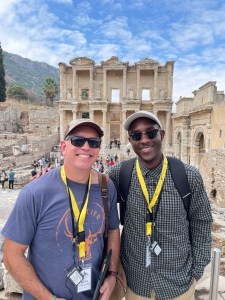
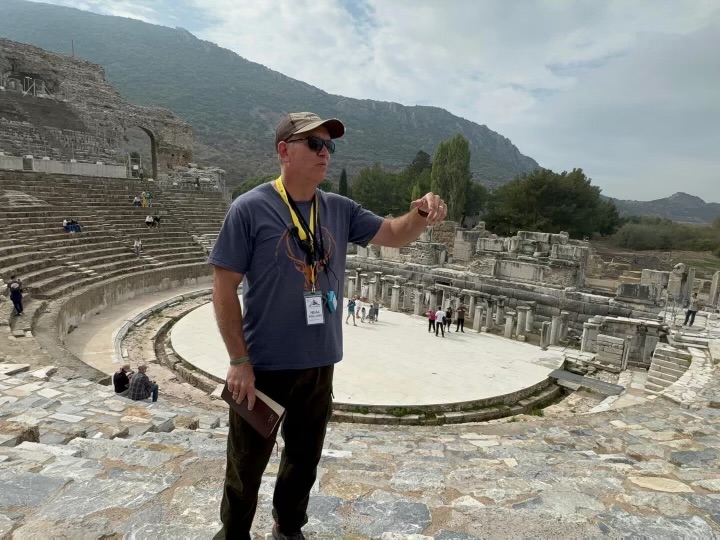
We spent a full two hours at Ephesus, starting at the ancient Harbor Road which Paul would have traveled to come up from the ancient port site of the city. Then, we went into the very theatre we read about in Acts 19:29! Getting to speak for a few minutes about that moment to our group in this theatre was a personal highlight! We saw the facade of the library of Celcus, an impressive second-century building. All along the way, we saw ancient ruins of this once thriving and leading city of Asia and the entire Roman Empire.

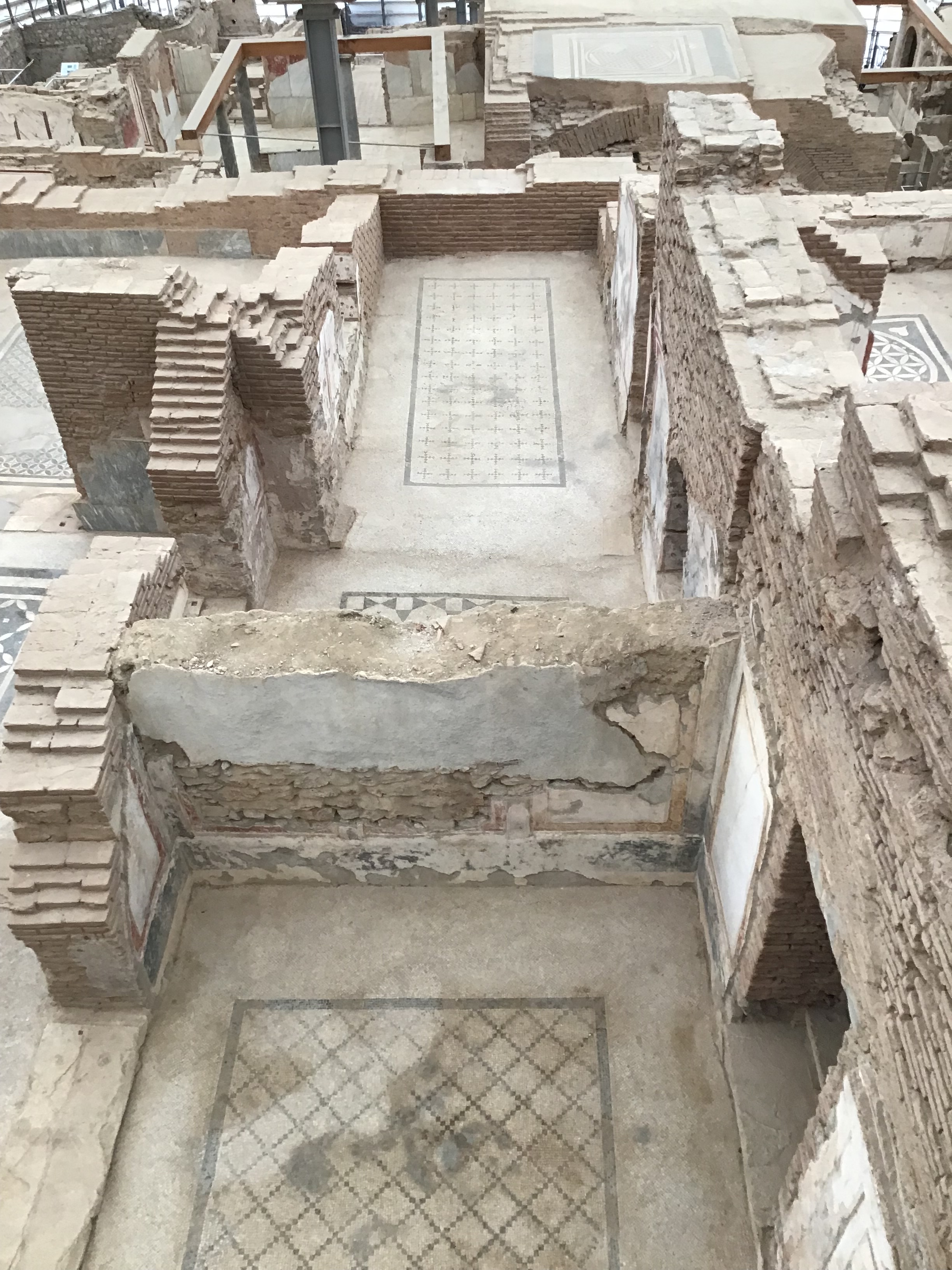
But perhaps the most exciting part of the day (though a visit to Aladdin’s Rug Warehouse was quite the unexpected treat) had to be walking through the recent excavations of the terrace houses among the Ephesus ruins. John Moore did us the wonderful favor of scheduling this as an add-on to the tour, and it was more than worth it! Cenk stopped the group and read this passage from Colossians 4:15, which says, “Greet the brethren who are in Laodicea and also Nympha and the church that is in her house.” Laodicea is about 120 miles due east, inland from where we stood in these houses. With the thriving, growing congregation at Ephesus, it was very likely that Christians were meeting somewhere in these houses or houses just like them. Church buildings were not built until the fourth century, after Christianity was “legalized” in the Roman Empire.

It is hard to describe how exciting it was to know we were walking through a city Paul called home for three years (Acts 20:31) and where he worked so fruitfully (please take a moment to read Acts 19). Paul shed tears with the Ephesian elders in and around these now ancient buildings, teaching publicly and privately to help this influential church grow! These are faith-building days, a reminder of how unique the Bible is as not only the supreme source of truth but as a book that constantly serves itself up as a book which is verified by history, archaeology, science, and geography!

And tomorrow is Athens, Greece!