Those Who Support The Savior

Women were widely regarded as second-class citizens in the Jewish and Roman world of the first century. How does Jesus elevate the role and work of women in His kingdom? In more ways than you might think. Luke 8 gives us some valuable insight…

Neal Pollard

In Luke 8:1-3, Luke provides an interesting interlude between the visit to Simon’s house and his record of Jesus’ teaching of the parable of the sower. It is a practical note, helping us understand how Jesus and the twelve had the financial wherewithal to go from one city and village to another, proclaiming and preaching the kingdom of God (1). They owed this opportunity, monetarily, to the generosity of “some women.” Among them, according to Luke, was Mary Magdalene (who had seven demons cast out of her), Joanna the wife of Chuza, Susanna, and many others (2-3). They weren’t preachers or public proclaimers, but they were vital partners in the success of Jesus’ ministry! They also provide such a powerful example to us today, reminding us that we all can have a role in causing His work to succeed. 

They Did Not Let Social Position Keep Them From Supporting Jesus (2). In the first-century Jewish world, being a woman did not put you at the top of the social heap.  As Stein says, “That certain women followed Jesus indicates that his attitude toward women was quite different from the attitude of most first-century rabbis” (NAS commentary on Luke, 340). They could have used disadvantage as an excuse, but instead they accompanied and supported them. 

They Did Not Let Setbacks Or Sicknesses Keep Them From Supporting Jesus (2). How much time had they lost, individually and collectively, to these problems? We don’t know, but they responded in gratitude to the One who released them from them. These things were not crutches to lean on, but springboards of opportunity. 

They Did Not Let Secular Ties Keep Them From Supporting Jesus (3). One of the women had a husband who worked for Herod Antipas. “It may be that the special knowledge of Herod and his court reflected in Lk. came through him; he and his wife are no doubt named as well-known personalities in the church and are evidence for the existence of Christian disciples among the aristocracy” (Marshall, NIGTC, 317). Many believe Luke’s intimate knowledge of Herod’s household came through her. Herod was a politician, and that life, then as now, brings a spotlight. No doubt, whatever Joanna did reflected on her husband, Chuza, which, in turn, reflected on Herod. Whatever pressure she might have felt did not keep her from identifying with and furthering the work of Jesus. What an example! 

They Did Not Let Sacrificial Choices Keep Them From Supporting Jesus (3). Did you notice that Luke says this ongoing contribution was coming out of their private means? Women did not ordinarily have financial independence, but these women were willing to use their own funds (stipend or allowance?) for Jesus’ divine mission. The old saying is, “Success comes in ‘cans,’ not ‘can’ts’.” They counted the cost (14:28)! 

Their financial support was not meant to be a substitute for doing the duties of discipleship. Mary, the first person Jesus will appear to after His resurrection (Mark 16), is given the job of being the first to tell others He had risen (Mat. 28:7ff). Today, as then, support comes in so many forms. We support Jesus by helping fulfill His Great Commission, by being His hands and feet in helping others, by financially contributing to His work, by edifying the church, etc. We might offer any number of excuses for why we cannot, but we do well to follow these women who did not let anything stop them from supporting the Savior! 

The Relationships Of Generosity

Neal Pollard

     I never cease to be amazed at the generosity of some people. Their capacity and faith for giving seems endless, yet their cheerfulness under such circumstances defies the understanding of man. While I have known so many generous people, I am humbled by my parents. Living on a very limited income for most of their adult lives, starting the life in preaching back in the mid-1960s, they have constantly poured out from that limited reserve abundantly upon others. I cannot count the number of poor families for whom they have bought a week’s worth of groceries. They often spent whatever Christmas bonus they received plus so much more, buying gifts for members. They have lent assistance to needy family and church members. They refused raises, asking instead that the increase go to support a missionary. That continues in their modest retirement years.

     This is on top of their regular contribution. I could write pages of material, giving specific examples of extraordinary good they have done with relatively little. The question that dominates my thinking is, “How have they developed such a giving spirit?” The answer that recently hit me is “relationship.”

     They have a proper relationship with people. It takes a servant’s heart, a heart which acts in love and concern for one’s fellowman, to so generously give. When we see our task as helping people however we can, we will give. We will give each Sunday, and we will find ways to give in our private opportunities.

     They have a proper relationship with money. What grace it requires to see money as a tool and a servant, a commodity used to live but also to give. Hoarders hurt, but sharers shine. Frivolity is sinful. Generosity is a grace. They, like Paul, have known abundance, though more often they have suffered want (Phil. 4:10ff). Whichever lot was theirs at the time, they seemed just as joyful and full of peace. They are savers, but they are also givers. They live well within their means, but they give well beyond their ability (2 Cor. 8:1ff).

     They have a proper relationship with God. Their sentiment is like one I once heard expressed by a gospel preacher. He said, “God will always give us the exact amount of money we need.” If we trust that the God who made us and remade us through Christ is control of it all, we know He will supply all our needs (Phil. 4:19). If we see ourselves as His stewards (managers, 1 Cor. 4:2), we will happily serve as a conduit of generosity.

     God has not caused their generosity to impoverish them. To the contrary, they live as close to debt-free as people can in our society. God has blessed them with things that man would find impossible to believe they could own in the wake of such bountiful benevolence and generous giving. What a lesson they serve to all of us to understand the relationships of generosity. 

Thanks, Dad and Mom.

Gary and Brenda Pollard will celebrate their 60th Anniversary this Friday (6/21/24)

How To Avoid Defrauding Deity

Neal Pollard

At the end of the Old Testament, the prophet Malachi simply asked, “Will a man rob God?” (3:8). Now that’s not a thought that naturally occurs to most. It would seem impossible to take by force what belongs to an all-powerful, all-knowing Being. Knowing about His supernatural nature, who would dare to try? Especially when you read that those who do so are  “cursed by a curse” by the One we just described (3:9). But Malachi said they robbed God in “tithes and offerings.” When it came to their financial giving, they stole from the Sovereign!

Is it possible to do that today? Wouldn’t we want to steer so far away from such a practice? Consider:

  • We rob God when we put our giving to Him anywhere but the top of our priorities. Malachi’s peers gave God the blind, the lame and the sick, which they would not dare offer their governor, for sacrifice (1:8). God calls this “evil.” What about when we put bills, entertainment, and other spending and saving first, then give God what, if any, is left over. Under the first covenant, God commanded His people give Him “the first fruits” (Ex. 23:16,19). But that covenant is inferior to what we have in Christ (Heb. 8:6). This should motivate us to make giving a “first fruit” and not an after thought.
  • We rob God when giving is a duty rather than a delight. For Malachi’s brethren, offering to God was described as despised, tiresome, and disdainful (1:13). When it came time to give, apparently they had a grimace rather than a grin on their faces. The God who gave them everything was met by a people who begrudged giving back to Him anything. Later, God will teach us that giving begins in the heart, with ourselves. Paul praises the impoverished Macedonians who exceeded expectations (2 Cor. 8:3) in their giving because they first gave themselves to the Lord, then gave their money to His work (2 Cor. 8:5). Paul could characterize them as cheerful givers (2 Cor. 9:7). This was not because they were prosperous and gave a big contribution from the overflow. Their wealth was their generosity (2 Cor. 8:2). They gave beyond their ability and it made them happy to do so. 
  • We rob God when do not test Him with our giving. This is an unexpected admonition. God wanted a chance to show them what He does for the one who gives sacrificially and by faith. The principle does not work and is inconsistent with God’s will if we do not test Him by giving sacrificially and generously. God says, “test me now in this” (3:10). Give generously and see “if I will not open for you the windows of heaven and pour out for you a blessing until it overflows” (3:10). In light of how we can see God work like this in our lives, why would we take that opportunity from Him to show His incredible power. He always proves that He cannot be out-given.

We may ask, “How much should I give?” Truly, there is no set percentage stipulated under Christ’s covenant. They gave a tenth of everything they owned under the Old Law (Deut. 14, 26). What we have is better! We do not have to bring sacrifices for our sins year after year. Christ sacrificed Himself once for all (Rom. 6:10; Heb. 10:10; 1 Pet. 3:18)! It’s hard to imagine a Jew, accustomed to giving a tenth, coming up out of the mikvah (baptistery) on Pentecost, forgiven of their sins, and rejoicing, “Now that I’m a Christian, I don’t have to give ten percent any more!” 

No, God doesn’t give us estimates or projections. He gives us exhortations and principles. He wants us to give to Him out of our trust in His care and out of our love and appreciation for His gifts to us. When we take inventory of that (and start with Calvary!), we will learn to give the way He wants us to give. 

Give Like Jesus

Neal Pollard

When we think about Jesus and material possessions, perhaps we think of passages like Luke 8:3 that tell us He lived from the financial support of Mary Magdalene, Joanna, Susanna, and many others. Or His own words: “The foxes have holes and the birds of the air have nests, but the Son of Man has nowhere to lay His head” (Luke 9:58). Jesus lived humbly. Despite this, how often do we reflect on Jesus’ giving?

  • He gave Himself. Scripture says this explicitly in several places. He gave Himself “for our sins” (Gal. 1:4;). He gave Himself “for me” (Gal. 2:20). He gave Himself “for us” (Eph. 5:2; Ti. 2:14). He gave Himself for the church (Eph. 5:25). He gave Himself “for all” (1 Tim. 2:6). No matter how you look at the cross, it must be described in terms of His giving. This gift was the most significant act of all history. The writer of Hebrews says “we have been sanctified through the offering of the body of Jesus Christ once for all” (10:10). Isn’t it interesting that Paul praises the unexpected generosity of the Macedonian givers, in part, by saying “they first gave themselves to the Lord and to us by the will of God” (2 Cor. 8:5). Gracious, generous giving is impossible without our first giving ourselves to God. Submitting ourselves to Him in utter dependency, yielding our will and desires, is a prerequisite for Christlike giving.
  • He found it more blessed to give than receive (Acts 20:35). This was His mentality and outlook. His default position was doing for others, not having others do for Him (Mat. 20:28). Paul, speaking with the Ephesian elders, reflects back on this character trait of Jesus, saying, “In everything I showed you that by working hard in this manner you must help the weak and remember the words of the Lord Jesus, that He Himself said, ‘It is more blessed to give than to receive.’ ” What is Paul talking about? In the context, he is talking about material things like gold, silver, and clothing (33), material needs (34), and helping the weak by working hard (35). He’s not referring to the Sunday collection (cf. 1 Cor. 16:1-2), but an attitude of heart instead. Again, the Macedonians embodied this attitude. Paul is still speaking of them when he writes, “Each one must do as he has purposed in his heart, not grudgingly or under compulsion, for God loves a cheerful giver” (2 Cor. 9:7). We should grow to the point where it brings us joy to give to God. Isn’t that how Jesus gave Himself for us? Study Hebrews 12:1-3 closely!
  • He gave with grace (2 Cor. 8:9). Most lexical definitions of “grace” include the word “gift,” “favor,” and “benefit.” These are undoubtedly giving terms and, when Paul uses it in 2 Corinthians 8:9, a financial term. Paul says, “For you know the grace of our Lord Jesus Christ, that though He was rich, yet for your sakes He became poor, so that you through His poverty might become rich.” He ties Christ’s gracious giving to his admonition that Corinth be gracious givers, too. He urges them to complete this gracious work (6), to abound in this gracious work (7), and co-participate in this gracious work (19-20). For Jesus, grace meant giving up something to meet the needs of others. For us, gracious giving means giving up something to supply the needs of others. Like with Jesus, we prove the sincerity of our love by gracious giving (8).

Should we give out of duty and obligation? Not entirely and certainly not primarily. Should we give out of gratitude? That’s certainly better than guilt. How about giving out of an effort to imitate our Savior? When we are giving, it is not merely “to the church.” It is giving to the head of the church, the one who gave everything to purchase it (Acts 20:28). Remarkably, sacrificial giving is a tangible, explicit way for us to give like Jesus. Could there be a stronger motivation?

Putting In Money Or Putting In More?

Monday’s Column: Neal At The Cross

Neal Pollard

TODAY’S ARTICLE IS REPRODUCED FROM YESTERDAY’S LEHMAN LEARNER. I EMAIL AN EXPOSITORY STUDY OF A SECTION OF A BIBLE BOOK EACH MORNING. YOU CAN SUBSCRIBE AT “LEHMANOFFICECOC@GMAIL.COM.”

S.J. Friesen, in a book edited by Susan R. Holman entitled Wealth and Poverty in Early Church and Society. Holy Cross Studies in Patristic Theology and History (2008), reveals at least seven categories or classes in imperial Rome. This would have certainly applied to Jesus’ day. From top to bottom, they were:

  • Imperial elites (0.04% of society)
  • Regional or provincial elites (1%)
  • Municipal elites (1.76%)
  • Moderate surplus resources (7% estimated)
  • Stable near subsistence level with reasonable hope of remaining above the minimum level to sustain life (22% estimated)
  • At subsistence level and often below minimum level to sustain life (40%)
  • Below subsistence level (28%) (p. 19-20)

In that lowest category were included beggars, the disabled, unskilled day laborers, prisoners, and unattached widows. 

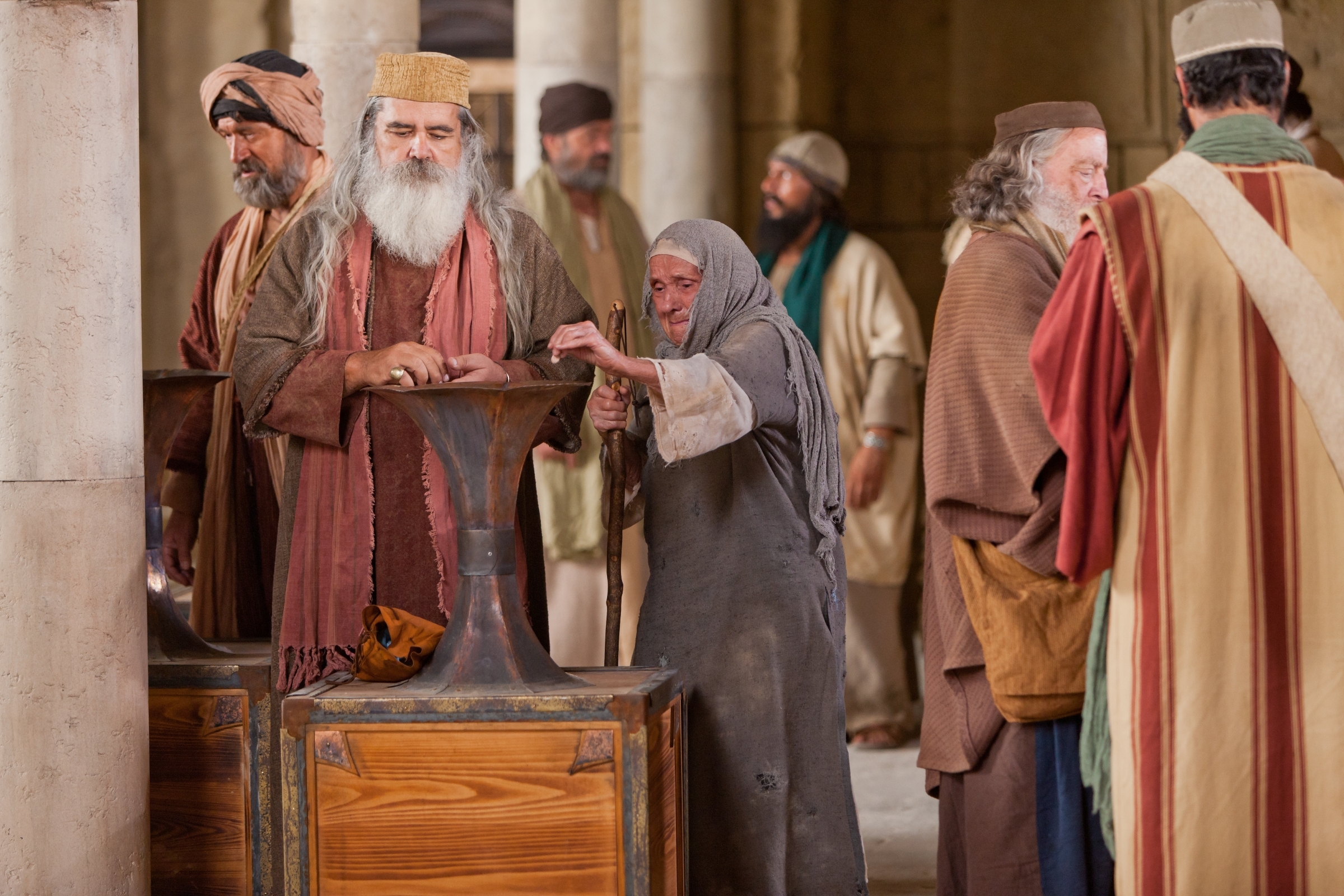
So the woman we meet in Mark 12:41-44 was on the bottom rung of society. Typically, every day was a fight for survival and full of uncertainty about meeting the basic needs of life. She had no advocates, champions, and could have been the target of unscrupulous men if she had a house or anything her husband had left her. Just before Jesus calls attention to the widow in our text, He had condemned the scribes for at least five offenses. The fourth was that they “devour widows’ houses” (40), for which “they will receive the greater condemnation” (40). Was the widow in these verses one of their victims?

What we know is that she enters the alms area of the temple in the court of women carrying “two small copper coins, which make a penny” (42). He makes no judgment on the contributions made by the wealthy, but holds up the woman as a contrast to the scribes and any who practiced pretentious religion.

She gives unpretentiously. She does not draw attention to herself. She quietly slips in the two coins. It is because Jesus is omniscient and observant that He is aware of her gift. She did not make any announcements or ask for any prayer requests, that God help her since she was giving everything to God. It was an assuming moment in time that might have passed unnoticed but for Jesus. 

She gives sacrificially. Many rich people put in large sums (41), yet Jesus says they contributed out of their abundance (44). However much they gave, they could continue their lifestyle at the same rate and pace as before their gift. But she “put in everything she had, all she had to live on” (44). The Macedonians were great givers, who “according to their ability, and beyond their ability gave of their own accord” (2 Cor. 8:3). As incredible as that is, this poor widow gave more. Only Jesus could exceed her gift (cf. 2 Cor. 8:9). 

She gives abundantly. Jesus signifies this by saying she gave more than the rich that day (43). It was not a competition to her, a cause for swelling pride. We will suggest her motive in a moment, but the consequence of her gift was that it was unmatched generosity. Those whose giving cost them something know the fulness of heart and the favor of God this woman must have felt. What a challenge!

She gives trustingly. Mark does not tell us this. In fact, neither does Luke (21:1-4). But what other conclusion can we draw? She gave God all she had to live on. Do we suppose that she left the temple, curled up in a ball, and died of starvation and exposure? Is that how God has ever responded to those who give in faith? Has anyone ever out-given God? That does not mean that God moved her up a rung or two in society because of her gift. That is a very materialistic way to view this account. Instead, the way she gave was inseparably joined to the way she lived. She gave with reckless abandon, left only with a confidence that God would be her protector. Had she heard that day or at some point the words of the psalmist, “How blessed is he whose help is the God of Jacob, Whose hope is in the Lord his God, Who made heaven and earth, The sea and all that is in them; Who keeps faith forever; Who executes justice for the oppressed; Who gives food to the hungry. The Lord sets the prisoners free. The Lord opens the eyes of the blind; The Lord raises up those who are bowed down; The Lord loves the righteous; The Lord protects the strangers; He supports the fatherless and the widow, But He thwarts the way of the wicked” (146:5-9)? She seemed to know the source of her help and hope, her administrator of justice, provisions, and support. She gave accordingly.

Next Sunday, we will make an offering as part of our worship. Across 2,000 years, Jesus holds up this widow to challenge us. Will we give like her, unpretentiously, sacrificially, abundantly, and trustingly? If we do, will He cause us to suffer? That is the mental battleground upon which we all stand. May He help us successfully fight that battle. 

What Generous Giving Shows

Monday’s Column: Neal At The Cross

Neal Pollard

After praising the Corinthians in the midst of his second letter to them, Paul challenges their growth in a specific area of their Christianity. It is an area where several need to be challenged. Jesus urges us to have proper hearts by laying up treasure in heaven (Mat. 6:19-21) and Paul spends time showing what a proper heart looks like. Notice what he says on this subject in 2 Corinthians 8. 

GENEROUS GIVING REFLECTS THE GRACE OF THE LORD (1-2,9)

Paul holds up the impoverished churches of Macedonia and the Lord Jesus Christ as examples of grace for the Corinthians. The poor saints of Macedonia, in a great ordeal of affliction, had abundant joy and a wealth of liberality to give generously despite that poverty. Who does that look like? The Lord Jesus Christ, who, though rich, for our sakes became poor that we through His poverty might become rich. Do you want to look like Jesus? Give generously and abundantly.

GENEROUS GIVING REVEALS AN EAGER, SACRIFICIAL HEART (3-6)

What kind of hearts did the Macedonians have? They had willing hearts, which caused them to give “beyond their ability” (3). They had begging hearts, which considered being allowed to give a favor (4). They had giving hearts, which prompted a financial generosity out of their first giving themselves to God (5). How is my giving? Let me first ask how my heart is, when it comes to “my” money. Paul uses Macedonia’s example to spur on Corinth.

GENEROUS GIVING REINFORCES OTHER OTHER SPIRITUAL QUALITIES (7-8,24)

Paul credits Corinth for their faith, utterance, knowledge, earnestness, love, and sincerity. The first three seem to be alluding to their spiritual gifts (cf. 1 Cor. 12-14), necessary to grow the church. The last three are attitudes Christians must possess. Yet, Paul tosses generosity right onto that figurative pile. He calls for them to abound in this gracious work, too. It proved the sincerity of their love. Later, Paul urges them to “show them the proof of your love and of our reason for boasting about you” (24). It’s not generous giving or these other qualities, or vice versa. God wants all of us. 

GENEROUS GIVING READIES ONE FOR COMPLETION (10-15)

Paul calls for them to finish what they intended to do in this matter. Intentions, as great as they may be, cannot be spent or used to meet the various needs Paul is concerned about. The completion of it was as vital as the readiness to do it. God sees giving as the great equalizer between those with abundance and those with need. He’s not talking about redistribution of wealth. He’s talking about a healthy attitude toward one’s wealth that leads to God supplying all that’s needed through our generosity. Don’t just intend or desire to give. Do it!

GENEROUS GIVING RESULTS IN ACCOMPLISHING GOD’S WORK (16-24)

This is a matter of practicality. Real needs in spreading the gospel existed, requiring monetary aid to accomplish. Titus brought it to their attention. Paul is reminding them of it. As they participated in this gracious work, they were helping the church. 

Do you find it interesting that for the inspired Paul, the subject of giving was not off-limits whether he was talking about the rich or the poor or the weak or the strong? Giving is a fundamental aspect and expression of our faith. It is not a substitute for good works. It is a specific example, one of many good works. We need to excel in this gracious work also!

They Saved $200, But What Did It Cost Them?

3108864732_09588a7913_b

Neal Pollard

I respectfully wade into Kentucky’s most hallowed sport (basketball) because of information passed along by some diehard Wildcat fans in the eastern part of the state. A brother shared with me that Pat Summitt almost became the university’s women’s basketball coach, but they refused to pay her moving expenses–calculated at about $200. Turns out, it was 1976 and the 24-year-old future Hall-of-fame women’s basketball coach was approached by the athletic brass from Lexington about her becoming their head coach. She was making $8900 at Tennessee, and Kentucky offered her $9000. She didn’t feel she could afford to move for a mere $100, so she asked for the extra expenses. Apparently, they refused and the rest is history. By the time she died (prematurely) at the age of 64 in 2016, Summitt was the winningest head coach in NCAA women’s basketball history with 1098 wins and eight national championships (via npr.org, kentuckysportsradio.com, and sbnation.com). 

Can you imagine the way that conversation may have gone, with someone in authority (who obviously, forever wished to remain unnamed) vetoing the offer because he didn’t want Kentucky paying those exorbitant moving expenses? Who knows? It may have been unanimous or perhaps unilateral, but someone changed the course of women’s college basketball history for what in 2019 dollars is $901.79. 

Do we ever suffer from the same kind of shortsightedness, as individuals and as churches? Have we ever said “no” to something because we were unwilling to count the cost? The matter may have involved the stewardship of money and material resources and the amount may have been proportionately bigger than $901.79, yet still discounted the aid of the One who owns it all. Have we ever failed to dare and do the very mission the Lord has us here to do because we counted the cost and felt it was more than we were willing to pay? Some will have never obeyed the gospel for this reason (Luke 9:57-62). Some will have never shared the gospel with a dear friend or family member for this reason (Matt. 10:37). Some will have never been more involved in the work of the church for this reason (Mark 8:34-36). Some will have never stood up for Christ in their daily lives for this reason (cf. 1 Peter).  Some will have never given generously of their livelihood for this reason (2 Cor. 8:1-8). The reason? The cost. 

We could focus on what we gain by self-sacrifice and sacrificial service. But let us also focus on what we lose by failing to give ourselves generously for His cause. It could be that our values are distorted and we are measuring the wrong way. Remember the words of Caleb Bradlee:

Count up the joys, and not the pains;
Think not of losses, but of gains;
Keep the clouds back; gaze at the sun;
Thus life will smoothly with you run.

Our gifts are more than all our blows,
And what is best we know God knows;
And He will send His blessings down,
Some veiled; but all will hide a crown.

If we could know the meaning grand
In tears that come by God’s command,
Then sweetly should we take the cross,
And count as gain what seems a loss.

But only let us wait and pray,
Then out of night will come the day;
And pearls long hid from human sight,
Will crown our brows with holy light.
(Via Library of Congress, 1888)

The Gift That Jesus Gave

Neal Pollard

Often, during this time of year, there is an emphasis placed upon the gifts brought by the magi to Jesus—“gifts of gold, frankincense, and myrrh” (Mat. 2:11).  They understood how Jesus was worthy of worship (2:2,11) and celebration (2:10).  Their giving flowed from that recognition.

The book of Hebrews turns the tables and reveals the Jesus who is the gift-giver. The same Greek word used to describe the wise men’s gifts to Jesus is used twice by the writer of the epistle to talk about Jesus’ gift. He does so in the context of Jesus’ work as a High Priest, as contrasted with the gifts offered by priests under the Law of Moses. In Hebrews 5:1, the writer talks about the qualifications necessary to serve in that role—taken from among men, working on behalf of men in order to offer both gifts and sacrifices for sin. Chapter five deals more with His qualification to serve and offer, but the writer does deal with the gift itself later on. Later on turns out to be chapter eight. The writer uses that same word for “gifts” in Hebrews 8:3-4 to talk about what Jesus offered. His gift is contrasted with those that cannot make the worshiper “perfect in conscience” (9:9). He gave His own blood (9:10) and with it obtained eternal redemption which will “cleanse your conscience from dead works to serve the living God” (9:14). The writer summarizes that gift, “the offering of the body of Jesus Christ once for all” (10:10), as the gift that sanctifies us to God.

But what do we give in return? We cannot repay His priceless gift. But God presupposes that we will be motivated to give. Jesus does, referring to worship in Matthew 5:23-24. He does again, referring to the monetary gifts of the wealthy and the sacrificial (Luke 21:1-4). The Hebrews writer will use Abel as an example of faith-fueled giving (11:4). But our most generous gifts to Christ, however moved by sincere love and unwavering commitment, is but a shadow and reflection of His gift. We give Him money, honor, time, energy, heart, and everything else we can, because He is the greatest giver of all. May we take the time, every day, to honor and give freely, to the Gift-Giver!

hqdefault

A Small Portion Does Not Mean Small Proportion

Neal Pollard

Those who address us prior to our giving often make a statement like this, that we are giving back but a small portion of what God has blessed us with. In other words, if you could owned and could contribute all the world’s wealth, week after week, how would that compare to the sacrificial gift of Christ (cf. Mat. 16:26)? In fact, how could it compare with the many additional blessings besides atonement—a body equipped with the ability to perform involuntary actions (breathing, blood flow, cell regeneration, etc.), an environment conducive to life (air to breathe, photosynthesis, etc.), a planet in harmony with sun and moon making life possible, and the list is endless. It is not only impossible to out-give God, it is impossible to come anywhere close.

The Bible does not dictate a percentage for the New Testament Christian giver. The inferior covenant (cf. Heb. 8:7-8) required a tenth of all (Heb. 7:5), a pretty good benchmark for those of us having access to the better covenant established upon better promises. It is impossible to know what anyone might be thinking who hears the well-intended, if well-worn, statement, “We have the opportunity to give back a small portion of the many blessings we have received…” It does not mean, “A small proportion.” Nowhere does the Bible sanction stingy, leftover-style giving. In fact, it condemns such (read Malachi). Instead, Paul writes, “Now this I say, he who sows sparingly will also reap sparingly, and he who sows bountifully will also reap bountifully. Each one must do just as he has purposed in his heart, not grudgingly or under compulsion, for God loves a cheerful giver” (2 Cor. 9:6-7).

Giving involves a monetary, financial exercise, but it is a distinctly spiritual activity. It is an act of trust, a faith that the God who has provided will continue to provide and bless the one who bountifully shares what he has been given. When we, like the Macedonians, give beyond what we believe is beyond our ability (2 Cor. 8:1-5), we open up an exciting door in our walk with Christ.

If you are one who gives a small proportion of your income, may I challenge you to increase it? See what happens in your life. You are not giving to manipulate or coerce God, but you will experience a growth not possible on the “small proportion” side of generous giving. Trust Him! He has never broken a promise yet (read Mal. 3:10 and Luke 6:38).

article-2189659-14951d3a000005dc-746_468x311