Genesis: These Are The Generations (XIII)

Stumbling In The Face Of Blessings (12:1-20)

Neal Pollard

How important is Abram to the subsequent narrative of the entire Old Testament? From creation to the flood is at least 1656 years, and it is covered in six chapters. Abram’s lifespan is 175 years (25:7), and it is covered in 15 chapters (ch. 11-25)! In the first full chapter, this chapter, we see the development of Abram’s faith.

To say “development” is to point out that it needed to grow and mature. As this chapter and even later circumstances show, Abram wrestles with fear and anxiety when facing intimidation. Yet, God foresaw what his faith could become and chose this man to father the nation through whom His Son would come. 

A Commission (1,4-6,8-10). Let’s not dismiss the greatness of Abram’s faith to receive and obey such an incredible charge, a call to leave his homeland for a distant land (1). The commendation of Scripture is, “So Abram went forth as the Lord had spoken to him” (4a). He was 75 years old, and while he would live another century he was at best middle-aged! Abram collected his apparently considerable possessions and the people of his household and traveled toward Canaan. The trek recorded here covers hundreds of miles, with Abram first going northeast well into modern-day Syria before heading southwest into the heart of what would become Israel. However, Abram goes on his own much further south into Egypt because of famine (10). This would prove a stumbling block in his journey of faith.

A Commitment (2-3, 7). God binds Himself with an incredible promise to Abram that requires divine ability to fulfill. There are several components to this promise:

  • I will make of you a great nation (2).
  • I will bless you (2).
  • I will make your name great (2).
  • I will bless those who bless you (3).
  • I will curse those who curse you (3).
  • In you all the families of the earth will be blessed (3).
  • To your descendants I will give this land (7).

As you can see, there are seven parts to what God promises Abram. Eventually, God will fulfill every one of them even though some would be long after this patriarch’s death. While we see obedient faith on this man’s part, we also see grace and mercy on God’s part through each stage of this mission.

A Concern (11-14). Perhaps it was a lapse of faith that caused Abram to head into Egypt for famine relief (there is no record of God telling him to go down there). His confidence is certainly shaken once he and Sarai get into this pagan territory. Knowing his wife’s beauty, Abram coaches her to mislead any who inquire about her by telling them he was her brother rather than her husband. Technically, they are half-siblings (20:12), but that was not the nature of their relationship. Sure enough, his concern was well-founded. The Egyptians, seeing Sarai, found her “very beautiful” (14).

A Compromise (15-20). Abram’s faith failed him in Egypt. By his influence, Sarai sells the lie. Because of it, Pharaoh takes her into his house (15) and gifts Abram with much livestock and servants (16). The Lord strike’s the pharaoh’s house with plagues, leading him to confront Abram (17-18). Not only did Abram deceive, but he also brought suffering on others and was the proper subject of rebuke from this pagan ruler. Pharaoh says, ““What is this you have done to me? Why did you not tell me that she was your wife? Why did you say, ‘She is my sister,’ so that I took her for my wife? Now then, here is your wife, take her and go” (18-19). God’s providence is still with Abram and Sarai, as they are allowed to leave unharmed and with increased goods (20). God shows grace and favor even when His people fell short.

While these words are written worlds away from where we are today, I think about some unmistakable parallels to our circumstances today. We have been given a commission (Mat. 28:18-19), one requiring faith on our part to follow. Yet, with that comes a divine commitment of help and His presence (Mat. 28:20). We are going out as sheep among wolves (Mat. 10:16), and being frightened and intimidated in carrying out our mission is an ever-present concern (1 Pet. 3:14-15). What we cannot do is compromise our faith! God is counting on us to faithfully represent Him to the world. However, isn’t it wonderful that God extends His grace and mercy when we do fail? This is not a license to give up and stop pursuing our mission! Abram doesn’t stop. Let us be thankful for God’s patience and faithfulness, even when we are not at our best. We can still be people of faith, even if we stumble along the narrow road.  

Genesis: These Are The Generations (XII)

“The Records Of The Generations Of Shem” (11:1-32)

Neal Pollard

The observation of Shem’s genealogies is a significant turning point in the book of Genesis. With it, Moses is closing his focus on the global situation and initiating his focus of his family situation. As we will see, this family warrants special attention for at least two reasons. First, this family would eventually be the Jewish nation, and, second, this family would eventually give the world its Savior. 

Before giving this special information, though, Moses shows us what happened to the rest of the world and how the population spread to different lands. In fact, notice the bridge between the two chapters: ” These are the families of the sons of Noah, according to their genealogies, by their nations; and out of these the nations were separated on the earth after the flood” (10:32).

How were they separated? That is the task of Genesis 11:1-9. The people gather in the plain of Shinar, hundreds of miles due east of the Jordan River, and begin a building project. Most translations call their structure a “tower,” and the root of the word signifies “greatness” and “growing up.” A tower would be the highest or greatest structure in a town or area. Certainly, that seems to be what is intended by this construction feat. 

When we think tower, we think tall, narrow defensive building (Swanson, Dict. Of Bib. Lang., np). But just how narrow and tall, we aren’t told. Neither are we told if this was to protect them from enemies or an attempt to prepare for a future calamity like the flood which wiped out their predecessors. We do know that their motivation seems self-serving (4) and lacking in faith (4). We also know that the Lord saw a unity on such a shaky foundation as a cause for divine concern (6). Their intention certainly seems in conflict with God’s mandate to “be fruitful and multiply; populate (lit., “swarm in”) the earth abundantly and multiply in it” (9:7).

Some years ago, in teaching about God’s eternal plan of salvation, I shared these lessons to be learned from Babel:

  • They Left God Out Of Their Plans (3-4)
  • They Had Improper Motives (4)
  • We Cannot Hide Ourselves Or Our Work From God (5)
  • The Value Of Unity (6)
  • God Is In Control And Always Has The Last Word (7)
  • Division Thwarts (8)
  • Unless The Lord Build The House, They Labor In Vain Who Build It (Ps 127:1)

Whenever God confuses their languages and communication is so hindered, they stop building and scatter (8). The city with the tower came to known as Babel, a name then and now that means confusing or confusion (i.e., to babble; cf. Acts 17:18). 

In Genesis 11:10-32, Moses turns his attention away from the rest of the earth and examines Seth’s family tree. As I teach “scheme of redemption,” I call these generations planks on a bridge leading us closer to Christ: Shem, Arpachsad, Shelah, Eber, Peleg, Reu, Serug, Nahor, Terah, and Abraham (10-26). God is building a bridge to allow us to be reconciled to Him, accomplishing it generation by generation through time. As with Babel, nothing could subvert God’s intentions and plans in bringing His Son, our Savior, into this world.

Within this lineage of Shem, Moses includes the “generations of Terah” (27-32).  In so doing, he explains how Lot came to be traveling with Abram and Sarai, with the loss of his father, Haran (27-28). Moses also introduces us to an important fact which will come to the foreground later, that Sarai “was barren; she had no child” (30). He also introduces what he will explain in the next chapter, the sojourn of Abram, Sarai, and Lot from Ur to Canaan (31-32). They pause their journey in Haran, where Abraham’s father, Terah, dies (32). We will learn more about this journey in the next chapter. 

Genesis: These Are The Generations (XI)

The Generations Of The Sons Of Noah (10:1-32)

Neal Pollard

With his next use of “toledoth” (generation), Moses gives the background for all the nations. Everyone on earth today has descended from one of these three men–Ham, Shem, or Japheth. This table of nations is both informative and important. One can consult various commentaries (Kenneth Matthews has a twenty-page discussion in the New American Commentary, while Kurt Strassner has a much more concise breakdown in the Opening Up Commentary series) of the nations which descended from these three men. 

The latter ties today’s Eastern Europe to Japheth (10:2-5), North Africa and the Middle East (on the southern and eastern coasts of the Mediterranean) to Ham (10:6-19), and the dominant nations of the Middle East to Shem (10:21-31)(51). But there is more to this list than a geography and ethnic studies lesson. Moses is setting the reader up for the material he will share in the next chapter, when the people of earth will disperse and settle in various places ( see 5,11,18, etc.). 

The observation of Reyburn and Fry is correct when they say, “This follows a pattern that is repeated a number of times in Genesis, in which the individuals and their descendants who are not in the line chosen by God are mentioned first, while those who are in the chosen line are mentioned last, and the story then continues with them” (Handbook, 228). You see that first in Genesis 4-5, and you will see it again in Genesis 10-11. There are a few matters of note which Moses lays out in giving this genealogical record.

First, he mentions the mighty hunter, Nimrod (8-12). He is so renowned for these skills that subsequent great hunters were likened to him. Look up “hunter” in the dictionary and one of its synonyms is “nimrod.” He will be listed in the genealogies of 1 Chronicles 1:10, then in the prophetic work of Micah (5:6). Yet, more important than his skill is the place he settled. Though Moses would not have to deal directly with them, the Assyrians would factor prominently in the later history of Israel. The foreknowledge of God is at work here, informing the people of God of the “genesis” of this wicked enemy. Verses ten through twelve unambiguously mention not only Babel (i.e., Babylon–another later, even stronger enemy), but Nineveh and Assyria. These are kingdoms and lands built by Nimrod.

See also more local enemies which would plague Moses’ ancestors, Moses himself, and Moses’ descendants. He mentions where the original inhabitants of the promised land originated. Ham’s descendants would give us the Canaanites, Amorites, Hivites, Jebusites, and Girgashites (13-17), along with the other thorns in the people’s sides. Soon, Moses will be moved by God’s Spirit to share His promise to Abraham concerning the ultimate expulsion of these people in favor of his descendants (15:18ff).

Among others of Ham’s descendants are the inhabitants of Sodom and Gomorrah, who will also feature prominently in the narrowing focus on Shem’s (8th great-grandson), Abraham (19). They will grow so wicked that God destroys them.  Here, we are simply taught of their origin.

Moses is setting up the reader for one family among all the nations, while giving us five generations of Seth (Shem, Arpachsad, Shelah, Eber, and Peleg; see ch. 11). In this accounting, Moses is more interesting in giving us the rest of the descendants of Shem before he rivets in on Abraham’s line. One other interesting line, nestled in those genealogies of Shem, is the statement made about Peleg. “In his days the earth was divided” (25). While many take this to refer to the incident at Babel, when the inhabitants were socially divided, it is also possible that this refers to a breaking up of the continents into a continental drift. A study of earth’s major land masses shows a complementary form between those separated by seas and oceans. Robert Utley tells us, “The Hebrew term literally means ‘irrigation canals’ which would fit southern Mesopotamia, but the popular etymology is ‘divisions’” (How It All Began, 123). Given the ambiguity of the word in this context, no one should be dogmatic about either position. 

Isn’t it incredible all the layered, even subtle, discoveries possible when studying even apparently obscure, mundane chapters of the Bible? This rich book is full of discoveries waiting for the Bible student to find by mining its inspired veins. With this listing, Moses gets down to the more specific interest of his inspired record. 

Genesis: These Are The Generations (X)

The Rest Of Noah’s Days (9:1-29)

Neal Pollard

With a global clean slate, the survivors emerged with a need for purpose and direction. As He had from the beginning, God gives just that. God issues a series of mandates:

  • Be fruitful and multiply, and fill the earth (1,7).
  • Reign over the living creatures (2).
  • Eat meat as well as plants (3).
  • Abstain from eating blood (4-5).
  • Do not shed man’s blood, as he is the image-bearer of God (6).

Before there was a written code, God spoke to the fathers as the book of Genesis and Job bear out. As He spoke to Noah before the flood, so now He gives he and his sons these basic rules of conduct for order and prosperity. 

Along with instructions, God issues promises (8-17). That a sovereign, all-powerful, and eternal God would voluntarily desire to enter into covenant with man is not only humbling, but incredible! A covenant is a “treaty, compact, i.e., an agreement between two parties” (Dict. Of Bib. Lang., np). The Greek counterpart means “to make a solemn agreement involving reciprocal benefits and responsibilities” (Louw-Nida, 451; cf. Acts 3:25; Heb. 8:10). Here, God only speaks of what He will do. The now culturally-infamous rainbow was established by God as a signal of His promise never to destroy the earth with water again (11). Interestingly, it would not only serve as a reminder to man (12-13) but also, according to God, a reminder for Himself when He sees it (14-16). Have you considered that whenever you see a rainbow and remember what it represents that your Almighty Creator is doing the exact same thing?!

As a bridge to the next “toledoth” (generation) mentioned by Moses, he sets it up by explaining the role of Noah’s three sons in populating the whole earth (19). Along with this, Moses summarizes the last portion of Noah’s life. He became a farmer and planted a vineyard (20). Knowledge of fermentation and winemaking must have survived the flood or at least Noah learned the art. More than that, he imbibed in his product and got drunk (21). As so often accompanies drunkenness (read Prov. 23:29-35), Noah lost control of his faculties and did what he would not have done in sobriety. 

The greater focus of the paragraph is on Ham’s response when he sees his naked father in his tent. What was Ham’s sin? “Both Jewish and Christian interpretation speculated that Ham’s deed was a sexual offense since the same language is found in the Pentateuch describing sexual transgressions. Further support was garnered from v. 25, which refers to what Ham ‘had done to him’” (Matthews, NAC, 418). However, we leave solid ground when we speculate, and there is no reason for this. At the very least, Ham’s action in seeing his father then telling his brothers was sufficient enough for Noah to curse his son. They imitate God’s compassionate response to Adam and Eve in the garden, clothing their naked father. They deliberately avoid looking at their father (23).

Moses’ underlying purpose in this event is to give the background of the descendants of Noah, which he will continue to develop in the next two chapters. Ham’s son, Canaan, is cursed and consigned to serve the lineage of Shem and Japheth (25-26). Then, he pronounces the prolific line that would proceed from Japheth, who would have fellowship with Shem and be enlarged (27). Here, Moses simply mentions the blessed state of Shem’s line and his sovereignty over Ham’s line (26). We will read more of Shem’s descendants as the genealogical forerunners of not only Abraham, but David, and ultimately Christ (Mat. 1; Luke 3).

Concerning any further descendants of Noah, Scripture is silent. It simply says he lives 350 years after the flood, making him 950 when he died (28-29). What can we apply from this chapter to our lives?

First, God keeps His promises. Often, He signifies them in some way. They may not necessarily be physical and tangible like a rainbow in the sky, but He promises to never leave nor forsake us. How often have we felt the full force of that through trials, difficulties, and temptations (Deut. 31:6,8; Heb. 13:5)?

Second, God cares how we treat our parents. This isn’t just true when we’re little children. Preserving this event in history, including Noah’s cursing of Ham, we see how God feels when children abuse, in any way, those who gave them life. Also, as Scripture repeatedly identifies God as Father and we are His children, we are taught a certain respect and honor for that relationship. To fail in this is not only unnatural, but unholy (Prov. 30:11). 

Third, God is at work on His eternal plan. What begins as a promise in Genesis 3:15 is played out, day after day and year after year, through time and events. God is building a bridge that will lead to the Messiah, through whom man can be reconciled to God. There are dramatic moments in God’s “scheme of redemption,” but there are also multitudes of moments that unfold in mundane, ordinary ways–generation after generation, decision after decision. 

Genesis: These Are The Generations (IX)

“But God Remembered Noah” (9:1-22)

Neal Pollard

On the 17th day of the second month in his 600th year, they entered the ark (7:11). This is followed by 40 days of rain and flooding. The water prevailed on earth for 150 days. The ark rested on the 17th day of the seventh month (8:4). From that day until the cover is removed on the first day of the first month of Noah’s 601st day (8:13), there were 163 days in which the water recedes. During that period, the mountains are seen on the first day of the 10th month of his 600th year (8:5) and the raven is sent on the 10th day of the 11th month (8:6). From the day the cover is removed until they exit the ark, there is 57 days spent waiting. The 27th day of the second month of his 601st year, they do finally leave (8:14). The total time of the flood, then, is 313 days and their total time in the ark is 370 days. 

This past fall, we went on our first cruise as part of a Bibleland Passages tour. We spent 12 nights at sea in very comfortable accommodations, all the food you could eat, and even amenities like fitness centers and theaters. When we moved to Bowling Green, we stayed in the Hammers’ RV for a month in the KOA. Though the quarters were cramped, it was very comfortable and had indoor plumbing, running water, and air conditioning. Can you imagine spending just over a year in a floating barge without electricity, running water, climate control (apart from nature), and so many conveniences we simply take for granted today?

Noah and his family waited on the Lord as He, the great and original scientist (the very maker of the laws of science), not only destroyed the earth but provided a feasible timetable to make it habitable again (2) for the eight souls who would leave the ark up on Mt. Ararat (4). It was a gradual, but steady process (5) until the ground was dried (13-14). 

Moses begins the chapter with a summary, including the idea that “God remembered Noah” (1). On His timetable, He affects the conditions necessary for Noah and the rest of his family to repopulate the earth. It is equally beautiful that Noah remembers God, sacrificing “of every clean animal and of every clean bird” (20). The Lord accepts Noah’s worship and vows never to duplicate this act, despite man’s evil inclinations (21). Instead, God would perpetuate “seedtime and harvest, and cold and heat, and summer and winter, and night and day” (22). No wonder Moses would encapsulate this great patriarch’s faithful life as a man who walked with God (6:9). And what a humbling truth that God walked with Noah, all the way through these cataclysmic events and brought them safely through the water (1 Pet. 3:20).

While you will not ever face any global floods, you will be deluged with difficulties in this short life. Do not think that God could ever forget you, even as you are tossed about in the sea of struggle! God will remember you, rescue you, and reward you as you keep walking with Him! The waters of weeping will dry up and you will again stand on solid ground–whether in this life or in the eternity which follows! Trust that! 

Genesis: These Are The Generations (VIII)

God Brought A Flood Upon The World Of The Ungodly (7:1-24)

Neal Pollard

In Genesis 5:32, Noah was 500 years old when blessed with his sons. Here, in verse six, he is 600 years old when he and his family enter the ark. In that 100 years, he learns of God’s resolve to destroy the earth with water and receives his commission to build the ark. Peter says he also preached righteousness (2 Pet. 2:5) during an age of utter unrighteousness (6:5). 

Noah: The Ideal Candidate (1-10)

Can you imagine a commendation like Noah receives? Already given a glowing tribute in Genesis 6:8-9, this chapter begins with this further compliment: “Enter the ark, you and all your household, for you alone I have seen to be righteous before Me in this time” (1). So, he is ideal because of his character. Apparently, his family shares at least the influence of his righteousness (7). 

He is also ideal because of his obedience. This is how he proves his character. Three times in this chapter, Moses says Noah obeyed what God commanded (5,9,16). In the first reference, he puts it that “Noah did according to all that the Lord had commanded him” (5). See that as he fulfills what God calls for regarding taking clean animals (2-7), taking in the animals two by two (8-9). See it in what was previously observed, regarding the many commands he obeyed in constructing the ark (Gen. 6). 

He is ideal because he seems to do everything without debate and resistance. This dutiful submission is unlike the response of even many of the Bible’s greatest heroes, including the inspired author of Genesis! Read through this entire account and every inspired reflection on his life and see if there is any questioning of God’s wisdom or His plan. Instead, “By faith Noah, being warned by God concerning events as yet unseen, in reverent fear constructed an ark for the saving of his household. By this he condemned the world and became an heir of the righteousness that comes by faith” (Heb. 11:7).

The Rest Of Humanity: Subjects Of Judgment (11-24)

After the graphic account of the wickedness of humanity (6:5-7), we have an almost matter-of-fact accounting of their destruction and that of the rest of creation. The rains and floods that saved the family of Noah (7,13,16) served to obliterate what was outside. Peter writes, “the heavens existed long ago, and the earth was formed out of water and through water by the word of God, and that by means of these the world that then existed was deluged with water and perished” (2 Pet. 3:4-5).

Moses tells us “the water” six times from verse 17 to 24. It prevailed and it increased and covered the earth. “The earth perished” as the result of that (21). All flesh (21)… died (22). “He blotted out every living thing…from the earth” (23). The “crime” is in chapter six and the “consequence” is in chapter seven. So it ever is (Rom. 6:23).

Chapter eight chronicles humanity’s reemergence from this destruction and judgment. God accomplishes this and preserves His promise through the hero of this account. He will not be a perfect man, but he will be a pliable man ready to do God’s will. First, though, God had to judge the iniquity of this world. He plans to do that one more time. Remember, “But by the same word the heavens and earth that now exist are stored up for fire, being kept until the day of judgment and destruction of the ungodly. But do not overlook this one fact, beloved, that with the Lord one day is as a thousand years, and a thousand years as one day. The Lord is not slow to fulfill his promise as some count slowness, but is patient toward you, not wishing that any should perish, but that all should reach repentance. But the day of the Lord will come like a thief, and then the heavens will pass away with a roar, and the heavenly bodies will be burned up and dissolved, and the earth and the works that are done on it will be exposed” (2 Pet. 3:7-10). We are encouraged to be Noahs in a world destined for destruction! Like him, we can be rescued through God’s plan. 

Genesis: These Are The Generations (VII)

The Generations Of Noah (6:1-22)

Neal Pollard

Again, understanding that chapter divisions are man-made, we should appreciate that the individuals covered in the first seven verses of this chapter are part of the “toledoth” (generations/descendants) of Adam (4:1-5:1). Moses gives the genealogies of the first ten generations from Adam to Noah, and it is at Noah that the examination of lineages splits. Adam’s descendants, apart from Noah, give us the lamentable conditions we read about in the opening verses of chapter six. Noah is a stark contrast to all of that, as we will see. Also keep in mind that the problems we read about can be traced back to when men began to multiply on the face of the land (1). These circumstances had been building from early on and only came to a climax in the days of Noah. 

The earthly wickedness (1-5)

The problem with man was not their procreating and proliferating (1,4). Neither was the problem the fact that women were beautiful and men were attracted to them (2). The problem was not their might or renown (4). The problem originated in their hearts (5) and permeated into their lives, which Moses dubs great wickedness (5). 

Perhaps the subject of greatest fascination revolves around the identity of “the sons of God.” Maybe the oldest interpretation among Jewish scholars is that these are angels. “Sons of God” elsewhere in the Old Testament refer to angels (Job 1:6; 2:1; Psa. 29:1; 89:6; Dan. 3:25). Added to that is an apparent connection made by Peter and Jude to these circumstances in Genesis six, where angels are discussed (2 Pet. 2:4-5; Jude 6). We should be careful about putting too much on the meaning of “Nephilim,” which is difficult to precisely define and is as likely “warrior-like people” as the offspring of fallen angels and humans (see Peterson, Lexham Bible Dictionary, np).

There is also a good argument to be made that this is a spiritual designation rather than a reference to a literal cohabitation between angels who assumed flesh and Adam’s descendants. Saying it this way (sons of God and daughters of men), it lays a foundation for how Noah stands out from the wicked others of his time. The line of Adam (and Cain) spread their corrupting influence until the situation grew to the grim point we are reading about. 

Whichever answer is ultimately correct, the point seems to be the impact of living enslaved to the flesh rather than pursuing righteousness. Moses describes a moral erosion that had reached its zenith. Something had to be done. 

The heavenly sentence (6-7)

Moses shifts attention from the earthly iniquity to the heavenly response. This is evident before verse six. First, “the Lord said” He was not going to let this continue as it was (3). Second, “the Lord saw” the depraved condition in Noah’s day (5). This leads to the assessment in verse six: “The Lord was sorry that He had made man….”  Thus, “the Lord said” He would destroy all flesh (7). Man was acting like a beast, driven by lust. Thus, God was going to destroy mankind along with the rest of all flesh (11-13). This is not some impetuous response from a petulant being. God is long-suffering, and He will show it for a century longer while Noah preaches and builds the ark (1 Pet. 3:20). He had patiently endured, but men had exhausted His patience. What a sobering thought, that there is a point where the all-powerful God’s patience is completely used up! 

The righteous exception (8-22)

In light of the seeming promise to save mankind through the seed of woman (3:15), we are reminded of the character of God. As a perfect being, He will keep His word. Satan will be crushed! The vast majority of mankind would be judged and destroyed, “but Noah found favor in the eyes of the Lord” (8). 

Noah had exceptional character (9). He is said to be “righteous” (innocent; in the right). He is “blameless in his time” (complete; having integrity). He walked with God, a phrase always indicating fellowship and harmony with God (see 5:24-26). 

Noah had exceptional opportunity (13ff). God spoke to him directly, sharing His plans and intentions with this righteous patriarch. He was warned by God concerning things that had not happened, and the writer of Hebrews says he believed God (Heb. 11:7). He had access to God’s Word and he shared that word with others (2 Pet. 2:5). 

Noah had exceptional faith (14-22). That faith is demonstrated by his obedience (22). “According to all that God had commanded him, so he did.” God gives Noah at least eleven commands: “make” (14), “make” (14), “cover” (14), “make” (16), “finish” (16), “set” (16), “make” (16), “enter” (18), “bring” (19-20), “take” (21), and “gather” (21). There was nothing God required which Noah failed to do. He was not perfect, but his faith was resilient and unwavering. 

Genesis: These Are The Generations (VI)

The Descendants Of Adam (5:1-32)

Neal Pollard

The men who are listed in the genealogies of Adam in this chapter have been called “the ten commitments,” trusting in God’s promise (3:15). There were spiritual giants among this group. Two of them were said to have “walked with God”–Enoch (5:24) and Noah (6:9). We probably know them most, as a group, for their longevity. In the pre-flood world, when the cursed earth was its youngest and least tainted, conditions were most ideal and genetics most favorable for long life. 

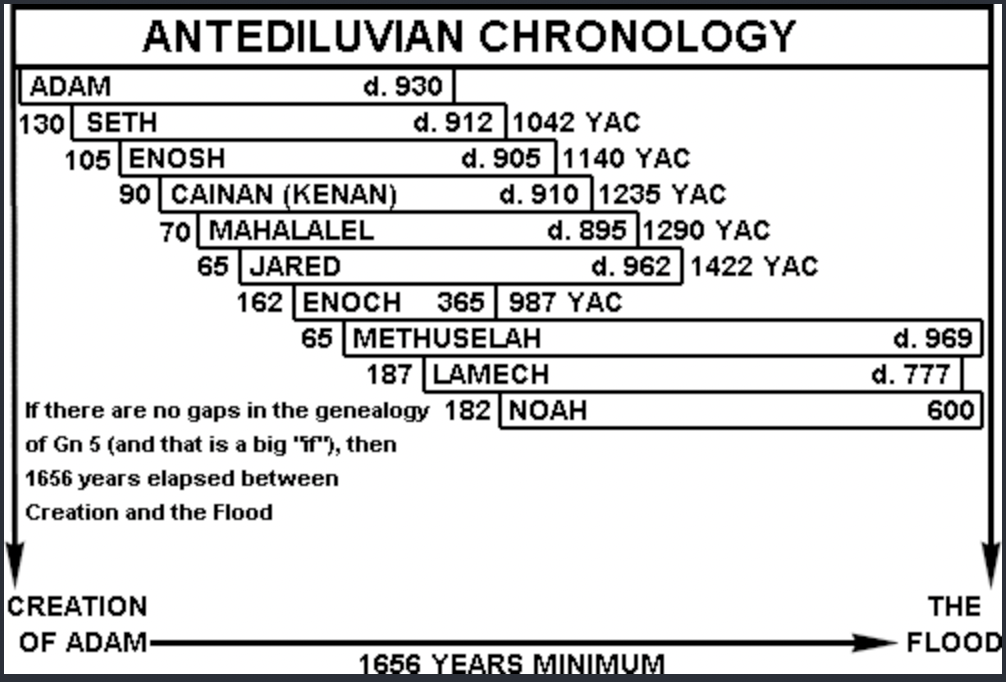
James Smith gives us this chart:

In laying out the genealogies, Moses goes back and speaks of the theology and biology of creation. Man is made in God’s likeness (1), and God made them male and female (2). Adam becomes father to a son (3), and thus it goes through all the genealogies. Moses’ record follows the same formula in laying out these ten generations: the father lives so many years, has a notable son (in the Messianic Genealogies–Luke 3:36-38), lives so many years after that birth, and finally dies. As the chart suggests, there is vast opportunity to populate the earth as they live on for centuries.

There are some interesting insights among the Bible’s first look into a family tree. Furthermore, there are implications from this chapter that resonate throughout the rest of Scripture. Notice just a few of these.

“…And he died” (5,8,11,14,17, 20,27,31; cf. 3:19). While these men lived nine or ten times longer than any of us would dare to believe we could live (imagine your life overlapping the lives of Saladin, Genghis Khan, and Thomas Aquinas; see also 6:3), they could not escape the reality of the death sentence brought on by Adam’s sin. Hebrews 9:27 avers that death is an inevitable appointment.  1 Corinthians 15:21-22 reiterates that by a man came death and that in Adam all die. 

“Enoch walked with God” (21-24). He is the exception to the rule just mentioned. Moses  writes a beautiful truth about this man. He strove for intimate fellowship with God. This is indicated by the phrase that “he walked with God.” This phrase might be ambiguous and unclear, if not for subsequent Scripture. This is tied to his faith (Heb. 11:5). Therefore, “he obtained this witness that before his being taken up he was pleasing to God.” He was a prophet of God sharing the word of God (Jude 14). We are told nothing about his wife or any of his other children apart from the famously old Methuselah, but if he lived anywhere close to the others he would likely have been alive the year of the flood if not taken by God. 

God defines what walking with Him should look like, as He speaks to His people at the end of the Old Testament. Speaking of the faithful Levitical priests, He says, “He walked with Me in peace and uprightness, and he turned many back from iniquity” (Mal. 2:6). His lips preserved knowledge and He was a devoted messenger of God (Mal. 2:7). That harmonizes with what Scripture says about Enoch. 

“(Noah) will give us rest” (29-32). Lamech “became the father of a son” (28) he named Noah. Why? “This one will give us rest from our work and from the toil of our hands arising from the ground which the Lord has cursed” (29). As it turns out, Noah will give comfort not to those before him but to those who would come after him through Shem, Ham, and Japheth (32). The same word translated “rest” is found in a different form in Genesis 6:6,7 and is translated “sorry.” Because God was sorry for making man, who had become sinful, He resolved to destroy man and beast. But Noah will find grace in the eyes of the Lord (6:8). The ground would continue to labor under the curse (Rom. 8:20-21). But spiritual rest would be possible through Noah’s obedience (1 Pet. 3:20; Heb. 11:7).

With all this time that passed as recorded in Genesis 5, God’s eternal plan was still in motion. Salvation would ultimately come, starting with these ten generations. Through His sovereignty and providence, God would ensure that “the kind intentions of His will” (Eph. 1:5,9) would be accomplished despite man’s continual faults and failings. 

Genesis: These Are The Generations (V)

The First Children (4:1-24)

Neal Pollard

The sobering truth about sin is that we cannot anticipate its consequences. Scripture credits sin as entering the world through Adam, not Eve (Rom. 5:12). Despite her role for which she received her own consequences (1 Tim. 2:8-15), God places the responsibility ultimately upon her husband. It is still the same today (Eph. 5:23). The Bible does not tell us how the events regarding his sons, Cain and Abel, emotionally impacted him. If you are a parent, you can well imagine.

Moses is not concerned with giving us a strict chronology in chapter four. This will help when reading through the narrative where certain details are omitted. They are not deemed as important to the story, though they might drive our imaginations wild. Like what, specifically? How many siblings (male and female) were born after them before the egregious actions of Cain in verse eight? Apparently, a great many–though Moses does not record it. Where did Cain get his wife (see 3:20)? Was incest permitted? Obviously, in accord with the mandate of Genesis 1:28, it had to be. In fact, it is not “outlawed” until the Law of Moses (Lev. 18:6). How much time occurs between verse one and verse fourteen, when Cain is worried about people finding him and killing him? Antediluvian (pre-flood) lifespans reached in excess of 900 years old, which we will see in the next chapter. 

The focus of the chapter appears to be the divergent mindsets of obedience and disobedience in the world after the fall. The chapter begins by chronicling the births of the first two known children of Adam and Eve. Cain is firstborn, followed by Abel (1-2). Cain was a tiller of the ground while Abel was a keeper of flocks (2). 

Why did God accept Abel’s offering, but reject Cain’s (3-5)? Genesis four does not spell this out. John tells us Cain’s “deeds” were evil, and Abel’s deeds were righteous (1 John 3:12). More clearly, the writer of Hebrews says, “By faith Abel offered to God a better sacrifice than Cain, through which he obtained the testimony that he was righteous, God testifying about his gifts, and through faith, though he is dead, he still speaks” (Heb. 11:4). On the other hand, rebellion and apostasy are implied in Cain’s actions (Jude 11). Abel complied with what God wanted, but Cain did not. It was an error of worship. Cain offered what he wanted rather than what God wanted. 

Cain compounded the problem by his intemperate response (5-7). God warns him of the price for sinful anger, but the older brother loses all self-control and murders Abel (8). Once again, we find the offended God seeking out the offender. Such long-suffering love! God pursues Cain, exposing his sin (9-10) then revealing the consequences of that sin (11-12). He is divinely prevented from being a vegetable farmer, settled in one place. Instead, he is consigned to being a wandering vagrant (12-13).

Cain is concerned that he will be a hunted fugitive (14). In His mercy, God protects Cain (15). Cain has a wife (did she marry him before the murder of Abel?), and they begin to have children. Much of the rest of the chapter involves revealing the line of Cain. As the late Wendell Winkler once showed us in class, “The line of Cain gave us nomads, farmers, musicians, smiths, polygamists, and murderers, but not one who ‘called upon the name of the Lord’ (24).” Verses 17-24 reveal the infamous legacy of the line of Cain as well as a reflection on the consequences of his father’s sinful choice. 

Yet, a glimmer of the divine plan of redemption shines through in how Moses ends the first “toledoth.” He returns to the first parents and reveals the birth of another son, Seth, in whom Adam and Eve placed their hopes of a better legacy. We will see more about Seth’s lineage in the next chapter and its significance to the ultimate birth of the Messiah and fulfillment of Genesis 3:15. But out of the shattered pain of sin and disappointment there came home. “…Men began to call upon the name of the Lord” (24). 

Genesis: These Are The Generations (IV)

“Where Are You?” (3:1-24)

Neal Pollard

A dramatic shift occurs as we come to chapter three. The beautiful ending of chapter two is that “the man and his wife were both naked and were not ashamed” (2:25). It is harder to find a purer picture of innocence and carefree life than the sinless condition of Adam and Eve as revealed at their creation.

Genesis 3 explains how things changed and what the consequences of that are, not only for the first couple but for all subsequent humanity. It is important to keep in mind that these events are presented in narrative style and are not myth or legend. Bible writers who look back on Adam speak of him as historical, not fictional (1 Chron. 1:1; Job 31:33; Hos. 6:7; Luke 3:38; Rom. 5:14; 1 Cor. 15:45; etc.). The same is true of Eve (2 Cor. 11:3; 1 Tim. 2:13). We will examine the serpent momentarily.  Consider the content of this important, if grim, chapter.

The Serpent And Sin (1-7)

There are so many interpretations concerning the serpent. Reyburn and Fry say, “Serpent, which translates the usual word for ‘snake,’ has had a long history of interpretation. Some commentators have held that the serpent refers to Satan in disguise. Others have taken the position that it is a symbol for curiosity. The serpent is found in the stories of many societies as the creature who brings good luck, knowledge, and wealth, and who is sometimes described as being able to speak” (81). Yet, the serpent is introduced as a beast which God made (1). Connect that statement back to Genesis 2:19. 

What does seem clear is that Satan is somehow involved in this incident. Satan is called “the serpent of old” (Rev. 12:9). He is the father of lies (John 8:44). Combining those facts with the curse of verse 15 leads us to conclude that Satan uses the apparently willing and crafty serpent to tempt Eve (2 Cor. 11:3,14).

The focus of the text is the temptation. The serpent “deceives” Eve (13). He does so by casting doubt on God’s command (1; 2:16-17), implying that God is unfair (1), denying truth (4), and suggesting that God is trying to prevent Adam and Eve from having better and more (5). By entertaining his arguments, Eve opens the door of her heart to temptation. The tree of the knowledge of good and evil appeals to her flesh, her eye, and her pride (6; 1 John 2:16). She eats and gives to Adam, who also eats (6). Their eyes are opened, but it does not have the anticipated effect. Instead, they are filled with shame (7).

James Smith writes, “These additional points in Satan’s temptation strategy should be noted: (1) he attacked when Eve was alone; (2) he selected the ground carefully, waiting until the woman was in full view of the tree; (3) he employed ambiguous and obscure language; and (4) he pretended to be seeking only the best for his victim” (The Pentateuch, 67). Oh that we could always remember that “sin’s seductive promises always turn out to be a mirage”

(Strassner, 35). 

The Search (8-13)

The chapter opens with a dialogue between the serpent and the innocent woman. Next, we see the dialogue between God and the sinful couple. Eric Owens once reminded me that it is all too easily to read into this text what is not there. Do you ever imagine the tone of God’s voice and His response as severe and scolding? Look closely at this chapter and see if you see evidence of it!

Instead, Moses tells us the couple hears the sound of the Lord God walking in the garden… (8). What a comfort that must have been before this day! Now, hearing it, their instinct is to hide. Sin covets cover (8)! Their sin has led them to shame. 

We read that God calls to the man and asks, “Where are you?” (9). Whatever else you deduce, do not miss that God pursues those who chose to disobey Him! He does not leave them to languish and suffer in their sin without His guidance and instruction. In God’s subsequent questions–“Who told you that you were naked” (11), “Have you eaten from the tree of which I commanded you not to eat?” (11), and (to the woman) “what is this you have done?” (13). 

Of course, the God who is revealed in Scripture as all-knowing (Psa. 139; John 2:25; 1 John 3:20). These questions are not for His information, but for Adam and Eve’s instruction. They are rhetorical, yet beneficial for their spiritual recovery. Like the rest of God’s Word, these words are a mirror for their reflection. Adam, though deflecting (10,12), ultimately confesses (12). Eve, also redirecting, nonetheless confesses (13).

The Sentence (14-24)

The just God metes out punishment. He is full of integrity and must keep His word (Num. 23:19). God addresses the guilty.

The serpent will crawl on its belly and eat dust (14). There will be enmity between the seed of the serpent and the seed of woman (15), with the latter ultimately triumphing. Given the earlier discussion about the serpent and Satan, we must understand the import of this statement. From ancient interpreters on down, this has been called the “protoevangelium” (the first gospel proclamation). This is fostered by Paul’s words that “the God of peace will soon crush Satan under your feet” (Rom. 16:20a) as well as the Messianic Genealogies that follow in chapters four and five. See also Hebrews 2:14-15. The idea is that the devil would experience triumph in the death of the Messiah, but the Messiah would deal a greater, crushing blow through His resurrection.

The woman will experience pain in childbirth and her husband would rule over her (16).  The middle phrase, “your desire will be for your husband,” appears to be less about the sexual and more about her role. Kenneth Matthews points to Genesis 4:7 as a parallel to this verse, saying, “The ‘desire’ of the woman is her attempt to control her husband, but she will fail because God has ordained that the man exercise his leadership function. The force of the defeat is obscured somewhat by the rendering ‘and he will rule’; the conjunction is better understood as ‘but he will rule'” (NAC, 251). This is cemented in 1 Corinthians 11:3. No doubt, the woman in her rebellion has the most painful consequence.

The man will suffer a cursed ground as he attempts to cultivate it (17). He will contend with thorns and thistles (18) and will grow food only with difficulty and adversity (19). Not only that, but he will die–return to the ground and go back to the dust he came from (19). This is not to suggest that all men, subsequently, would be farmers. It is to say that his heretofore pleasant and unobstructed work will no longer be either of these things. 

All three, serpent, woman, and man, receive a punishment that fits their sin. In fact, in two of the three pronouncements, the punishment was given “because” (14, 17). Likewise, the woman who led her husband into sin was now to be led by him. 

After a couple of notes of explanation–Adam naming his wife, now endowed with childbearing, “Eve” (mother of all living) and God compassionately clothing the couple reeling from the shame of knowing their nakedness (20-21)–there is one last part to their sentencing. They must leave their garden paradise (22-24). They must be separated from the tree of life (22), and cherubim would guard the tree of life with a flaming sword (24). We do not see these created beings referenced in this duty station anywhere later in Scripture, and their appearance would no doubt have been frighteningly intimidating. Surely, neither Adam nor his descendants dared get close to this spot again.

As Milton famously dubbed it, this describes “paradise lost.” The New Testament sheds further light on the spiritual implication of these events. Indeed, “…through one man sin entered into the world, and death through sin, and so death spread to all men, because all sinned” (Rom. 5:12). That context shows the cost of “the offense of Adam” (Rom. 5:14), the deadly transgression (Rom. 5:15-18), and the resulting condemnation (Rom. 5:16,18). But thank God for His grace that brings life, justification, and righteousness where it is not deserved (Rom. 5:16-19). God knew man would eventually exercise his free will to sin, and He already had the rescuing response ready! Even in the frightful darkness, God exerts His life-giving remedy. 

Genesis: These Are The Generations (III)

“The Creation Of Man And Woman” (2:4-25)

Neal Pollard

Not only did chapter one help with the question of where we came from, but it also gives crucial insight into who we are. Genesis 1:27 teaches us more than the nature of the Godhead. It tells us something about ourselves. We are made in the image of God, in His likeness (5:1)! There is a part of us reflecting God! I agree that “God’s image obviously does not consist in man’s body which was formed from earthly matter, but in his spiritual, intellectual, moral likeness to God from whom his animating breath came” (TWOT, 768).

Certainly, what Moses wrote in Genesis 1:27 helps us appreciate the additional clarification yielded from the first use of the Hebrew “teledoth” (account, NASB, NLT, NIV; “history,” NKJ; “generations,” ESV) in Genesis 2:4. This is a peg Moses drives down to separate his inspired account into significant sections. I have an excellent chart from Donnie Bates dividing up the book of Genesis, using “teledoth” as a textual marker. 

  • 1:1-4:26–The generations of the heavens and the earth
  • 5:1-6:8–The descendants of Adam
  • 6:9-9:29–The descendants of Noah
  • 10:1-11:9–The descendants of the sons of Noah
  • 11:10-11:26–The descendants of Shem
  • 11:27-25:11–The descendants of Terah (Abraham’s father)
  • 25:12-25:18–The descendants of Ishmael
  • 25:19-35:29–The descendants of Isaac
  • 36:1-37:1–The descendants of Esau
  • 37:2-50:26–The descendants of Jacob 

(Syllabus handout for “Genesis,” Bear Valley Bible Institute)

In the midst of unfolding “the generations of the heavens and the earth,” Moses centers on the creation of man and woman. Notice how he does so. 

Preparing the earth for man (2:4-6). After speaking of the earth 21 times from Genesis 1:1-2:1, Moses speaks of it five times in these three verses. In context, the shrubs and the plants to be cultivated from the ground served a purpose. They would provide food for man (15-17). There is a sense in which man’s being in God’s likeness is demonstrated in his place and dominion over the whole earth (1:28-30; 2:16,19-20). As God is over everything, He delegated authority to man over the earth. Of course, God is the sustainer and provider of what the universe needs to continue to operate (Mat. 5:45; Acts 14:17; Col. 1:17), but man was created to be a steward of its resources. Incidentally, there was at least a time when God did not send rain but rather mist from the ground for its provision (6). 

Creating man from the earth (2:7). There is also a unity or harmony between man and the earth. God created the ground, then He formed man from the dust of the ground. He breathed life into man’s nostrils and man became a living being. The word translated “being” (soul) here seems to be used to speak of his having life and animation. The Bible clearly teaches there is an everlasting part of a person, but that’s not Moses’ purpose in this verse. Moses is describing how the first man came to life. The same word is used of “living creatures” (1:20-21; cf. 2:19). 

Fitting man for the earth (2:8-15). Moses goes to great lengths to speak more of God’s provisions for man’s habitation of the earth. He planted a garden and trees for man’s dwelling place (8-9). He provided rivers to water the garden (10), and it flowed out of the garden in four tributaries–Pishon, Gihon, Tigris and Euphrates (11-14). James Smith notes, “The author seems to be describing the geography of ancient Sumer just north of the Persian Gulf in what is present-day Iraq. Ancient pagan legend remembered a paradise at the northern end of the Persian Gulf” (The Pentateuch, OT Survey Series, 59). Associated with these geographical markers, Moses makes the first mention of money (11-12). Man’s job is to care for the earth prepared by God for him (15). 

Preparing man for his time on earth (2:16-17). God does more than give man physical purpose. He is giving him spiritual boundaries. Moses includes this command about the “forbidden fruit” to show God’s loving nature in creating man with the ability to choose. At this point, evil is not part of man’s consciousness nor has it stained his soul, but it exists as the opposite of the “good” that God created (see Moses’ repeated use of “good” in chapter one). Man would have to choose to leave the “good” of sinlessness, but that was a choice from the beginning. What Paul says of the Gentiles is true, ultimately, of everyone since Adam: “In the generations gone by He permitted all the nations to go their own way” (Acts 14:16). 

Giving man what the earth alone could not give him (2:18-25). Of course, God knew what man needed before man had an opportunity to even discover it. God determined to give man a “helper suitable for him” (18). He presents all the animals for Adam to name, and among these there is no “suitable helper” (19-20). It is not incidental that God created woman from man. He could have formed her from the dust of the ground, the same as man but apart from him. But, denoting the intimate connection He intended, He makes her from him (21-22). As has  been noted, is there anatomical symbolism here? She was not taken from his head or his heel to rule over or be enslaved to him. She was a partner is truest sense, taken from his side. 

Adam recognizes this and speaks a truth beyond just his circumstances (21-24). God teaches that gender is not fluid, but fixed (note the pronouns and description throughout the paragraph). God teaches the permanency of marriage (23-24), which Jesus will reference in restoring marriage under His covenant (Mat. 19:1-9). God gives the first allusion to the church,  and Paul will draw on the analogy in Ephesians 5:22-33. God gives gender roles in the leadership of the church, hearkening back to this cross-cultural circumstance in 1 Timothy 2:8-15. 

But there is more than doctrinal truth being instilled here. There is the most beautiful earthly relationship ever made by God, transcending every relationship except the one between a person and God! God knows our physical, emotional, social, and spiritual needs. His original remedy for that was marriage! What a wise creator we serve! 

GENESIS: THESE ARE THE GENERATIONS (II)

“In The Beginning” (1:1-2:3)

Neal Pollard

The first chapter of the Bible’s 1189 provides a helpful reminder that chapter divisions are an act of man (Stephen Langton in 1227) rather than an act of God. Genesis 1:1-2:3 is the inspired record of the creation of the universe followed by a more intimate account of the creation of man (2:4-25). There is incredible structure in the way Moses records the making of the universe, showing the Creator to be a being of order and design.

The skeletal information of the chapter falls out easily enough:

  • The beginning (of the universe): God created a formless and void earth, and darkness as well as God’s Spirit were over the surface of the water (the deep)(1:1-2). Incidentally, isn’t the “end” implied with the word “beginning”? With perfect foreknowledge, God knew that this world would someday come to an end (see Isaiah 46:10). 
  • Day one: God created light and separated the light from the darkness (1:3-5).
  • Day two: God created the sky (called the expanse–“beaten, [metal] plate, firmament (i.e. vault of heaven, understood as a solid dome)” (CHALOT, 347) (1:6-8).
  • Day three: God created dry land and vegetation (1:9-13).
  • Day four: God created sun, moon, and stars (1:14-19).
  • Day five: God created water animals and winged creatures (1:20-23).
  • Day six: God created mammals, reptiles, and man (1:24-31).
  • Day seven: God rested from all the work which He had done (2:1-3).

Another way to divide this account is through two words Moses uses. Days one through three record God “forming” (1:7) what had been “formless.” Days four through six record God “filling” (1:22,28) what He had “formed” (see Kurt Strasser, Opening Up Genesis, 20-21, for more on how he develops this idea). Despite those who wish to accommodate epochs of time and the theory of evolution “in the beginning,” we have the testimony of chapter one identifying each day of creation as a 24-hour period (5,8,13,19,23,31). The same writer, Moses, will look back on the creation in the establishment of the Sabbath, noting that God created the universe in six days (Ex. 20:11; 31:17). Do you find it interesting that civilizations everywhere throughout time have constructed their calendars and functions around the seven day week? It is sown into the fabric of creation!

We are impressed with God’s active involvement in the creation process (note the verbs–I  count 38 in these 34 verses, actions God takes in these seven days of work). As we read the remainder of the Bible, we will appreciate how God remains active and involved with His creation and especially the pinnacle of His creation (1:27). Whether observation, speaking, or otherwise creating, we see God at work.

We are impressed by God’s “triune” nature as revealed in Genesis one. We see the second most common designation for God (2532; YHWH, God’s proper name occurs around 6800 times in the O.T.) and is used for divine beings, associated with might and strength and creation (from the first verse of Scripture). The Spirit of God is first referenced in verse two, and the plurality of personalities is clearly found in this inaugural chapter. How? “Elohim” is a plural noun each of the 35 times it appears in these first 34 verses. Further, as God discusses the creation of man among Himself (even saying it strains the limits of our comprehension), He says, “Let us make man….” (27). Not multiple Gods. The rest of Scripture will show us what it first introduced here. God has an essence and nature. Only One (only God) is all-powerful, all-knowing, uncaused, present everywhere all at once, perfect, sinless, etc. Yet, God is three distinct persons. Two are explicitly identified here (Father, Spirit). One is averred to be the agent of Creation elsewhere (John 1:3; 1 Cor. 8:6; Col. 1:16; Heb. 1:2). 

God’s first question for Job is a confession that He created the universe (Job 38:4). Israel sang about the creation (Psalm 104:4-5). Every New Testament writer but Jude (who still refers to events in Genesis) makes reference to the creation account. All divine revelation rests upon the truth of Genesis one. God permitted the universe to be and subsequent chapters will help us understand why. 

GENESIS: THESE ARE THE GENERATIONS (I)

Background And Introduction

Neal Pollard

One of the first and most basic questions most people seek the answer to is “where did I come from?” Since I am here, there must be some explanation. And since that explanation predates me and anyone I could consult personally or through recorded history, I must look for an explanation outside of those sources. Any answer is subject to evaluation for its credibility and reasonableness. 

The book of Genesis asserts itself as the all-encompassing answer to all the big questions humanity inevitably asks. One finds its answers feasible, reasonable, and intelligible. Having 50 chapters, 1533 verses, and 32,267 words, it is a large book that sets the tone for the 65 books which follow it. It was first written for the Jews to understand their history and their place in God’s eternal plan. This is accomplished in many ways. One significant way is through Moses’ repeated, periodic use of a word translated “generations,” “account,” “genealogies,” or “order.” The word is used 13 times in Genesis, with apparent intentionality. It is how Moses divides the contents of the entire book (2:4; 5:1; 6:9; 10:1,32; 11:10,27; 25:12-13,19; 36:1,9; 37:2). We will note those transitions as we move through the book.

The book is called “Genesis” because it reflects the idea of “beginnings.” Truly, “The title of the book of Genesis in Hebrew is bereshith, which literally means “in the beginning.” This title is the first word of the first verse. In a similar way the Hebrew titles of each of the first five books of the Old Testament are taken from a significant word in the first sentence of the book, usually the first or second word, or both. This was the practice also in the literature of other ancient languages in the Middle East” (Reyburn, UBS, 19). 

The book can be easily divided into two parts, one more general and the other more specific. Genesis 1-11 deals with the creation of the whole world, while Genesis 12-50 deals with the choosing of a single people from among the whole world. James Smith describes Genesis as a book unfolding the construction, destruction, and reconstruction of the world (The Pentateuch, 36). We see the construction in the creation accounts of the first two chapters, the destruction in the fall, the flood, and the foolhardy rebellion at Babel (Gen. 3-11), and the reconstruction through the call of Abram and his descendants (Gen. 12-50). 

Look for important themes as you move through the book of Genesis. Again, consider Smith’s suggestion of major theological truths uncovered by the book: the doctrines of creation, sin, judgment, grace, election, promise, and faith as they are repeated not only in Genesis but throughout the rest of the Bible (40). Another way to trace the book is geographically, as much of the book revolves around at least five significant journeys made by Abraham, Isaac, and Jacob. 

Genesis helps us understand the world, its maker, ourselves, and our place in this world. Each chapter will unfold some aspect to help us understand the most important “whys” we will ever think to ask. It is written in narrative form, but is full of rich, theological truth which the subsequent writers and speakers of the Bible frequently look back to as foundational. There are over 100 quotations or allusions to Genesis made to Genesis in the New Testament alone on themes as basic as creation, salvation, human identity, marriage, judgment, the nature of God, the devil, the role of woman, sexuality, and much, much more. Let us journey together with the Bible’s first steps! 

Long-Living Legends

Dale Pollard

Long-Living Legends 

According to the book of Genesis, the Antediluvian (pre-flood) humans once lived extraordinarily long. Adam was 130 when he had his first son Seth who lived to 912. Seth’s great-great-great-great-grandson, Methuselah, is the oldest man on the biblical record— dying at the ripe old  age of 969. 

For perspective, 969 years ago from the point of this writing (Monday, November 27, 2023) was Monday, November 27, 1054 A.D. If mankind had continued to live that long through the modern era, Christopher Columbus would still be alive today and wouldn’t die for another 400 years! 

How The Ancients Aged 

Some have speculated that a canopy made up of water vapor once surrounded the earth but then it collapsed at the time of the flood. Interestingly, five of the nine planets in our solar system have thick cloud canopies including Venus which is closest to earth in both size and distance. The water canopy before the flood could have been attributed to the long lifespans of early humans by blocking out harmful radiation and producing higher oxygen levels, much like a greenhouse. 

This could also be the reason why people post-flood slowly began to live shorter lives like Terah, the father of Abraham, who lived for only 205 years.The  atmosphere would not only have added many years to life, but it was also conducive for massive growth. Everything from plants to animals were larger versions of their modern counterparts. For instance, fossils of Glyptodons (ancient relative to the armadillo) could weigh around 4,000 pounds and reach lengths of 5 feet. 

Non-Canonical Coincidences 

The Sumerian King List records the lengths of reigns of the kings of Sumer. The initial section deals with kings before the Flood and it begins with their oldest rulers reigning for thousands of years but their later kings live significantly shorter. While the Bible doesn’t mention anyone living for thousands of years, it’s intriguing to find more ancients who have documented such lengthy lifespans— even if exaggerated. 

In ancient Persian legend, the fourth king of the world was a man named Jamshid and he was said to have reigned for 700 years. He was a great inventor and during his reign people neither sickened nor aged.

DELUGE DELUSIONS

Tuesday’s Column: Dale Mail

Not long ago my wife and I went to visit the ark exhibit located in Williamstown, Kentucky. While exploring the decks you get to imagine what it may have been like to walk in Noah’s sandals. Half of one floor was dedicated to ancient legends that told of a worldwide flood as well as the religious beliefs and backgrounds of the various cultures. Two things resonated with me as I read the plaques and took in the artifacts on display. First, the similarities in the flood legends. The second observation was the fact that the further from Mesopotamia you traveled, both in time and distance, the more implausible the story seemed. While the inspired Genesis account gives a great deal of detail other legends lack the realism and plausibility factors. Genesis records construction of the ark giving us the material, water-proofing methods, dimensions, and labor period. It tells us where the flood waters came from and even the general area where the ark came to rest. Interestingly, the seaworthiness of the ark has even been tested in the modern era.

“…naval architects have confirmed that a barge with the Ark’s dimensions would have optimal stability. They concluded that if the wood were only 30 cm thick, it could have navigated sea conditions with waves higher than 30 meters” 

(Hong, S.W. et al., Safety Investigation of Noah’s Ark in a Seaway.,Journal of Creation)

Known legends written closer to Noah’s time and neck of the woods like the Sumerian version (Epic of Gilgamesh) describe an ark as being cube shaped. A cube shaped ark would tumble and role in the treacherous deluge. Further evidence for the reliability of the Biblical account can also be seen in the date of writing. Noah’s flood was written earlier than the Sumerian version and the proof is in the religious practices depicted in these competing tales. Even secular scholars confirm that early mankind were monotheistic. In the Epic of Gilgamesh there’s a small pantheon of gods mentioned, and this pantheon grew as time passed. One character in the Sumerian version offers a sacrifice after the flood waters receded, but Christians will pick up on the language used to describe this offering. 

The gods smelled the savor,
the 
gods smelled the sweet savor,
and collected like flies over the sacrifice
.’

The gods also bickered amongst each other and showed incredibly human attributes. They were fickle and violent, often contradicting their own alleged virtues. 

Two Concluding Thoughts About The Almighty 

God is the only form of our imitation. His Holiness and righteousness is set apart from humanity— He supersedes the natural world.

God is the owner of absolute truth: To know Him is to know truth, to know love, to know forgiveness, to know honesty, to know perfection. God wants all of us to come to a knowledge of Him, because a knowledge of Him is to know Truth. This point is emphasized in the Book of John. It’s essential in the development of our relationship with Him. If one doesn’t know Truth, then one doesn’t know God. 

Dale Pollard