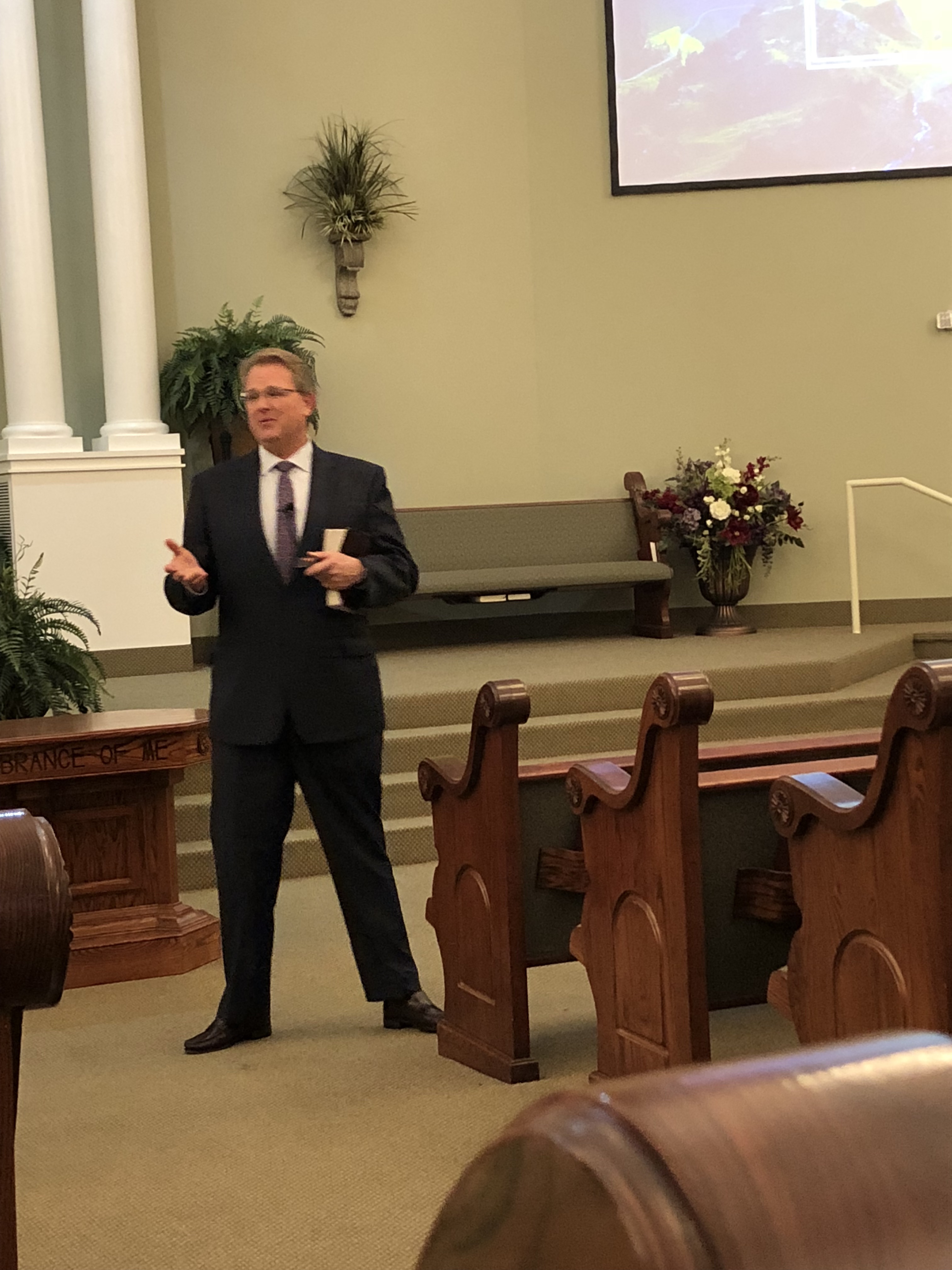
The Invitation

Carl Pollard

Revelation 3:20, “Behold, I stand at the door and knock. If anyone hears my voice and opens the door, I will come in to him and eat with him, and he with me.”

This verse is one of the most well known invitations in Scripture, but it is often misunderstood. Many assume Jesus is speaking to unbelievers about initial salvation. While the principle certainly applies, the context shows that Jesus is actually speaking to Christians who have grown spiritually indifferent.

Revelation 3:20 is part of Jesus’ message to the church in Laodicea (Revelation 3:14–22). The Laodiceans believed they were spiritually healthy. They said, “I am rich, have become wealthy, and have need of nothing” (Revelation 3:17). Yet Jesus exposed their reality they were, “wretched, miserable, poor, blind, and naked.”

Their problem was lukewarm faith (Revelation 3:16). They were not openly hostile to Christ, but they were not passionately devoted either. They had allowed comfort and self sufficiency to push Jesus to the margins of their lives.

Jesus uses a powerful image, He is standing outside the door knocking. The church belonged to Him, and yet He was outside.

This idea is one of patient persistence. Jesus isn’t breaking the door down. He’s knocking and calling. The responsibility rests on the individual, “If anyone hears my voice and opens the door.” Faith is personal. Each person must respond.

Jesus promises something beautiful, “I will come in to him and eat with him, and he with me.” In the first century, sharing a meal represented fellowship, acceptance, and relationship. Jesus is offering restored intimacy.

The Laodiceans had religion without love. Christ was offering them the very thing they lacked, true communion with Him!

This verse forces an uncomfortable question, Is Jesus really at the center of our lives, or have we pushed Him outside? It’s possible to attend church, know the Bible, and still live spiritually distant from Christ. Like the Laodiceans, we may feel self sufficient while our relationship with Him grows cold.

But the good news is that Jesus still knocks. He calls us back through His Word, through conviction, and through moments that soften our hearts. When we respond, He doesn’t reject us, He restores us.

Christ doesn’t want our attendance or routine. He wants our fellowship! The door only has one handle, and it’s on the inside. The question is simple, Will we open it?


What Does It Mean To Be “First Fruits”?

Brent Pollard

“In the exercise of His will He brought us forth by the word of truth, so that we would be a kind of first fruits among His creatures” James 1.18 NASB 1995).

In James 1.18, we learn about our identity as believers and what it means to be a new creation in Christ.

James, the brother of Jesus, reminds us in James 1.18 that God’s will enables us to be reborn as new creations through the word of truth. This rebirth sets us apart as “first fruits of His creatures,” which starkly contrasts humanity’s natural inclination towards sin (James 1.13-15). We cannot save ourselves on our own, but through the transformative power of the Lord and His word (Romans 1.16), we can experience real change.

In biblical times, people offered God the first harvested crops, called “first fruits.” By drawing from this example, spiritually, being “first fruits” means dedicating ourselves to God and His purposes. It is more than just a title; it comes with a great responsibility to live our lives in a way worthy of our calling. James, in his letter, explains what this responsibility entails.

For those sanctified:

  • Control Your Anger (1.19): It is crucial to control oneself and refrain from giving in to anger, as it does not lead to righteousness, which God desires. Often, anger stems from impulsive speech and not paying attention to what others are saying. James 1.26 warns us that an uncontrolled tongue signifies a lack of genuine faith.
  • Reject Sin (1.21): We should strive to eliminate all impurity and widespread evil. As sin opposes us to God (4.4), those sanctified by God willingly accept and adopt His teachings, allowing them to fill the void left by sin. God’s word has a deep and dynamic connection with us. He expects us to actively apply His word rather than passively hear it (1.22-25). Our actions genuinely reflect our faith (2.14-26).
  • Show Impartial Love (1.27-2.9): We must protect and support the vulnerable, including widows and orphans, and show equal love for all, reflecting God’s love for humanity (2.8).

God has allowed us to be reborn through His Son’s grace. His will is evident, as He wants us sanctified (1.18). As we realize our identity as the first fruits, let us contemplate how this change affects our everyday choices and relationships. We must try to become the first fruits that truly please Him in every aspect of our lives.

The Invitation Song

Thursday’s Column: Captain’s Blog

carl-pic

Carl Pollard

Some of the most powerful messages are often delivered through song. If you want to really show someone how much you love them, you write a song. If you want to tell others about yourself or your family, you write a song. Songs are a great way to get across a message in a powerful way. In the church we sing songs for several reasons.
 
Paul tells us in Col. 3:16, “Let the word of Christ dwell in you richly, teaching and admonishing one another in all wisdom, singing psalms and hymns and spiritual songs, with thankfulness in your hearts to God.”
‭We sing to help the word of God dwell in our hearts. We sing to teach each other. We sing admonish and correct. We sing out of thankfulness for God. Since there are so many different reasons we sing, each song has a different message. Some are encouraging, some are reminders, and some are a plea to the sinner. We call some of these “invitation songs. ” And usually these are sung after a lesson as a way to encourage lost souls to respond and return.
 
“Though Your Sins Be As Scarlet” identifies a major problem that has plagued man since the Garden of Eden, our sin. The choices we make, the way we live, has stained us. This song calls to our attention the sin problem of man. This song is based on Isaiah 1:18, “Come now, let us reason together, says the Lord: though your sins are like scarlet, they shall be as white as snow; though they are red like crimson, they shall become like wool.”
This invitation song shows us the blessing that Christ has given. Though we’ve been stained by sin, they shall become like snow. Pure, holy, undefiled. If you’ve ever spilled grape juice on a white T-shirt, that’s the imagery.
 
Sin has ruined our hearts, but Christ is the perfect stain remover. He is able to remove every spot and blemish. Rom. 3:23 tells us that all have sinned and fallen short of the glory of God. Do we really think that we could live up to the glory of God himself? Could we have fixed this sin problem on our own? No. And we sing this song to remind us of WHO our solution is.
 
Through the gift of Christ they will be removed. Though your sins be as scarlet, they shall be as white as snow.
 
On an old rugged cross Jesus paid it all, and all to him I owe. I come just as I am, but I surrender all. Will you cherish the old rugged cross? Do you recognize the blessing and the blood that has washed us whiter than snow?
 
 
One of my favorite preachers delivering the invitation in Lexington, KY (2018)