Being engrossed in thought or distracted can be a bad thing, when you are driving, operating heavy equipment, or conversing with your spouse. But if you are preoccupied with those tasks, you should be commended. There is a word found a handful of times in the New Testament which conveys a powerful thought. The word is προσκαρτερέω (prostartereo). Depending on context and whether it is connected with a person or an object, it is translated “stand ready” (Mark 3:9), “devoting” (Acts 1:14; 2:42; 6:4; Rom. 12:12; 13:6; Col. 4:2), “continuing” (Acts 2:46; 8:13), and “personal attendants” (Acts 10:7, noun form). Two of the passages speak of physical laborers who were focused on a task for one who had the right or power to command them (Mark 3:9; Acts 10:7; the Greek Old Testament uses this word in Numbers 13:21 when Moses tells the spies to “make an effort then to get some of the fruit of the land”). One speaks of how earthly rulers are servants of God, devoted to their rule). The other passages refer to actions Christians took the initiative to do.
What preoccupied the time, thoughts, and energies of the early saints?
Prayer (Acts 1:14; 2:42; 6:4; Col. 4:2).
The Apostles’ Teaching (Acts 2:42).
Fellowship (Acts 2:42).
The Lord’s Supper (Acts 2:42).
The Ministry Of The Word (Acts 6:4).
It’s not a long and complicated list. They were engrossed in the public and private practice of prayer. They were riveted on studying and knowing and sharing the Word. They were dialed in to spending time with each other (and welcoming others to become part of them). They were obsessed with coming together to praise and adore God in worship. It affected their whole lives all the time.
The word carries the idea “of decisive or unflinching perseverance” and “emphasizes the persistent and submissive perseverance and tenaciousness of a self-enclosed group collectively oriented toward specific goals” (EDNT, 172). As you evaluate your life, what are your preoccupations? Your obsessions? What are you constantly driven to think, say, and do? Does it reflect the undivided attention of the early Christians, who by such preoccupation took the gospel to the whole world (Col. 1:23) and turned it upside down (Acts 17:6)? Devoutness to exclusively the things that will be destroyed when Christ returns is a tragic distraction! Let’s boil life down to the irreducible imperatives, “the good part, which shall not be taken away from…” us (Luke 10:42).
The book of Proverbs contains helpful “dos and don’ts” for the gainfully employed working-age child of God.
Do (For Employees).
Develop the skills that will earn you the notice of your boss or customer base (Proverbs 22.29).
Work diligently to earn a promotion (Proverbs 12.24).
Profit by your industry, not grand schemes that never reach fruition (Proverbs 14.23).
Do (For Employers).
Be a planner (Proverbs 21.5).
Encourage the input of others (Proverbs 15.22).
Though not micromanaging, be aware of everything happening within your purview (Proverbs 27.23-27).
Champion the rights of your workers (Proverbs 29.7).
Treat your employees so well that they will love you (Proverbs 29.21).
Show your employees what is in it for them to work well (Proverbs 16.26).
Don’t (For Employees).
Don’t be lazy because you will irritate your employer (Proverbs 10.26).
Don’t be a slacker (Proverbs 18.9).
Don’t (For Employers).
Don’t be oppressive (Proverbs 28.16a).
I would be remiss if I did not address the 800-pound gorilla in America’s living room in closing. Our workforce has lost interest in working. Thus, they cannot profit from Solomon’s sage wisdom provided previously.
It is a biblical expectation that all of God’s children of working age will work for someone else or as their own boss (2 Thessalonians 3.6-12). God is good, sending rain on the righteous and unrighteous (Matthew 5.45), but He only promises Providence to those who seek His kingdom and righteousness first (Matthew 6.33). Such a person seeking God should be obedient to His commands, including those concerning the necessity of work. Furthermore, even if not for himself, a person should want to care for his family because failure makes him worse than an infidel (1 Timothy 5.8).
In November 2021, the US Chamber of Commerce conducted a poll. 8% of those polled said they would never work again! At the time of publication, more than half of those surveyed said they were not actively looking for work. And this is not a problem for young people. The respondents ranged in age from 25 to 45+. People said they hoped to change industries or were awaiting the allure of a large signing bonus. Despite media reports, theBureau of Labor Statistics shows little has changed.
It’s anecdotal, but I know of two local businesses that closed because no one showed up. Both were restaurants, even if they were not technically in the same industry (one is fast food and, thus, considered food and beverage, and the other is hospitality industry). I’ve previously discussed this issue in this forum, but it persists. There are still desperate burger joints offering above-minimum-wage pay for a guaranteed 40-hour week, and people aren’t applying. How is this possible?
These indolent who expect others to look after them cannot expect even God’s children to feel compassion for their self-inflicted plight. As Paul tells us, “The one who is unwilling to work shall not eat” (2 Thessalonians 3.10 NASB).
One of the tedious but necessary items we pay attention to on the news is the economic reports. No, we do not do so out of love for money, but because we desire to be good stewards with the resources with which God has entrusted us. But unfortunately, the SARS-COV-2 virus has had quite an impact on our economy. In addition, we are coming up on the third anniversary of the pandemic shutdowns. So, it is safe to say that things have yet to return to where they were before March of 2020.
Some industries, like the hospitality industry, have been decimated. For example, as of January 2022, the National Restaurant Association found that about 80,000 restaurants have closed because of COVID.1And those restauranteurs with an open business have difficulty staffing themselves and obtaining supplies. Here locally, I noted a combo KFC and Taco Bell franchise offering an $500 sign-on bonus in January 2021 to rectify the labor shortage. I have since read of other fast-food restaurants across the nation likewise offering large sign-on bonuses to perform what is considered non-skilled labor.
Now, I do not call any work in which one employs himself to be beneath anyone’s dignity, despite the technical designation of some jobs as being “non-skilled.” On the contrary, these are routine jobs suitable for teenagers seeking their first job experiences or seniors needing to supplement their retirement or stay active. But something has happened because of the pandemic. Whether large or small, one factor that keeps people away from gainful employment is the CARES Act, passed in March 2020. With this piece of legislation, one could argue that our federal government incentivized the acceptance of unemployment payments that, for many, exceeded the salaries earned at jobs from which COVID displaced them. In contrast, we might point out that those states doing better economically today wised up quickly and took away those incentives to stay out of work.
And now, we are hearing a strange new phrase on newscasts: “The Great Resignation.”2 Since there are more jobs than workers, people dissatisfied with their current occupations opt to quit. You have likely heard the real estate terms of “buyer’s market” and “seller’s market.” The former is a real estate market where buyers have the upper hand. As a result of various circumstances, there is more inventory than demand. As a result, the buyer has greater leverage to ask for price reductions from the homeowner. In a seller’s market, you have the opposite conditions. There is less inventory available. So, a buyer will pay more to purchase a house or land because other potential buyers are waiting in the wing. With the Great Resignation, the thought is that we are basically in a “worker’s market.” These job-shoppers know that employers need workers so desperately that they will do things like offering $1,000 to entice them into accepting the position they offer.
As anecdotal evidence for this “worker’s market,” I will offer a repeated observation from my lengthy hospital stay in 2021. There is no doubt that doctors and nurses have had it rough during the pandemic. Thus, we rightly call their actions heroic. But among the nurse technicians, I heard a few of the “lesser heroic” ones talking about how they loved the current climate because they could just quit abruptly and walk down to the next hospital to take advantage of the better incentive package they offered. Before someone thinks I am being too harsh, I will tell you more. These individuals said they could bounce around, even returning to the hospitals that they had left to game the system. Their “loyalty” was to the highest bidder.
What has this to do with Christians or theology? I will put the question to you this way. What kind of a society is born from our current environment with people choosing to stay at home and collect benefits for not working or taking advantage of desperate employers? Does this mindset end with work, or does it spill over into all of one’s life? Is there an immoral cause? Paul cautioned the Thessalonicans: “…if anyone is not willing to work, then he is not to eat, either.” (2 Thessalonians 3.10 NASB1995) In addition, idleness poses a danger. An idiom pairing well with 2 Thessalonians 3.11 is “idle hands is the devil’s workshop.” Paul said the nonworkers within the Thessalonican church made themselves busybodies, living undisciplined lives. Ouch.
Remembering one’s actual Employer resolves a part of this problem. Paul reminds us:
“Slaves, in all things obey those who are your masters on earth, not with external service, as those who merely please men, but with sincerity of heart, fearing the Lord. Whatever you do, do your work heartily, as for the Lord rather than for men, knowing that from the Lord you will receive the reward of the inheritance. It is the Lord Christ whom you serve.” (Colossians 3.22-24 NASB1995)
Though not “slaves” in the same sense as those recipients in the first century (most people living in the Roman Empire were slaves to someone), we see how we are fángnú (Chinese for “mortgage slaves”) today. God expects us to be industrious. Even the inaugural pair placed in paradise had to “cultivate and keep” their garden home (Genesis 2.15). A nation where people work doesn’t have time to riot, loot, play keyboard warriors, “cancel” others, or push agendas on other people’s children. We are citizens of the Heavenly Kingdom first and foremost but let us not participate in those shortcomings here that create a land where you get paid a sign-on bonus to flip burgers.
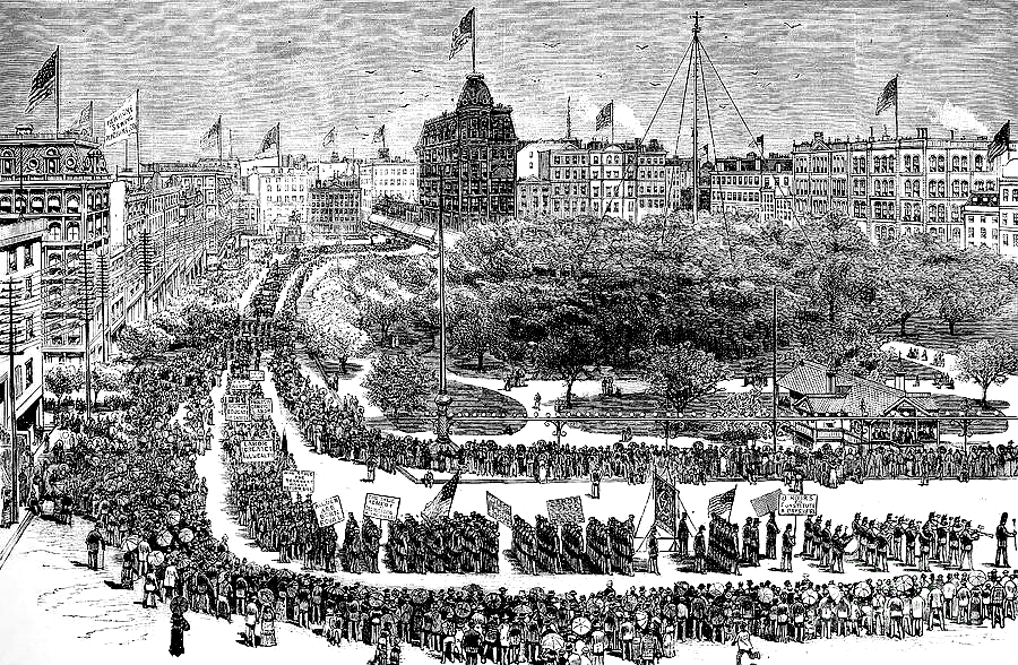
Tomorrow, most of us will be able to celebrate the Labor Day Holiday. That means, ironically, that most of us will have a day off from–well–labor. Schools and workplaces across the nation will shut their doors and many will be off for their last “summer vacation.” Friday, an anticipated 3 million passengers took to the friendly skies to enjoy the long weekend. We can either thank Peter McGuire or Matthew Maguire for being the mastermind of this holiday, both secretaries for New York labor unions who made significant efforts to recognize a day for American workers.
The U.S. Department of Labor has published a lot of useful information about this holiday, which it states was started as a “national tribute to the contributions workers have made to the strength, prosperity, and well-being of our country” (dol.gov). It was a local observance in the northeast at the height of the Industrial Age, though Oregon was the first state to pass statewide legislation to observe the holiday. That same year, 1887,Colorado, Massachusetts, New Jersey, and New York followed suit. In 1894, Congress made it a legal holiday to be celebrated the first Monday of September.
In the early days, there were picnics, street parades, speeches by prominent men and women, and “Labor Sunday” which was “dedicated to the spiritual and educational aspects of the labor movement” (ibid.). The first parade, in New York City in 1882, had up to 20,000 marchers as well as “Windows and roofs and even the lamp posts and awning frames…occupied by persons anxious to get a good view of the first parade in New York of workingmen of all trades united in one organization” (ibid.).
I find it interesting that we honor work with a day of rest and that the holiday itself has seen a shift in emphasis and expression. That’s neither a complaint or criticism. I intend to enjoy Labor Day with Kathy, taking the vacation day given to me in my working agreement.
But, as we celebrate this national holiday, it’s fitting to recognize the hard work done by so many in this congregation. When you teach Bible classes, lead in worship, decorate bulletin boards, provide transportation to services, stock our pantry, do work on our facilities, engage in soul-winning efforts, practice hospitality, serve officially as church leaders (whether elders, deacons, or someone else tasked with some work), prepare the communion, clean the kitchen, organize the teacher’s work room, go on mission trips, make visits, handle church finances, coordinate worship, serve as ushers and greeters, host youth devotions, or the many, many other things you do, you are doing honored work. Jesus taught that greatness comes through service (Mat. 20:25-28; Jn. 13:12-17). New Testament writers honored those who work among us, Paul urging us not to “be weary in well doing” (Gal. 6:9) and to “always give yourselves fully to the work of the Lord” (1 Cor. 15:58, NIV). Often, Scripture speaks of the Godhead working. It instructs us to be “to the work.” Enjoy the holiday tomorrow. Yet, in the general, ongoing sense, “We must work the works of Him who sent Me as long as it is day; night is coming when no one can work” (Jn. 9:4). Labor on, brothers and sister!
You Are An Insurance Agent—Life (Philippians 2:16), Health (cf. 1 Peter 2:24), and Fire (2 Peter 3:9-10).
You Are A Tour Guide (1 Peter 2:9; Acts 8:31).
You Are A Soldier (Ephesians 6:10ff; 2 Timothy 2:1-3).
You Are A Slave (Romans 6:17).
You Are A Firefighter (Jude 23).
You Are An Ambassador (2 Corinthians 5:20).
You Are A Priest (Revelation 1:6).
You Are A Conductor (2 Corinthians 2:14; 9:11).
You Are A Day Laborer (John 9:4; cf. Matthew 20:1ff).
You Are A Farmer (2 Timothy 2:6; Luke 8:5).
You Are A Fisherman (Matthew 4:19).
You Are A Gem Distributor (Colossians 1:27).
You Are A Taste Tester (Colossians 4:6; Hebrews 5:14).
You Are Royalty (Revelation 1:5-6).
You Are A Student (2 Timothy 2:15).
You Are A Body-Builder (Ephesians 4:16).
You Are A Restorer (James 5:19-20; Galatians 6:1).
You Are A Physician’s Assistant (Hebrews 12:12-13; cf. Mark 2:17).
You Are A Standard-Bearer (Philippians 3:16; 2 Timothy 1:13).
You Are A Builder (1 Corinthians 3:10).
You Are A Judge (John 7:24; 1 Corinthians 6:2).
You Are A Nutritionist (1 Timothy 4:6).
You Are A Maintenance Worker(Phlippians 2:2; Titus 3:8,14, KJV).
You Are A Cleaner(2 Timothy 2:21; James 4:8).
You Are A Runner(1 Corinthians 9:24; Galatians 2:2; 5:7; etc.).
You Are A Boxer(1 Corinthians 9:26).
I’d be amazed if I did not leave out several of our job titles and descriptions. Suffice it to say that there is plenty of work for all of us to do. The next time we find ourselves figuratively twiddling our spiritual thumbs, wondering how we can be involved, let’s draw from the exhaustive inventory of tasks the Lord has left us! Remember, “Whatever you do, do your work heartily, as for the Lord rather than for men” (Col. 3:23).
The slothful or sluggard man is condemned many times in Proverbs. God treats laziness with contempt. God says the sluggard is so lazy he buried his hand in his food and won’t even bring it back up to his mouth (Prov. 19:24; 26:15)! Since he knows all the answers, he has no need for work (cf. Prov. 26:16). Notice how Proverbs describes him.
HE HAS NO INITIATIVE (Prov. 6:6-11). He lacks the ambition to work, the foresight to plan, and the desire to provide necessities. He is the one who constantly needs a fire lit under him. He cannot conceive of the idea of being a “self-starter.” No doubt, he has difficulty finding and keeping employment. He constantly seeks out the easy way. He is lethargic. A Christian should never lack determination, for there is great purpose in Christ and His love should motivate us to act (Gal. 5:6).
HE’S UNRELIABLE AND IRRESPONSIBLE (Prov. 10:26). He cannot be entrusted with a task. His word means little. His effort is sub par. The verse says, “As vinegar to the teeth, and as smoke to the eyes, so is the sluggard to them that send him.” Are there ever sluggards in the church, who promise involvement, pledge support, talk up church plans, but never or irregularly produce? They make promises, but people quickly learn not to expect of them. The sluggard forgets that his or her words mean something (cf. Matt. 12:36-37). Too, Jesus says, “Ye shall know them by their fruits” (Matt. 7:16,20).
HE HAD RATHER WISH THAN WORK (Prov. 13:4). He is long on cravings, short on diligence. Therefore, he spends his life in a dream world. Someone said, “If wishes were horses then beggars would ride.” The lazy man is a poor steward of his time (Eph. 5:16) and his mind. Dreams alone are vanity (cf. Ecc. 5:7).
HE WANTS BENEFIT WITHOUT INVESTMENT (Prov. 20:4). He wants something for nothing. This proverbs says that the sluggard goes hungry because he won’t hitch up the team in plowing season. He wants to eat, but he doesn’t want to work for it. Paul suggests that such should not be allowed a spot at the dinner table (cf. 2 Thess. 3:11-12). What about churches that want growth without evangelism? Or individuals who want success without self-discipline? Anything worthwhile requires effort!
There may be a bit of sluggard in us all. The tendency to slough off is often tempting. The devil will surely use idleness to try and defeat the cause of Christ. What sagacity is found in doing with all the might what the hand finds to do (Ecc. 9:10)!





 The Preacher Pollard Blog