
Neal Pollard
Paul contrasts the “old man” of sin, before conversion, and “the new man” who is striving to live a right and holy life (Ephesians 4:20-24). As such, he gives a list of old and new behaviors:
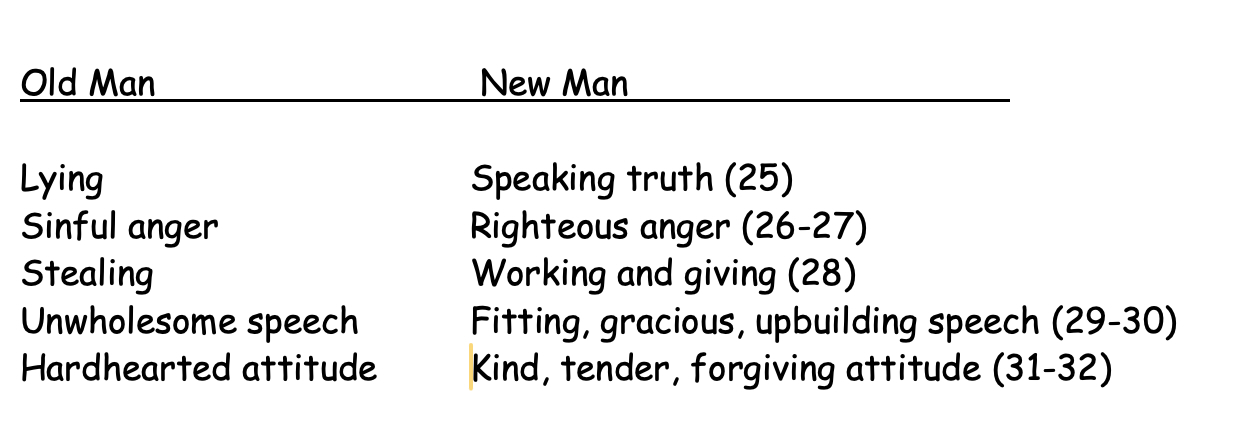
In some of these contrasting behaviors, he highlights the fact of spiritual warfare, a theme he returns to in chapter six. For example, by giving in to sinful anger, one gives the devil an opportunity (27). By having a godly attitude, we imitate God’s grace in forgiving us (32). Yet, to me, as sobering as anything Paul says in this paragraph is a warning he issues in verse 30: “Do not grieve the Holy Spirit, by whom you were sealed for the day of redemption.”
The Sin. The word “grieve” (“bring sorrow,” NLT) is an intense word, meaning “to cause severe mental or emotional distress” (BDAG, 604). Elsewhere in the New Testament, it describes Herod’s reaction when the daughter of Herodias asked for the head of John the Baptist (Matthew 14:9), the apostles’ reaction when Jesus predicts His death (Matthew 17:23), and the Christian’s response to the loss of a loved one (1 Thessalonians 4:13) and persecution (1 Peter 1:6). But, the cause of such anguish is our actions, specifically our speech. The word “and” closely ties what Paul says in verse 30 to the admonition in verse 29. Truly, willful, habitual sin of any sort would have the same effect, but Paul ties grieving the Holy Spirit to “unwholesome speech.” Zodhiates says that word “unwholesome” (“corrupting,” ESV; “foul or abusive,” NLT) was used to describe spoiled or rotten vegetables, meat, fish, or fruit (Matthew 7:17; 13:48; etc.)(np.). The idea is rotting, decaying, and offensive (TDNT, Vol. 5, 94-95). While Paul doesn’t use the graphic illustrations James does in warning about sins of the tongue (James 3:1ff), his warning is no less intense! We are wise to think about the wholesomeness (or lack thereof) of our words! Words that fail to meet the standard Paul sets in the second half of the verse have to be suspects on the list of unwholesome! Words that are destructive, demeaning, dirty, and the like leave the lasting effect of the intense feeling of sorrow and grief to God Himself! Refusing to stop such speech perpetuates this pain for Him!
The Seal. They made Jesus’ tomb secure with a seal (Matthew 27:66). The Christians in Revelation were said to be marked for identification with a seal (Revelation 7:3). The idea of sealing is to mark, set apart, acknowledge and prove (Newman, 177). Scripture teaches that the Holy Spirit indwells us as a sign or acknowledgment that we are in Christ (Romans 8:9-11; 2 Corinthians 1:22). Let us revisit the idea that the all-knowing, omnipresent Spirit of God is grieved by the unwholesome speech of a Christian. How much more grievous must that be for Him dwelling within us as we think the thoughts that precipitate such speech! Furthermore, how long will He remain in one who continuously, hardheartedly engages in such “old man behavior” (1 Samuel 16:14; Psalm 51:11; Hebrews 6:4-6; 10:26-31)?
The Salvation. Thankfully, each of us gets to choose! We do not have to succumb to the practice of sin, whether unwholesome words, the other old man behaviors in Ephesians 4, the works of the flesh in Galatians 5:19-21, or any other sinful practice disclosed in the New Testament. We have the option to live the Spirit-led life revealed in God’s Word! Nothing will drive us to do so any more than “the day of redemption.” This should be the ambition that wakes us up each day and drives us through the ups and downs of life. However we are pushed, pressured, and tempted, we will bear the fruit of the Spirit that will lead us to be found in Him (Philippians 3:9).
Do you struggle with taming the tongue (see James 3:1ff)? What will motivate you to put that away? How about remembering that God’s Spirit is in you between now and the day of redemption? Won’t this help you think more carefully about what you say and how you say it? Won’t it allow you to use those words which build up and bring grace to those who hear?

 The Preacher Pollard Blog