Insights From Cookout And Scripture

Carl Pollard

Have you ever been to Cookout? My first visit was shortly after my family moved to Kentucky, and I still remember the experience vividly. As we went through the drive-thru, I was struck by the sheer size of their menu. The number of options was overwhelming. Should I go for a quesadilla, a chicken wrap, a classic burger, or maybe a hot dog? And then there are the sides—crispy onion rings and fries đꤤ

One of the highlights of their menu is the “Cookout Tray.” Believe it or not, there are over 54,000 different ways to customize that tray. To put that into perspective, if you decided to eat there every day and tried a different combination each time, it would take you 148 years to sample every option. With such an abundance of choices, it’s no surprise that there are websites dedicated to helping you navigate the menu!

While having options is great, sometimes the sheer number of them can be paralyzing. This feeling of being overwhelmed doesn’t just happen at fast-food joints; it mirrors the significant decisions we face in life.

Think about it: What career should I pursue? Which school is the right fit? How do I choose a spouse? What home should I buy? What car should I drive? Which church should I attend? With so many possibilities, figuring out the right direction can feel impossible.

In moments like these, the teachings of Jesus provide crucial guidance. In Matthew 7:13-14, He presents us with two distinct paths: one that leads to life and one that leads to destruction. This part of His Sermon on the Mount emphasizes the importance of making intentional choices.

“Enter through the narrow gate,” Jesus commands, showing us a critical decision we each must face.

Two Gates

  1. The Wide Gate: This path is inviting and seems easy to walk through. Many people choose this route because it feels comfortable and promises instant gratification. However, it ultimately leads to destruction.
  2. The Narrow Gate: Fewer individuals find this gate. It requires effort, commitment, and sometimes sacrifices to walk this path. Though less traveled, it leads to something far more significant—eternal life.

Two Ways

  1. The Broad Way: This path is crowded, filled with people seeking pleasure and quick fixes. Unfortunately, it leads to spiritual emptiness and destruction.
  2. The Narrow Way: While it’s challenging, this path brings real fulfillment and aligns with God’s purpose for us. It’s about growth, discipline, and faith.

Two Groups

  1. The Many: The broad way is full of travelers who might not even realize the dangers waiting for them. They can easily get distracted by worldly desires.
  2. The Few: In contrast, the narrow way is trodden by a smaller group—those who genuinely seek truth and righteousness. They face challenges because they know the promise of life is worth it.

Two Destinations

  1. Destruction: The broad way ends in spiritual death and separation from God. As Proverbs 14:12 reminds us, “There is a way that appears to be right, but in the end, it leads to death.”
  2. The narrow path leads to fulfillment and a deeper relationship with God. John 10:10 reassures us of this promise: “I have come that they may have life, and have it to the full.”

“Few there are that find it.” That’s a tough pill to swallow. How few is “few”? With Noah and the flood out of an estimated ten million people, only eight were saved— 0.00008 percent of the population (Genesis 7). 

In 1 Kings 19, God reveals to Elijah that only 7,000 people in Israel remained faithful and had not bowed to Baal, amidst a population that likely exceeded ten million. So how many is few? I have no idea. But the word suggests a fraction of all people who have ever lived. 

The takeaway is clear: while we may not know how many walk the narrow path, it is our responsibility to be among the few. We are called to live authentically, reflecting Christ’s love and guiding others toward that narrow gate.

What does Cookout and Christianity have in common? Both have an endless number of decisions to make. However, when we ground ourselves in the teachings of Jesus, we can cut through the noise and distractions. The path we choose not only shapes our lives but also influences those around us.

Time

Maddox Wilson

As we end one year and begin another we tend to think about how we have spent our time. My time management is questionable at times. I do a lot of things last minute, especially school work–mainly geometry. It is a reminder that we must use the time we have been given. It is more valuable than money. Money can be made again but time once lost, is gone forever. We must be intentional with how we spend our limited time. James 4:14 says “Why, you do not even know what will happen tomorrow. What is your life? Even a vapor that appears for a little time and then vanishes away.”

Time is a gift. We make time for school, work, sports, video games, friends, and family. Are we making time for the most important things in life? How many minutes a day do we spend studying God’s word? For me, I could be doing better. It’s easy to let minutes wasted on my computer turn into hours.

How do we get a better understanding of how to best use our time? Matthew 22:37 says, “Love the Lord your God with all your heart, and with all your soul, and with all your mind.” To do that we must

  1. Put God first in our life. Romans 6:13 says, “Give yourselves to God, surrender your whole being to him to be used for righteous purposes.” So, keep our priorities straight. Matthew 6:33 tells us, “Seek first the kingdom of God and his righteousness, and all these things will be given unto you.” Seek him above all other things in our daily life.
  2. If the axe is dull and its edge unsharpened, more strength is needed but wisdom brings success” (Ecclesiastes 10:10). We must use our time to strengthen our knowledge of God’s word. We need to work smarter in managing our time and completing tasks. Add our Bible study to our TO DO list. Put it at the top until it becomes a habit.
  3. Make time spent on important things into a goal. Proverbs 16:9 says, “A man’s heart plans his way, but the Lord establishes his steps.” At school they tell us to make SMART goals. We can use this in our Bible study life too. Specific goal, Measurable goal (how many minutes to read) , Action oriented- what am I doing to meet this time goal, Realistic- remember my actual attention span, and Timely- actually make progress. Share your goal with a friend and help each other.
  4. Finally understand the limit of the time we are given. We are certainly not promised tomorrow (even if a teenager). Ephesians 5:15-17 tells us, “Look carefully then how you walk, not as unwise but as wise making the best use of the time, because the days are evil. Therefore do not be foolish, but understand what the will of the Lord is.” Are my time choices bringing me closer to the relationship?

I need to have with God. James 4:14 asks, “Why you do not even know what will happen tomorrow. What is your life? You are a mist that appears for a little while and then vanishes.”

The way you spend your time has eternal consequences. Maybe you have not made the best choices on how you spend your time. Maybe you need to make the most important decision of your time here on earth. If you haven’t made the decision to be baptized now is the perfect time. Or if you have any other need there is no better time than the present.

Maddox Wilson is one of two young men speaking on the Equipped Workshop, April 18-21, 2024, at the Lehman Avenue church of Christ.

Homesick

Thursday’s Column: Captain’s Blog

Carl Pollard

I’ve never been a homebody. I tend to get stir crazy if I’m there for more than a few hours. While this may be true here on earth, this won’t be the case in Heaven. Homesickness is a desire to not only be back in a familiar place, it’s a longing to be around the ones you love and care for. 

I long for the day when I’ll never have to be away from the ones I love again. When the body of Christ, past present and future will all be together. Forever at a home free from tears. Forever at home with likeminded brothers and sisters. Forever at home with the Father, His Son, and the Spirit. 

We will be with the Father that crucified His Son. We will be with Christ, the one who hung on a cross for us. We will be with the Spirit who gave us the Words of life. Philippians 3:20 says, “our citizenship is in heaven. And we eagerly await a Savior from there, the Lord Jesus Christ.” Heaven is our true home. It’s where we belong. And it’s where God wants us to be. 

I’m homesick for heaven because it is my true home. The sad reality of heaven is that not everyone will be reunited. The wives who walked alone with God. The husbands who tried so hard to save the soul of their dearest friend. The parents that pleaded to their wayward children to come home to no avail. The heartbreaking reality of eternity is that some will get to heaven and notice family members and loved ones are missing. 

I don’t want to be the rich man in Luke 16  who wanted to warn his family but it was too late. The question we must ask ourselves, will I be the one missing in heaven? If sin is controlling your life, God will judge you based off of your decisions. Don’t be the one missing in eternity. If your family is lost, don’t stop trying to save their soul. 

The Influence Of Papaw Mitchell

Neal Pollard

May 14, 2004, was the day I preached my maternal grandfather’s funeral. It was a signal honor to do so. He had passed away early on Wednesday morning, May 12. The morning he passed, I wrote this about him:

Within you today are a temper and trends
A view toward the unfolding tomorrow
Have you stopped to question on what that depends
From what spiritual bank you do borrow?

Though each person forges his own internal road
Based on unique decisions and conscience
Before him to help pave it is an influence to goad
A role model, an example bestowed.

For those so endowed with a godly loved one
One righteous, driven by the Giver of grace.
To see their own faith is to look at one done
A journeyman who victoriously ran his own race.

I know one like that, a follower of Him
Who led much family both of flesh and of faith
Who shaped hearts and lives in times good and times grim
Who laid course that to follow was safe.

When we all get to heaven and give praises unending
Who knows what will be or how we’ll appear?
I know that for anyone in that Paradise spending
That all who shaped our faith will be clear.

Everyone that knew Harold Edward Mitchell, Sr., was closer to heaven because of his influence. He lived over 90 years, converting from denominationalism in young adulthood and ultimately serving decades as an elder. At his funeral, I shared five facts about my “Papaw Mitchell.”

  • He loved his family. He wasn’t gregarious, but rather reserved. Yet, he taught his family the right way to live and how to face death, to know what ultimately counts, what was right and what was wrong.
  • He had a sense of adventure. From semipro baseball as a teen to seeing the entire country in retirement, a lifelong cotton farmer had a wider view of the world. He came of age in the depression and endured some terrible grief, but no one could remember hearing him complain. 
  • He worked hard. He wasn’t a waster of resources, least of all time. He was up with the sun and down with the sunset. He instilled that work ethic in his children and grandchildren. 
  • He put Christ above all else. As a Christian, he took what the Bible guided him to do and be in life at face value. His life went beyond mere rule-keeping. He kept the rules, but he loved the rule-maker. You could see Jesus living in him.
  • He was ready to die. That’s the most important thing any of us could have said of us.

I saw grandpa the Monday night before he passed away. He was able to talk, but it was the first time I saw him that I felt he might not live forever in that earthly body he took such good care of. It was probably the first time I thought seriously about my own mortality. Our spirits are engineered for eternity, but our bodies of clay wind down more each day. In the fifteen years that have passed since then, I am more aware of that than I was even then. Our pilgrimage here won’t go on indefinitely, though we’ll live as long as God lives.

Examples like my Papaw motivate me to clear the hurdles from my path and stay dependent upon God to help me, like him, to finish my face. To die faithful and prepared means to live faithfully and make preparation. One day, someone will speak at your funeral and mine. What can they honestly say about the example and influence we will have left on others?

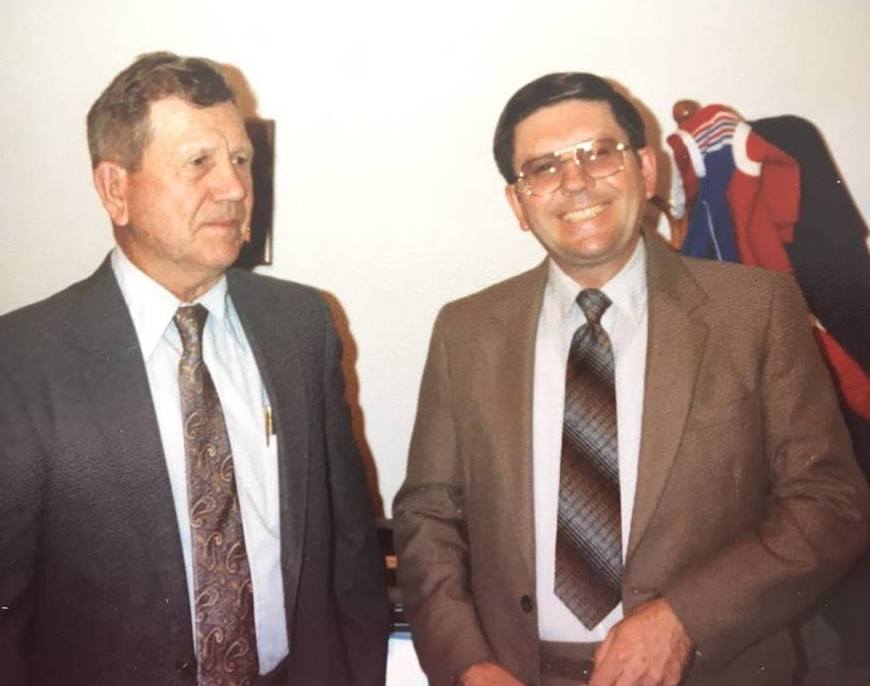
grandpa mitchell and uncle larry
Papaw (L) and Uncle Larry (my mom’s older brother), probably between 30-40 years ago.

What Is Your Trajectory?

Neal Pollard

The New Oxford Online Dictionary defines trajectory as “the path followed by a projectile flying or an object moving under the action of given forces” (n/p). The term is used of everything from ammunition to astronomy, but in its figurative sense can be used to speak of the law of sowing and reaping or cause and effect.  There appears to be three elements to this definition: the path, the object, and the action of given forces. Apply this to a person’s life and the discussion becomes eternally serious.

  • The path: Jesus teaches that there are really only two paths to take, “the broad way” and “the narrow way” (Mat. 7:13-14).  Some have given no thought as to which road they are taking. Others convince themselves they are on the narrow way when an honest, objective look reveals it to be the other way. Some change roads, for good or bad. However, we cannot successfully argue that we are not on a path leading somewhere, whether the destination is “destruction” or “life.”
  • The object: Friend, the object (projectile) in this path of trajectory is the individual. It is you and me. We are moving closer to eternity every day and to some eternal destination. God created a never-dying soul within us (Mat. 25:46; Ec. 12:7). As it was with the rich man and Lazarus (Lk. 16:19-31), we will lift up our eyes in either Abraham’s bosom or in torment. That soul was precious enough to God to pay the highest price to ransom it (John 3:16), but we may choose to give it away by allowing the trajectory of our life to miss the intended target (cf. Mat. 16:26).
  • The action of given forces: We are not helpless regarding this, but force implies pressure, resistance, and influence. The decisions we make, the people we allow to have prominence, our choices, what we prioritize, and what values we establish become the forces moving us to the destination. It’s not what we say is important, what we know is right, or what we intend to do. It is seen in our attitudes, words, and actions.

The earlier we figure this out, the sooner we will make it our aim to do everything we can to head in the only right direction. We can change paths, but the longer we are aimed the wrong target the harder we make it on ourselves to change course. This is true with finance, physical health, occupation, marriage and family, but nowhere are the stakes as high than as concerns our eternal destiny. Let’s give thought to the trajectory of our lives and be sure that where we are heading is where we really want to go.

2000px-parabolic_trajectory-svg