IF THE CHURCH OF CHRIST WILL TRULY BE UNDENOMINATIONAL

Neal Pollard

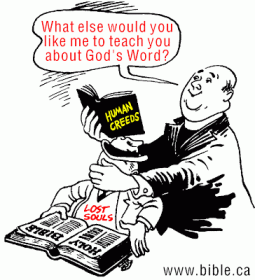
The Restoration Plea is valid, vital, and victorious!  It urges every believer in Christ to throw off the shackles of humanly-devised traditions and beliefs that undermine and contradict the sole, supreme authority of Christ.  Religious division has been spawned through time because of men’s preference for their own creeds and doctrines.  Reason and rationale becomes, “We’ve always done this” or “We prefer this” rather than “Thus saith the Lord!”  With human nature, we are often prone to see such faulty thinking in others while being blinded to our own potential guilt.  This happens to us individually and it certainly can happen to us collectively.  Painfully aware of my own limitations and shortcomings, may I offer some cautions to us out of a sincere love of Christ and His glorious bride?

If the church of Christ will truly be undenominational,

  • We must build our faith and beliefs from the “text out” rather than assert our beliefs and then find verses to support it.
  • We must avoid blind loyalty to any individual, congregation, school, work, and the like.
  • We must determine not to press our inclinations, preferences, judgments, and opinions to the extent that such divides brethren or becomes matters of fellowship.
  • We must strive to preach and practice “the whole counsel of God,” even in unpopular matters or those we may have neglected (church discipline, evangelism, marriage, divorce, and remarriage, moral purity, first-century-like benevolence, etc.).
  • We must be patient and loving within and towards congregations, be they Thessalonicas or Corinths.
  • We must avoid unconditionally venerating and idolizing men above the Lord.
  • We must repent of our intensely “in-reach” philosophy and rededicate ourselves to intense “outreach” in our communities.
  • We must avoid convenient silence in our pulpits and classrooms regarding New Testament distinctiveness and doctrine.
  • We must increase our faith in the absolute, unqualified Lordship of Jesus.

This list is inevitably incomplete and imperfect.  How could it not be, since it is put forward by one who is certainly both those things?  Yet, it is put forward to emphasize that there is an urgent need for us to continually examine our beliefs and practices making sure our allegiance is to the Christ and not men—however great and noble they seem to us.  Our Lord said, “He who rejects Me and does not receive My sayings, has one who judges him; the word I spoke is what will judge him at the last day” (John 12:48).

What Makes “In Jesus’ Name” So Offensive?

Neal Pollard

At Planet Fitness this morning I caught a glimpse of an old “Fresh Prince” episode, where Will Smith’s character was getting married.  During the ceremony, the preacher prayed, beginning “Dear Heavenly Father” but ending “in Your Name, Amen.”  With the recent controversy about the omission of Jesus’ name in prayers by the Robertsons on the very popular “Duck Dynasty” series, I was surprised that this trend goes back at least a few years.  In an interview on YouTube, Phil Robertson talked to producers who surmised that editors in Hollywood thought the name of Jesus, in prayer, would offend some viewers.  Certainly, judging from court cases, from the ACLU’s lawsuit against government bodies in North Carolina praying in Jesus’ name at their meetings to Freedom From Religion’s bullying Kanawha County, West Virginia, into ceasing prayer in Jesus’ name before its High School football games.  As Annie Laurie Gaynor, co-president of FFR, contended, “We are not a Christian nation, this is not a Christian school district, football games…are not Christian football games” (Dave Boucher, Charleston Daily-Mail, 9/24/12).

Certainly, we understand that we live in a climate of political correctness.  That seems to mean that any attempt to honor and glorify Christ in any public way is offensive.  Yet, why is such so offensive in certain circles?

  • In His name is salvation (Mt. 1:21; Ac. 4:10-12).
  • In His name is life (Jn. 20:31).
  • In His name is remission of sins (Ac. 2:38).
  • In His name is healing (Ac. 3:6).
  • In His name is true unity (1 Co. 1:10).
  • In His name is justification from sins (1 Co. 6:11).
  • In His name is supremacy (Ph. 2:10).
  • In His name is authority (Co. 3:17).

Truly, as the songwriter says, “Jesus, name above all names. Beautiful Savior, glorious Lord. Emmanuel, God is with us, blessed Redeemer, living word.”  There is something about that name!  It is the sweetest name on the tongues of those who know Him.  It symbolizes judgment, unwanted accountability, objective standards, and exclusivity for those who refuse to know Him.  Rebellion is as old as mankind, but what they are missing who reject His name in life.  Some day, at that very name, everyone will be compelled to bow (Ph. 2:10-11).  To do so then will be too late.  To do so now opens the door to joy here and eternally.

Staying On The Rails

Neal Pollard

Without A Belief In The Bible’s Inspiration…

  • Why would I read, meditate upon, or study it daily (or at all) to guide my life?
  • What will be the paradigm for directing and shaping my life?
  • From where will I draw my understanding of Who Jesus is, what He did, and how I must relate to Him?
  • How do I form my understanding of where I came from, why I am here, or where I am going?
  • Why would I trust or follow what it says to do in even a single case, circumstance, or verse?
  • What logical, ultimate constraint do I have from any behavior or act I desire to do, no matter how aberrant or outlandish society finds it?
  • How do we evaluate the content of any word, attitude, or action for rightness or wrongness?
  • On what basis would I accept absolutes, which I must (even if I absolutely deny the existence of absolute truth)?
  • Who or what will be my standard of authority?

One of the most famous movie scenes of all time depicts Dr. Richard Kimble, played by Harrison Ford, desperately running, orange prison jump suit, shackles, and all, as a derailed train caroms out of control, rapidly gaining on him, and threatening his life. The videography is spectacular, cutting quite an imposing figure.  A multi-ton mass of metal off the rail and out of control promises nothing but damage and destruction.  As long as the train is on the track, its weight and speed do not pose a threat.  If it is not, the prospects are frightening.

The premise that the Bible is the Word of God from the mind of God through men provides an answer to all the above, weighty questions.  If one refuses to accept the Bible is what it claims to be (1 Cor. 2:11-12; Gal. 1:6-9; 2 Tim. 3:16-17; 2 Pet. 1:20-21; Jude 3; etc.), then of necessity he or she must choose an alternate guide for life.  It is fair to evaluate that alternative with equal criticism and scrutiny.  Wisdom would seem to suggest choosing what best explains the whole picture–our complex design, moral compass, appreciation for beauty, universe’s order, and more.  What we are talking about are the very biggest issues of life! They deserve our deepest thought and wisest choice.


CORN DOGS, SAUERKRAUT, AND COTTAGE CHEESE

Neal Pollard

The food items above have one sure thing in common–they are all items I cannot even choke down.  Each of them are undesirable to me for different reasons, but they are all checked off in my gross column.  You may love them all, and if so, in the words of the great philosopher Briscoe Darling, “more power to you.”  I just do not.

Culinary tastes differ.  I enjoy mixing peanut butter and table syrup, using homemade biscuits to sop up this fine, tasty blend, but I realize I may not have a lot of company in that proclivity of mine.  Some things are healthier and more suitable to eat than others, but much of that is simply a matter of taste.

Sadly, there are people who have tried to lean on their human reasoning and experience, determining what they will and will not do and believe based on personal preference and taste.  They do not see Scripture as authoritative.  In our postmodern age, people have tried to make our culture–with its peculiar tastes, desires, and leanings–preeminent over God’s revealed truth.  When this is the case, a society can put sins like abortion, homosexuality, adultery, living together, modern dancing, immodesty, and greed into the palatable and even desirable category.  The same group may put godly traits of character like honesty, courtesy, commitment, conviction, faithfulness, and the like into the distasteful category.

I remember my dad preaching a sermon about “Cafeteria-Style Religion.”  Back in those days, cafeteria-style restaurants were more common and popular.  You walk in the restaurant, walk past meats, vegetables, breads, and desserts, putting only what you wanted on your tray while rejecting the rest.  The spiritual application of that, that people pick and choose what commands of God to obey and what to ignore, is even truer today than it was then.  Today, it is not just doctrinal matters but also moral matters.

We need to remember this.  Scripture itself speaks of a way that seems right to a man that leads to death (Prov. 16:25).  It is not in man to direct his own steops (Jer. 10:23). Paul had been responsible for Christians’ deaths, yet could say in Acts 23:1 that he had lived with a clean conscience before God to that very day.  God has left a complete revelation that has been preserved, despite what agenda-driven skeptics say.  Our task is to swallow that, but to spit out any alternative authority.

THE STRUGGLE OF SUBMISSION


Neal Pollard

I confess to not knowing all the reasons behind some of the rules and protocol onboard the airplane.  Why do you have to power off your electronics?  Why must you have a seat when the plane is taxiing to the gate after landing?  I know what I am told, but that does not mean I necessarily see the logic as sound in every situation.  Having said that, nothing aggravates me as much as seeing fellow passengers flaunting the express command to cut off their phones.  I have seen people finishing texts even as the plane is leaving the ground.  Perhaps my feelings make me biased, reading the news story about the “rowdy” high school seniors from the Yeshiva in Flatbush in Brooklyn who were kicked off their 6 A.M. AirTran flight from LaGuardia  to Atlanta. According to an AP report, “Southwest Airlines, said in a statement that flight attendants asked passengers several times to take their seats and put their mobile devices away. The airline said that when some didn’t comply, the captain repeated the request. When that didn’t work either, the whole group of students was ordered to disembark for safety reasons” (David B. Caruso, 6/4/13).

Why do so many of us struggle with following the rules?  Children don’t want to obey parents.  Students don’t want to obey teachers and administrators.  Employees don’t want to obey employers.  Church members don’t want to obey elders.  Mankind doesn’t want to obey God.  This tendency is not only widespread, but has been timeless.

If we will honestly assess this problem, we will find that our biggest threat in this matter is internal rather than external.  Our biggest enemy in this is ourselves.  Certainly, James 1:14 applies to this struggle. We get carried away and enticed by our own lust.  With this, that ugly monster of pride swells within us, causing us to think, “Nobody can tell me what to do!” Let us remember Proverbs 16:18!  What a dangerous mentality.

Our perfect, innocent Lord faced a painful death on the cross at the hands of wicked men.  He did not complain of unfairness or decry His loss of rights.  He tearfully, humbly prayed, “Not My will, but Yours be done” (Lk. 22:42).  May we humble ourselves and follow His example in the areas of life that require us to submit to the rules.

FAITH OR OPINION?

W. Gaddys Roy

Neal Pollard

One of the fond memories I have from my first local work was attending a gospel meeting in a tiny block building in York, Alabama, conducted by the late gospel preacher and teacher, W. Gaddys Roy.  He was talking about authority that evening, and a member of a nearby non-institutional congregation took umbrage with some of brother Roy’s lesson.  Particularly, the brother did not like the idea that eating in a church building was a matter of opinion.  He thought it was a matter of faith, and his question for brother Roy was, “Where’s your authority to eat in the building?”  Brother Roy said, “Where’s your authority for the building?” The brother pressed his point, but ignored brother Roy’s question.

Sometimes, we hear people asking “where is your authority?” for something when they have misunderstood that the Bible authorizes generically as well as specifically.  In fact, a specific command will almost always authorize generically in some way.  For example, we are commanded to sing in our worship.  That leaves no room for “singing AND anything else” (like playing an instrument, beat-boxing, percussion, humming, etc.).  Yet, we are authorized to do or use anything that expedites our obeying that command (like songbooks, overhead lighting, shape notes, singing in parts, a projector, a pitch pipe, etc.).

We may have strong feelings about something, but we must beware the tendency to elevate our opinions to the level of being a “faith matter.”  If we make laws where God has not, we are as guilty of violating the will of God and challenging the authority of God as those who seek to generalize where God has specified.   We may not like something or be uncomfortable with something, but we must be careful not to press our case too strongly.  We must make sure we have Christ as the foundation of our objection.  Otherwise, we have simply elevated our will to be on a par with or to exceed His.

Was Uzzah’s Death Unfair?


Neal Pollard
If you Google the phrase “Uzzah Death Unfair,” you will find at least 1380 hits most of which addresses that idea. In case you are having a momentary brain cramp over exactly who Uzzah was, he was the man who died when he tried to steady the Ark of the Covenant as David arranged for it to return to Jerusalem. Since the last day of Eli’s life, the Philistines had assumed possession of the Ark (1 Sam. 5:1). That idolatrous nation, given the trouble they received from God for keeping it, returned it to Israel, to Kiriath-Jearim, where Eleazer was consecrated to keep it at Abinadab’s house on the hill (1 Sam. 7:1). Then, following Saul’s reign, David wanted to bring the ark back to Jerusalem (2 Sam. 6:1ff). Abinadab’s sons, Uzzah and Ahio, set the ark on a new cart and began the journey toward Jerusalem. At Nachon’s threshing floor, the oxen stumbled and Uzzah took hold of the ark (2 Sam. 6:6). Then, “God struck him down there for his irreverence; and he died there by the ark of God” (2 Sam. 6:7). David became angry because of the Lord’s outburst against Uzzah, even calling the site of Nashon’s threshing floor that name (Perez-Uzzah).

One might ask why God reacted in what the modern mind sees as a harsh way “simply” for steadying the ark after the oxen stumbled. In 1 Chronicles 15, several inspired answers are given. First, David said it was “because we did not consult Him (God) about the proper order” (13). In other words, Israel took it on themselves to move the ark-which they knew as the residing place of the glory of the Lord (1 Sam. 4:22; cf. 2 Sam. 6:2)-without regard to how God commanded it to be done. Jeremiah says that it is not in man to direct his own steps (10:23). Second, they had gotten away from their spiritual roots. In this case, their spiritual roots were what “Moses commanded according to the word of the Lord” (1 Chron. 15:15). God had an established, authorized way to carry the ark which the writer reviews in this verse. On this occasion, they did as Moses revealed. “The Levites bore the ark of God on their shoulders, by its poles” (15a). Finally, they tried to get by on self-reliance (26). Their newly rediscovered reverence following Uzzah’s death led David, the Levites, and all Israel to see that “God helped the Levites who bore the ark of the covenant.” This spirit of dependency apparently did not exist when Uzzah walked behind the oxcart.

Is it unfair for God to want people to consult Him, to be true to their spiritual roots, to properly regard and revere Him, and to rely upon Him? Certainly not. Uzzah certainly shows us the grave spiritual danger we face by trying to go out on our own, without reverence toward, reliance upon, and recognition of God and His power and authority in our lives.

What Is God’s View Toward Homosexuality In 2012?

Neal Pollard

In 1998, Lisa Bennett, then a fellow at Harvard University’s Center on Press, Politics, and Public Policy in the John F. Kennedy School of Government, wrote a research paper on perceived prejudice in the press toward homosexuality.  She noted that immediately following World War II, “all the major religions condemned it as a sin against God and nature. Psychiatrists treated it as a serious mental disorder. Almost every state in the nation had a law against it, with many calling for a prison term for convicted homosexuals” (Bennett 2).  She credited Alfred Kinsey’s reports for revealing how much of what the Bible calls sexual immorality was being clandestinely practiced by Americans (though it has been widely noted that Kinsey skewed and manipulated his results to match his own, private agenda; opponents include the American Legislative Exchange Council, Margaret Mead, Karl Menninger, Eric Fromm, and a who’s who of Kinsey’s contemporaries in science and psychology).

Even in the last 30 years, attitudes toward homosexuality have changed dramatically. Gallup indicates that in 1977, Americans were evenly divided over whether or not homosexuality should even be legal (43% for and against).  In 1983, only 34% thought homosexuality should be considered an acceptable alternative lifestyle. In 1996, only 27% favored homosexual marriage (www.gallup.com/poll/108115/Americans-Evenly-Divided-Morality-Homosexuality.aspx).  These and similar findings are radically different in 2012.

Whatever the exact numbers are now, it is safe to say that many, many more Americans accept, if not embrace, homosexuality in our society than in the years immediately following World War II.  This cannot all be laid at the feet of one man, but at a few elite institutions.  One is higher education, where professors in academic isolation surrounded only by like-minded peers can pursue carnal theory and philosophy with seeming earthly impunity (i.e., free from consequences).  Incidentally, many of these professors have taken their places in seminaries and other religious graduate schools, softening and changing the positions of religious teachers and preachers across the religious spectrum.  Another is the media, whose message has long been an influencer and molder of thought rather than a reflection of it.  Its story-lines, role models, and biases continue to push the moral envelope.  Yet another is politics, where legislators, judges, and others pander to activists and special interest groups who pressure with money and power.

All of this is presented, not to argue for changing our positions on homosexuality or any other moral issue, but to help us take a look at the moral slide so many are riding.  No matter what percentage of Americans, academicians, politicians, or media types, call homosexuality or other sin natural, normal, and acceptable, God’s Word stands firm.  It will not change, for it is the expressed will of God.  In short, though God loves every sinner, homosexuality is, and forever will be, a sin (Rom. 1:24-27; 1 Cor. 6:9; 1 Tim. 1:10).

“EX-CHURCH-OF-CHRIST” AND GENTLENESS

Neal Pollard

There are a couple of web sites out there regarding churches of Christ.  While I do not have the time to read every page and all content, I spent some time looking at them in-depth.  These sites have the following in common regarding their view of churches of Christ.

(1) They vehemently affirm that we are a denomination.

(2) They insinuate or explicitly say that we are a cult or close to a cult.

(3) They point out that we defend what we teach and practice with “ad hominem” (i.e., personal and character) attacks or with hateful, abrasive speech.

Given that we have no convention, headquarters, or central, governing body, no one of us can speak on behalf of every congregation or even every member of a congregation.  Thus, I will not say that there are not congregations that have become denominational or even a denomination.  Regarding denominationalism, what I can say is what I believe and teach (and what many others do).  I do not rest my “heritage” in the life and works of Alexander Campbell, Barton Stone, or any other man but Jesus.  What I teach is that we need to get “before” Catholicism and Protestantism, striving to teach and follow what New Testament Christians did.  Is it possible to worship, teach the same way to salvation, and hold the same moral ideals and principles that the New Testament reveals that the first Christians did?

Regarding the charge of being a cult, religious experts on the subject, like Martin or Ankerberg and Weldon, define and describe a cult in great detail.  Their description has been generally accepted as factual and logical.  A cult is defined as a group of people who follow a person or that person’s interpretation of the Bible (Mary Baker Eddy, Joseph Smith, Jim Jones, or David Koresh).  They consider their own writings of equal authority with the Bible.  They redefine the most basic of Bible doctrines of concepts, including the Godhead, the deity of Christ, human suffering, and works.  Their redefinition has no roots or resemblance to revealed scripture. They also work through excessive spiritual or psychological regulation or dependence (A&W, XXII). These do not even come close to describing mainstream churches of Christ.

However, let me say something about that last charge.  Too often, well-meaning, passionate members of the church have been guilty of lacking adequate kindness and gentleness in responding to individuals like those responsible for the aforementioned websites.  I can understand righteous indignation and love for Christ and His church.  But, let us remember that it is never right to do wrong.  To personally attack anyone, to allow righteous anger to become sinful anger, to be insulting, demeaning, ridiculing, or sarcastic is unjustifiable.  Any defense of such tactics falls short of the ethical and moral standard taught in the New Testament.  I have often heard it said, and I agree, that “if you’re not kind, you’re the wrong kind” or “you can be right, but be wrong.”  Let us study more and sting less, being more knowledgeable and less nasty.  Divine truth is powerful enough to stand on its own merit.  Let us “speak the truth in love” (Eph. 4:15) and be known for our love (Jn. 13:34-35).  It is our most powerful weapon to fight those first two, false charges.

HEAVENLY STANDARDS

Thom Vaught

It was a chilly Sunday morning on February 7th 1904.  The men of Engine Co. 15 were expecting a quiet day as they readied for inspection.  Their routine was interrupted by an automated fire alarm at 10:48 a.m. in the John Hurst and Company building.  These men were answering the first call of the Great Baltimore Fire of 1904.

Once the Fire Chief was on the scene, he quickly realized the danger.  High winds were causing the blaze to spread quickly and efforts to douse the fire were hampered by the freezing temperatures.  He called in nearly the entire Baltimore City Fire Department to fight the fire but even that was not enough to contain the persistent flames.

A plea for help went out to areas surrounding Baltimore and the response was astounding.  Firefighters from Washington DC were the first to arrive.  Upon arrival they were were dismayed to find out that their fire hose couplings would not fit the fire hydrants.  Baltimore like most cities of that day had their own standard by which fire hydrants and firefighting equipment were manufactured.  As firefighters arrived, they tried to adapt to this different standard but the lowered water pressure and leaks continued to impact their ability to help.  Firefighters from as far away as Philadelphia  and New York City answered the call but each time the story was the same.  The lack of a standard caused confusion and the resulting efforts were less effective.

The Great Baltimore Fire raged across the city for two days.  Damage caused by the blaze was so extensive that it is hard to imagine.  It destroyed over 1,500 buildings covering nearly 70 city blocks.

In a report presented to congress, the lack of a uniform standard was cited as a major contributing factor to the massive destruction.  Congress tasked the fledgling National Bureau of Standards now known as the National Institute of Standards and Technology (NIST) to investigate the matter.  They discovered around 600 different sizes for fire equipment in use throughout the nation.  As a result, the organization established a national standard for fire equipment.

Having a standard is great, but it is only useful when it is followed.  Fires as recent as the 1991 Oakland Hills Fire have been hampered by cities not following the NIST standard.  In 2004, the NIST published a centennial progress report on the adoption of their standard after the Great Baltimore Fire.  In it they disclosed that several major cities are still not following the standard established a century earlier.

Moving from the physical to the spiritual.  God recognized the need for a standard for us to follow.  Furthermore, our Lord has not confused man with a plethora of differing standards but gave us a single one.  This heavenly standard is the God-breathed word of the Bible and it is meant as our only standard for life and worship.  As when Paul exhorted Timothy (2 Timothy 3:16,17) during the first century, we also have in Scripture everything necessary to understand and follow God’s will.  How can we hope to fit into the spiritual mold that God desires if we pursue any standard other than His?