Seven Reasons We Fail To Give Thanks

Brent Pollard

Thanksgiving is just around the corner, and I can’t help but wonder how many people in the United States will take a moment to thank God. While some reject the day due to its association with Plymouth and the “original Thanksgiving” celebration, the fact remains that all of our presidents have thanked God in their Thanksgiving proclamations. Therefore, I am okay with doing away with the pilgrims as long as we can maintain the day’s significance set forth by historical figures such as Abraham Lincoln. On Thanksgiving Day, we reflect on our blessings, express our gratitude to God, and ask for His continued beneficent providence in our national life. Thus, unlike Easter and Christmas, which carry pagan baggage from the standpoint of their traditions, Thanksgiving is the most Christian of all federal holidays.

Luke records an instance during Christ’s ministry in which He encountered ingratitude on a par with modern America. Only one of the ten lepers He healed returned to thank Christ for what He had done (Luke 17.11–19). Jesus even asked, “Were there not ten cleansed?” (NASB Luke 17.17) People do their best to spin the nine’s actions in a positive light. Emotion overcame the nine, and they longed to return to their previous lives. Besides, they followed Christ’s command to go and show themselves to the priests. And what if the Samaritan only returned because he lacked a priest to whom he could present himself as a foreigner? In any case, Jesus told the Samaritan that his actions had made him “well” (Luke 17.19).

What prevents us from showing gratitude like the Samaritan? Here are seven possible reasons:

We are too busy and distracted. Modern life can be busy and distracting, making it difficult to appreciate the present moment and count blessings.

We can be too materialistic. It can be challenging to be grateful for what one has in consumerist societies because materialism has overtaken the value placed on intangibles like relationships and experiences.

We compare ourselves to others. Due to constant comparison with others and the influence of social media, one may experience feelings of inadequacy or jealousy, which can prevent one from feeling grateful for their life and circumstances.

We may have a negativity bias. People naturally tend to dwell on negative rather than positive things. Instead of focusing on what we have, we will concentrate on what we don’t. That inclination is a negativity bias.

We are on a hedonic treadmill. This phenomenon of becoming accustomed to pleasure is known as hedonic adaptation. In simpler terms, we get used to things emotionally. For example, when I acquire a new and shiny object, it brings me happiness. However, this happiness is short-lived, as I soon become accustomed to it.

Similarly, when something terrible happens, I feel sad but adapt to the change over time, and my happiness levels return to normal. As a side note, we note that God offers us joy, not happiness. Joy is renewed from within, avoiding the hedonic treadmill. Hence, it can even be an implied imperative (see Philippians 4.4).

We forget to be still. This results from failing to heed Psalm 46.10, which says, “Be still, and know that I am God” (KJV). A similar root cause is that people are too preoccupied with their lives to stop and offer thanks. Luke 11.24–26 shows that refraining from one bad behavior is not enough to prevent the substitution of another bad behavior. We need to fill the void by starting something useful. New Agers and Buddhists would call this “practicing mindfulness.”

But Christians do engage in their form of mindfulness as well. A Christian sets aside specific times for quiet reflection, away from the distractions of daily life, rather than sitting in the lotus position and breathing deeply. Christian mindfulness is about creating a space to focus inwardly and become more aware of God’s presence. Praying and reading the Bible are two of the best ways to accomplish this. Those who commit to being still and knowing God will be grateful.

We feel entitled. Individuals may feel entitled in societies where success and happiness are highly valued. This thinking can dull people’s gratitude and lead them to take their blessings for granted. Gifts become their norm rather than providential occurrences (see James 1.17).

As Thanksgiving draws near, we must truly understand what this holiday is all about. It’s not only a time for food and family gatherings but also genuine gratitude. In our busy lives, full of distractions and the pursuit of material comforts, we often forget to give thanks for the simple things. However, this day allows us to break free from these tendencies. It encourages us to step off the hedonic treadmill, put aside our negativity bias and the sense of entitlement that clouds our perception, and instead embrace a spirit of thankfulness. By being still, as suggested in Psalm 46:10, we can truly appreciate the blessings bestowed upon us, recognizing them as gifts from God rather than mere entitlements or passing pleasures. Thanksgiving, at its core, is a day to emulate the gratitude of the Samaritan leper, acknowledging our blessings and expressing our heartfelt thanks to the Divine. In doing so, we honor the tradition set forth by figures like Abraham Lincoln and cultivate a more profound sense of joy and contentment in our lives. So, let this Thanksgiving remind us to pause, reflect, and give thanks with a full heart.


A Lasting Influence

Thursday’s Column: Captain’s Blog

“Devote yourselves to prayer, keeping alert in it with an attitude of thanksgiving; praying at the same time for us as well, that God will open up to us a door for the word, so that we may speak forth the mystery of Christ, for which I have also been imprisoned; that I may make it clear in the way I ought to speak. Conduct yourselves with wisdom toward outsiders, making the most of the opportunity. Let your speech always be with grace, as though seasoned with salt, so that you will know how you should respond to each person.” Colossians 4:2-6

Speech plays a major role in our influence. Speech and actions are the two primary ways that we influence those around us. If our words differ from our actions, people will see it. Paul died 2000 years ago, and his speech is still influencing Christians today. Our words can have a lasting impact! In 1887 the coffin of Abraham Lincoln was pried open to determine if it contained his body. What makes that act so remarkable is the fact that Lincoln’s body had rested in that coffin for 22 years. Yet, even more amazing is that 14 years later a rumor circulated again that Lincoln’s coffin was actually empty. The rumor so gripped the land that the only way to silence it was to dig up the coffin–again. This was done and the rumor silenced when a handful of witnesses viewed the lifeless body of Abraham Lincoln.

Words have power. We know the harm that can come from them, but also the good. 

In fact, we can use words to build up or tear down. To build, or destroy our influence. 

Facebook is a king of spreading words. Each one of us has our own unique set of friends that see our posts. And although social media can be used for good, sadly the majority of posts are negative. Christian influence can go a long way on Facebook. But what good are we doing if all we do is argue and tear down others? Colossians 4:5 says, “Conduct yourselves with wisdom toward outsiders, making the most of the opportunity.”

A wise person isn’t going to get involved in a fruitless Facebook conversation. A wise person isn’t going to chew out someone else. A wise person doesn’t use his influence to hurt others, but he looks for ways he can be a good influence. 

“Conduct yourselves with wisdom towards outsiders, making the most of every opportunity.” You have an opportunity I will never have. You can have an influence on your family that no one else has. So make the most of it. If you’re like me, that sounds extremely hard. But we do it for the souls of our children, our spouses, and our friends. Our influence has the ability to instruct, and to lead our homes to Christ. 

If someone paid you 10 cents for every kind word/action you did for others, and you had to pay 5 cents for every bad word/action, would you be rich or poor? Our influence is so important. We must grow it, and pray for it. What has my influence done? Has it brought my family closer to Christ? Has it grown at all? Is my influence better than it was last month? Has it charged me as guilty? What kind of influence is in my book of life? Has it instructed my children? Has my influence been profitable? Let’s be sure to leave a lasting impression while we have the chance.

Carl Pollard

“I’ll Trust The Science”

Friday’s Column: Brent’s Bent

Today, the term “science” is overused, or should I say abused? People conflate consensus with knowledge. To get rid of today’s biases, let’s go back in time to see how Noah Webster defined the word nearly 200 years ago. Webster told us that “science” refers to “knowledge, or certain knowledge; the comprehension or understanding of truth or facts by the mind” (Webster). The focus then shifts to determining the facts upon which we can rely. Perhaps you’ve heard that something can only be established as fact if it is observable or repeatable in the case of an experiment. That determination is valid.

Thus, regardless of whether you accept the existence of a Creator or believe our existence is the result of random chance, you must recognize your conclusion as a matter of faith. This admission is not to say that there isn’t any evidence. There is proof. The Creator supplies testimony of Himself that the creationist accepts. But, it becomes a matter of faith because we were not present to witness firsthand events, and we cannot recreate our universe’s emergence from chaos or nothingness. As a creationist, I have more reason to believe in my facts than the person who has to think that everything came from nothing, an event that all of written history fails to report.

I apologize for the lengthy preface, but a brother once chastised me for not approaching these topics more “scientifically.” There appears to be an irrational belief that you cannot open your mouth to speak on a subject unless you have a doctorate. People seem to have forgotten that the world had learned men before American colonials established Harvard or Yale. Indeed, men like Abraham Lincoln, who kept the American Union together, were self-taught. No one questions Lincoln’s wisdom as they read the speeches that have outlived him.

However, in this information age, we have become skeptical of any information that contradicts our paradigm. I’m not necessarily condemning this skepticism because it’s often justified. As Christians, we recall the Holy Spirit’s compliment to the noble Bereans for cross-referencing Paul’s sermons with God’s Word (Acts 17.11). But we must remember that education is only a tool, a means to an end. Education teaches us how to comprehend the truth. Any idiot can wield a chisel, but only the diligent can carve a statue out of a marble slab. I say this to remind us that a man with an advanced degree can have an overpriced piece of paper and stumble over a topic, whereas an avid reader can speak eloquently about the issues about which he reads.

I cannot speak eloquently on the science found in Genesis 1.1-2. I can only offer what I’ve learned from researching the topic. I will say that I have made an effort to comprehend opposing viewpoints. They can be entertaining, even if I know they are not valid explanations for our existence. I add that God did not intend the Bible to be a science textbook. As a result, any science gained from the Bible results from the fact that the Bible is true (John 17.17).

Friends who do not believe in a Creator are left to believe in one of several competing theories. Most of us are familiar with the Big Bang. In August 2022, some said that the James Webb Space Telescope disproved the Big Bang theory. On the other hand, scientists claim that such a declaration results from a false scientific approach (Cooper). Fair enough. There would be several other intriguing alternative explanations, even if one dismissed the Big Bang. The concept of quantum entanglement is one of these theories. Don’t worry. I won’t even attempt to explain it since I have no advanced degrees in physics.

However, time, energy, space, and matter are all mentioned in Genesis 1.1. Interestingly, NASA informs us that the universe “includes all of space, and all the matter and energy that space contains. It even includes time itself” (Brennan). So, Genesis 1.1 looks at our existence from a scientific point of view.

“In the beginning” refers to time.

“God created” refers to energy.

“The heavens” refers to space.

“The earth” refers to matter.

But this is where things get tricky. God used the idea of time to help us understand. He did this by dividing the creation into 24-hour blocks of creative work, starting in verse 3. Real-time, however, began when the light from day one merged into the sun on day four, the sun around which our planet transits. A year is a unit of time defined by one complete revolution around this star. God elaborated further with the creation of the sun, moon, and stars, saying that they “serve as signs and for seasons, and for days and years” (Genesis 1.14 NASB).

We would not know that there were three consecutive 24-hour periods if God did not elaborate that what He did on days one through three was completed in an evening and morning, a day (i.e., the Hebrew “yom,” which implies the length of a typical day). As a result, God completed the initial work of creation when time did not exist. I don’t say this as a concession to allow for a fourteen billion-year-old universe.

The unspoken implication is that God first created the material from which He would later shape our universe, as demonstrated in Genesis 1.2. There was something nebulous there, over which God’s Spirit hovered before He said, “Let there be light.” What happens when you try to age something that existed before time? Consider the dating techniques we employ and the potential flaws they contain. These methods necessitate consistency. When estimating the decay of a radioactive isotope in a rock, for example, I must assume that this radioactive element has always decayed at the same rate. Have any of us been alive during the time required to observe the stated decay rate? In short, the answer is no. How did these radioactive isotopes get into that rock in the first place?

There’s also the question of what we see when God creates flora, fauna, and humanity. He made all of these things fully mature and capable of reproducing. Thus, despite being only seconds old, Adam would have appeared to be an adult man. Why should our planet and universe be any different? There is no reason for me to make an exception. As a result, a mature world may appear billions of years old despite being only ten thousand years old.

Despite being frequently used against Christians, I believe Occam’s razor is on the side of creationists. The most basic explanation for our origin is that a Being with the ability to create a universe did so. Otherwise, our observations of this complex universe force us to resort to explanations including absurdities, such as the possibility that a Higgs boson or something similar exploded and produced all of the universe’s material, which gradually shaped itself into what we now observe. The latter shaping process managed to do so without the assistance of Intelligence and created conditions on one specific planet orbiting a star in just the right place to allow primordial seas to slosh together the right set of molecules capable of transforming an inanimate substance into an animated one. The topper is that we have not even explained from whence the Higgs boson has come. 

When all is said, it comes down to faith. Which set of facts will be accepted? I’ll borrow a smug expression from today: “I’ll trust the science.” Yes, I believe in the science of Genesis 1.1-2.

Sources Cited

Webster, Noah. “Websters Dictionary 1828 – Webster’s Dictionary 1828 – Science.” Websters Dictionary 1828webstersdictionary1828.com/Dictionary/science. Accessed 26 Jan. 2023.

Cooper, Keith. “The James Webb Space Telescope Never Disproved the Big Bang. Here’s How That Falsehood Spread.” Space.com, 7 Sept. 2022, www.space.com/james-webb-space-telescope-science-denial.

Brennan, Pat. “What Is the Universe? | What Is an Exoplanet? – Exoplanet Exploration: Planets Beyond Our Solar System.” Exoplanet Exploration: Planets Beyond Our Solar Systemexoplanets.nasa.gov/what-is-an-exoplanet/what-is-the-universe. Accessed 26 Jan. 2023.

Brent Pollard

The True Meaning of the Thanksgiving Holiday 

Friday’s Column: Brent’s Biblical Bytes

81121814_2462862270639428_5746232403106463744_n

Brent Pollard

Hopefully, those within the United States enjoyed a safe and joyous Thanksgiving holiday yesterday. Thanksgiving is one of those holidays that has come under attack by secular humanist forces in recent years. Worse than merely shifting the focus to turkey and American football, some people are trying to attack the holiday based on injustices perpetrated against the American Indian population over a century ago. While true that the “Thanksgiving feast” in seventeenth-century Plymouth serves as a romantic backdrop to our current holiday, we should not forget that days of giving thanks is not limited to one group or one time.  


Many countries observe some Thanksgiving holiday today. These observances are typically about the giving of thanks for the bounty of the harvest. They may reflect a pagan rather than Christian influence. However, to single out the United States’ practice as a matter of perpetuating injustice is a move by those seeking to erase American history with its Judeo-Christian values. The removal of said Judeo-Christian values are necessary to create the secular humanistic state esteemed by the disciples of Karl Marx. It is not an exaggeration to say we are in the midst of a great cultural war here within the United States. The winner of this cultural war will determine whether the United States continues to be free or becomes despotic. I realize that may sound like hyperbole on my part. Still, the Founding Fathers were clear in emphasizing that only religious people could maintain the liberties enshrined within the Constitution.  

Thus, we find the American Thanksgiving holiday’s actual genesis in 1789, the year of the United States Constitution’s ratification. President George Washington wrote that Congress had tasked him to declare a day of Thanksgiving. The purpose of this day was to thank God for blessing the newly-formed United States with peace and prosperity. A cursory examination of all of the Presidential Thanksgiving Proclamations demonstrates the common theme of acknowledging and thanking Providence. Many Presidents likewise include an exhortation to remember the less fortunate and spend the day in service to others. President John Adams approached it differently. He asked people to fast on Thanksgiving and include with their prayers those of penitence, acknowledging national sins. How novel!  

Thomas Jefferson balked at the idea of making Thanksgiving Proclamations. He thought it smacked too much of enjoining the populace to some State religion. I believe Jefferson was mistaken, but it should help you understand that this holiday has been one long conceived as religious in tone. After Jefferson’s successor, Madison, the practice of the President giving a Thanksgiving Proclamation fell by the wayside until the Civil War. At the behest of Secretary Seward and a private citizen, Sara Josepha Hale, Lincoln reinstated the practice of issuing Thanksgiving Proclamations. Essentially, Lincoln helped make Thanksgiving an annual observance. It would not be until 1941, though, that the federal government made Thanksgiving an official holiday. Except for President Garfield, who died from an assassin’s bullet, every President since Lincoln has issued a Thanksgiving Proclamation, regardless of party affiliation.   

The beloved Norman Rockwell contributed to the iconic depiction of Thanksgiving with his painting “The Freedom from Want” in 1943. (It was a part of Rockwell’s “Four Freedoms” series.) A patriarch and matriarch stand at the head of the table around which the family has gathered. The matriarch has prepared a sumptuous turkey feast. Delight fills the faces of all assembled. For me, however, the best Rockwell depiction of Thanksgiving was the last Thanksgiving cover he would paint for The Saturday Evening Post in 1951. He entitled that painting “Saying Grace.” A “grandmother” and a little boy sits in a restaurant. Their heads are bowed in prayer as others look on. The looks given by their tablemates seem to show amusement or curiosity. (Frankly, they seem to be reacting as if it were the first time they have seen this behavior.) Within those brush strokes, Rockwell has, to me, captured the true meaning of Thanksgiving. Amid the rush of a secular world, we pause, giving our thanks to God for even the simple meal. It matters not if others are willing likewise to thank God.  


I fully expect that should God allow time to continue that we will see an assault on the Thanksgiving holiday of 2021 since that would mark 400 years after Plymouth. Again, secular humanists want to take God from the picture. They wish to define the holiday as an observance in which we celebrate the rape and plunder of indigenous peoples by calling their seized property our possession. Yet, such critics demonstrate ignorance also of that original Plymouth feast. Thanksgiving is not about what we have. Thanksgiving is about acknowledging our Benefactor. It is a day for our nation to pause and admit that we would not be here without the Providence of God. And, as we count our blessings, we are motivated to show mercy to our neighbor as God has shown mercy to us. 

Works Consulted and Further Reading 

“Thanksgiving Proclamation of 1789.” George Washington’s Mount Vernon, Mount Vernon Ladies’ Association,www.mountvernon.org/education/primary-sources-2/article/thanksgiving-proclamation-of-1789/


Maranzani, Barbara. “How the ‘Mother of Thanksgiving’ Lobbied Abraham Lincoln to Proclaim the National Holiday.” History.com, A&E Television Networks, 3 Oct. 2013, www.history.com/news/abraham-lincoln-and-the-mother-of-thanksgiving


Miller, Cheryl. What So Proudly We Hail, What So Proudly We Hail, 30 Apr. 2013, www.whatsoproudlywehail.org/curriculum/the-american-calendar/thanksgiving-day-proclamations-1789-present


“‘Freedom from Want,” 1943 – Norman Rockwell Museum – The Home for American Illustration.” Norman Rockwell Museum, Norman Rockwell Museum., 1 Mar. 2017, www.nrm.org/2016/11/freedom-want-1943/


“Saying Grace (Rockwell).” Wikipedia, Wikimedia Foundation, 26 Sept. 2020, en.wikipedia.org/wiki/Saying_Grace_(Rockwell)


Abraham Lincoln’s Memorandum Of August 23, 1864

Neal Pollard

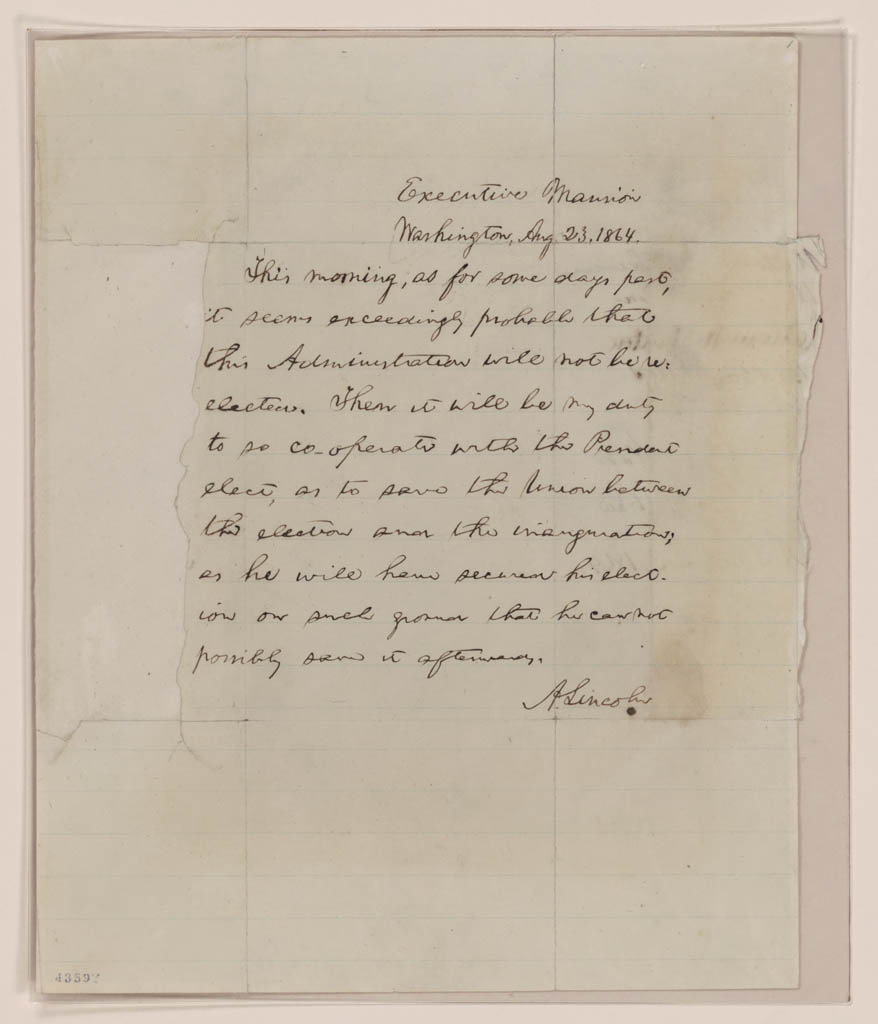
Somehow, I was unaware of the existence of a document which Abraham Lincoln drafted and had endorsed by every member of his cabinet, though unseen by them, and which remained sealed until November 11, 1864. These were not only dark times for the nation, embroiled in civil war for over three years at that point, but gloomy for the war-weary north which could not end the conflict against the greatly outmanned but tactically superior south. Politicians and citizens were unhappy with the perceived lack of success and progress at such high cost—the death and disabling of so many of her sons in the prime of their lives.  Lincoln detected that popular sentiment was such that he would not be reelected. Thus, he drafted his memo, which read, 

This morning, as for some days past, it seems exceedingly probable the this
Administration will not be reelected. Then it will be my duty to so cooperate
with the President-elect as to save the Union between the election and the
inauguration: as he will have secured his election on such ground that he
cannot possibly save it afterward (Coolidge 139). 

Lincoln seemed to think that the north had had enough of this war and would rather sue for peace and allow our sea to shining sea to be two nations rather than continue with such devastating effects a war they could see no end to. He appears dedicated to whatever he could do to preserve unity.

Of course, several things changed the course of Lincoln’s fate in his bid for reelection that swept him decidedly into office for a second term. There was the north’s victorious show in The Battle of Atlanta, Fremont’s withdrawal from candidacy, the Democrats internal division between the Copperheads—eager to end the war now—and the War Democrats, and the fact that no electoral votes were counted from the Confederate States of America.  But, Lincoln could not see the future. He was preparing for what he saw as the worst.

There is a well-worn battle taking place in our world. It is not technically between two factions. It might be framed as Christianity versus other world religions. It could be cast as New Testament Christianity versus so many individual denominations. Yet, internally, there are multiple stressors to the biblical unity Christ prayed and died for, too (John 17:20-21). 

Christians are soldiers (Eph. 6:10ff), but our battle is not with flesh and blood (Eph. 6:12).  Our war and weapons are not “of the flesh” (2 Cor. 10:3-4). All the same, many have grown weary of fighting the good fight and not a few feel as though we are fighting in a losing cause. The restoration ideal of doing Bible things in Bible ways seems archaic and impossible to growing numbers of saints. Some fight with equal vigor to preserve traditions not rooted in Scripture, and unnecessarily harm the great cause. 

As we strive at all costs to be true to the pattern of New Testament Christianity, let us do so going to whatever lengths we can to maintain unity wherever possible. Not for a moment does that mean sacrificing truth or compromising even one “thus says the Lord.” But it does mean embracing a spirit of love and protectiveness for the precious Bride of Christ, the church. That involves loving and working with those who are the members of it. 

Ultimately, the Lord’s cause will prevail. His victory is as assured as every other divine promise. We must be striving on His side to share in that. For now, we cannot give up the fight! Let’s cooperate wherever and however we can, standing unitedly on the foundation of Christ and His will. The rest (which is most of it), we will leave to our Great Commander In Chief!

Works Cited:
Coolidge, Louis A. American Statesman Ulysses S. Grant (New York: Chelsea House, 1983).

blind-memo-recto-al0204