Recently, I heard former college player and head coach and current UFL head coach Rick Neuheisel say this. He was discussing why the “portal” and “NIL” is creating a “wild west” upheaval that is changing college sports. His co-host kept bemoaning and wondering why everyone was letting this happen and ruining something so many have enjoyed. Then came Neuheisel’s hilarious, but Solomonic reply. Isn’t it true? Where knowingly or not, the coach was quoting the king: “Bread is made for laughter, and wine gladdens life, and money answers everything” (Ecc. 10:19).
Why have we been sold so many lies about healthcare, diet, investing, politics, fashion, home design, education, and the like? “Take this. Do this. Buy this.” Many times, the answer is money. Money is a neutral commodity, but loving it drives people to do just about anything. Often, those drives are destructive. You remember what Paul said about it?
“But those who desire to be rich fall into temptation, into a snare, into many senseless and harmful desires that plunge people into ruin and destruction. For the love of money is a root of all kinds of evils. It is through this craving that some have wandered away from the faith and pierced themselves with many pangs” (1 Tim. 6:9-10).
This is what so often follows “the answer”–temptation, traps, tragedies, transgressions, turmoil, tears, and treachery! Desire becomes harmful desire. Love of money eclipses healthy desires. People lie, cheat, steal, and kill for it. How many relationships, friendships, marriages, homes, and families have been blown apart because someone or everyone placed the money above the Master’s message about it?
“Beware, and be on your guard against every form of greed; for not even when one has an abundance does his life consist of his possessions” (Luke 12:15). “No one can serve two masters; for either he will hate the one and love the other, or he will be devoted to the one and despise the other. You cannot serve God and wealth” (Mat. 6:24). Jesus warns against those who are trying to find the answer in money.
Money is such a wonderful tool and servant. It meets needs (2 Cor. 8-9). It provides supports (2 Cor. 8:4). It is a tangible way to show grace (2 Cor. 8:7). It can prove our love (2 Cor. 8:24). Giving it cheerfully pleases God (2 Cor. 9:7). It can increase the harvest of your righteousness (2 Cor. 9:10). Giving it enriches you in ways no net worth will reflect (2 Cor, 9:11). That’s how money can be the right answer. But we must let God both ask the questions and give the answers!
When Paul wrote to the brethren of Philippi, the Romans had already implemented tariffs to boost revenue, oversee and regulate the movement of goods across their lands, and unify various economies within the empire, all while preserving Roman economic dominance. Hence, the Apostle had a good idea of how tariffs impacted one’s finances. Yet, as we’ve already observed, he preached contentment regardless of one’s financial circumstances. Paul could make tents if his brethren weren’t financially providing for him (see Acts 18.3). Clearly, the Roman tariffs enforced by the notorious Nero were not a source of sleepless nights for Paul.
Brent Pollard
Many individuals frequently misinterpret the writings of the Apostle Paul, pulling them from their intended context. Peter observed this concern regarding numerous writings of Paul (see 2 Peter 3.14-16). Philippians 4:13 states, “I can do all things through Him who strengthens me” (NASB95). Paul wasn’t suggesting that believers can attain every wish through Christ’s strength; instead, he pointed out that they can withstand any financial circumstance, whether in plenty or want. Remembering this when consuming news or scrolling through social media chatter regarding our economy’s current and potentially future state is crucial.
A Gallup poll published on April 20, 2025, revealed that many respondents expressed worries about the potential downturn of their financial situations. A significant 45% of respondents to a survey by the Pew Research Center on April 23, 2025, expressed concern about a potential economic decline. The responses indicate that participants’ primary worry centers on the cost of products. A recent poll by CNBC and SurveyMonkey, published on April 10, 2025, showed that 73% of respondents claimed to face financial stress. Notably, the latter part of the CNBC/SurveyMonkey poll reveals that 66% of respondents attributed their financial stress to Donald Trump’s tariffs.
I am not writing this to defend any man or political party. I do this because Jesus forbade us from succumbing to worry, particularly regarding our needs for food and clothing (see Matthew 6:25–34). Paul conveyed to Timothy that anyone who possesses these two gifts promised by Jesus to those who prioritize God’s kingdom and righteousness should find contentment (1 Timothy 6.8). In light of that foundational principle, I aim to alleviate your concerns by delving into the historical context of this recent financial specter: the tariff.
When Paul wrote to the brethren of Philippi, the Romans had already implemented tariffs to boost revenue, oversee and regulate the movement of goods across their lands, and unify various economies within the empire, all while preserving Roman economic dominance. Hence, the Apostle had a good idea of how tariffs impacted one’s finances. Yet, as we’ve already observed, he preached contentment regardless of one’s financial circumstances. Paul could make tents if his brethren weren’t financially providing for him (see Acts 18.3). Clearly, the Roman tariffs enforced by the notorious Nero were not a source of sleepless nights for Paul.
However, tariffs have existed for an even longer time. Clay tablets from ancient Sumerian cities, dating back to approximately 2,500 BC, document the duties imposed on goods that traversed their lands. The adversaries of the post-exilic Jews sought to undermine the Temple’s reconstruction by prompting the Persian king to scrutinize the Jews. Ezra 4:20 reveals a critical insight regarding the Hebrews: “…mighty kings have ruled over Jerusalem, governing all the provinces beyond the River, and that tribute, custom and toll were paid to them” (NASB95). In other words, kings like David used tariffs.
Adam Smith, often regarded as the father of capitalism, clearly opposed tariffs under most circumstances. Conservative thinkers such as Thomas Sowell and Milton Friedman share Smith’s perspective. Libertarian Republican Rand Paul contends that tariffs essentially function as a tax burden on the American citizen. As a result, individuals across the political spectrum agree that Donald Trump’s tariffs will have negative financial repercussions for us. Undeniably, tariffs lead to a rise in the cost of goods. This increase will hit hard in a nation like ours, which has become reliant on inexpensive products frequently produced by forced labor overseas. Take, for instance, the Apple iPhone. Tim Cook mentioned that an iPhone made in America would come with an additional cost of $300. Analyst Dan Ives has boldly asserted that a U.S.-manufactured iPhone could carry a staggering price tag of $3,500! How could one not worry when hearing these dire predictions?
Jesus reminded us, “So do not worry about tomorrow; for tomorrow will care for itself. Each day has enough trouble of its own” (Matthew 6.34 NASB95). In simpler terms, avoid creating unnecessary problems for yourself since every day brings challenges. Focus on the task at hand and tackle what’s right in front of you. In the prayer model, Jesus instructed us to request solely for “our daily bread.” Luke articulates it as: “Give us each day our daily bread” (Luke 11.3 NASB95). The outcome remains uncertain because of one President’s choice to impose reciprocal tariffs. (Among those tariffs Trump implemented, only those against China are punitive.)
An age-old adage in the news industry goes, “If it bleeds, it leads.” What is the significance of this? This phrase highlights how the media often places sensational, violent, or shocking news stories at the forefront of broadcasts or on the front pages. It’s a harsh reality that media outlets tend to spotlight stories filled with conflict, tragedy, or violence, as these are the ones that capture attention and boost viewership or readership. “Bleeding” is a metaphor for any significant or negative occurrence, while “leading” indicates that these narratives receive prominent visibility. The apprehension surrounding Trump’s tariffs fits into this category, given that Donald Trump is incredibly divisive.
What impact will all of this have on us? Are we on the brink of another Great Depression, or could these tariffs act as a national dose of Ipecac, cleansing us of our reliance on foreign-made goods and encouraging industries that left the United States to return? Those issues do not pertain to the realm of devotional contemplation. Our emphasis is “That which has been is that which will be, And that which has been done is that which will be done. So there is nothing new under the sun” (Ecclesiastes 1.9 NASB95). We are not the first people on planet Earth to experience monetary disturbances. And, if God allows time to continue, we will not be the last. Paul reminded Timothy that we entered this world with nothing and will leave it with nothing (1 Timothy 6.7). We must trust God’s ability to feed and clothe us providentially (see again Matthew 6.25-34).
In times of economic uncertainty, it is essential to remember that God’s provision has never faltered. The challenges we face today are not unique in the grand scheme of history. As those before us have navigated financial struggles, we can trust God’s guidance and providence for our needs. Let us find comfort in knowing there is nothing new under the sun and place our faith in His eternal care for us.
“Let Pharaoh appoint commissioners over the land to save a fifth of the harvest of Egypt during the seven years of abundance” (Genesis 41.34).
*Joseph implements a similar budgeting strategy used today, the 50/20/30 model
“Dishonest money dwindles away, but whoever gathers money little by little makes it grow” (Proverbs 13.11)
Consistency and being smart with your money is the key to growth no matter how much you make.
Example:
Monthly Savings – $200
12 Month Total – $2,400
Don’t Buy What You Don’t Need
“Why spend your money on what is not bread and your labor on what does not satisfy? Listen, listen to me, and eat what is good, and you will delight in the richest of fare” (Isaiah 55.2)
Investing Principle
“The man who received five bags of money went and put the money to work and gained five bags more”
(Matthew 25.16)
Monitor What Comes In And What Goes Out
“Suppose one of you wants to build a tower. Won’t you first sit down and estimate the cost to see if you have enough money to complete it?”(Luke 14.28)
Good People Aren’t Selfish
“A good person leaves an inheritance for their children’s children…” (Proverbs 13.22).
I was given permission to search around a home that was over one hundred years old and rumored to have treasure buried on the property. The abandoned homestead was set off the road and down in this wooded valley and after making my way down to it, I decided to take a look under it. It’s a dogtrot house, meaning there’s an opening in the middle with two doors. This style of home was commonly found in old western settlements as the opening allowed for more air flow in hot summers. On the side of the house I could see the massive stone foundation had large gaps that I was able to peer through. It was flooded and there were timbers that had caved in. I just slipped through the gap in the foundation with my metal detector which sounds easier than it was. There was sheet metal on the ground that my unit was not happy about.
The stench of sulfur under the house was overwhelming. The water I had seen was not from past flooding. My guess is that the house was either built over a sulfur spring, or perhaps more terrifying, a sinkhole that had since opened under the foundation. My heart began to pound as I was attempting to swing the detector in search of old coins, my foot slipped and my boot sank down into the water. It was deep. I’m not sure how deep but I thought it was only a couple inches when I had originally decided to crawl under the home. Surrounded by an old stone foundation, any sound I made would have been muffled to the outside world. That could have become deadly in a blink. Had I known how treacherous the loose footing would be and how deep that hole of water was, I wouldn’t have entered. Sadly, the risk yields nothing. No relics, no coins, though I’m sure they’re under there.
Christ does not deprive us of our treasure, but directs us in the choice of it. In Matthew 6.21 we’re reminded that what we hold most dear to us, has our heart. A treasure is an abundance of something that is, at least in our opinion, precious and valuable. God knows that earth’s treasure is not going to last so the most prudent thing to do is to load up our loot in eternity. The vanity of valuables became all too real to an aging Solomon and that’s seen throughout the inspired collection of his lived experiences that we call Ecclesiastes. What treasure is worth pursuing? Only those that are found in the kingdom. Jesus will attempt to save us the time that could so easily be wasted in searching for something we hope will satisfy us by telling us what to look for. He simply says, “..seek first the kingdom” (6.33). If you’re not seeking that, you’re looking in the wrong place.
Brian Castner has written an excellent book called Stampede: Gold Fever and Disaster in the Klondike. In it, he chronicles the history of the gold rush to Alaska that occurred at the turn of 20th Century. There had been an economic depression in the 1890s that was just starting to lift around the time reports came out of the Klondike that people were striking it rich way up north. Castner tells of disease, death, and dismemberment from typhoid fever, violence in cities like Skagway and Dawson City and on White Pass and Chilkoot Trails, avalanches, exposure, starvation, and drownings in the white water rapids of Lake Bennett. They called it “gold fever” because men (and women) with no experience with the elements and no real plan threw all caution and common sense to the wind in order to strike it rich. The overwhelming majority of them wound up broke and broken.
Peter told a new Christian, “May your silver perish with you” (Acts 8:20). You may remember that Simon the sorcerer was a big shot in Samaria before the traveling missionary, Philip, came to town with the transforming message of Christ. The gospel turned the heads of men and women, including Simon (12-13). Peter and John come from Jerusalem to impart the miraculous gifts of the Spirit on the new Christians, and Simon was tempted by his past when he saw this (18-19). Did he see this power as a cash cow or a way to build his already renowned reputation as “someone great” (9-10). Part of his sin was the abuse of his money.
There is more than one way that our “silver” may “perish” with us.
Loving it (1 Tim. 6:10).
Making it the stuff life is made of (Luke 12:15).
Storing it up for ourselves and not being rich toward God (Luke 12:21; Mat. 6:19-21).
Making it an idol (Psalm 115:4).
Being greedy (Col. 3:5).
Trying to find satisfaction by it (Ecc. 5:10).
Letting it motivate us to do wrong (Amos 2:8; Mic. 3:11; Mat. 26:14ff).
Choosing it over wisdom (Prov. 16:16).
It is said several ways, but God is trying to ensure our spiritual survival. He knows that wealth can become our god when it drives us or becomes our central purpose. He knows that not only is that futile and unsatisfying, but He also knows how destructive such desire is for the other people in the lives of those who are suffering from “gold fever.” Paul describes it vividly, saying, “But those who want to get rich fall into temptation and a snare and many foolish and harmful desires which plunge men into ruin and destruction. For the love of money is a root of all sorts of evil, and some by longing for it have wandered away from the faith and pierced themselves with many griefs” (1 Tim. 6:9-10). Let’s not perish with our silver or with an unholy pursuit of it!
All Scripture should mean more to us than anything else, but sometimes passages of Scripture hit home more when our circumstances are more relevant. With the cascading effects of economic crisis moving from supply chains and interest rates to market volatility and failing banks, Paul’s words of warning to Timothy are much more stark and meaningful!
We came into the world empty-handed and we’ll leave that way (1 Tim. 6:7).
We should be content with basic necessities like food and covering (1 Tim. 6:8).
We invite disaster when we want to get rich and we love money (1 Tim. 6:9-10).
We need to run away from materialism (1 Tim. 6:11).
We had better not get arrogant about how much we have (1 Tim. 6:17).
We should not attach our hope to uncertain riches (1 Tim. 6:17).
We should trust God rather than ourselves to take care of our needs (1 Tim. 6:17).
We should use our wealth to serve God and how He wants us to use it (1 Tim. 6:17-19).
That is quite a challenging list of demands God makes on our spiritual lives. It runs contrary to human nature, self-reliance, and the pride we take in creating and preserving wealth. Some who trust in material things never have to endure an economic crisis in this life, but awaken in eternity to see how costly their approach is (Luke 12:16-21; 16:19-25). Many are blessed to lose the money they “banked” on in time to repent and amend their unhealthy or unholy attitude toward things.
Jesus warned, “Do not store up for yourselves treasures on earth, where moth and rust destroy, and where thieves break in and steal. But store up for yourselves treasures in heaven, where neither moth nor rust destroys, and where thieves do not break in or steal; for where your treasure is, there your heart will be also” (Matt. 6:19-21).
Neither Jesus nor Paul warn about the having of wealth, but rather the wanting, loving, and trusting of it. Whether or not the current economic issues are a canary in a coal mine of an impending breakdown, it is an opportunity for us to be reminded that we should invest our hope and trust in God rather than wealth (Matt. 6:24). It is an object lesson about not trusting what is here today and gone tomorrow and will, in the end, be burned up (2 Pet. 3:10-11)!
The Bible contains numerous references to money, including earning and spending, saving and giving. The Book of Proverbs, in particular, deals with financial issues like wealth and poverty. And even though money can help, it can’t solve every problem. What you need is wisdom. So let’s begin our study by examining some of the benefits of wealth described by King Solomon.
I will begin with the one most attractive to all of us. Riches do provide one with a measure of security. Today, as inflation is so high, most of us have to do some real belt-tightening. But inflation doesn’t impact the rich nearly as much. Consider what Solomon says about the security provided by wealth: “The rich man’s wealth is his fortress, The ruin of the poor is their poverty.” (Proverbs 10.15 NASB1995).
Another advantage of wealth is that it is easy to make “friends.” Though it creates a situation in which the wealthy have a more difficult time determining who they can trust, they have no shortage of people eager to orbit their sphere of influence. Solomon says: “Many will seek the favor of a generous man, And every man is a friend to him who gives gifts. All the brothers of a poor man hate him; How much more do his friends abandon him! He pursues them with words, but they are gone.” (Proverbs 19.6-7 NASB).
We’ll note the last advantage of wealth is that the wealthy also wield power. “The rich rules over the poor, And the borrower becomes the lender’s slave.” (Proverbs 22.7 NASB1995)
But money isn’t everything. Money doesn’t spare one from death, the great equalizer of all. Aside from that, the stock market may crash, or a catastrophic event may deplete a bank account, and then what?
Wealth, as Paul clarifies in the New Testament, is not sinful. On the contrary, it is the love of money (1 Timothy 6.10). As a result, there is nothing wrong with attaining wealth. However, wisdom necessitates adherence to these guidelines:
One must earn wealth honestly through labor (Proverbs 13.11).
Avoid being a “trust-fund baby” [It didn’t help the Prodigal—Luke 15.11ff] (Proverbs 20.21).
One should acquire wealth gradually rather than quickly. [My apologies to the lucky lottery winners.] (Proverbs 28.20,22).
Do not amass wealth through deception or predatory lending (Proverbs 20.17; 21.5-6; 28.8).
Remember that wealth is a tool you use, not something using you (Proverbs 23.4-5).
On the flip side, Solomon offers advice on how to deal with financial hardship. Poverty isn’t always self-inflicted, but it can be! Self-inflicted poverty is something we should avoid at all costs. So, consider what lessons we can learn from Proverbs about spending our money.
Some are economically disadvantaged due to their sloth. We can deny it because it sounds mean, but that doesn’t change the fact that it’s true (Proverbs 20.30-34).
Men also waste money in the pursuit of pleasure (Proverbs 21.17). [This pursuit can include gluttony and drunkenness—Proverbs 23.21.]
One can waste resources on things of no value (Proverbs 12.11).
The Book of Proverbs contains valuable advice on managing money and avoiding financial struggles. May the Lord grant us the wisdom and grace to use our resources wisely.
One of the many reasons you’ll never find me sewing is because I can never seem to thread the needle. It takes a good 45 minutes of fumbling around, licking the thread, and missing the hole before I finally get it. This is because the eye of your average sewing needle is approximately 0.6 mm wide. Or a better way to describe it is about the width of two periods placed side by side. Now try to imagine your average camel that stands at over seven feet tall and weighs 1300 pounds fitting through this space that is so small a toothpick can’t even fit through it.
Jesus uses this exact illustration in one of his interactions with a ruler during His earthly ministry. This account is found in three of four gospels, Luke, Mark and Matthew.
Jesus met many different people in His ministry on earth, from those of weak faith to great faith, from those in opposition to those in support. The account in Matthew 19 stands out for a few reasons. It applies to us more than we realize. We normally don’t think of ourselves as being rich. Rich is Bill Gates or Jeff Bezos. Many of us are richer than we think. For example if you earn $25,000 or more annually, you are in the top 10 percent of the world’s income-earners. The average income in America is $56,180. In America, if you make $32,000 you are considered to be apart of the poor to near poor income bracket, and yet even then you’re still making three times more than the average person worldwide. All of this to say, we are rich. Which makes what Jesus says to the rich young ruler hit a little closer to home.
Matthew 19:16 says, “And behold, a man came up to him, saying, “Teacher, what good deed must I do to have eternal life?” From the outside looking in, this person had it all. He was young so he had lots of life left to live. He was rich so he had no worries financially. He was a ruler so he had power and authority. While he had all of these qualities, he felt a need to go to Jesus for help.
The rich young ruler made many right decisions. He came at the right time (while he was young). He came to the right person (he ran and knelt at the feet of Jesus Mark 10:17). He asked the right question (“how can I inherit eternal life?”).
He received the right answer (Jesus tells him the truth). BUT…he made the wrong choice (he left the Lord broken-hearted).
The rich young ruler came to Jesus and asks, “what good deed must I do…?”
This question is singular. He was looking for a single action that would save his soul and give him eternal life. Sadly the action Jesus tells him to do was too much for him to handle. His riches kept him from salvation. If you live in America chances are Jesus would say to you, “How difficult it is for you to enter the kingdom of God.” May we never let what God blesses us with keep us from spending an eternity with Him.
The eyes are the window to the soul…sounds like something straight out of a Shakespeare sonnet. While this is a phrase that was around even before the time of Christ, many believe that it is from Matthew 6:22-23.
This saying is often a misapplication of what Jesus said while preaching the Sermon on the Mount. To understand it better we need to understand the purpose of Matthew chapters 5-7. Jesus is speaking about righteousness. I’m fact, this section in chapter 6 is one of the five areas of righteousness that Jesus talks about by way of practical application. In verses 19-24, Jesus is talking about money. Using exegetical principles we can better understand Matthew 6:22-23.
Verses 19-21 say, “”Do not lay up for yourselves treasures on earth, where moth and rust destroy and where thieves break in and steal, but lay up for yourselves treasures in heaven, where neither moth nor rust destroys and where thieves do not break in and steal. For where your treasure is, there your heart will be also.”” Now notice verse 24, “”No one can serve two masters, for either he will hate the one and love the other, or he will be devoted to the one and despise the other. You cannot serve God and money.” If verses 19-21 is talking about money, and vs. 24 is talking about money, what is he talking about in verses 22-23?
Money! He says, “The eye is the lamp of the body. So, if your eye is healthy, your whole body will be full of light, but if your eye is bad, your whole body will be full of darkness.” Jesus is talking about our view of money. The eye is the lamp of the body. Basically the way we view money effects our way of living. If we have a healthy view of money, our priorities will be in line with Gods. If we have an unhealthy eye, and view money as more important, our whole body will be full of darkness because we have chosen money over God.
The problem with the saying “the eye is the window to the soul” is that it has often offered people permission to judge the state of a person’s soul. It gives permission to judge others solely because of what they perceived a person was looking at or thinking. Biblically, we can’t know the state of a person’s soul simply by looking at their eyes. Only God has the ability to see the intentions of the heart. As humans we don’t have the power to condemn someone, only God has this power.
That being said, it is our job to be attentive to people. Our duty to one another in the church is to look out for the souls of everyone. Our view of money can either corrupt our priorities, or help us grow the kingdom.
–I have taught a Bible study in the hut of a woman in a jungle village of southeast Asia. She had no furniture and only a couple of cooking vessels and utensils. Her one-room house was thatched in a place that averages an inch or more of rain each week. Her lifestyle reflected that of nearly all of her neighbors.
–I have stayed in the house of a faithful, fruitful gospel preacher in west Africa. One night, the temperature in the house was 91 degrees overnight. The interior walls were made of styrofoam, thin enough to hear the rats scurrying around and scratching behind them. They were actually better off than most in their village.
–I have stayed not far from the Bay of Bengal in a crowded city across from a leper colony. Taking a bath/shower consisted of using a large cup from a single spigot in a “bathroom” where the water ran a light brown color. Within a hundred miles of there, at least 100,000 people were living under cardboard boxes and old tarps.
–I met a man at a church service in east Africa who made his living working in a gem mine. He and his wife had four children of their own. Their neighbors both died of AIDS, leaving their three children orphaned. This Christian and his wife adopted them. He made $2 per day and Sunday was his only day off. He supported a household of nine on less than $15 per week.
In every one of the examples above, I was only there for a couple of weeks and returned home to hot water, running water, reliable shelter and automobiles, and a thousand other amenities.
Many of the people in our world, before the current pandemic, struggled to survive through subsistence farming, poor nutrition, virtually non-existent healthcare, and little access to education. This sets up a cycle of poverty and disease that lowers life expectancy to middle-age at best. Sports, vacations, retirement plans, and insurance are, for many, a pipe dream if even a concept they have ever entertained. I once drove past a slum in a capitol city that was part of 2.5 million homeless people living in what was essentially a trash dump.
The current crisis is real and impactful. It has required adjustments, changes, and sacrifices. Yet, from a medical, monetary, and material standpoint, we still find ourselves at the top of over 200 nations in just about every earthly way things can be measured. This is a time for us to pause and humbly thank God for His abundant blessings, to ask forgiveness for complaining in the face of such generosity, and to seek His guidance in how we can use this time to focus on others’ needs and helping those who are truly unfortunate. Matthew 25:31-46 is a convicting text, where the Lord tells us He watches how we respond to the hungry, thirsty, naked, stranger, sick, and imprisoned among “the least” of the world. Perhaps what we are going through now is a door of opportunity, to sharpen our perspective on what is essential and what is extra. Let it begin with me!
I respectfully wade into Kentucky’s most hallowed sport (basketball) because of information passed along by some diehard Wildcat fans in the eastern part of the state. A brother shared with me that Pat Summitt almost became the university’s women’s basketball coach, but they refused to pay her moving expenses–calculated at about $200. Turns out, it was 1976 and the 24-year-old future Hall-of-fame women’s basketball coach was approached by the athletic brass from Lexington about her becoming their head coach. She was making $8900 at Tennessee, and Kentucky offered her $9000. She didn’t feel she could afford to move for a mere $100, so she asked for the extra expenses. Apparently, they refused and the rest is history. By the time she died (prematurely) at the age of 64 in 2016, Summitt was the winningest head coach in NCAA women’s basketball history with 1098 wins and eight national championships (via npr.org, kentuckysportsradio.com, and sbnation.com).
Can you imagine the way that conversation may have gone, with someone in authority (who obviously, forever wished to remain unnamed) vetoing the offer because he didn’t want Kentucky paying those exorbitant moving expenses? Who knows? It may have been unanimous or perhaps unilateral, but someone changed the course of women’s college basketball history for what in 2019 dollars is $901.79.
Do we ever suffer from the same kind of shortsightedness, as individuals and as churches? Have we ever said “no” to something because we were unwilling to count the cost? The matter may have involved the stewardship of money and material resources and the amount may have been proportionately bigger than $901.79, yet still discounted the aid of the One who owns it all. Have we ever failed to dare and do the very mission the Lord has us here to do because we counted the cost and felt it was more than we were willing to pay? Some will have never obeyed the gospel for this reason (Luke 9:57-62). Some will have never shared the gospel with a dear friend or family member for this reason (Matt. 10:37). Some will have never been more involved in the work of the church for this reason (Mark 8:34-36). Some will have never stood up for Christ in their daily lives for this reason (cf. 1 Peter).Some will have never given generously of their livelihood for this reason (2 Cor. 8:1-8). The reason? The cost.
We could focus on what we gain by self-sacrifice and sacrificial service. But let us also focus on what we lose by failing to give ourselves generously for His cause. It could be that our values are distorted and we are measuring the wrong way. Remember the words of Caleb Bradlee:
Count up the joys, and not the pains;
Think not of losses, but of gains;
Keep the clouds back; gaze at the sun;
Thus life will smoothly with you run.
Our gifts are more than all our blows,
And what is best we know God knows;
And He will send His blessings down,
Some veiled; but all will hide a crown.
If we could know the meaning grand
In tears that come by God’s command,
Then sweetly should we take the cross,
And count as gain what seems a loss.
But only let us wait and pray,
Then out of night will come the day;
And pearls long hid from human sight,
Will crown our brows with holy light.
(Via Library of Congress, 1888)
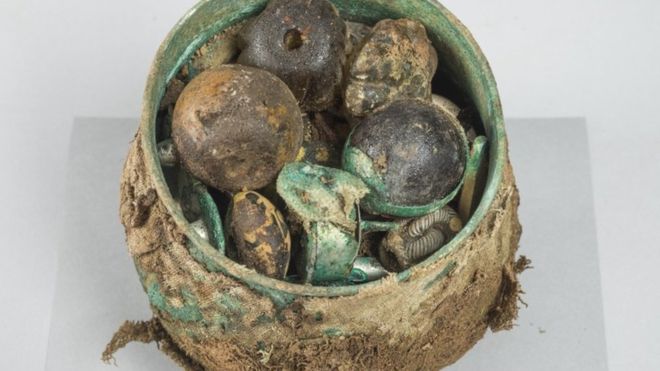
BBC reports that Historic Environment Scotland, Treasure Trove Unit, and the Queen’s and Lord Treasurer’s Remembrance’s conservation team have discovered an ancient Viking pot full of treasure, including six silver Anglo-Saxon disc brooches, a silver brooch from Ireland, Byzantine silk, a gold ingot, and gold and crystal objects wrapped in cloth bundles (read article here). The objects date from the 8th or 9th Century. The article goes on to tell us what the discover cannot tell us, at least without years of further research and theorizing. Stuart Campbell of the Treasure Trove Unit says, “”The complexity of the material in the hoard raises more questions than it answers, and like all the best archaeology, this find doesn’t give any easy answers. Questions about the motivations and cultural identity of the individuals who buried it will occupy scholars and researchers for years to come” (ibid.).
While we do not know whether the owner of this pot was a Christian or was more interested in laying up treasure in heaven, we do know that he (or she) was laying up treasure on this earth. We also know that this treasure did not continue to benefit the owner following his or her demise. The photographs released with the find also show that the objects have been worn and decayed with time. It seems like a fitting illustration of what Jesus taught.
In the Sermon on the Mount, he wrote, “Do not store up for yourselves treasures on earth, where moth and rust destroy, and where thieves break in and steal. But store up for yourselves treasures in heaven, where neither moth nor rust destroys, and where thieves do not break in or steal; for where your treasure is, there your heart will be also” (Mat. 6:19-21). He doesn’t condemn saving or even making money. He does continue to warn that one inevitably chooses God or money as master (Mat. 6:24). This find in Dumfries and Galloway, Scotland, reminds us of the ultimate futility in laying up treasures on the earth. What’s held and hoarded isn’t stored in heaven, but it does reflect what’s in the heart. Later, Paul urges Timothy to teach the need to fix the hope on God rather than riches (1 Tim. 6:17).
It would be great to find out that this was the church treasury of a congregation of God’s people being taken and used to help the poor or preach the gospel or the personal portfolio of a person who put his riches to good use in the kingdom. It’s not statistically probable, but it’s possible. What I do know is that there is a Perfect, Heavenly Accountant who knows what we treasure most. May our legacy be that we “seek first the kingdom of God and His righteousness” (Mat. 6:33).
The book of Proverbs is divided into 31 chapters and 915 verses. So, nearly 1,000, divinely-authored truisms are packed into this one book penned by Solomon and others. In Proverbs 13, the writer begins by talking about what a wise son does, then describes a prudent man, a lazy man, a righteous man, a wick man, a rich man, and a poor man (2-10). Then, in verses 11-13, an alarm is sounded against three deadly behaviors.
A warning is sounded against dishonest wealth (11). “Wealth gained by dishonesty will be diminished, but he who gathers by labor will increase.” Financial scandals, surrounding company presidents and CEOs, often dominate current headlines. Not all swindlers, defrauders, embezzlers, and cheats are found out—in this life (cf. 1 Tim. 5:24). Cheating, lying, misrepresenting, deceiving, and otherwise acting unethically to get gain causes one to forfeit the riches of eternal life (Ti. 3:7). Be careful how you get what you get. “…Attend to your own business and work with your hands…” (1 Th. 4:11; see Rom. 12:17).
A warning is sounded against deferred hope (12). “Hope deferred makes the heart sick, but when the desire comes, it is a tree of life.” This verse is not about choosing instant gratification over delayed gratification. It recognizes a principle played out daily. Look at an elderly person, relatively strong in body but who has “given up hope.” Such do not usually live very long. Consider a couple whose problems so overwhelm them that they surrender in some way to despair. Divorce cannot be too far off in the distance. For the human spirit to thrive, it must have hope. Hope anchors the soul (Heb. 6:19). Paul, oft-imprisoned, oft-persecuted, muses, “If in this life only we have hope in Christ, we are of all men most miserable” (1 Cor. 15:19). What pulls the Christian through his or her troubles? It is the present help of hope. Those who throw it away often say goodbye to their faith, too!
A warning is sounded against despising the word (13). “He who despises the word will be destroyed, but he who fears the commandment will be rewarded.” Few physically take their disgust for God’s will to the point Jehoiakim did, the wicked king who cut out with a penknife the portions of scripture he hated (Jer. 36:23). Not everyone is so bold as their atheist, the satanist, or the pagan in expressing their disdain for the Bible. Yet, everyone who transgresses against it in willful, habitual, and premeditated ways, despises the word. The price for such rebellion is eternal (2 Th. 1:7-9).
Interestingly, these three verses deal with three pitfalls—of deeds, depression, and doctrine. As God’s people, we must guard against the wiles of the devil as he seeks to destroy us. Our souls are at stake. Don’t let him win. Let Christ reign!










 The Preacher Pollard Blog