
FAMILY TOGETHERNESS

Neal Pollard

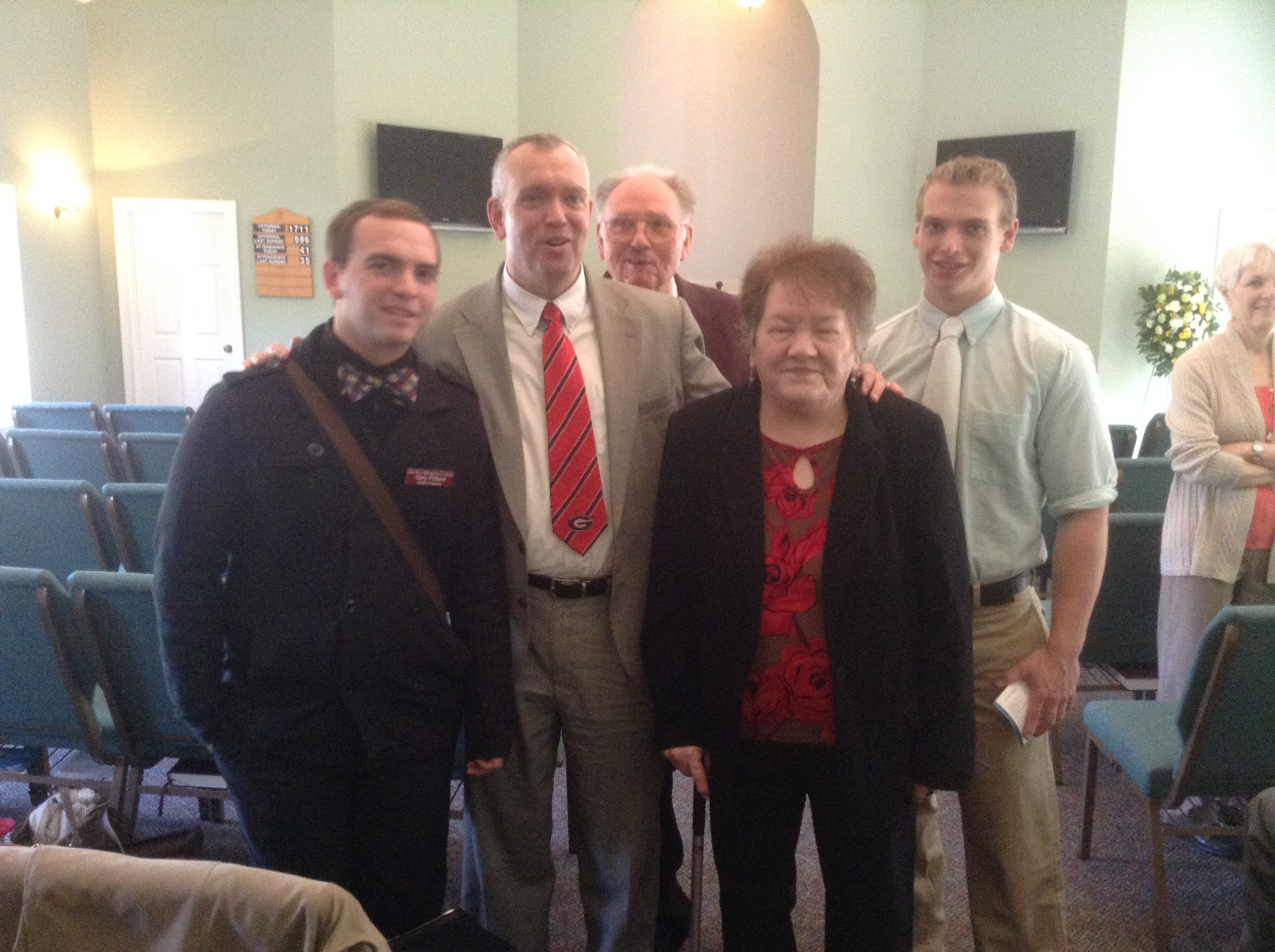
It was a bit ironic to me as a stood up to preach on the subject of family that I had my parents and two of my children sitting and listening.  How rare and wonderful that, normally separated by a couple of time zones and over a thousand miles, we were all able to be together in the same worship service!  It makes me long for heaven, when we can be in the presence of God in eternal adoration of Him and sweet fellowship with one another.  Being together with family is a blessing many of us take for granted and can maybe only fully appreciate when it tends more toward the exception than the rule.

One of the many incredible facets of God’s perfect design for the church is that He made us a family.  Paul depicts us as fathers, mothers, brothers and sisters (Titus 2:1-4).  He refers to it as God’s house (1 Timothy 3:15).  Christ is the bond that brings us together, with all our diversities (skin, background, income, education, etc.), to be a spiritual family.  The best attributes of family—love, acceptance, encouragement, motivation, understanding, heritage, leadership, unity, sympathy, assistance—come together in God’s family.  This is what has always baffled me when I think of brothers and sisters who can stay away from their spiritual family for weeks, months, and years at a time.  Who could sustain us and fill the vacuum caused by earthly life like God’s children, our spiritual siblings?

When you look at the church, you perceive it a certain way.  I’m convinced you are either drawn to it or repelled by it.  You long for her members or loathe them.  Certainly, there are the indifferent, the lukewarm, and those who are essentially unfeeling toward other members. But these are steadily moving toward abandoning their family.  Their hearts have already done so, if their bodies haven’t yet.  The indifferent and hostile may blame the church for their attitude, but we choose our mindset.  God puts us in this family (Acts 2:47), a plan He gave to help us successfully survive this life and obtain eternal life.  It’s a sign of spiritual health to long to be around, grow closer to, and be in love with the church.  Luke records, “And all those who had believed were together…” (Acts 2:44a).  What a beautiful picture!  We get to enjoy the same blessing today.  May we never take it for granted, but relish it.
pollards-in-georgia

“As We Go Our Separate Ways…”

Neal Pollard

I’ve heard this prayed my whole life: “Be with us as we go our separate ways.”  I fully appreciate what is meant, but I lament a trend I’ve seen for many years.  Too often, we go our separate ways until the “next appointed time.”  We have no contact with one another. Instead, the bulk or totality of our contact is with worldly people with ungodly philosophies.  While we need to be among the world to exert salt and light, perhaps we have neglected something else that first century Christians took full advantage of.  Luke describes it this way, saying, “Day by day continuing with one mind in the temple, and breaking bread from house to house, they were taking their meals together with gladness and sincerity of heart” (Acts 2:46).  As he had observed in verse 42, they were continually devoting themselves to fellowship.  This created a close knit community that could not only weather some huge storms of opposition, but it helped them produce an attractive environment that thousands of people wanted to be a part of. Perhaps we discount or even overlook what a vital part of church growth that fellowship and time together had on the early church.

Today, we have our civic activities, our kids’ full slate of responsibilities, our work and overtime, our personal entertainment regimen, and similar time-consuming matters that are not inherently wrong but that can help create a dramatic separation from our spiritual family during the week.  Where is the time allotment for getting together with other Christians during the week?  Have we relegated or resigned ourselves to Sunday morning, Sunday night, and Wednesday night?  Are we losing the art of hospitality, of having spiritual family over to deepen Christian relationships?

Wouldn’t it be wonderful to be able to speak of each other and say that our hearts have “been knit together in love” (Col. 2:2)?  In that same context of the church’s beginning mentioned earlier, Luke adds, “All those who had believed were together and had all things in common” (2:44).  What will happen to the local church that becomes very intentional about this, not just with an exclusive few but in a way that includes new Christians, potential Christians, the otherwise disconnected, and those of different as well as similar demographics? Certainly, it requires time, effort, and even some expense, but what will it yield?  A feeling of connection in the place of separation.