The Christian Decision

Carl Pollard

Our family used to hike a lot when we lived in Colorado. There were many hikes that I went on that were straight up miserable. Ive always been the chunky kid, but the worst part about this was that I  was surrounded by a healthy and very active family.. This meant that on every hike I was the one in the back feeling like I was about to pass away. Hiking was never really something I was the best at. There are several times I remember thinking, “I’m not going to make it.” 

We used to hike a trail called “Moffit Tunnel” It was an 11 mile hike that ended with a summit path that gained 3000 feet of elevation in under half a mile. As you can imagine the path was practically vertical, and filled with rocks, mud, snow, and sadness. 

When I think of “a hard path” this is what comes to my mind. In Matthew 7:13-14, Jesus describes the way to salvation as a path that isn’t for the faint hearted; it’s for the dedicated Christian that is determined to reach eternal life. There’s no denying that the Christian life can be tough. It is filled with persecution, especially for those who aren’t as fortunate to have the freedoms we enjoy in America. The Christian life is tough because we will face persecution, but we are more likely to face rejection in our society today for standing up for some very unpopular teachings. If we are devoted to teaching and standing with God’s Word this means we must defend God’s view on homosexuality, marriage, divorce, and remarriage, baptism, sin, hell, and many more divisive topics. If we are devoted to walking the difficult path we must remain faithful in the rejection, hatred and persecution we will face. 

But the rejection and hate from the world isn’t the only thing hard about this path.

As Christians we are commanded to put ourselves to death. Matt. 10:37-39 say,  “Whoever loves father or mother more than me is not worthy of me, and whoever loves son or daughter more than me is not worthy of me. And whoever does not take his cross and follow me is not worthy of me. Whoever finds his life will lose it, and whoever loses his life for my sake will find it.”

Walking the difficult path means we have put ourselves to death. In doing so we are saying we love Christ more than our parents, our children and ourselves. In order to walk the difficult path we must be willing to take up our cross and follow Jesus. The cross is an instrument of death. The cross we pick up is the instrument of death that we have used to crucify ourselves on. Once we have taken up our cross we have made the decision to love Christ over anyone and everyone. We no longer serve ourselves because we have died to Christ. 

When we choose to walk the difficult path we are no longer living without purpose. We have a goal, a meaning for our lives. God uses us to spread His saving word to others. We have purpose in everything we do. We are here to encourage each other, to save souls, and to glorify God. One of humanity’s most asked question, “Why am I here?,”is answered by God. How we serve God will ultimately change someone else’s eternal destiny. We are given the true words of life that are able to save our most valuable possession, our souls. We also experience the blessing of having confidence in death. Death is scary. Why are so many scared of death? It’s the unknown, the end of our existence as we have known it. As Christians, when we choose to walk the difficult path, we are given the promise that when we face death we can be confident in knowing our soul is in the hands of almighty God. We know what is coming, and we can find hope in this. 

It was a hard climb, but what a payoff!

THE PRISON OF “NOT”

Neal Pollard

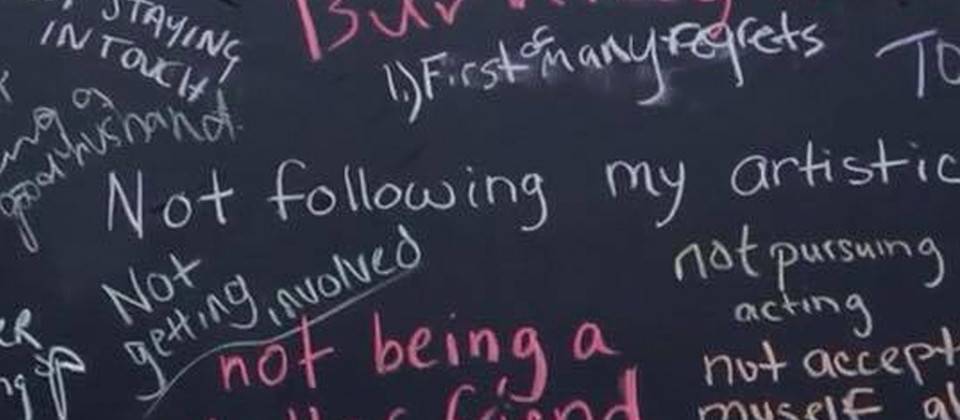
Strayer University shared their video from the day they ran an ingenious experiment in New York City.  They put up a chalkboard on a busy street with this caption written at the top: “Write Your Biggest Regret.”  Scores of people wrote on the chalkboard.  Nearly every answer visible in the video included the word “not.” Interestingly, it was not confessions of sins of commission. Instead, it was about opportunities missed, dreams not pursued, and things they failed to do.

That exercise made me wonder how many are inmates in the prison of “not.”  While Strayer seemed more interested in highlighting regrets that were tied to career, that impacted quality of physical life, and the like, regret reigns in people’s hearts and has dominion over their spiritual and eternal lives, too.  Scripture shows us those challenged with the gospel message who ultimately refused to follow Christ. The rich young ruler was not willing to choose Christ over his stuff (Mat. 19:22). Many of the rulers believed in Him, but they put their stock in the approval of men rather than God (John 12:42-43). Felix trembled at truth, but ultimately turned away (Acts 24:25). His cohort, Agrippa, was nearly there but not quite (Acts 26:28).  Other examples can be found of those who came so far but would go no further.

How many people have been shown the way to eternal life and have acknowledged, to a point, that it is the way they should go? Yet, when push comes to shove, they refuse to leave the cell of self and confine themselves to the chains of a condemning choice. Before Christ, they will see their regrets realized in a rejection that cannot be remedied.

The incredible news is that they keys are in reach of this prison.  It was a running gag in the Andy Griffith show that particularly Barney would leave the keys on the peg of the Mayberry jail where the prisoners could reach the keys and let themselves out. Would you picture our spiritual circumstances this way? The Psalmist praises God for many reasons, including the fact that “the Lord sets the prisoners free” (146:7). In a Messianic passage, Isaiah writes of His mission to “proclaim liberty to captives and freedom to prisoners” (61:1; cf. Luke 4:18; 7:22; Mat. 11:5). He can emancipate lifelong slaves to sin (Heb. 2:15). He has left the keys where we can grab them, but we must want to be free and choose to be free.

This video ends with the participants taking an eraser and removing all the regrets from the board. One of them writes just two words in their place: “Clean slate.”  What an optimistic, hopeful, empowering difference that contrasting concept is. Regret can be replaced with resolve. Do you believe that is possible for your spiritual life? Don’t you think God wants you to experience that exhilarating hope? The proof is there at Golgotha and the sepulcher that could not keep His Son entombed. What He did there can provide you with a clean slate! Take possession of the freedom He came to give you!

Strayer video link: http://aplus.com/s/83d4dc91dee

paxp-deijewhat-is-your-biggest-regret-strayer-university-chalkboard-video-new-york-city-960x420

THE POLLS ARE OPEN

Neal Pollard

All over the nation, poll levers are being pulled, votes cast, and the office of many political positions is in the process of being filled by the winning candidate. People in this place of democracy are, at this moment, helping to decide the political fate of individuals vying for a place of public leadership. Those elected may or may not be persons of worth and integrity. Their careers may be starting, extending, or ending, depending on the majority’s say. They may gain or lose a place of authority based on their political, international, domestic, economic, and social philosophies. After all, public officials are always vulnerable to the fickle feelings of the voter.

Everywhere in the world at every moment, everyone is casting a vote of a different nature. Only one figurative ballot is used in this worldwide decision. Only two choices appear on the ballot. The issues are paramount in importance. This vote is not cast secretly behind a curtain, either. Many times, a righteous minority may be caused to suffer because of the foolish “majority vote” (cf. Proverbs 14:34). When all of life is over, the voting record of every individual will be made public. In fact, all people of all nations for all time will know which choice every individual elected to make in his life. And yet, with this poll, one can change his vote as long as life and opportunity are his.

Does the Kingdom take PRIMARY importance in your life? In Matthew 6:33, Jesus says, “But seek ye first the kingdom of God, and his righteousness; and all these things shall be added unto you” (Mat. 6:33). The head of this kingdom is Christ “and he is the head of the body, the church; who is the beginning, the firstborn from the dead; that in all things he might have the preeminence” (Col. 1:18, emp. NP). God demands first place. We must love Him more than anyone or anything else (Lk. 10:27). Whatever keeps us from attending the worship assembly, from actively seeking the lost, and from modeling true Christianity before the world, takes priority over serving and obeying God in His Kingdom.

Are you casting the VOTE of your life for or against Jehovah? All Israel stood before Joshua to decide to whom their life belonged. In Joshua 24:15, Joshua had said “God or gods.” “And the people answered and said, God forbid that we should forsake the Lord, to serve other gods; For the Lord our God, he it is that brought up and our fathers out of the land of Egypt, from the house of bondage, and which did those great signs in our sight, and preserved us in all the way wherein we went, and among all the people through whom we passed: And the Lord drave out from before us all the people, even the Amorites which dwelt in the land: therefore will we also serve the Lord: for he is our God” (Josh. 24:16-18). The people of God cast their vote out of appreciation, for they remembered the deliverance of God. The people of God cast their vote out of attention, for they recognized the power of God. The people of God cast their vote out of alarm, for they revered the justice of God. The people of God cast their vote out of aversion, for they rejected the enemies of God. Joshua reminded them that God would go with them only as long as they went with God. Because God is a jealous God who wants first place in our lives, He expects the import of our lives to reflect our submission and trust in His way.

Does King Jesus REIGN in your heart? The promise of Christ’s coming included the announcement of Gabriel, who said, “And he shall reign over the house of Jacob for ever; and of his kingdom there shall be no end” (Lk. 1:33; cf. Dan. 2:44). The “throne of the heart” is often mentioned in figurative language. All of us place something there. We place our accumulation before that throne (Matt. 6:21), our affections around that throne (Col. 3:1; Rom. 12:2), and our allegiance before that throne (Jas. 4:4; 1 Jn. 2:15-17). Is Jesus “a resident” in the “castle” of your heart? If so, is He King or peasant to you? The Bible calls Jesus “the King of the ages” (1 Tim. 1:17), “The blessed and only Sovereign, the King of kings…” (1 Tim. 6:15), and “KING OF KINGS AND LORD OF LORDS” (Rev. 19:16). How much greater than the mere prince of the power of the air (Eph. 2:2) is our Almighty King Jesus!

God created every person with the ability to freely choose. He will not rule us dictatorially (tyrannically). He leaves the power of choice in our hand. Yet, we must choose carefully. The decision we make has eternal consequences. King Jesus says, “He who rejects Me, and does not receive My sayings, has one who judges him; the word I spoke is what will judge him at the last day. For I did not speak on My own initiative, but the Father Himself who sent Me has given Me commandment, what to say, and what to speak. And I know that His commandment is eternal life; therefore the things I speak, I speak just as the Father has told Me” (Jn. 12:48-50). Whether we elect Him King of our lives or not, He has been appointed by God to judge us on an appointed day. The polls are open. Will you choose Christ and His law?

size0