

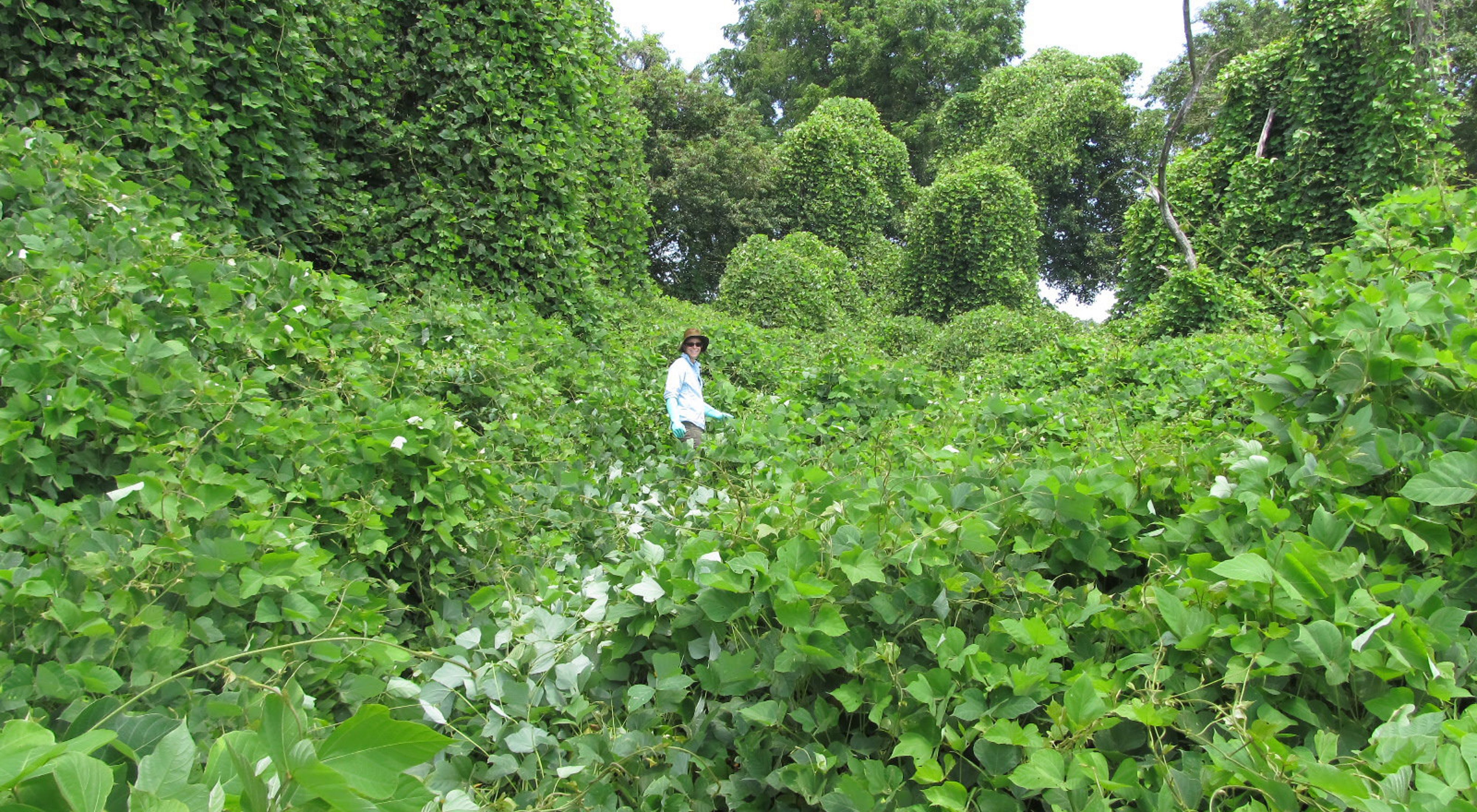
I found an old commercial promoting kudzu for groundcover while researching my family’s history on Newspapers.com, an Ancestry.com extension. Given the plant’s current status as an invasive species plaguing the southeastern United States, this revelation made me laugh. This year, particularly, has seen a remarkable increase in the kudzu crop.
Looking through historical documents, I discovered that kudzu first appeared on American soil in 1876 during the Centennial International Exhibition. This exotic vine proudly displayed in the Japanese pavilion at the World’s Fair in Philadelphia, captivated spectators so much that it was quickly renamed the “Jack and the Beanstalk vine.”
Early twentieth-century newspapers like The Boston Globe recommended kudzu for backyard gardeners, praising its rapid growth, pleasant aroma, and low maintenance requirements. By the 1950s, however, the federal government was forced to acknowledge the drawbacks of kudzu’s rampant spread, a species they had promoted for decades for erosion control. The USDA designated kudzu as a weed in 1970 and was redesignated as a “noxious weed” in 1997.
This story of kudzu—initially celebrated, then reviled—resembles the Parable of the Mustard Seed, which appears in Matthew 13.31–32, Mark 4.30–32, and Luke 13.18–19. Jesus uses The mustard seed in this parable to demonstrate the profound potential that can emerge from humble beginnings.
In the parable, Jesus compares the Kingdom of Heaven, God’s divine rule, to a mustard seed. Though it is the smallest of all seeds, when planted, it grows into the largest of garden plants, even becoming a tree. This tree then becomes a haven for birds, providing shade and a place for them to nest in its branches.
The mustard seed’s growth, from small to great, signifies how God’s kingdom begins as a tiny seed in our hearts and develops into a powerful influence. Similarly, kudzu started as a tiny seed in the United States and grew into a major ecological force. Instead of providing a haven, it became an uncontrollable pest, engulfing large areas of the southern United States.
So, what can we learn from the Parable of the Mustard Seed and the story of kudzu? Both teach us about the potential consequences of small beginnings and remind us to consider the possible long-term impact of our actions. We have the free will to choose our efforts. Let’s aim to plant excellent seeds that enrich our environment through activities that align with the divine and benefit the world (as taught in Luke 8.11).
…

 The Preacher Pollard Blog