

The Kingdom Is Here Today

Brent Pollard

The author of Hebrews uses the example of the Melchizedekian priesthood to establish the priesthood of Christ. Jesus belonged to the tribe of Judah, which Moses did not mention regarding the earthly priesthood. Therefore, there was a need for a covenant change to allow a non-Levite to serve as a priest. The writer of Hebrews spends chapters eight and nine explaining how the New Testament replaced the Old Testament in line with prophecy (see Jeremiah 31.3–14). In summary, the Holy Spirit confirmed that it was God’s will for Jesus to be a priest, but since He could not serve as a priest on earth because of Moses’ Law, Jesus instituted the New Testament so that He could be our High Priest in heaven.

Some believe that Jesus will reign as King from David’s throne in a future Jerusalem-based kingdom. However, there is an obstacle preventing Jesus from doing so on earth. God cut off David’s seed from sitting on David’s throne, as mentioned in Jeremiah 22:30, making it impossible for any of Jeconiah’s (or Jehoiakim’s) descendants to reign in Judah. This fact is relevant because Jeconiah was an ancestor of Joseph, Jesus’s foster father. Matthew traces Jesus’s legal lineage through Joseph in Matthew 1:12. Since Jesus is a descendant of Jeconiah, he cannot reign as an earthly king even though it was God’s will for Christ to be King. If God had not taken away the right of Jeconiah’s descendants to reign in Judah, Jesus could have certainly been an earthly king.

So, how is Christ a king? Jesus promised to establish a kingdom (Matthew 16:18–19). When Pilate pressed him, Jesus admitted to being a king (John 18.37). However, consider how Jesus qualified the nature of His kingdom in John 18.36. “My kingdom is not of this world. If My kingdom were of this world, then My servants would be fighting so that I would not be handed over to the Jews; but as it is, My kingdom is not of this realm” (NASB 1995). This truth means that Christ’s kingship is spiritual rather than earthly, as is His priesthood. It is worth noting that Jesus also accomplished this through His New Testament.

Many people misunderstand the truth and think that the apocalyptic language of a millennial kingdom in Revelation 20.6 refers to a future earthly kingdom that Christ will rule in Jerusalem. This misunderstanding is because they do not understand the interchangeability of the terms “kingdom” and “church” in Matthew 16.18–19. The word “church” is a Latin loanword that does not appear in the Bible. The actual word for church is “assembly.” Thus, the church represents the people. The word for “kingdom” is “basileia,” which means a kingdom or realm over which a king has sovereign authority. Therefore, God’s will was for Christ to choose a group of people from all over the world willing to submit to his authority.

According to the Book of Daniel, God showed King Nebuchadnezzar a prophetic dream about the future (see Daniel 2). In the dream, a cut stone struck a large image at its feet, causing the entire image to shatter and signifying the end of all worldly authority. Different materials comprised the image’s body parts, representing different empires. Babylon was the head of gold, Persia was the chest and arms of silver, Greece was the belly and thighs of bronze, and Rome was the legs of iron and feet of iron and clay. The feet mingled with clay represented the internal weakness of Rome. Commentators are familiar with this dream’s timeline. However, some believe that the Kingdom of God, symbolized by the cut stone, is yet to appear. However, according to Daniel, the kingdom emerged during the reign of the Roman emperors, referred to as “those kings.”

Jesus said, “Truly I say to you, there are some of those who are standing here who will not taste death until they see the kingdom of God after it has come with power” (Mark 9.1 NASB 1995). For those who refuse to believe that Jesus established His kingdom as He intended, there must be more than one person of advanced years who can prove they are older than two millennia! We understand that the power to which Jesus referred was the Holy Spirit, who descended on the apostles on the day of Pentecost, around 33 AD (Acts 2.4). As a result, Jesus reigns as King today and will continue to do so until His return. Following His return, Jesus will hand over His authority to the Father and the redeemed from all ages (1 Corinthians 15.24).

Combining biblical texts and prophecies creates a deep understanding of Jesus Christ’s position as King and High Priest, which goes beyond worldly limitations. Jesus fulfills the roles God has designated for Him, not as a political leader or a member of the old priesthood, but in a heavenly and everlasting sense through the New Testament and His heavenly kingdom. This understanding challenges traditional beliefs about a future earthly kingdom, instead emphasizing Christ’s spiritual reign, which began during His ministry and continues today. As Christians, we have the honor of living in this heavenly kingdom that Christ, our eternal King and High Priest, rules over in a merciful and benevolent manner. Recognizing this broadens our spiritual understanding and strengthens our faith in the eternal truth of God’s word and His ultimate plan for redemption.
Genesis: These Are The Generations (XV)

War And (The King Of) Peace (14:1-24)

Neal Pollard

Genesis 14 is more than a Sunday morning Scripture-reader’s nightmare (though the first ten verses would intimate the most golden-tongued!). We are introduced to an obscure, enigmatic character whom David and the writer of Hebrews will compare to Christ. However, what is the background of this King of Salem and his important encounter with Abram?

There is a local war around the Salt Sea, “four kings against five” (9). The cause of the conflict is the rebellion of the kings of the valley (Sodom, Gomorrah, Admah, Zeboiim, and Bela) against Chedorlaomer, who had conquered all the nations in the region–the Rephaim, the Zuzim, the Emim, the Horites, the Amalekites, and the Amorites (4-7). The confederation of the valley kings “arrayed for battle against” Chedorlaomer and his allies (1) “in the valley of Siddim” (8). The kings of Sodom and Gomorrah, Bera and Birsha, died in the tarpits of Siddim as they fled from the invaders’ army, and the rest of the army of the five kings fled to the hill country (10).

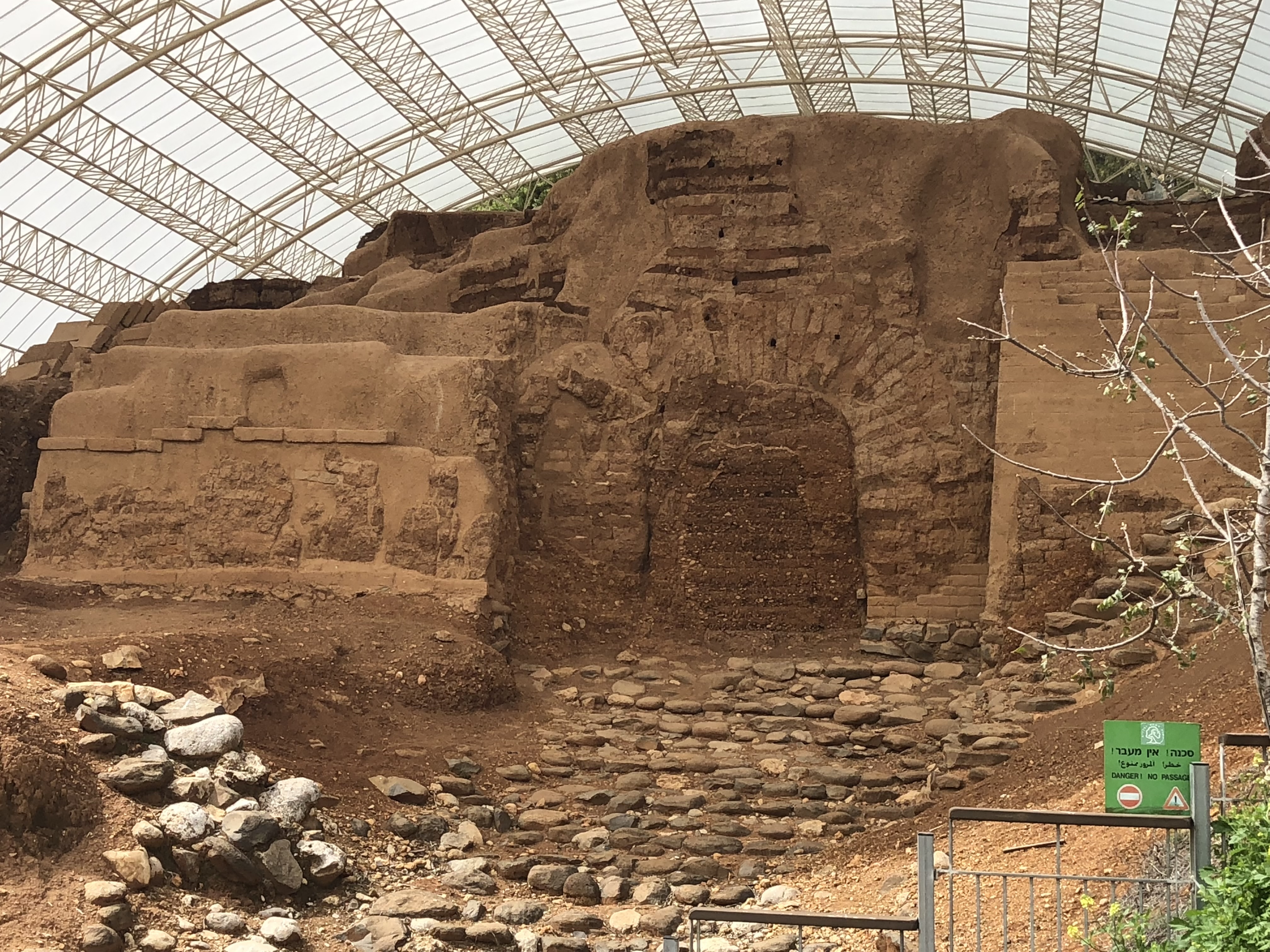
Chedorlaomer and his allies plunder all the goods of Sodom and Gomorrah and take Lot, the women, and the people of his house along with his possessions (11-12,16). An escapee tells Abram what happens, and the patriarch musters his allies and his own personal army to get his nephew and his house back safely (13-15). He has a battle plan, dividing his forces and attacking at night, and they defeat the invader in what is modern-day Syria (15-16). On multiple occasions, I have visited the ruins at Dan and have seen the so-called “Abraham Gate.” It dates back at least as far as Abraham’s day, almost 2000 years before Christ. 

(My photo of the “Abraham Gate,” March 2018)

After rescuing Lot and his house and goods, Abram is met by a priest named Melchizedek (18). The Holy Spirit, through the author of Hebrews, uses Genesis 14:17-20 and Psalm 119:4, and this one incident with Abraham to drive home an incredibly powerful point. Jesus is a High Priest, not like the Levites who descended from Aaron, but like this obscure figure, Melchizedek. 

The Bible uses a literary device called an antitype. “From the Greek antitupos, which occurs in Heb. 9:24 and 1 Pet. 3:21, where the AV translates it ‘figure.’ An antitype is the substance of which a type is the shadow, or the fulfilment of that which the type foreshadowed” (Cairns, Alan. Dictionary of Theological Terms 2002: 33). The antitype is always the greater; the type is always lesser and represents in some way the greater. So, Melchizedek is a type of Christ. He himself was greater than the Levitical priesthood in the ways we read in Hebrews 7, but the specific attributes we read about Melchizedek in this chapter are more fully and greatly found in Jesus.

What are the specific types? 

  • His position (18; Heb. 7:1). He is the king and priest of the Most High God. As king, he is king of righteousness and king of peace (2). 
  • His preeminence (20; Heb. 7:2,4-5). Abraham paid tithes to Melchizedek, signifying the greater prominence of the priest over the patriarch.
  • His perpetuity (Psa. 110:4; Heb. 7:3). “Without father, without mother, without genealogy, having neither beginning of days nor end of life, but made like the Son of God, he remains a priest perpetually.” None of Melchizedek’s ancestors or descendants filled this role, so in that way “he remains a priest perpetually.”
  • His purpose (19; Heb. 7:6-7). Melchizedek blessed the one who had the promises, an indication of his greater position and authority.
  • His precursory place (Heb. 7:8-11). Melchizedek lived many generations before Aaron, through whom the Levitical priesthood descended. Aaron was still in “Abraham’s loins,” meaning that Abraham did not have children yet. Much later, he would sire Isaac, who beget Jacob, etc., until finally Aaron was born through this genealogy.

In the way that Melchizedek served as greater than Levi, Jesus more fully and greatly serves as greater than Levi. If it were a math problem, we would say Levi < Melchizedek < Christ. Obviously, then, Levi < Christ. The writer of Hebrews, in chapter seven, draws some conclusions about this type of Christ. Because Christ is the antitype of Melchizedek,

  • It makes sense that perfection comes from His priesthood rather than the Levitical priesthood of Judaism (11).
  • There needed to be a change of laws (from Moses’ to Christ’s)(12).
  • It is right that this greater High Priest comes from a different tribe in which none had or could have served as priest (13-14).
  • Christ serves as priest “not on the basis of a law of physical requirement, but according to the power of an indestructible life” (15-17).
  • He sets aside the old law and brings in a better hope (18-19).
  • He was appointed High Priest by means of the oath of God (20-21).
  • He has become the guarantee of a better covenant (22). 
  • He does not die, but continues forever as High Priest (23-24).
  • He is able to save forever those who draw near to God through Him (25-28). 

It is this last truth, concerning His salvation, where the author draws out several incredible points for our consideration. It is the crescendo of his “Melchizedek argument.” His work is unparalleled–He always makes intercession for us (25). His character is unparalleled–He is holy, innocent, undefiled, separated from sinners and exalted above the heavens (26). His sacrifice and offering is perfect (27). His oath is unparalleled–He is a Son, made perfect forever (28).

Of all the ways the writer establishes the superiority of Christ over all rivals, this one is the most interesting to me. It shows the masterful way God weaves events and Scripture together. The writer of Hebrews is making the point that the Levitical priesthood has been replaced by something better. Why would you exchange the superior for the inferior? 

After this encounter, which seems relatively insignificant until David and the writer of Hebrews later expound upon it, Abram refuses to enrich himself by the unsavory people of Sodom. The new King of Sodom only wants the people, but offers Abram to keep all the returned spoils from Chadorlaomer. Abram will have no part in that, taking only provisions necessary for the completed battle. Abram will continue to rely on God’s promises to take care of his needs, and he parts company with the king of this wicked domain. 

(Picture taken on March 10, 2018, running at the Dead Sea with Keith Kasarjian)