

The Split Rock Of Horeb

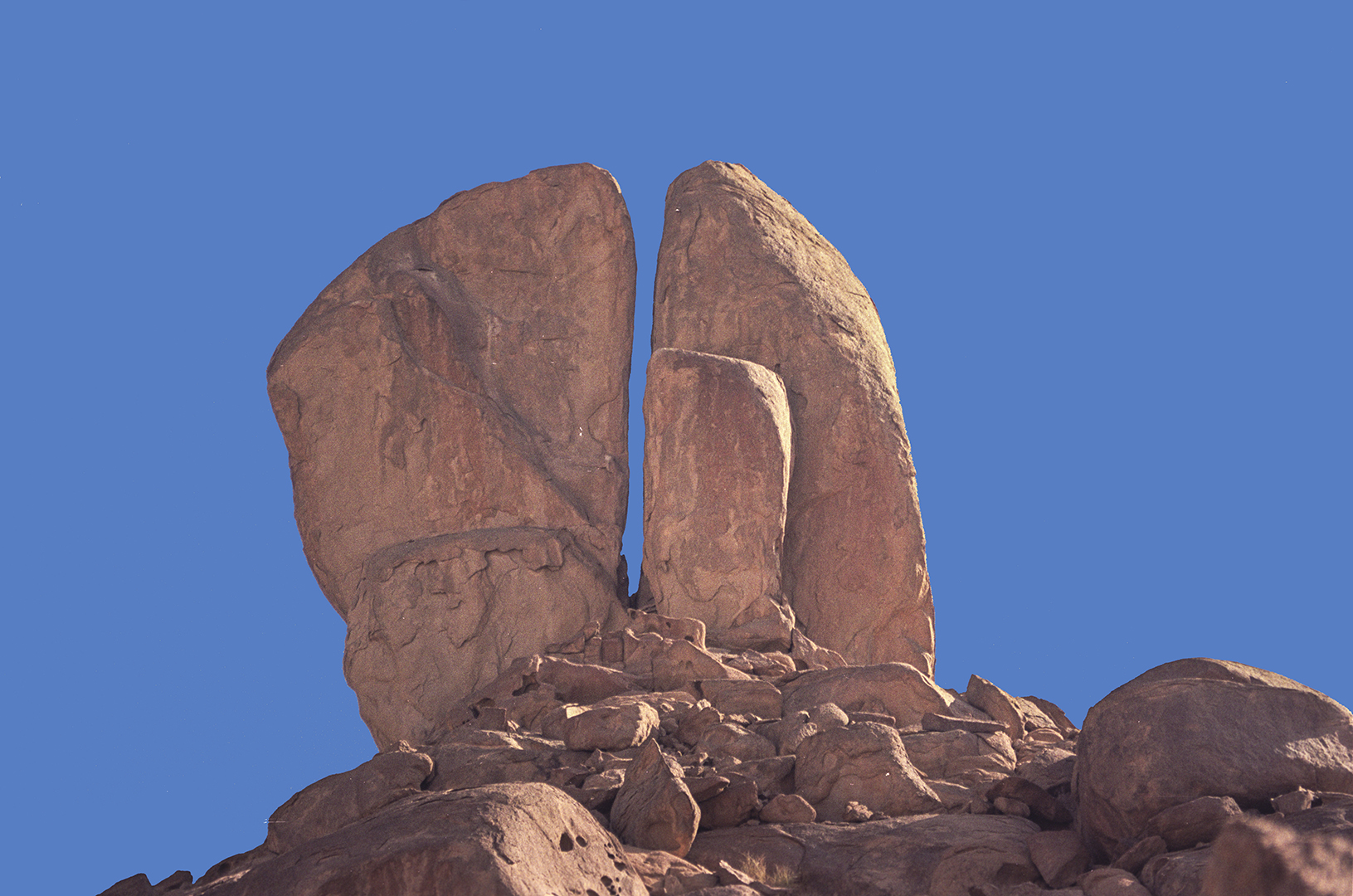
Rising stark and solemn from the barren Saudi wilderness, the Split Rock of Horeb stands like a silent sentinel of ancient power. Towering nearly 60 feet high, the colossal granite monolith looms over the desolate plain, its weathered and tan flanks are etched by wind and time. But what sets it apart, what seizes the imagination…

Dale Pollard

 —————————————————

It’s not just a rock. 

It’s a rock surrounded by empty silence and scorched earth. It appears, not as a mere geological feature, but a thunderstruck altar where the desert drank. A place where a miracle met stone. 

Rising stark and solemn from the barren Saudi wilderness, the Split Rock of Horeb stands like a silent sentinel of ancient power. Towering nearly 60 feet high, the colossal granite monolith looms over the desolate plain, its weathered and tan flanks are etched by wind and time. But what sets it apart, what seizes the imagination—is the cleft. A prodigious vertical split that is so unnaturally straight it’s as though it were torn by an invisible hand. 

The two halves, still joined at the base, are separated by a gap so wide a man could walk between them. Where is the magic sword from heaven that must have struck it so cleanly? 

At its base, the rock bears smooth channels and grooves—as if torrents of water once burst forth, carving trails into the stone that in wild obedience submit itself to divine command. Light filters through the divide, casting shadows that whisper about that day even to this day.

Yes, the rock still stands. 

Despite centuries of exposure to harsh desert winds, sand, and temperature extremes, the massive split rock remains tall and intact. It has an imposing presence, seemingly sliced vertically in a way that defies typical erosion patterns. The site receives occasional attention, but not too much and rarely up close. 

It’s in a remote, restricted area which is often under military control, and access has historically been limited or even outright prohibited by Saudi powers. 

NO TRESPASSING?

Many of the widely circulated photos and videos of the rock come from unauthorized expeditions, but here’s a couple  stand outs (Ron Wyatt won’t get any attention here). 

Jim and Penny Caldwell
 (1992) 

They were just the average American oil workers living in Saudi Arabia, but with a neat twist.

On numerous occasions they took considerable personal risk by sneaking into restricted areas to document the rock and other sites, including:

  • The Split Rock 
  • The blackened peak of Sinai 
  • Altar-like structures and petroglyphs of bulls (linked to the golden calf story)

Oh, and they had to smuggle all  pictures and footage out of the country. 

Bob Cornuke 

(Late 1990s-Early 2000s)

He was just your average former police investigator, but with a neat twist! 

He collaborated with the Caldwells and visited the site to gather photographic and testimonial evidence. His trips were perfectly reasonable, just slightly (ok, entirely) unauthorized and clandestine.

Other explorers have faced interrogation, arrest, or deportation by Saudi authorities and the government has since built a fence around Split Rock. Access is now heavily restricted or off-limits to the public. 

                      ————————-//————————

Bonus Neat 

Local Bedouins have called it the “Rock of Moses” for generations and their oral traditions speak of how water once flowed from it. Some Bedouins avoid the site entirely. 

Bread Facts 

“And the LORD said to Moses, ‘Pass on before the people, taking with you some of the elders of Israel, and take in your hand the staff with which you struck the Nile, and go.

I will stand before you there on the rock at Horeb, and you shall strike the rock, and water will come out of it, and the people will drink.’ And Moses did this in the sight of the elders of Israel.”

Exodus 17:6-7 

(see also, Numbers 20:1–13) 

God’s Solutions For Our Problems

Tuesday’s Column: Dale Mail

blond man with goatee smiling at camera with blazer on
Dale Pollard

It’s been said that the there are more stars in the known universe than all of the sand on earth combined. That being said, in just one grain of sand there are more atoms than all of the stars. That’s pretty amazing. Our planet is but a speck in the grandeur of space. Countless stars, planets, galaxies, lightyears and somehow God is well aware of the happenings of people. Have you stood on the mountain tops? Have you observed the power of the oceans as the waves crash on the shore? Has your heart almost stopped after the vibrating sensation of a thunder clap resonates in your chest? The might of the Creator is everywhere in the world around us and at times it just demands to be noticed. 
A section of scripture that is mysterious and fascinating is found in 1 Kings 19:11-13. The Lord of hosts is about to show Himself to a depressed and exhausted Elijah, but in a way that he would never forget. “The Lord said, ‘go out on the mountain in the presence of the Lord, for the Lord is about to pass by.’ Then a great and powerful wind tore the mountains apart and shattered the rocks before the Lord, but the Lord was not in the wind. After the wind there was an earthquake, but the Lord was not in the earthquake. After the earthquake came a fire, but the Lord was not in the fire. And after the fire came a gentle whisper. When Elijah heard it, he pulled his cloak over his face and went out to stand at the mouth of the cave. Then the voice said, ‘what are you doing here Elijah?’” In the solitude of Horeb, Elijah seeks to avoid the troubles of his world. 
The acoustics of the mountainous area along with the time spent in silence must have made the shattering rocks, raging fire, splitting hills, and rumbling earth all but deafening and definitely a terrifying display of divine power. Then in sharp contrast, a still whisper comes. This gentleness, no doubt, is the reason Elijah decides to cautiously emerge from his hiding place. God is teaching His worn-out servant a lesson that holds true for us today. The fact is, there is no more God, His wisdom, power, and presence in an earthquake than there is in the sweet breath of a blooming flower. The quiet ticking of a wrist watch reveals just as much intelligence and purpose as does the striking of a clock tower’s bell. 
One may walk out into an open field at night and stare up into the vast sky, lit up with numerous twinkling stars and declare, “I’ve found God!” But God is no more in the sky than He is in the blades of grass flattened beneath your feet. The question came to Elijah from that still voice, “What are you doing here?” To the prophet, his problems were too great and too large and his solution was to run and hide. God, in a magnificent way, is trying to remind Elijah of his place.
 Our place in life is not to take matters into our own hands or solve life’s many difficulties on our own. The answer is not to run away, but to walk humbly with our awesome God. He is strong enough to lift our burdens, wise enough to counsel us, patient enough to allow us to learn, and loving enough to constantly forgive.