This week’s question is, “Should we always follow the rules, even if doing so causes someone harm?”
What kind of rules? We often hear something like, “We are a nation of laws.” Yes we are — best estimates put the number of our laws and regulations in the hundreds of thousands. Some have even claimed that the average American unknowingly commits a small number of felonies every day. Not all laws/rules are created equal. Some are important (ie. to prevent serious abuse and exploitation of the vulnerable), most are totally arbitrary.
The Pharisees did the same thing with God’s law. By the time Judaism was in full swing, there were around 613 laws. But rabbis were dissatisfied with how vague some of the commands were, so rather than leaving those to a person’s conscience or common sense, they eventually produced the Mishnah and Gemara. These were commentaries on The Law that “clarified” how those 613 commands were to be followed. Those opinions were enforced as law, which infuriated Jesus on several occasions. The rabbis had made faithful Judaism functionally impossible.
So the short answer is, “What’s the rule your conscience is wrestling with?” If following the rule in question would cause you to violate love for God or love for your neighbor, that’s a legitimate reason to not follow the rule.
We do have to remember that Romans 13 and I Peter 2.13ff and Titus 3.1-2 tell us to obey the laws and rules our governments put on us. The governments those early Christians had to obey were just as corrupt as our own today. If there was any confusion, Peter clarified with “Obey everyone who has authority over you in this world” (I Pt 2.13). He does use παση, which means “all” or “every”.
I don’t like reading stuff like that. We’re supposed to be a country built on English common law tradition, with protections against government abuse explicitly listed in the Bill of Rights and in precedents from hundreds of legal cases. But this current world is not my home, and I’m more afraid of God than I am distrustful of the powers that be. The Bible doesn’t say, “Snitch on friends and family when they violate the law.” But it does say that we have to obey all governing authorities from the top down.
So do we always have to follow the rules, even if doing so causes harm to others? Yes and no — remember that loving God and loving your fellow man are the most important laws. Be willing to sacrifice self rather than cause undeserved harm to others. But any law/rule that doesn’t conflict with those two must always be followed, regardless of the consequences.
The Paradox of Freedom in America’s Founding and Faith
Brent Pollard
Every year on July 4th, Americans come together to commemorate their liberation from the rule of Great Britain. However, though we praise the Declaration of Independence for emphasizing self-reliance, it can also be seen as a testament to the deep reliance on a Creator God.
Reflect upon the opening line, “When in the Course of human events.” This statement establishes a benchmark that surpasses the power of any leader. It implies the existence of a higher law, a natural law, originating from a divine source.
This fundamental document declares that some rights are “self-evident,” i.e., they are part of the human condition and not something a king or queen can grant. This fact suggests that these rights come from a source beyond the control of any human government.
The famous passage “endowed by their Creator with certain unalienable Rights” clearly recognizes the divine source of these fundamental rights. They are not merely gifts from rulers; a higher power has bestowed them upon us.
The second paragraph concludes by appealing to the “Supreme Judge of the world” and recognizing the significance of considering others’ perspectives. This reverence for humanity’s perspective is rooted in a collective faith in a superior ethical framework.
The revolution is fully justified because the king broke the sacred laws governing nature and the divine. The colonists were not rebelling against a rightful authority but rather against a ruler who violated the sacred law.
This perspective highlights the importance of relying on a higher power in various significant ways:
• Origin of Rights: Our rights are not self-derived but instead bestowed upon us by a higher power, implying that we must preserve and protect them.
• Limits of Government: The government aims to safeguard these inherent rights rather than diminish them.
• Emphasizing Accountability: A higher law applies to rulers and the ruled, fostering a more just society.
These concepts shouldn’t surprise anyone familiar with how people express their dependence on God in the Scriptures. Also, God’s word reminds Christians that God has given them freedom; it also guides them by principles of lawfulness and expediency, which prevent them from indulging in their desires without restraint (e.g., 1 Corinthians 10.23).
As we approach our conclusion, we want to highlight various statements from the Bible that show our dependence on God. These scriptures highlight different aspects of our reliance on God, including our need for His guidance, power, wisdom, protection, and existence. They stress the limits of human understanding and ability, contrasting them with God’s all-knowing and all-powerful nature.
Jeremiah 10.23: “I know, O Lord, that a man’s way is not in himself, nor is it in a man who walks to direct his steps.” (NASB95)
This verse acknowledges that humans lack ultimate control over their lives and require God’s guidance.
Acts 17.28: “For in Him we live and move and exist, as even some of your own poets have said, ‘For we also are His children.’” (NASB95)
Paul underscores that we are entirely dependent on God for our very existence.
John 15.5: “I am the vine, you are the branches; he who abides in Me and I in him, he bears much fruit, for apart from Me you can do nothing.” (NASB95)
Jesus employs a metaphor to vividly demonstrate how we rely entirely on Him for spiritual productivity.
Proverbs 3.5-6: “Trust in the Lord with all your heart and do not lean on your own understanding. In all your ways acknowledge Him, and He will make your paths straight.” (NASB95)
This passage encourages reliance on God’s wisdom rather than our limited understanding.
Psalm 127:1: “Unless the Lord builds the house, they labor in vain who build it; unless the Lord guards the city, the watchman keeps awake in vain.” (NASB95)
This verse powerfully underscores the uselessness of human endeavors without God’s participation.
Philippians 4.13: “I can do all things through Him who strengthens me.” (NASB95)
Paul admits that his capability to deal with his economic circumstances originates from God, not himself.
2 Corinthians 3:5: “Not that we are adequate in ourselves to consider anything as coming from ourselves, but our adequacy is from God.” (NASB95)
Paul reiterates that all our abilities come from God, not within ourselves.
James 4.13-15: “Come now, you who say, “Today or tomorrow we will go to such and such a city, and spend a year there and engage in business and make a profit.” Yet you do not know what your life will be like tomorrow. You are just a vapor that appears for a little while and then vanishes away. Instead, you ought to say, “If the Lord wills, we will live and also do this or that.” (NASB95)
This passage highlights our inability to control the future and our need to submit to God’s will.
Psalm 46.1: “God is our refuge and strength, a very present help in trouble.” (NASB95)
This verse vividly depicts God as our ultimate source of protection and strength, particularly in challenging times.
Isaiah 41.10: “Do not fear, for I am with you; do not anxiously look about you, for I am your God. I will strengthen you, surely I will help you, surely I will uphold you with My righteous right hand.” (NASB95)
God assures us of His presence, strength, and support, indicating our essential need for these divine provisions.
The principles of independence remind us of a profound paradox: our reliance on a higher authority closely connects us to true freedom. The Declaration of Independence acknowledges our freedom from earthly rule and dependence on divine providence. We find this sentiment throughout Scripture, continually reminding us of our reliance on God for guidance, strength, and even our existence. As we celebrate our national independence, let’s also embrace the humility and wisdom that comes from recognizing our ultimate dependence on the Creator. In doing so, we honor the enduring principles that have guided our nation since its beginning and continue to shape our understanding of freedom and equality.
Hopefully, those within the United States enjoyed a safe and joyous Thanksgiving holiday yesterday. Thanksgiving is one of those holidays that has come under attack by secular humanist forces in recent years. Worse than merely shifting the focus to turkey and American football, some people are trying to attack the holiday based on injustices perpetrated against the American Indian population over a century ago. While true that the “Thanksgiving feast” in seventeenth-century Plymouth serves as a romantic backdrop to our current holiday, we should not forget that days of giving thanks is not limited to one group or one time.
Many countries observe some Thanksgiving holiday today. These observances are typically about the giving of thanks for the bounty of the harvest. They may reflect a pagan rather than Christian influence. However, to single out the United States’ practice as a matter of perpetuating injustice is a move by those seeking to erase American history with its Judeo-Christian values. The removal of said Judeo-Christian values are necessary to create the secular humanistic state esteemed by the disciples of Karl Marx. It is not an exaggeration to say we are in the midst of a great cultural war here within the United States. The winner of this cultural war will determine whether the United States continues to be free or becomes despotic. I realize that may sound like hyperbole on my part. Still, the Founding Fathers were clear in emphasizing that only religious people could maintain the liberties enshrined within the Constitution.
Thus, we find the American Thanksgiving holiday’s actual genesis in 1789, the year of the United States Constitution’s ratification. President George Washington wrote that Congress had tasked him to declare a day of Thanksgiving. The purpose of this day was to thank God for blessing the newly-formed United States with peace and prosperity. A cursory examination of all of the Presidential Thanksgiving Proclamations demonstrates the common theme of acknowledging and thanking Providence. Many Presidents likewise include an exhortation to remember the less fortunate and spend the day in service to others. President John Adams approached it differently. He asked people to fast on Thanksgiving and include with their prayers those of penitence, acknowledging national sins. How novel!
Thomas Jefferson balked at the idea of making Thanksgiving Proclamations. He thought it smacked too much of enjoining the populace to some State religion. I believe Jefferson was mistaken, but it should help you understand that this holiday has been one long conceived as religious in tone. After Jefferson’s successor, Madison, the practice of the President giving a Thanksgiving Proclamation fell by the wayside until the Civil War. At the behest of Secretary Seward and a private citizen, Sara Josepha Hale, Lincoln reinstated the practice of issuing Thanksgiving Proclamations. Essentially, Lincoln helped make Thanksgiving an annual observance. It would not be until 1941, though, that the federal government made Thanksgiving an official holiday. Except for President Garfield, who died from an assassin’s bullet, every President since Lincoln has issued a Thanksgiving Proclamation, regardless of party affiliation.
The beloved Norman Rockwell contributed to the iconic depiction of Thanksgiving with his painting “The Freedom from Want” in 1943. (It was a part of Rockwell’s “Four Freedoms” series.) A patriarch and matriarch stand at the head of the table around which the family has gathered. The matriarch has prepared a sumptuous turkey feast. Delight fills the faces of all assembled. For me, however, the best Rockwell depiction of Thanksgiving was the last Thanksgiving cover he would paint for The Saturday Evening Post in 1951. He entitled that painting “Saying Grace.” A “grandmother” and a little boy sits in a restaurant. Their heads are bowed in prayer as others look on. The looks given by their tablemates seem to show amusement or curiosity. (Frankly, they seem to be reacting as if it were the first time they have seen this behavior.) Within those brush strokes, Rockwell has, to me, captured the true meaning of Thanksgiving. Amid the rush of a secular world, we pause, giving our thanks to God for even the simple meal. It matters not if others are willing likewise to thank God.
I fully expect that should God allow time to continue that we will see an assault on the Thanksgiving holiday of 2021 since that would mark 400 years after Plymouth. Again, secular humanists want to take God from the picture. They wish to define the holiday as an observance in which we celebrate the rape and plunder of indigenous peoples by calling their seized property our possession. Yet, such critics demonstrate ignorance also of that original Plymouth feast. Thanksgiving is not about what we have. Thanksgiving is about acknowledging our Benefactor. It is a day for our nation to pause and admit that we would not be here without the Providence of God. And, as we count our blessings, we are motivated to show mercy to our neighbor as God has shown mercy to us.
“‘Freedom from Want,” 1943 – Norman Rockwell Museum – The Home for American Illustration.” Norman Rockwell Museum, Norman Rockwell Museum., 1 Mar. 2017, www.nrm.org/2016/11/freedom-want-1943/.
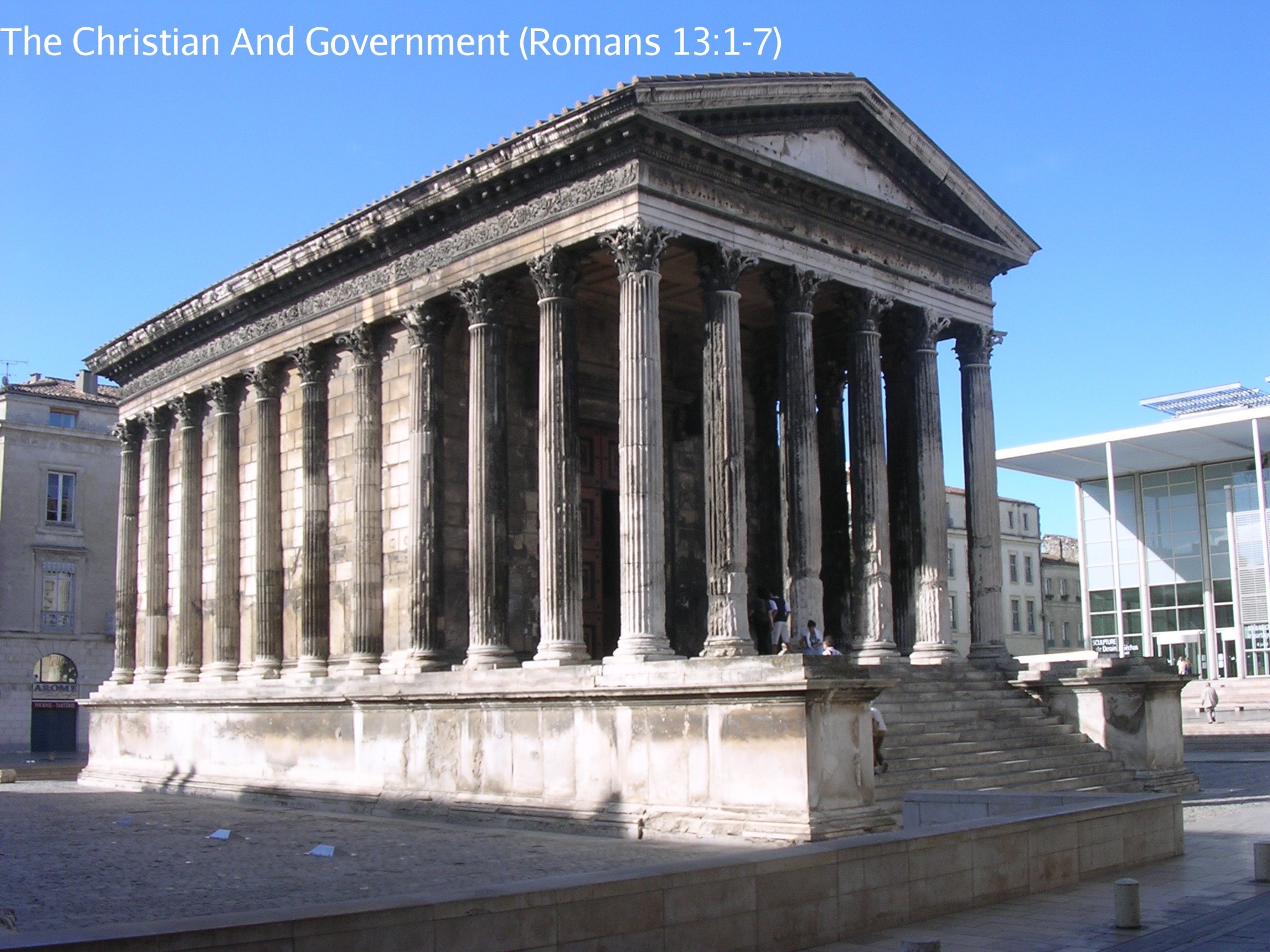
There is a passage that can be so disturbing because it is so adamantly clear. That passage is Romans 13:1-7. The early church fathers had a lot to say about this passage. They lived at a time when the government sponsored and led persecution and even execution of Christians simply for being Christians and sharing Christ with others. Nobody living in our country today has any experience with what this is like. Despite the pain and price inflicted by the Roman Empire on them, over and over the early Christians defended Paul’s words in Romans 13.
Basil—It is right to submit to higher authority whenever a command of God is not violated thereby
Ambrosiaster—Those who believe cannot play fast and loose with the law
Apollinaris—To disobey rulers is condemned as a mistaken way of thinking
Chrysostom—There should be rulers and ruled and…that things should not just lapse into anarchy is the work of God’s wisdom (Ancient Christian Commentary, Vol. VI, Oden, ed.).
Whether you long for the Obama administration or love the Trump administration, whether you love or loathe your governor, senators, and congressmen, Romans 13 applies to us today. Whatever your feelings about law enforcement or our judicial system, Romans 13 applies to us today. No one should be more conscientious about their relationship to the Civil Government than a Christian. What does this text reveal to us about “the earthly powers that be?”
The government has a Divine source (1). They are “from God” and “established by God.”
The government is a divine statute (2). Paul calls their ruling “the ordinance of God” and he warns against opposing such.
The government is comprised of Divine servants (3-6). The term Paul repeatedly uses of those within such earthly institutions is “ministers of God” (“servants of God,” 6) bearing the sword, bringing wrath, and devoting themselves to maintaining divinely-ordained order on earth.
The government carries Divine stipulations (7). God calls for Christians to render them what is due to them, namely taxes, customs, fear, and honor.
The limit to this is if they command us (forbidding or making us) to do what would cause us to disobey God (cf. Acts 5:29). That is not the same as commanding us to do something that restricts our “rights,” “freedoms,” or “liberties.” There may be privileges we enjoy in a free nation which contribute to our comfort, happiness, and enjoyment. They may even be dubbed “unalienable rights” in our national constitution. May we never confuse earthly privilege with divine precept. The inspired Paul makes it clear that God is behind government for the reasons seen above. Peter, in a context about civil government, reminds us that we are “aliens and strangers” on this earth (1 Pet. 2:11; cf. 13ff). As we loudly, lustily sing, “This world is not my home, I’m just a passing through…” “For such is the will of God that by doing right you may silence the ignorance of foolish men” (1 Pet. 2:15). May God give us the strength and wisdom to this end!





 The Preacher Pollard Blog