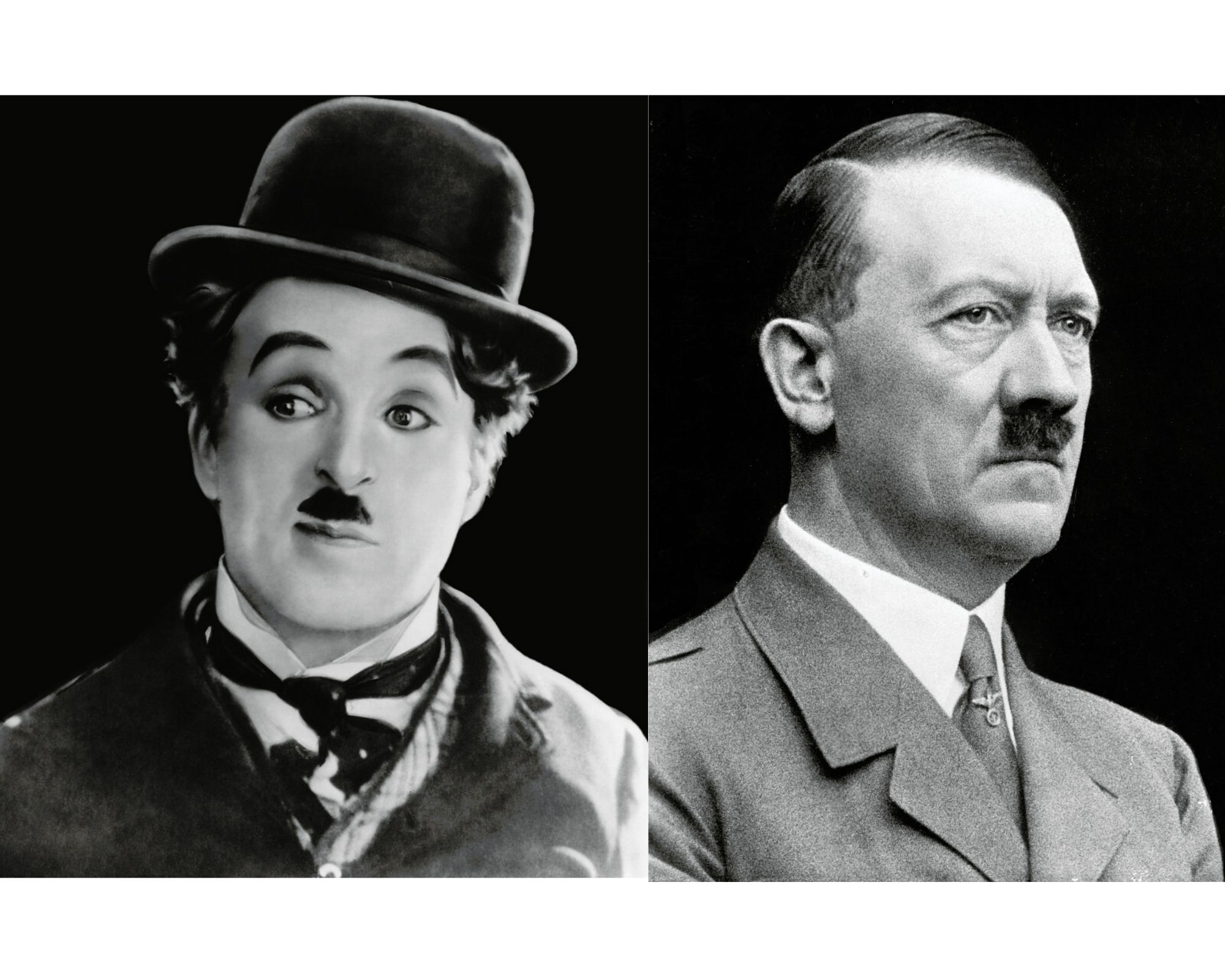
They were born within four days of each other, both on the European continent. Both adored their mothers and resented their drunken fathers. Both grew up knowing real poverty. Both were incredibly intense and ambitious. Both were mesmerizing performers who commanded crowds. Both sported the same, strange mustache and bore a striking resemblance.
One became a comedian who made people laugh. The other became a dictator responsible for the death of millions. Neither were moral giants, but each used their influence for very different ends.
It doesn’t matter where or when one is born. To a certain degree, we do not have to be defined by the home we grew up in. Being poor is not an automatic determiner of either success or failure. Our looks are a neutral commodity. Our talents and opportunities are a blank canvas we choose to decorate as we please.
The parable of the talents in Matthew 25:14-30 is a Divine reminder that we all take what God gives us and decide what we will do with it. Nothing is foreordained or forced upon us. We determine, both by action and inaction, to be a servant or slothful. What we must be aiming for is much greater and higher than earthly ambition, whether to be loved or feared by the world. Our purpose must be to be “a vessel for honorable use, set apart as holy, useful to the master of the house, ready for every good work” (2 Tim. 2:21). The good news is that where, when, and how you were born is a fact, but it does not have to define you. If we empty ourselves of ourselves and let Him fill us, He will define us!
This article requires a preface. Christianity is apolitical. Were our Savior in the voting booth, He would not have a party affiliation. Though I cannot say Jesus Christ would stand with David Lipscomb, advocating Christians abstain entirely from political involvement, I know our Lord would remind us that the Father establishes the governments of men (cf. Daniel 2.20-21;4.17,25; Romans 13.1ff). Frankly, I cannot imagine our Emmanuel casting a ballot. However, I think He would still be concerned by a government allowing abortion on demand and loose sexual ethics since these things subvert God’s Will.
2020 is, of course, an election year in the United States, and it is safe to say that the world is watching to see how this election will turn out. Obviously, other governments have preferences about whom they would rather work with on the global stage. Vladimir Putin of Russia is no different. On October 7, 2020, various news outlets reported Putin’s statement about the upcoming election. Putin stated he could see himself working well with a Joe Biden Administration since the latter’s party shared “common values” with the Communist Party of the Soviet Union (Gehrke). One may recall that Putin was a member of the communist party and KGB officer (Wiki).
Despite what you may be anticipating, I am not using Putin’s “endorsement” as a means to influence the American reader to vote for “the other guy.” I am taking issue with Putin’s words that these shared values are akin to “Christian values” (Swindoll). Unfortunately, there is a lie that primitive Christianity was communist. This misunderstanding is an extrapolation from the benevolence of the early church. Yes, Christians are said to have held all things, including their property, in common (Acts 4.32). Yet, context is critical. There was no mandate to forfeit personal, worldly property to the leadership of the church. In communism, by contrast, the State (i.e., leadership) owns all capital.
After Barnabas gave the proceeds from his real estate sale to the Apostles (Acts 4.36-37), Ananias and Sapphira also sold their property (Acts 5.1). Acts 5 records how Ananias and Sapphira decided to keep a portion of their profit but lie about the size of their donation to the church’s coffers. They told the Apostles that they were giving all. Peter exposed their lie. In addition to his rebuke of the foolish pair, which included their sudden deaths, Peter said, “While it remained unsold, did it not remain your own? And after it was sold, was it not under your control? Why is it that you have conceived this deed in your heart? You have not lied to men but to God” (Acts 5.4 NASB—emphasis mine). Note that Ananias and Sapphira maintained ownership of their capital in contradiction to socialist dogma.
We think Paul went on his journeys to found local congregations of the Lord’s church, but God tasked Paul with collecting aid for the brethren of Jerusalem and Judea during a famine (Acts 11.27-30). As Paul instructed these new local congregations about their contributions (cf. 1 Corinthians 16.1-2), he told them God did not want them to feel compelled to give. They were to provide as they purposed in their hearts cheerfully (2 Corinthians 9.7). Like the Macedonians, some presented themselves to God so that they could give despite their poverty (2 Corinthians 8.1-5). Others, however, such as the Achaeans, were able to give more freely. Hence, Paul used the example of the Macedonians to encourage the Achaeans of Corinth to be liberal with their giving (2 Corinthians 8.10-15).
So, I am sorry, Mr. Putin, that you have confused communist values with Christian values. Christianity is not communist. The church can be benevolent without being socialist and should be (cf. Matthew 25.31ff).
Nadezhda Khazina was born in Russia at the turn of the 20th Century. She met and married the famous poet, Osip Mandelstam, in Kiev, Ukraine, after the Russian Revolution and establishment of communism. The couple saw enough of that system of government to conclude it was destructive and harmful, so they railed against it as they had opportunity. Mandelstam had a wide audience through his poetry, and his 1934 epigram about Joseph Stalin was a work he called “his suicide note” and that has been described as his “sixteen line death sentence.” He was arrested, exiled, and died of exposure and neglect four years later. Nadezhda became even more active in crusading against the tactics used in the Soviet Union, then near the end of her life she wrote a two volume autobiography of her life and work: Hope Against Hope (1970) and Hope Abandoned (1974)(https://spartacus-educational.com/RUSkhazina.htm). What’s interesting is looking up the name “Nadezhda” or the more familiar form “Nadia”; the name means “hope.” In fact, Lois Fisher-Ruge wrote a book by that title in 1989.
Do you see the irony? Her name meant hope, but her life was full of hopes dashed and hopelessness in the midst of her struggle. But, she kept on working because of the hope she felt.
Peter writes 1 Peter to Christians who were going to see some seemingly hopeless situations in their lives. Some of them lived in Bithynia, a region whose governor, Pliny, famously bragged to the emperor Trajan at the turn of the second century about his pogrom of executing professed Christians for their faith. This was just about half a century after Peter writes this epistle warning of persecution.
Despite Peter’s warning about the testing of their faith in unfavorable circumstances, he frequently mentions not just the ultimate reward we see for faithfully serving Christ but also “hope.” Five times in the first three chapters, Peter mentions this hope. It’s a living hope caused by Christ’s resurrection (1:3), a complete hope (1:13), a hope in God (1:21; 3:5), and a reasonable hope (3:15). The world around them was hopeless; they lived without hope. They wanted to drag the Christians into that hopeless state, but Peter urges them to hold onto hope.
Our hopes are tested by times like these, by a world full of sin and iniquity. It’s easy to restrict our focus to this earth and this life. Peter’s words are for us, too! Do not be hopeless! You have Christ. Only those in Him have legitimate hope!
Drone photo from Nick Dubree of our drive in service at our new property.
The latest twist in the latest Dennis Rodman saga, being admitted to rehab, may help explain what led to his state of mind in his recently-completed “diplomacy trip” to North Korea. Except for his most ardent supporters, people were left scratching their heads over his extremely friendly overtures and fawning over a regime recently described by Robert Marquand in this way: “The regime is repressive in a way unthinkable in the West. Loyalty to the Kim family is paramount. There is no exile movement, no dissent, no opposition newspaper. Access to South Korean media is outlawed, as is free travel. Famously repressive Cold War states like Albania and Romania were fabulous models of freedom compared to the North today” (via Christian Science Monitor, 1/19/14). Execution, torture, and starvation is a routine form of population control there, and this is a nation possessing nuclear weapons. Why Rodman would call its dictator a “beloved friend” and a “very good guy” is beyond baffling. He seems out of touch with reality.
The Bible warns the Christian against forging associations that hurt the cause of Christ. In 2 Corinthians 6:14-18, Paul addresses the matter of being “bound together with unbelievers.” Notice what the text reveals.
THE EXHORTATION (14). He writes, “Do not be bound together with unbelievers.” Paul found this matter both urgent and important. Who we connect ourselves with makes a difference.
THE EXPLANATION (14-16). Paul says such fellowship is spiritually irrational, showing examples of how non-sensical it is. He also says such fellowship disregards the fact that we are God’s temple. We cannot be flippant about that!
THE EVIDENCE (16-17). Paul cites at least six different Old Testament passages, proof for his point of the destructiveness of these evil associations (Ex. 29:45, Lev. 26:12; Jer. 31:1; Ezek. 37:27; Ex. 25:8; Isa. 52:11). By doing this, Paul shows that this is a concept—avoiding fellowship with unbelievers—proven by Scripture.
THE ENRICHMENT (18). When we avoid unrighteous fellowship, we help open the door to fellowship with God. He welcomes us, adopts us, and forges relationship with us. The choice of enjoying fellowship with God or the unbeliever seems clear and easy.
I cannot understand guys like Mr. Rodman. He may be seeking attention. His motives may never be known. Yet, when it comes to how we as Christians conduct ourselves with the world, we are going to have the spiritual insight to choose wisely!





 The Preacher Pollard Blog