Meaning

Gary Pollard

Among the dozens of the-most-commonly-asked-questions Carl compiled for me, most fall into one of maybe three fundamental categories. Most of them also betray a sense of chaos in how people view reality. How do I know something is true/accurate/best practice? Is it always true? What about when a person stops being alive? Is it all nothingness? What is happiness? Is it quantifiable? What is my responsibility to other people? Do I have one? What makes me different from non-human life? Is there a significant difference? What is real? How do we know? Is it possible to be absolutely positive? What is my destiny? Do I have one? Why am I conscious? Am I, or is this a construct? 

Chaos and the abyss were frequently described in the ancient world as having nothing below and nothing above. You can’t look up/forward to some goal, and you had no solid base to stand on. No fixed point to compare something to. No metric to organize information into a usable hierarchy. It was conceived of as the worst possible existence, all of hopelessness and despair realized. It was seen as the destiny of those who deserved the most severe punishment, as no experience could possibly be worse than this. 

Ironically, the “freedom” promised by social/moral liberation proponents almost immediately devolves into this nightmare. People in general seem to feel lost and unable to know what’s real. Even much of our humor is now dark, existential hopelessness! So many are addicted to short-term euphoria, and each crash is a fresh wave of meaninglessness. We look everywhere for answers, but don’t always know if we can trust those answers because they’re so often subjective. There are too many threads to chase and knots to untie, and we don’t even know where to start. 

To a seeking person, the division so prevalent in Christianity can be discouraging. How can anyone trust something that no one seems to agree on? Where people are, problems are. That’s true of literally every human enterprise, and doesn’t warrant discounting it entirely. And most of those disagreements are because of ignorance, not because of faulty source material. 

So if you’re looking for meaning and hope, give the Bible a chance! This might seem reductive or cliche to non-believers, but its teachings have brought so much good to the world. That alone makes it worth pursuing! Most importantly, it gives tangible hope for the future and a solid, reliable base to stand on. It helps us understand reality like no other source! At the very least, give it a shot.

Here are some (hopefully) helpful tips for beginner Bible readers: 

  1. Bias is impossible to avoid entirely, but keep an open mind (believer and non-believer alike). An open mind prevents legalistic or liberal extremes, which are no bueno. Come to the text with questions and a desire for accurate answers. Be willing to adopt, adjust, or discard your beliefs when the narrative requires it. 
  2. If you haven’t yet done a deep dive into its divine origins, presuppose absolute reliability. You’ll come to that conclusion anyway, and this lessens anxiety when seeing something that challenges a current belief. 
  3. Stick with the New Testament at first, and avoid commentaries like the plague (I’m writing one, don’t read it). Don’t give up on a passage that’s hard to understand — try harder. Use a good, easy-to-read modern translation primarily, but have a couple others on hand too. I love the ERV, but also use NIV, GW, and NET Bible. 
  4. Look for the narrative in each section you’re reading. What main idea does everything else seem to support or illustrate?
  5. John’s writings are a great place to start if you’re looking for the most fundamental building blocks of meaning. Don’t just read the words, look into the concepts he presents. 
  6. Ask questions. So many answers to the fundamental questions listed above are in the scriptures. They work so much better than any of the subjective secular answers offered today. 
  7. Highlight, underline, and otherwise mark up the text. Look for connections and for ways to bring out each concept. You’re not looking for a code or some kind of religious experience, you’re looking for meaning. It will eventually become the lens you look through to understand reality, and the hope you have of humanity’s destiny. You will gain a deep appreciation for who God is and what he does for humanity and what he will give us when he comes back!  
  8. Read all of it. It’s all good stuff — and there’s nothing wrong with starting at what resonates most with your interests or questions! Those interests only become more interesting once you have a better understanding of all the other stuff, too! 

What Standard Are We Following?

Gary Pollard

My truck overheated today. A couple of hours and $100 later, it was back on the road. Whoever worked on it last had put the thermostat in backwards, and had failed to bleed the system after a coolant flush. 

Dad pointed out at lunch that we use objective standards for everything. How I feel about the orientation of a thermostat — or whether I believe its orientations makes a difference — is irrelevant. The engine will overheat if it’s not correctly installed, because that’s how it works. 

We have standards in almost every field we rely on. We don’t want bankers changing their standards on us while handling our assets. We don’t want automotive or aircraft manufacturers going solely by what feels right to them. We don’t want surgeons to just wing it while we’re under the knife. 

Standards keep chaos at bay, and allow for reliable, consistent, effective results. On what basis would we throw standards away in the field of morality? If everything else in life requires some kind of standard to make it functional (ie. not chaotic), why wouldn’t the same apply to ethics and morality? 

There is mostly order, not mostly chaos. Good standards bring order, no standards have only ever produced chaos. When postmodern or any other progressive ideals attack your faith, find out what their standards are. There most likely are none, or they are arbitrary and reliably chaotic.  

How we feel about most things could not matter less. Our feelings do not magically bend reality! Always ask, “By what standard do we believe this to be true/false?” If that standard is subjective, it’s probably safe to throw it away. 

What Is Truth?

Gary Pollard

Introductory Explanation:

[This is an excerpt from some research I’m doing on first principles. A dangerous, neatly-organized method of destroying faith has developed in recent years, and I’m trying to wrap my tiny brain around it. The conclusion I’ve come to is that addressing each and every issue would take years, but that each one could be satisfied with a return to first principles. This section addresses the notion that truth is fluid and subject to the influence of time, language, and culture, and that no reliable, universal constants exist.] 

In Platonic thought, there is a concept known as Forms. These are things that exist outside of our physical perception but are universally accepted as Real. For example, no one has ever seen a “perfect” circle or a perfectly straight line. But we all recognize a circle or a straight line when we see one. 

There are universal constants. These are easily observed in the growth spirals of a Nautilus shell, which expresses mathematical constants like Fibonacci Numbers or Φ. We use these (and countless other reliable constants) every day to properly orient ourselves in our environment. Everything must have some kind of reference point to give it definition and meaning. Every zero has a one as its counterpart. Night has day. Life has death. Love has hate. Violence has peace. Happiness has grief. Sickness has health. 

If meaning were not fixed in language and narrative, how could civilization flourish? How would we, on an individual level, communicate with each other? How would such a thing as definable culture — which is in part the natural outgrowth of a collection of common narratives expressed as stories — even exist? What would be the purpose of linguistics? How is it that we are able to communicate with people who speak another language if the words of their language do not correspond in an adequately analogous fashion to the words of our own language? It would not be possible if meaning could not be fixed in language. 

So, some kind of objective, universal standard must exist, because order exists. This order keeps chaos at bay, as much as we are able to in this world. Chaos — like warfare, crime, civil unrest, disease — certainly exists, but we use objective standards to bring order from this chaos. These standards place boundaries around chaos, defines the undefined, and creates a narrative of propriety that allows billions of people with differing immediate contexts to somewhat peacefully coexist on the same planet. There is war and there always has been — but we are still here. Every functional civilization has laws that keep chaos at bay, which are nearly universally followed, and the breach of which introduces a chaos that is usually self-corrected by its culture or legal system. 

This is the primary first principle issue which we should adopt — there are universal constants that remain unchanged by time, language, or culture. The question every human must answer for themselves is, “Which system is most effective at keeping chaos in check?”

“Aliens”

Friday’s Column: Brent’s Bent

Brent Pollard

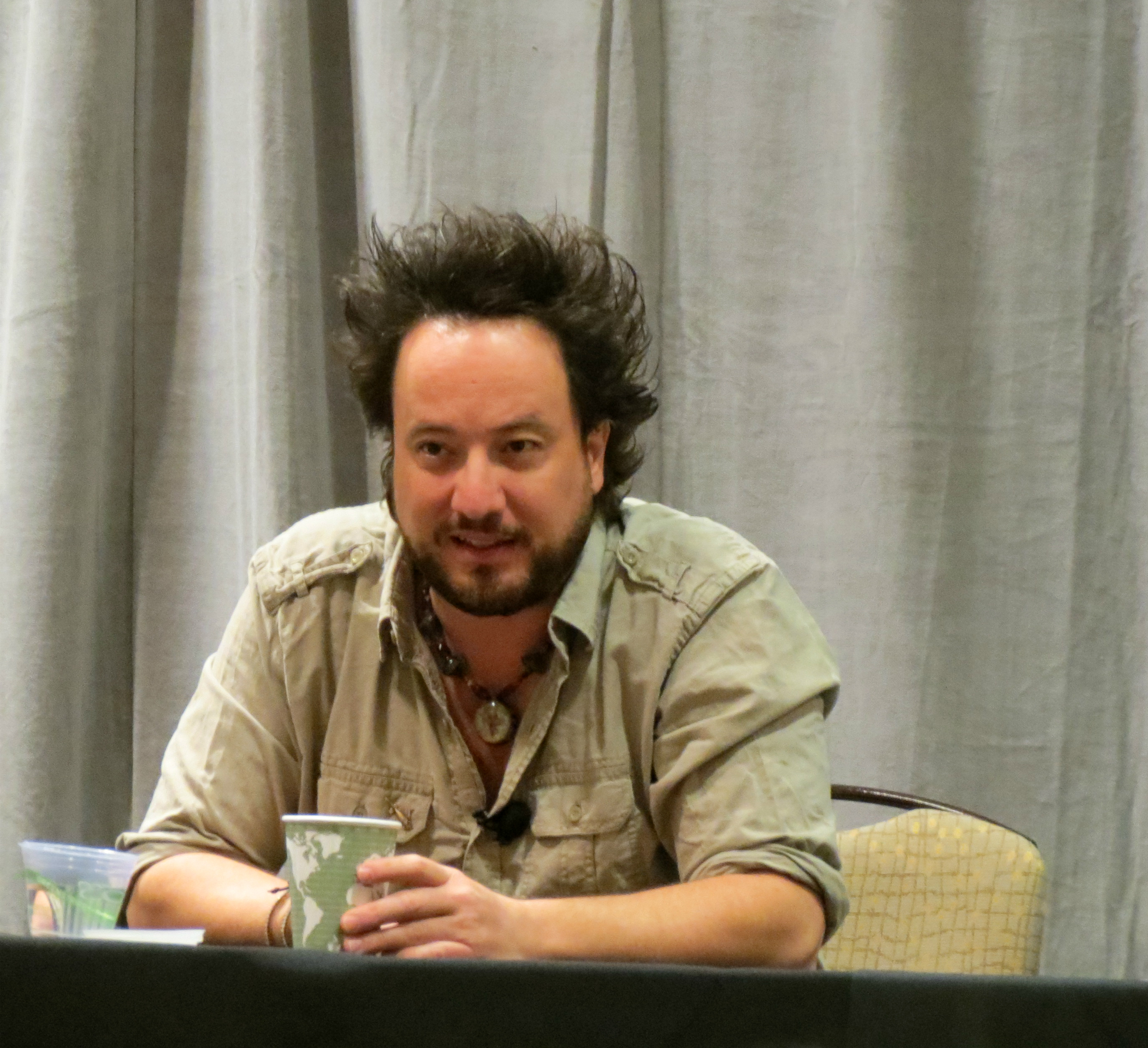
An older internet meme, originating in 2010, features Giorgio A. Tsoukalos from the History Channel’s Ancient Aliens program.1 As Tsoukalos believes ancient astronauts visited our planet in our distant antiquity, he often speaks enthusiastically about how such extraterrestrial visitors interacted with our remote ancestors. Hence, a screenshot of Tsoukalos from Ancient Aliens sporting his crazily coiffed hair and hands frozen in mid-gesticulation conveys the simple message to the viewer of “Aliens.” Another version of the meme, also featuring the same screenshot of Tsoukalos, reads, “I’m not saying it was aliens, but it was aliens.”  

What is the point of posting random pictures on the internet? Honestly, what is the purpose of any meme? The word “meme” derives from the Greek word “mimeme,” meaning something imitated.2 Without becoming too bogged down in explanation, a meme is a vehicle by which internet posters convey ideas. Then, others who identify with the message share it. In that simple act of reposting, one “imitates” the intent of the meme’s creator. When many people do this, we proclaim that the meme has “gone viral.” However, the power of the meme is that it will invoke a response so that even those angered by it will respond to it. For example, the “Aliens” meme is employed by those jokingly offering a Deus ex machina-type explanation for things to which we may or may not have the answers. How did ancient builders erect megalithic structures? Aliens. Who ate my last donut? Aliens. 

I cannot help but hear the voice of Giorgio A. Tsoukalos saying “aliens” in my head as I read headlines like this one from Yahoo!News: “How would humans respond to the discovery of aliens? NASA enlisted dozens of religious scholars to find out.”3 For some reason that escapes me, Hollywood has often speculated that the revelation of extraterrestrial life would destroy the faith of believers. You have likely seen such movies. There is typically some cabinet member telling the fictional President to keep things quiet lest the disclosure of the existence of extraterrestrials leads to chaos. By the way, rather than becoming terrified by the thought of aliens, the article suggests that religious people would most likely be better prepared to receive such visitors from afar. I agree with that conclusion. 

I cannot speak for other Christians, but I can say why I wouldn’t lose my faith in Jesus Christ because someone proves that the Roswell greys exist. First, my belief that God created everything that exists convicts me of the truth that if “aliens” also exist, God created them too. Genesis 1 details how God made the heavens with their inhabitants. A Christian realizes that, though the creation account mentions nothing about planets, the voice of God made Jupiter and Saturn, which are planets. Would it require more faith to believe that there could be one planet orbiting a star capable of supporting life in that sea of stars we see at night? No. Again, Genesis 1 tells us God created the heavens and the earth. It would be more a matter of what God has chosen to reveal to us. Deuteronomy 29.29 reminds us that God has only given us what He has revealed. The secret things belong to Him alone.  

Second, we ask what we can even understand about God apart from His Word. Isaiah 55.8-9 reminds us that the thoughts and ways of God are above our own. Science fiction author Arthur C. Clarke once stated what has since become known as one of Clarke’s Laws: “Any sufficiently advanced technology is indistinguishable from magic.”4 We might substitute the word “supernatural” for “magic.” The existence of aliens would not destroy my faith because I might ask whether the strange phenomena I was witnessing were not “aliens” but “heavenly visitors.” Maybe Ezekiel’s “wheel in the middle of the wheel” was a UAP (Unidentified Aerial Phenomena) (Ezekiel 1.4ff). Would it matter to you if God created the universe using advanced technology to which only He has access? Either way, He has the power to create and destroy us (cf. 2 Peter 3.12). 

Ultimately, all of this talk has more to do with scientists’ expectations regarding the recent launch of the James Webb Space Telescope.5 In addition to thinking they will see the Big Bang, scientists believe we might finally see those elusive extraterrestrials and life-sustaining planets. And why not? The government has even declassified reports about the existence of “Unidentified Aerial Phenomena.”6 Having said what I have about not having my faith shaken by the sudden revelation that there is other life out there, though, I find it more likely that each discovery reveals what we have known all along. God placed us in a particular spot within the cosmos to see His intelligent design and realize, yes, it had a beginning. It is not eternal. And one day, we will meet Him, Who created it all.   

Sources Consulted and Cited 

1 “Ancient Aliens.” Know Your Meme, Literally Media Ltd., 3 Dec. 2021, knowyourmeme.com/memes/ancient-aliens

2 “Memes | Psychology Today.” Psychology Today, Sussex Publishers, LLC,www.psychologytoday.com/us/basics/memes

3 Snodgrass, Erin. “How Would Humans Respond to the Discovery of Aliens? NASA Enlisted Dozens of Religious Scholars to Find out.” Yahoo! News, Yahoo!, 29 Dec. 2021, 21:42,www.yahoo.com/news/humans-respond-discovery-aliens-nasa-024208831.html

4 Jones, Andrew Zimmerman. “What Are Clarke’s Laws?” ThoughtCo, Aug. 26, 2020, thoughtco.com/what-are-clarkes-laws-2699067

5 Griffin, Andrew. “James Webb Space Telescope Latest: Alien-Hunting Spacecraft Unfurls on Its Way to Study the Universe.” Yahoo! News, Yahoo!, 30 Dec. 2021, 09:42, news.yahoo.com/james-webb-space-telescope-latest-144238287.html

6 Preliminary Assessment: Unidentified Aerial Phenomena. www.dni.gov/files/ODNI/documents/assessments/Prelimary-Assessment-UAP-20210625.pdf