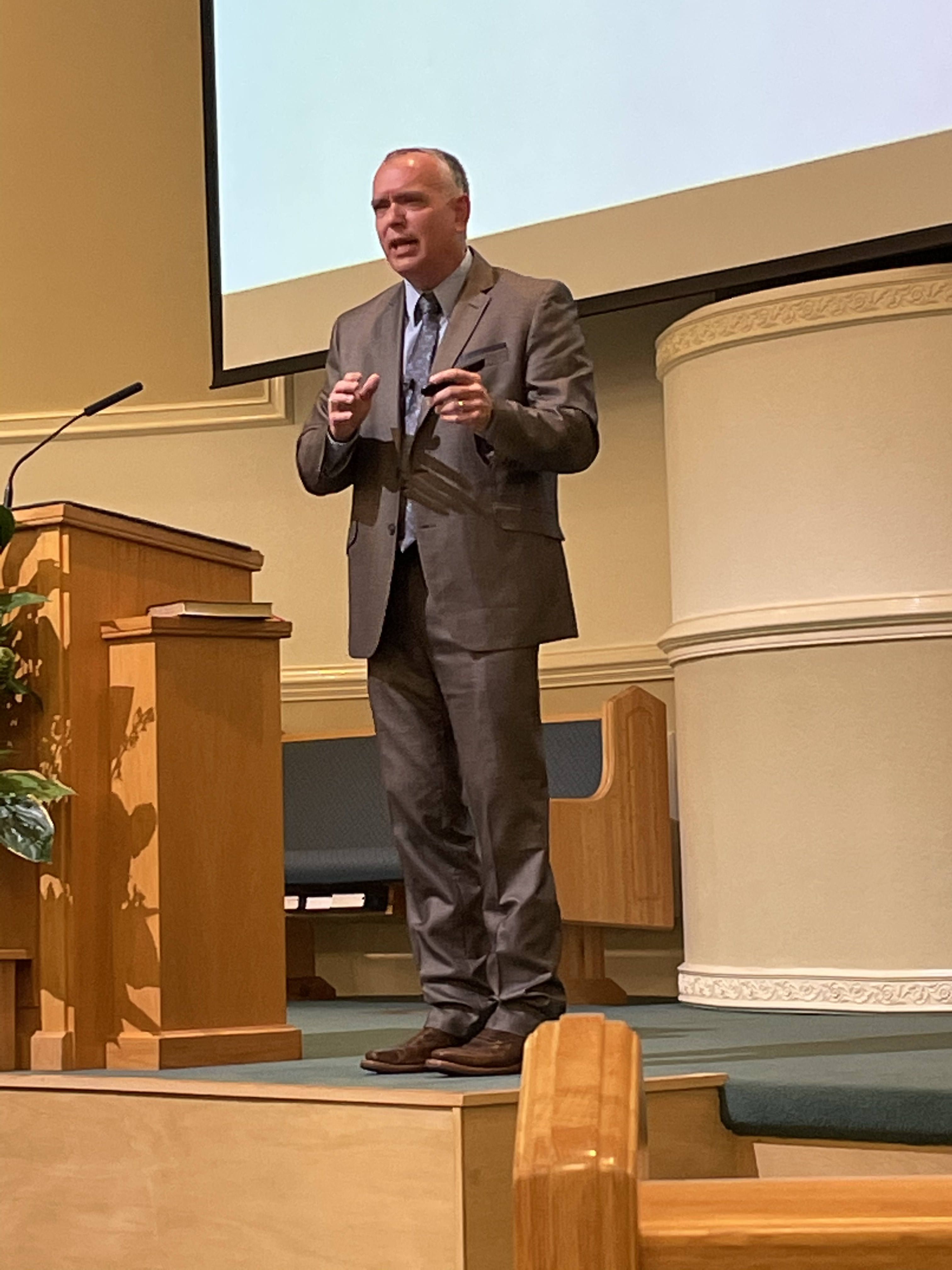
“I Am He”

Carl Pollard

Jesus describes Himself in many ways throughout the Gospels. Each name further explains His love, care, protection, judgment, and attitude towards us. There is one name He used that caused quite an uprising in His earthly ministry. However before we dive into the New Testament, we must start at the beginning. 

Exodus 3. 

Here we read that Moses was shepherding his father-in-law’s flock. He takes the herd to Horeb, the mountain of God. While he is there with the animals he notices a bush engulfed in flames, but the bush wasn’t consumed by the fire. Moses goes closer to investigate, and he hears a voice from the bush call his name. This voice is the voice of God and He had a job for Moses to do. 

He had heard the cries of His people in Egyptian captivity, and verse 10 He tells Moses to deliver them from the hand of Pharaoh. Moses isn’t too thrilled with his new task, but pay special attention to the next few verses: Exodus 3:13–14 says, “Then Moses said to God, “Behold, I am going to the sons of Israel, and I will say to them, ‘The God of your fathers has sent me to you.’ Now they may say to me, ‘What is His name?’ What shall I say to them?” God said to Moses, “I AM WHO I AM”; and He said, “Thus you shall say to the sons of Israel, ‘I AM has sent me to you.’ ” 

When God revealed Himself to Moses, He identified Himself as “I AM.” These two words summarize God’s nature. He is the only: 

  • Uncreated
  • Eternal 
  • Always-existing Being. 

He is the I AM because He just is. He exists in all power and majesty, He has no timeline, no beginning, no end. He is I AM. No one else is like Him. Well, maybe someone is…

Seven times in the gospel of John, Jesus used the name “I Am” while claiming to possess certain attributes of God. For the Jews, numbers had special meaning. Seven is quite possibly the most important. In Hebrew numerology the number 7 represents completion or perfection. God created the world in 6 days, and rested on the seventh. The Jewish week had 7 days. Shabbat occurred every seven days. Noah brought 7 pairs of clean animals on the ark. The number Seven is the most important symbolic number in the Hebrew Bible. It conveys wholeness, perfection and for the Jew it came to represent holiness. 

It could be a coincidence, but I do think it’s interesting that Jesus says “I AM” 7 times in the gospel of John. He is God in the flesh, He came to make us complete, and whole. 

He came to make us holy. Seven times, He says, “I AM.” With that in mind, let’s look at the last time He says this. 

John 18

Jesus has just finished a lengthy discussion with His apostles at the last supper. He goes to the garden where He knows that He will be arrested. 

Verse 3 tells us, “So Judas, having procured a band of soldiers and some officers from the chief priests and the Pharisees, went there with lanterns and torches and weapons. Then Jesus, knowing all that would happen to him, came forward and said to them, “Whom do you seek?” They answered him, “Jesus of Nazareth.” Jesus said to them, “I am he.” Judas, who betrayed him, was standing with them.“ 

Look at the very next verse, “When Jesus said to them, ‘I am he,’ they drew back and fell to the ground.” This claim is made as a blatant show of divine power. A band of heavily armed men have shown up to arrest Jesus. Jesus asks who they were there for, and they respond “Jesus of Nazareth.” 

His self-identification in verse 6 does something incredible. Every last Pharisee, Roman soldier, and chief priest stumbled back and fell to the ground when Jesus spoke the words “I AM HE.” At His spoken word, these men are blown back. 

It’s interesting that this same apostle wrote later of the power of the LOGOS. 

So why did John record this? They came to arrest Jesus with weapons. Christ was clear that He knew what would happen, and He chose to cooperate with God’s plan. This moment highlights His sovereignty, reminding everyone that nothing happens to Him which is beyond His own control. 

He WILLINGLY gave Himself because no man can destroy the I AM. But the I AM can sacrifice Himself.


“Charakter”

Monday’s Column: Neal At The Cross

Safari 2017

Neal Pollard

Character is defined as the mental and moral qualities distinctive to an individual and involves a person’s good reputation. The Greek word “charakter” first referred to the die used in minting coins, then came to include the sense of an image, stamp, seal, or copy. The Greeks used the word to speak of the typical features of an individual or nation, from which came the idea of “moral character” and then “the “distinctiveness” of a language, the “style” of a writer, or a “type” of philosophy (Kittel and Bromiley, TDNT, 1308). Arndt tells us the word means something produced as a representation or reproduction, and that human beings are formed by God as a representation of His own identity (1078).

The word is only found in the Bible in Hebrews 1:3. The epistle’s writer is describing Jesus, saying, “He is the radiance of His glory and the exact representation of His nature, and upholds all things by the word of His power.” It is an absolutely amazing truth that we are made in the image of God (Gen. 1:27), but the writer of Hebrews is saying something even more powerful about Jesus in Hebrews 1:3. He was not created by God as a reflection of God’s identity. The writer uses this specific word in Hebrews as part of His explanation that the Son is God! The NASB and NIV translate χαρακτήρ (CHARAKTER) as “exact representation.” The ESV has “exact imprint,” the NKJV has “express image,” the NLT says “expresses the very character of God,” and the ASV puts “the very image of His substance.” 

The author of this epistle leads out in his overall theme that Jesus is better by establishing the most important reason why. He is God. The writer uses Old Testament Scripture to prove it, citing Psalm 45 and Isaiah 61 to call Him God (Heb. 1:8-9). He then quotes Psalm 102:25 to say of Jesus, “You, Lord, in the beginning laid the foundation of the earth….” Then, in Hebrews 1:13, he quotes Psalm 110:1, which begins, “The LORD (Yahweh) said to my Lord (Adonai)….”

Let’s not miss the initial point of the letter driven home by the unknown writer. With a multitude of Old Testament passages, he proves this point about the essential character of Jesus Christ. He is God. He is as much God as Father and Holy Spirit. He is as powerful, all-knowing, omnipresent, perfect, sovereign, transcendent, self-existent, eternal–He is as Divine as Deity can be. 

That makes His willingness to be made a little while lower than the angels to taste death for everyone (Heb. 2:9) and to call us His brethren (2:11ff) all the more incredible. God lowered Himself not only to save us but to make us part of His family. We could spend the rest of the day meditating on that profound truth and still not fully grasp it. 

Here’s the question. God made us, became  one of us, died for us, and then opened the door to us to be His brother. What does that say about His character? As we try to fathom and appreciate that, it should give rise to another question? How should that affect  our character?

Facts About Jesus From John One That Many Deny

Monday’s Column: Neal At The Cross

preachingatPBL

Neal Pollard

Perhaps it is inevitable that someone as well-known as Jesus Christ would be subject to so much misinformation. Think about how things are said about Jesus that are not true. John’s gospel begins in a different way. His audience was wider than just Jews, just Romans, or just Greeks. His was truly a universal gospel, so he was writing to the whole world. In just the first several verses of his gospel, he affirms several things people subsequently denied about Him.

  • He is eternal (1-2)–“In the beginning was the Word” (see also 1:15,30).
  • He is deity (1)–“The Word was God” 
  • He created everything (3,10)
  • He became flesh (14)
  • He came to show us God, the Father (18)
  • His coming was to take away the sins of the world (29)
  • He is the Son of God (34)

There are those even in religion that say Jesus was a created being rather than being co-eternal as God. There are those who would reject the idea of the worship of Jesus being acceptable, though He is expressly called God. There are those who say that everything came into being by the process of evolution rather than Moses’ record (Gen. 1-2) being carried out by the Word (Col. 1:16-17). There are those who say God could not become flesh, since flesh is evil. There are those who deny the inspiration of Scripture, and thus would deny the New Testament actually records Jesus showing us the Father or otherwise communicating His will. 

It is incorrect to say that we can accept the biblical record of Jesus without faith. He existed eternally before becoming flesh. He was born of a virgin. He lived a totally sinless life. He died a death that satisfied God’s justice as a substitute for our sins. He was buried in a tomb, but was raised from the dead to live forevermore. He appeared to many of His disciples over forty days before ascending to heaven from which He will some day come again to judge the entire world. How can we say it takes no faith to follow Jesus? Instead, we should say that it takes more faith to embrace any competing explanation. The leading candidate to rival the biblical account is godless evolution. Try examining that with any level of care without discovering the infinitely greater amount of faith to explain how random chance and mindless, amoral matter produces the meticulously orderly, complex universe filled with intelligent life. 

Sometimes we are benefited by going back to basics. John one is written so simply and straightforwardly, yet it contains some of the biggest, broadest truths which so many reject. May we reflect carefully on the power of those truths so that it causes us to live better and differently!