Seven Reasons We Fail To Give Thanks

Brent Pollard

Thanksgiving is just around the corner, and I can’t help but wonder how many people in the United States will take a moment to thank God. While some reject the day due to its association with Plymouth and the “original Thanksgiving” celebration, the fact remains that all of our presidents have thanked God in their Thanksgiving proclamations. Therefore, I am okay with doing away with the pilgrims as long as we can maintain the day’s significance set forth by historical figures such as Abraham Lincoln. On Thanksgiving Day, we reflect on our blessings, express our gratitude to God, and ask for His continued beneficent providence in our national life. Thus, unlike Easter and Christmas, which carry pagan baggage from the standpoint of their traditions, Thanksgiving is the most Christian of all federal holidays.

Luke records an instance during Christ’s ministry in which He encountered ingratitude on a par with modern America. Only one of the ten lepers He healed returned to thank Christ for what He had done (Luke 17.11–19). Jesus even asked, “Were there not ten cleansed?” (NASB Luke 17.17) People do their best to spin the nine’s actions in a positive light. Emotion overcame the nine, and they longed to return to their previous lives. Besides, they followed Christ’s command to go and show themselves to the priests. And what if the Samaritan only returned because he lacked a priest to whom he could present himself as a foreigner? In any case, Jesus told the Samaritan that his actions had made him “well” (Luke 17.19).

What prevents us from showing gratitude like the Samaritan? Here are seven possible reasons:

We are too busy and distracted. Modern life can be busy and distracting, making it difficult to appreciate the present moment and count blessings.

We can be too materialistic. It can be challenging to be grateful for what one has in consumerist societies because materialism has overtaken the value placed on intangibles like relationships and experiences.

We compare ourselves to others. Due to constant comparison with others and the influence of social media, one may experience feelings of inadequacy or jealousy, which can prevent one from feeling grateful for their life and circumstances.

We may have a negativity bias. People naturally tend to dwell on negative rather than positive things. Instead of focusing on what we have, we will concentrate on what we don’t. That inclination is a negativity bias.

We are on a hedonic treadmill. This phenomenon of becoming accustomed to pleasure is known as hedonic adaptation. In simpler terms, we get used to things emotionally. For example, when I acquire a new and shiny object, it brings me happiness. However, this happiness is short-lived, as I soon become accustomed to it.

Similarly, when something terrible happens, I feel sad but adapt to the change over time, and my happiness levels return to normal. As a side note, we note that God offers us joy, not happiness. Joy is renewed from within, avoiding the hedonic treadmill. Hence, it can even be an implied imperative (see Philippians 4.4).

We forget to be still. This results from failing to heed Psalm 46.10, which says, “Be still, and know that I am God” (KJV). A similar root cause is that people are too preoccupied with their lives to stop and offer thanks. Luke 11.24–26 shows that refraining from one bad behavior is not enough to prevent the substitution of another bad behavior. We need to fill the void by starting something useful. New Agers and Buddhists would call this “practicing mindfulness.”

But Christians do engage in their form of mindfulness as well. A Christian sets aside specific times for quiet reflection, away from the distractions of daily life, rather than sitting in the lotus position and breathing deeply. Christian mindfulness is about creating a space to focus inwardly and become more aware of God’s presence. Praying and reading the Bible are two of the best ways to accomplish this. Those who commit to being still and knowing God will be grateful.

We feel entitled. Individuals may feel entitled in societies where success and happiness are highly valued. This thinking can dull people’s gratitude and lead them to take their blessings for granted. Gifts become their norm rather than providential occurrences (see James 1.17).

As Thanksgiving draws near, we must truly understand what this holiday is all about. It’s not only a time for food and family gatherings but also genuine gratitude. In our busy lives, full of distractions and the pursuit of material comforts, we often forget to give thanks for the simple things. However, this day allows us to break free from these tendencies. It encourages us to step off the hedonic treadmill, put aside our negativity bias and the sense of entitlement that clouds our perception, and instead embrace a spirit of thankfulness. By being still, as suggested in Psalm 46:10, we can truly appreciate the blessings bestowed upon us, recognizing them as gifts from God rather than mere entitlements or passing pleasures. Thanksgiving, at its core, is a day to emulate the gratitude of the Samaritan leper, acknowledging our blessings and expressing our heartfelt thanks to the Divine. In doing so, we honor the tradition set forth by figures like Abraham Lincoln and cultivate a more profound sense of joy and contentment in our lives. So, let this Thanksgiving remind us to pause, reflect, and give thanks with a full heart.

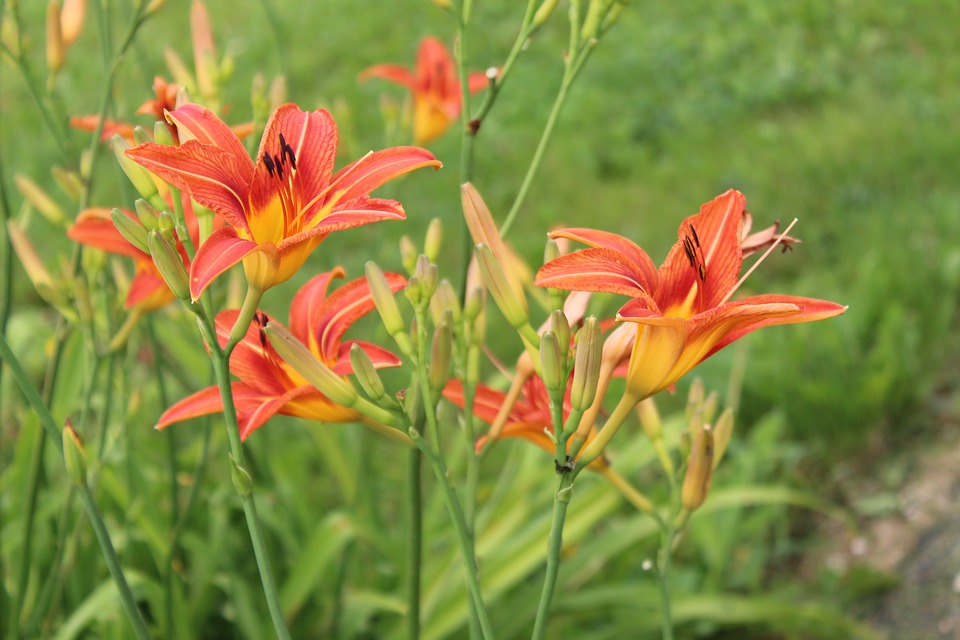
Surrounded by Orange Daylilies

Friday’s Column: Supplemental Strength

81121814_2462862270639428_5746232403106463744_n

Brent Pollard

Driving along the highways of north Georgia and western North Carolina, there is one flower that stands out, the orange daylily. I look forward to seeing them every year. However, I recently discovered daylilies are not even native to North America. The daylily, which, despite its name, is not a lily, is a native of Asia. At some point, merchants traveling the silk road brought them back to Europe. Later, when Europeans settled in the “New World,” they brought the daylily bulbs with them. Yet, they have become so common here that among their colloquial names is the designation of “ditch lily,” since they have become a ubiquitous feature along highway shoulders and medians. Some do still plant them purposefully, but it is not necessary unless one wants them in a specific location. It is as if some unseen John Chapman, but of the daylily bulb, travels the rural countryside of Appalachia, planting these flowers. It can be bad enough in some locations for the pretty flower to be labeled as “invasive,” since it chokes out local flora.

I’ve already mentioned how I am partial to daylilies, but the world would be less exciting and beautiful if all I saw were the orange daylilies wherever I looked. I understand that other flowers are needed to complement and balance this resilient flower.  I need purple lupines, red roses, and yellow black-eyed Susans too. When it comes to the daily living of our lives, we need such variety also.  Frankly, the only constant should be the “the true bread out of heaven.” Otherwise, our lives will become as dull as a world of but orange daylilies.   Paul reminds us, “Finally, brethren, whatever is true, whatever is honorable, whatever is right, whatever is pure, whatever is lovely, whatever is of good repute, if there is any excellence and if anything worthy of praise, dwell on these things.” (Philippians 4.8 NASB). There is no doubt that the items on Paul’s “focus list” are related and flow from one another. Of a truth, we can describe God using each of those words. Even so, there remains variety, even in the ways we choose to look at God. Do I want to focus on His love? His grace? His justice? His mercy?

“Orange daylilies” surround us in our life’s journey. It is the “news junkie” regurgitating cable news talking points, especially when his or her interpretation of “facts” is different from our own. It is the brother or sister who always has something negative about which to talk, especially the injuries he or she perceives to have suffered. It is the enthusiastic fan who regales us with the latest news from his or her fandom. It is the brother or sister in Christ weaned on a pickle, unable to find joy in life. Again, we do appreciate the orange daylilies for their worth. They have their beauty.  But if we only surround ourselves with them, it chokes out the other “flowers” we want to bloom as well. Consider that also about yourself and your topics of conversation and demeanor when around others. Adopt the attitude of Christ and work to be someone’s red rose or purple lupine even on those days you only feel like being an orange daylily too.

daylily-4590386_960_720

The Negative Mosquito

Thursday’s Column: Carl’s Corner

carl pic

Carl Pollard

I have loved living in Alabama for the past two years, but there’s one major problem I’ve run into since moving…the mosquitos. These bugs are a nightmare. The one good thing about the winter is there aren’t any of these blood sucking demons.
It honestly seems like there are two kinds of mosquitoes here. You have the ones that are small enough to fit through the screen door, and ones big enough to push it open.
I did some research and found out a few interesting details about mosquitoes. For one, they are attracted to high cholesterol (If you get bit a ton you most likely need to slow down on the burgers). Two, they are attracted to carbon dioxide and can actually smell it from 150 feet away. And three, a mosquito’s average lifespan is only about 10-14 days.
You may be wondering why I’m telling you this, but I actually found an interesting connection between mosquitos and a very specific group of people. The more I learned about them, the more they began to resemble negative people. For example, negative people love what isn’t good for them, just like carbon monoxide can kill you and cholesterol can stop your heart. Also, negative people can only seem to keep a friend for about 10-14 days.
Paul, in the book of Philippians, is urging the church to show humility and to be servant minded like Christ. In 2:1-4, he says, “So if there is any encouragement in Christ, any comfort from love, any participation in the Spirit, any affection and sympathy, complete my joy by being of the same mind, having the same love, being in full accord and of one mind. Do nothing from selfish ambition or conceit, but in humility count others more significant than yourselves. Let each of you look not only to his own interests, but also to the interests of others.”
Paul through inspiration uses the word “conceit” (kenodoxia). This is defined as “a vain or exaggerated self-evaluation.” A negative mindset under any circumstance is vain and  selfish. We must always keep in mind that the people we are negative toward should be treated as more important than ourselves.
There is no room for negative people in the body of Christ. We are commanded to love each other, serve each other and encourage one another. Keeping in mind what Jesus has done for us, live to help your brothers and sisters in Christ.
P.S. Don’t be a mosquito.
757px-aedes_aegypti_biting_human

“Ain’t No Stoppin Us Now”

Neal Pollard

When did I first know I wanted to be a preacher? I’m not sure, but I remember the day I addressed the city council in Cairo, Georgia.  I was only nine.  We were walking home from school.  Every day, we’d make the trek from 10th Avenue across Broad Street to our house on 12th Avenue.  It was a straight shot, but there was a penny candy store if you went south.  A couple of blocks south, between us and the store, was the court house. Of course, every self-respecting boy looks for shortcuts. Mine was through the court house that day.  It appeared empty to me, so I was singing the far out, new McFadden and Whitehead hit, “Ain’t No Stoppin’ Us Now.”  Just one more set of doors between me and the back door, I thought. So I burst through them bellowing, “…We’re on the move.”  With that, I brought the city council meeting to a stop and in the instant before my beet-red face welled up with tears of embarrassment, I think I saw looks of irritation as well as amusement.  For some reason, I was feeling really good that day…until that moment.

Do you ever feel unstoppable? Maybe you are bounding with energy, excited, or happy without even knowing why.  It may cause you to sing, exercise, eat, kiss your spouse, give exploding knuckles to a stranger, or pause in grateful thanks to God.  Every moment cannot feel euphoric and golden, but how wonderful when it happens.

Depression is a real malady that many people, including good Christians, experience.  Some deal with clinical depression, physiological and demanding chemical treatment.  However, some without such an excuse seem to have a hard time finding joy in their lives.  It could be because they have conditioned themselves toward negativity, constantly complaining, bemoaning, wallowing in self-pity, and being their own one-person thunderstorm.  Some seem to stand there, waiting for the lightning strike on a cloudless day.

As Christians, we are not expected to be out of touch with reality or even our own feelings.  Yet, only we can choose our outlook and attitude.  Isn’t it amazing that we are all exposed to national politics, economic uncertainties, sickness, disappointment, and betrayal, but some are resilient while others are resentful.  Some count blessings, but others court burdens.  May we, as God’s children, always focus more on what we have been given by Christ, what we have through Christ, and what we look forward to with Christ.  I tell you, it will make you feel unstoppable!

What Brings Alligators And Vultures Together?


Neal Pollard

Kathy and I were able to swing by the Everglades National Park a few weeks ago, near sundown.  The wildlife were very active, in a preserve that is a haven for many types of birds, panthers, snakes, crocodiles, and alligators.  As we were walking down one of the trails, we saw not only the beaty eyes of alligators in the adjoining canal but at least one that boldly ventured onto the trail.  You can imagine the respect and right of way the many park-goers like ourselves gave this scaly reptile.  I took this picture as three black vultures came boldly strolling up to the alligator.  There were gasps and fearful looks from some bystanders, most fearing the worst for the birds.  What do you think happened next?

It is very unpredictable.  Alligators are known to attack vultures, as a search of You Tube would amply demonstrate.  Vultures are known to attack alligators, too.  One is a strong, ferocious predator.  The other is a famous bird of prey, a scavenger who lives off of death and decay.  What might have happened under different circumstances, where hunger or a perceived threat or territorialism prevailed, is unknown.  Soon after the photo, however, the alligator lazily turned and retreated to the canal and the vultures returned to…whatever vultures do when they aren’t “vulturing.”

My imagination wandered.  What was this confrontation about?  Was this a game of “chicken”?  Were the vultures thrill-seekers?  Was the alligator full, bored, or something else?  Given that most alligator-vulture disputes center around vying for the same entree, the likeliest explanation is that the alligator had killed something and the vultures wanted a postmortem piece of the action.  They were likely brought together by death and devouring.

The Bible speaks of some who are like this, uniting for less than life-bringing reasons.  Asaph condemns God’s people for associating with adulterers and consenting with thieves (Ps. 50:18).  Some fellowship with the unfruitful works of darkness (cf. Eph. 5:11).  Some, who should know better, give hearty approval to those who practice things worthy of death (Rom. 1:32).  When you are with that companion or in that relationship, it is good to ask, “What brings us together?”  If the answer involves sin, spiritual darkness, and the spiritually deadly, maybe it is find to find a new “partner”–and not a partner in “crime.”