
“And Yet I Will Rejoice”

Many Christians serve a “God of good times,” praising Him when life is easy. But the God of the Bible is bigger. When the fig tree fails, the vines are bare, and the fields are empty, will you get angry, give up, or rejoice?

Carl Pollard

Corrie ten Boom was born on April 15, 1892, in the Netherlands to a devout Christian family. Her father, Casper, ran a thriving watchmaking business. Their deep faith shaped their response to the Nazi occupation of the Netherlands during World War II. The ten Booms joined the underground resistance, transforming their home into a safe haven for Jews and others persecuted by the Nazis. Using a hidden room in their house, they saved countless lives. Tragically, in 1944, a betrayal led to their arrest. Corrie and her sister Betsie were sent to a concentration camp, enduring brutal conditions. Betsie died there, and their father passed away in prison. Corrie survived and later wrote, “There is no pit so deep that God’s love is not deeper still.” 

How could she say this after such devastating loss? Life often feels like a pit—barren, hopeless, empty. The prophet Habakkuk faced a similar pit in Judah, a nation crumbling under the threat of invasion. Yet, he wrote one of the Bible’s boldest declarations of faith in Habakkuk 3:17-19: though everything fails, “I will rejoice in the Lord.” Unlike most prophets who spoke for God to the people, Habakkuk spoke to God for the people, asking two questions we often wrestle with: “Why?” and “How long?” His story offers three vital truths for navigating life’s darkest moments.

The Reality of Fear (v. 16)

Habakkuk trembled when God revealed His plan: the Babylonians would bring judgment on Judah. “I hear, and my body trembles; my lips quiver at the sound; rottenness enters my bones; my legs tremble beneath me.” He knew destruction was certain—starvation, cannibalism, the ruin of Solomon’s temple, the end of his nation. The dread was so deep it made him physically weak. We’ve all felt fear like this—news of a tragedy, a diagnosis, or loss that shakes us to the core. Yet, Habakkuk chose to “quietly wait for the day of trouble” to come upon the invaders. God promised to judge the Babylonians and deliver His people, though not in Habakkuk’s lifetime. The Hebrew word for “wait” means to rest or settle down, like David’s soul finding rest in God (Psalm 62:1). Instead of letting fear consume him, Habakkuk anchored his heart in God’s promises. Can we trust God’s timing, even when we’re afraid?

The Choice of Joy (vv. 17-18)

“Though the fig tree should not blossom, nor fruit be on the vines, the produce of the olive fail and the fields yield no food, the flock be cut off from the fold and there be no herd in the stalls, yet I will rejoice in the Lord; I will take joy in the God of my salvation.” Habakkuk describes total ruin in an agricultural society—permanent crops like figs and olives gone, annual crops like wheat vanished, livestock dead. This wasn’t just financial loss; it was famine, hopelessness, death. Yet, he declared, “I will rejoice in the Lord.” Like Job, who praised God after losing everything, Habakkuk’s faith didn’t rely on blessings. Satan once questioned if Job trusted God only because of His gifts. Job proved his faith was real, and Habakkuk does the same. True joy, rooted in Christ, can’t be taken away. When life strips everything else, can we choose to find joy in God alone?

The Strength to Rise (v. 19)

“God, the Lord, is my strength; He makes my feet like the deer’s; He makes me tread on my high places.” Habakkuk found strength not in himself but in God. Spiritual maturity means refusing to rely on our own resources. God gave him “feet like a deer’s” to walk confidently in difficult, high places—places he’d rather avoid. I’m terrified of heights; anything over 6’5” makes me weak. But God equips us to go where we wouldn’t choose, strengthening us for the journey. Sometimes, God strips away what we depend on to make Him our only joy. Faith says, “The just shall live by faith.” Habakkuk knew God would either rescue him or allow his death, but even death is under God’s control. Are we willing to let God lead us to higher places, trusting His strength?

Habakkuk had questions, and so do we. But faith rests in these truths: God is too wise to make mistakes, too kind to be cruel, and always in control. 

A man once saw a butterfly struggling to escape its cocoon. Frustrated, he cut it open, only to watch it die, unable to fly. The struggle strengthens its wings, just as trials strengthen our faith. Many Christians serve a “God of good times,” praising Him when life is easy. But the God of the Bible is bigger. When the fig tree fails, the vines are bare, and the fields are empty, will you get angry, give up, or rejoice? “And yet, I will rejoice.” If you’re struggling to praise God, battling sin, or need to obey the gospel, trust His promises—they never fail. Let God lead you today.

Habakkuk: Living By Faith (III)

Do you have a “no matter what” faith? How does one develop such a faith, one that grows and develops even when life is hard? Habakkuk knows.

FAITH TRIUMPHANT (3:1-19)

Neal Pollard

Nothing has changed in the circumstances Habakkuk is wrestling with. Babylon is still coming to execute God’s wrath for Judah’s sin. Babylon is still more wicked than Judah, the catalog of sins just reviewed in the previous chapter. But we notice the change in tone in the last verse of Habakkuk 2. The prophet has gladly resigned himself to the fact that God is on the throne, still in charge and perfectly knowing what He is doing.

This transformation leads directly to the prayer with which he ends this short book. The odd notation, “according to Shigionoth,” identifies it as a highly emotional poem. BDB Lexicon speaks of it as a “wild, passionate song, with rapid changes of rhythm” (993). So dramatic was this form of poetry that it “would be a song which provoked great excitement by its performance” (Koehler, HALOT, 1414). Habakkuk has come through the thick and dangerous fog of the trial of his faith, and he emerges into the clear blue sky of confidence in God’s character and work. What does his triumphant faith look like?

Appeal (2). He petitions God out of a deep fear and reverence that is apparent throughout this prayer. Yet, he is bold enough to ask God to revive His work and make it known. He asks for mercy amid His just wrath. It’s the only two things he asks for in the whole prayer. Habakkuk will describe the wrath in the latter part of the chapter (8,12). He wants God to swiftly answer (“in the midst of the years”). 

Admiration (3-4). As he copes with God’s pending judgment, Habakkuk still has a heart to praise. He writes of God’s splendor, radiance, and unmistakable power. He is pictured as a king coming in procession, only His harbingers are the radiance and rays of His glory. 

Awe (5-12). Habakkuk’s response to the greatness of God’s power is to describe His coming in judgment. He envisions the carnage in the aftermath of God’s wrath on the disobedient. He comes with pestilence and plague (5), standing, surveying, then shattering (6), rage, anger, and wrath (8), chastisement (9), and indignation and anger (12). All creation trembled at His coming (10-11). This God with whom Habakkuk had debated is transcendent, doing what is right in the proper measure at the proper time. Habakkuk can only watch in jaw-dropping wonder. 

Acknowledgement (13-16). Habakkuk proclaims the acts of God with four “you” statements–You went forth, You struck, You pierced, and You trampled. He acted in salvation for His people and in retribution against the wicked. Habakkuk’s acknowledgement of such perfect justice is telling: “I heard and my inward parts trembled, At the sound my lips quivered. Decay enters my bones, And in my place I tremble. Because I must wait quietly for the day of distress, For the people to arise who will invade us.” Not only does he acknowledge the greatness of God, but the justice of His decision to bring about the Babylonian Captivity against his sinful brethren. 

Acceptance (17-18). Out of this comes the resignation of trusting faith. It’s a “no matter what” faith on Habakkuk’s part. These verses have become some of the best known and most quoted of the entire book (along with 1:13, 2:4, and 2:20). How can we illustrate triumphant faith? How about these words? “Though the fig tree should not blossom And there be no fruit on the vines, Though the yield of the olive should fail And the fields produce no food, Though the flock should be cut off from the fold And there be no cattle in the stalls, Yet I will exult in the Lord, I will rejoice in the God of my salvation.” If every earthly blessing is withheld from me, I know that God is worthy of my trust and deserving of my worship and praise. This is the faith that will cause us to live (2:4)!

Acclamation (19). Habakkuk’s final declaration is of his strength through the Lord (cf. Phil. 4:13). Though the Chaldeans are knocking on the door, ready to break it in and take them away, the prophet pictures himself (and the faithful) as those who are still standing through God’s help. Like Job, praising God despite his pain (Job 42:2), Habakkuk rises from the ashes of his perplexity and the trial of his faith. He stands on the rock solid foundation of God’s trustworthiness. After the trial, with God’s help and by God’s mercy, he will stand. 

Where am I in my faith? Is it being tested? Am I listening to God’s truth as He teaches it? If so, then, no matter what, I will triumph through Him! 

Habakkuk: Living By Faith (II)

Faith often requires waiting patiently. What is now may seem like what will be, but trust in God’s character and power calls on us to “wait upon the Lord” (Isa. 40:31). What does Habakkuk have to say for the one struggling to keep faith in faithless times?

Faith Taught (2:1-20)

Neal Pollard

Habakkuk is struggling, but he desires to know God’s answer in the situation. There is a tremendous difference between railing out at God like a spoiled, uncontrolled toddler and reaching up to God begging for clarity and understanding while trusting that He can help. So, Habakkuk dutifully reports himself like a guard looking out from the walkway of a defensive wall, watching and waiting for an answer from God (1).

Starting in verse two, the Lord answers him. God wants him to write His answer down, a permanent and practical record for others to read. Habakkuk is told that these words are for the not-too-distant future (3). 

From verse four to the end of the chapter, God gives Habakkuk a lesson on faith.

LIVING BY FAITH (4). God starts the lesson with the contrast between the proud and the righteous. What He says about the proud sets the stage for what follows in the bulk of the chapter. His heart is not right within him. As the result, we will see what he is capable of. Yet, the righteous will live by his faith. This had to be comfort for Habakkuk as he struggles, by faith, to understand why God is using the wicked Chaldeans to punish the sin of the prophet’s country of Judah. The righteous would need to cling to their faith as they endured the events prophesied in chapter one. Think about how that has not changed today, even if the specifics are different. The world seems to be winning, and at times God may even use people and events to try and refine our faith. The proud has an impure heart, but the just shall live by faith (Rom. 1:17; Gal. 3:11; Heb. 10:38). 

LOSING BY FAITHLESSNESS (5-19). It appears that God is describing the character and behavior of the Babylonians. Though they are stronger and winning for the present, their immorality and ungodliness would undo them. Their voracious appetite for sin and destruction (5) would bring about their downfall (cf. Gal. 6:7-8; Prov. 22:8; Hos. 8:7). 

This is captured by the five “woe” statements in this chapter. “Woe” is an interjection of lamentation, found 50 times in the prophets. Ten percent of the occurrences are right here. It forms a list of charges that would indict the Babylonians. It would be a song sung by those who witnessed and endured their cruelty (6). The lamentation would be for those who:

  • …Take advantage of others financially (6-8). They would be overwhelmed by those who got the financial advantage over them. 
  • …Trust riches to get them what they think they want (9-11). They were impoverishing themselves, sinning against themselves. 
  • …Turn to violence and bloodshed to get what they want (12-14). God’s glory would eclipse not only whatever they temporarily achieve, but the name they briefly have for themselves (cf. Heb. 11:25). 
  • …Take advantage of others socially and sexually (15-17). What they sought to do to others would happen to them. The cup of judgment in God’s hand, which He was making others (like Judah) drink from as Babylon passed it to them, would come around to them and turn glory to disgrace. 
  • …Trust idols to save and lead them (18-19). They are proud of their invention, then turn and serve and worship it even though it cannot speak, guide, or save. 

We may feel more sophisticated than the Babylonians today, but we are wise to learn from their mistakes. The law of love will keep us from taking advantage of others in any way. Nor will we put our trust in money or anything that competes with the place only God is to occupy (Mat. 6:33). But if we do, God wants us to know how it will end. 

LOOKING UP BY FAITH (20). The end of the lesson is short and succinct. It will only be heeded by the faithful one of verse four. “The Lord is in His holy temple. Let all the earth be silent before Him.” This truth should produce hope, patience, confidence, but also reverence and fear. It will keep us from being hasty and impulsive, remembering that “God is in heaven and you are on the earth; therefore let your words be few” (Ecc. 5:2b). 

Habakkuk: Living By Faith (I)

Faith Tested (1:1-17)

Neal Pollard

Your Bible probably either has “oracle” or “burden” in verse one. The Hebrew word (‘massa’–pronounced like our brother at church) literally means “a load, what is carried about, with a focus on the effort needed to transport them” (Swanson, DBL Hebrew, np). It’s the word describing what a donkey (beast of burden) carries (Ex. 23:5).  If the date of this short book is around the time of the Battle of Carchemish in 605 B.C., if we conclude that the prophet’s words in Habakkuk 1:2-4 describe the reign of Jehoiakin, then the Babylonian invasion and the first wave of captivity is imminent.  There is a weighty burden to which Habakkuk is being exposed. The Babylonian threat is just emerging while his own nation, Judah, is blissfully ignorant and endlessly iniquitous. What Habakkuk sees truly tests his faith, especially as he considers what appears to him to be God’s inaction in response (2). What tests Habakkuk’s faith?

The silence of God (2).Have you ever intensely cried out to God in prayer about something very troubling, difficult, or painful, but could not perceive an answer? The longer and more faithfully you do, the more it can test your faith when things seem unchanged. You want help or rescue, but things remain as they have been. David often felt that way (Ps. 13; 22). We can lose sight of the faithfulness of God (cf. Jer. 14:9)! 

The sight of sin (3-4). What often compounds the trial of our faith is what is not silent or invisible all around us. Habakkuk has a front row seat to the iniquity, destruction, strife and contention, biblical ignorance, injustice, oppression, and perversion. The righteous seem to be losing, the wicked seem to be winning, and it’s a blowout! The prophet cannot believe it. It’s difficult to feel like a spiritual minority, even among a society that gives lip-service to faith but whose daily lives defy such conviction. Isaiah understood (Isa. 5:20). So did Jeremiah (Jer. 20:18). So do we (Eph. 5:12; 2 Tim. 3:1-5). 

The speech of God (5-11). In Habakkuk’s prophecy, God responds to him mid-crisis. Instead of commiserating with the man or acknowledging his lamentation, He gives him more and specific reasons to lament. He identifies a nation from among the nations whom He has chosen to punish the sin that Habakkuk sees (6). He warns that he would see it in his days (5). He would raise up the Chaldeans (Babylonians)(6). God describes the ferocious and fearful empire, unstoppable and unpitying (7-11). They invade like a predator (8) and cover like a sandstorm (9). They are godless and intimidating (10-11). They are much more experienced at iniquity than the sinful brethren of the prophet, and they are going to crush Judah! This is God’s answer to Habakkuk’s prayer?! Was this what he wanted to hear?

The sovereign choice of God (12-17). Habakkuk is trying to reconcile what he knows to be true about God and this message he has just received from God. There is a manifold dilemma. 

  • Why do you look favorably on those who act treacherously (13)?
  • Why are you silent when the wicked overwhelm those not as wicked (13)?
  • Why have you made men (everyone besides Babylon) like fish in their net (14-17)?

All Habakkuk can see is that Babylon is ruthless, bloodthirsty, and relentlessly wicked, yet also as godless and faithless as can be. Yet, he also knows some things about God. God is everlasting, holy, just, pure, and perfect (12-13). Because of this, why are things the way they are? Why is Babylon about to inflict punishment on Judah? Why isn’t God’s omnipotent wrath trained on the Chaldeans instead? 

If any chapter reflects the tenor of the lyrics, “Tempted and tried, we’re oft made to wonder why it should be thus all the day long. While there are others living about us, never molested though in the wrong,” it is Habakkuk one. The prophet is perplexed! It’s hard to imagine than anyone of faith, reading this chapter, can fail to relate. We live in a world where wickedness seems to wear the crown. Righteousness seems to be locked in the dungeon. God seems nowhere to be seen. We know better because we know God, but how can we reconcile everything? Like Habakkuk, we should prepare ourselves for His answer (2:1). Thankfully, He has something to say on the subject! 

Planning Like Prophets

Tuesday’s Column: Dale Mail

Dale Pollard

Vision: The ability to think about or plan for the future with imagination and wisdom. 

 In the book of Revelation we read of seven churches that needed to develop different areas of weakness in order to be the church Christ needed them to be. 

The Old Testament is also filled with valuable information and strategies to help congregations develop and execute their visions. Each church family will differ and since that’s the case, each congregation needs custom vision.

Here are two Old Testament passages that give us some insight into the mind of God on the subject of vision planning

  1. A Good Vision Is Visible 

         Habakkuk 2:2-3 

Though Habakkuk’s message was concerning the the conquest of Babylon, this text is invaluable for us today. 

Here we read God’s strategy for successful/effective planning. 

“Write down the revelation 

It should be tangible
    “and make it plain on tablets”

It should be precise 
    “so that a herald may run with it.”

It should be effectiveA vision without legs won’t go far. 

“For the revelation awaits an appointed time;
    it speaks of the end
    and will not prove false.
Though it linger, wait for it;
    it will certainly come
    and will not delay.”

 A vision should be lasting. When God spoke to the prophets they would often record things that would happen years in the future. With these future events written down, the following generations could plan accordingly. God is coming back and eternity is coming, we must create a plan so that we and those after us can continue to prepare. 

  1. If It’s Not His, It’s Hopeless 

          Jeremiah 23.16 

“This is what the Lord Almighty says:

God must have a voice 

“Do not listen to what the prophets are prophesying to you;

The ungodly shouldn’t have a voice when it comes to planning a vision for God’s people
    they fill you with false hopes.
They speak visions from their own minds,
    not from the mouth of the Lord.”

God must have a voice because the vision shouldn’t be born from the mind of man!

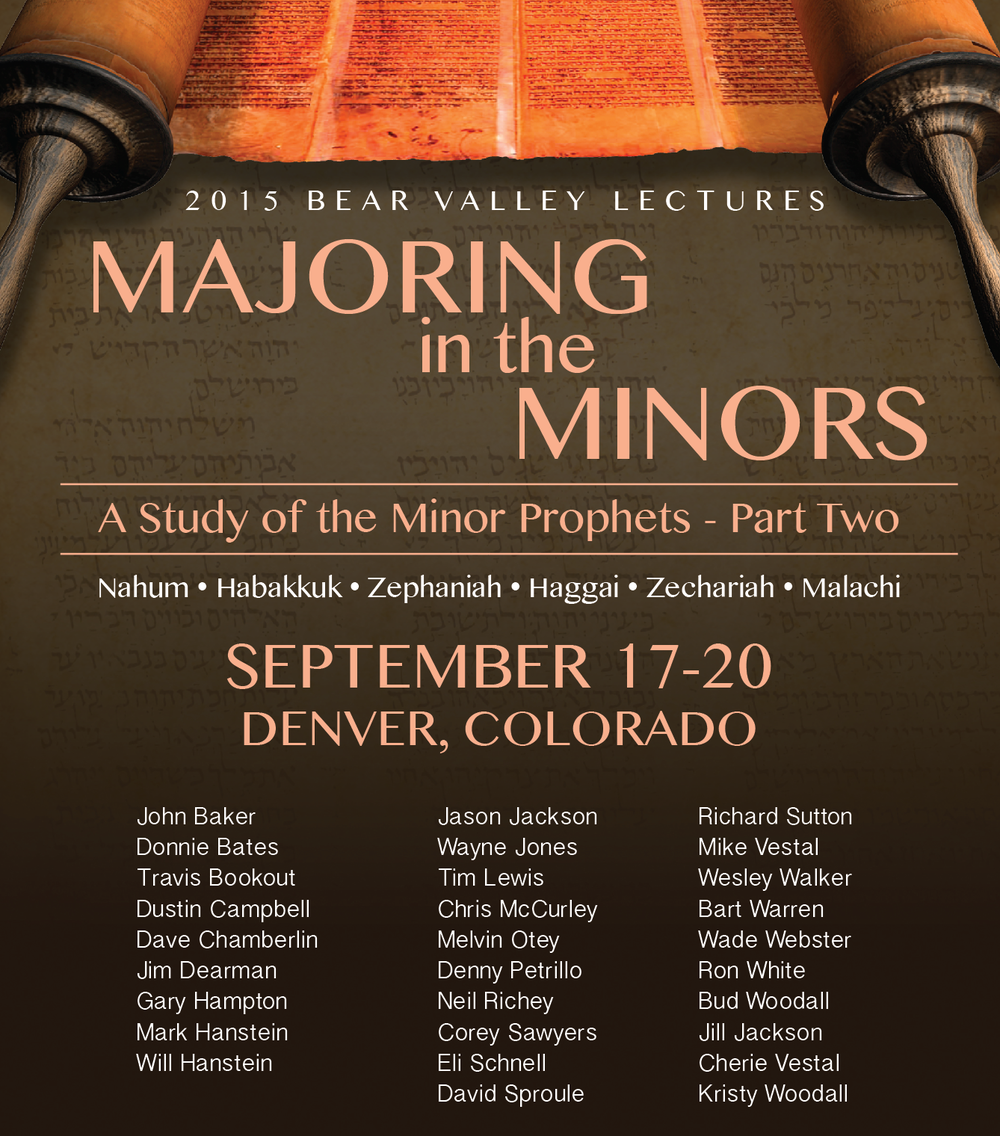
FACTS AND TRIVIA RELATED TO OUR LECTURESHIP

Neal Pollard

When the boys were younger, I would ask them questions about Old Testament characters as part of a quiz.  Included in that were questions about the Minor Prophets.  How well do you know the following without consulting your Bible (or Google)?

  • He wondered why God used a more wicked nation to punish his own nation.
  • He repeatedly talks about “that day” near the end of his book, referring to the day of Christ and the church.
  • He asked, “Will a man rob God?” and said, “God hates divorce.”
  • He wrote to condemn Nineveh and was a prophet of comfort for God’s people.
  • He said, “The just shall live by faith.”
  • He was the Minor Prophet who spoke the most about “the day of the Lord.”
  • His message was, “Rebuild the temple.”
  • He compared his nation to a person who touched an unclean body, who became unclean.
  • His book includes the “Shigionoth.”
  • He said, “The Lord is slow to anger and great in power, and will not at all acquit the wicked.”
  • He mentioned, “The Sun of Righteousness with healing in His wings.”
  • He saw a flying scroll.
  • He was the great-great grandson of Hezekiah.
  • He talked about putting wages in a bag with holes.
  • He talks about a Man whose name is “The BRANCH.”

All of these answers come from either the books of Nahum, Habakkuk, Zephaniah, Haggai, Zechariah, or Malachi.  This weekend will be more than about mere facts and information, though.  The message, principles, and application will enrich your heart and life because it is “a portion” of the Word of God. These prophets write at a significant time in Bible history, and the implications of much of their writing play out in the ministry of Christ and establishment of the church.  I hope you will come and be a part of our lectureship, if you can and for as much as you can. It will be a time of great growth and building up. Send me your answers and I’ll message you back with your “grade.” Happy test-taking!  See you here starting tomorrow night at 7 P.M.