
Making A Way When There Was No Way

Neal Pollard

Recently, I read the 2005 book by Candice Millard entitled The River Of Doubt. It chronicles Theodore Roosevelt’s exploration of the interior of Brazil, along with Candido Rondon. Their work literally put a major tributary of the Amazon River on the map. Rondon had come across the river in a 1909 expedition to lay telegraph wire and he longed to explore it. When Roosevelt was yearning for an adventure following his unsuccessful bid for a third term as president, this appeared to be the answer. It was called The River Of Doubt (Rio da Dúvida) because no one knew how long it was, what kind of terrain it passed through, or where it ended. The journey was dangerous and deadly, very nearly killing Roosevelt himself. But the risk resulted in geographical and scientific advancement that benefits the world even today.

I have always been fascinated to read about the works of pioneers. Gutenberg and the printing press, Jenner and vaccinations, the Wright brothers and flying. Whether travel and exploration or inventions, people who went first or paved the way for us are people we may never think about but we owe so much to them. Even our highway systems, with paved roads that go through tall mountains, took people to make a way when there was no way.

In Hebrews 6:20, the writer uses a term that’s only found in that verse–forerunner. The word had a very diverse usage. It was used in athletics of one who runs forward at top speed. It was used of one who went in advance of others, like horsemen ahead of the army or guides. The ancient Macedonian army had a special corp known as forerunners. In Alexandria, Roman ships heavily loaded with grain, were led out by a small guide ship. It was used in botany of the first green shoot, tree or flower of Spring. It was used metaphorically of a precursor, like John the Baptist.

The idea is that Jesus has gone behind the curtain before us into God’s presence. We can join Him there because His death made it possible for us (Heb. 5:8-9). But we also have unrestricted access to God’s presence now because He prepared the way. The writer tells us this is our sure and steadfast anchor of hope that allows us to take refuge.

It is beautiful to think that Jesus has gone before us and paved a way for us. It is a theme the writer of Hebrews addresses throughout the book as He shows us how Jesus has done that in the past, is doing it now, and will do it in the future:

  • Our forerunner went before us in the creation (1:1-3)
  • Our forerunner went before us in salvation (2:10)
  • Our forerunner has gone before us for our eternal destination (12:1-2).

One of our songs says, “Each step I take, my savior goes before me, and with His loving hand He leads the way. And with each step, He whispers I adore thee, Oh, what joy to walk with Him each day.” He’s gone before us! The question is, “Are we following Him?”
Use The Resources Available To You

Neal Pollard

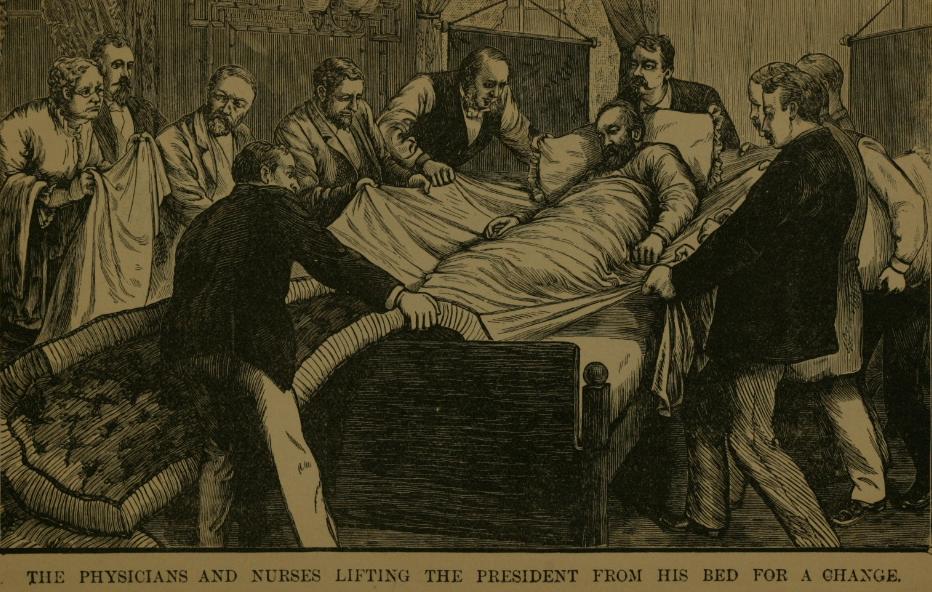
Judging from Candice Millard’s straightforward account of the assassination of James Garfield, there were two men responsible for his death. The more obvious villain was the shooter, Charles Guiteau, an unquestionably insane loner. The less obvious accomplice, judging from her words, was the man who seized control of Garfield’s care and appointed himself the president’s chief physician. The bullet that wounded the president would not have been fatal, but the medical attention he received afterward was. In fairness, a medical discovery already made in 1881 that could have helped Garfield was considered controversial and would not be generally embraced in America for a few more decades. Yet, Dr. Joseph Lister’s use of carbolic acid to sterilize surgical instruments and clean wounds had been in existence since the 1860s. The Englishman attended the Centennial Exhibition in Philadelphia in 1876, attempting to convince American doctors of its effectiveness. Alexander Graham Bell, whose telephone was discovered at that same exhibition, heard the news that Bliss could not find the bullet inside the president. The incredible inventor came up with the “induction balance”—a metal detecting machine. But Bliss waited too long to call Bell, and when he did he never allowed the inventor to check his left as well as his right side for the bullet. Bliss was sure it was on the right; an autopsy found it on the left. In court, Guiteau made the argument that the president died from malpractice rather than his attempt. While almost certainly true, Guiteau was still hung. Yet, most historians name Bliss as a proud, ignorant accomplice. Portrayed as a glory seeker, Bliss relied on his prowess and rejected several people and principles that could have prevented Garfield’s death (Millard, Destiny of the Republic: A Tale of Madness, Medicine, And The Murder of a President, Anchor: New York, 2011).

To be fair, it would have taken uncommon clarity and vision for Bliss to ignore the prevailing views of his colleagues and embrace Lister’s techniques and Bell’s invention, but he could have.

There will be people we encounter today, who appear to be in great health and no danger. Yet, the vast majority of them will face a fate infinitely more terrible than the one Garfield succumbed to. They will eventually die, unprepared for the eternity that will follow (Mat. 7:13-14). The most tragic part of this will be, if you and I are in their lives, that it will not have had to be this way. At least, we have the solution from the “Great Physician” and we should know how to administer it. God needs us to make use of the resources He’s made available to us—prayer, Bible knowledge, influence, personality, courage, love, and a sense of urgency (cf. Col. 4:2-6; 1 Pet. 3:15; Eph. 4:15; 2 Tim. 2:24-26; John 4:35; etc.). We can look within our congregations and see those who were reached in this way. We see others who are not far from the cure, but who need us to help them. How inexcusable is it to have the remedy but refuse to share it? May God help us use the resources we have available to us!

changing_garfields_bedclothes