

Hydrarchos Or Leviathan

Dale Pollard

The Sahara desert is one of the driest places on the planet, but the fossils of large aquatic creatures were found buried beneath the sand. In the late 19th century, the paleontologist Othniel Charles Marsh made some interesting remarks regarding the remains of the Hydrarchos; a large serpentine monster found near Cairo, Egypt, by Albert Gaudry, in a place dubbed The Valley of Whales.

This region also happens to be one of a few places speculated to be near Job’s homeland— Uz.

During one of his many colorful descriptions to the public, Marsh allegedly speculated that the remains of Hydrarchos could be linked to the creature mentioned in the book of Job— the  Leviathan. It should be noted that he may have also made the same claim about other fossil remains and that this was commonly done during a period referred to as “The Bone Wars.” It should also be noted that other specimens of the Hydrarchos were found around the same period in North America as well. 

It wasn’t long before the identification of the fossil remains were put under scrutiny and the reptile classification that was originally assigned to Hydrarchos was changed and it was moved into the whale family. 

This change didn’t come about because the specimen had been studied closer and a blowhole was found; the change in its classification was far more trivial. They figured its teeth were more like those of a whale and less reptilian in nature. Yet, when you look at the teeth and compare them to a whales you run into a few challenges. 

First, a whale can have a variety of different teeth depending on the kind. Some  whales use their “teeth” as a filter for krill while others, like the orca, use their teeth in a more shark-like fashion. Secondly, the teeth of the Hydrarchos not only appear reptilian but even modern paleontologist suggest that it used its teeth like a Mosasaur— an extinct aquatic reptile. 

In short, whales don’t all have the same teeth and  some don’t really have teeth at all. However, crocodiles and monitor lizards and other examples of dinosaurs have teeth just like or very similar to that of the Hydrarchos. It seems to be a weak reason to change classification, at the very least. 

One might assume that Othniel C. Marsh was a religious paleontologist since he drew biblical parallels, but that’s perhaps the most interesting part. Marsh was an early proponent of Darwin’s hypothesis of evolution— yet he still made the comparison.

The exact identity of the Leviathan isn’t known and this article isn’t an attempt to convince the reader of that either. It’s simply to showcase an example of a creature that closely resembles the one detailed by God in Job 41. 

“Who can strip off his outer garment?
Who would come near him with a bridle?
Who can open the doors of his face?
Around his teeth is terror.”

V.13-14 

Of course, many don’t need a fossil to believe that a creature that God said existed is true. Leviathan was real. The question is— did we find it? 
The Ankgor Wat Dinosaur

Neal Pollard

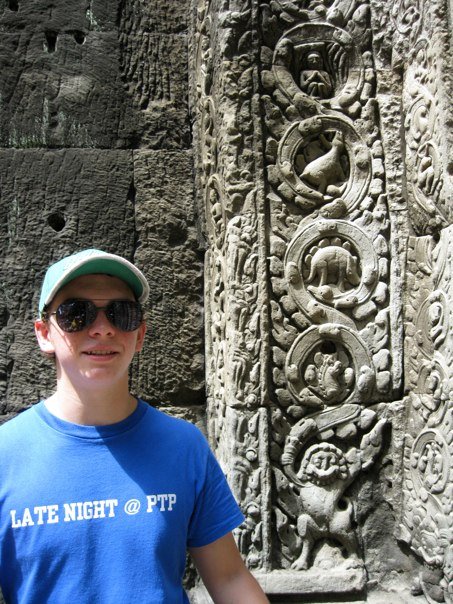
I have been to the Ankgor Wat temple complex, near Siem Reap, four times. It’s a fascinating tourist attraction, but there is one carving, among literally thousands, that stands out above the rest. It is found at Ta Prohm Temple. The temple was built between the late-1100s to early-1200s by King Jayavarman VII and dedicated to his mother. Today, it is “shrouded in dense jungle” and “fig, banyan, and kapok trees spread their gigantic roots over stones, probing walls and terraces” (tourismcambodia.com). “It took 79,365 people to maintain the temple including 18 great priests, 2,740 officials, 2,202 assistants, and 615 dancers” (ibid.). But it’s that stone carving that it most unforgettable.  One particular trip, which I made in 2009 with two elders, three deacons, and my oldest son, Gary, stands out in my mind.

I asked our guide, hired out by the Kazna Hotel in Siem Reap and of the Buddhist faith, what he thought this particular creature was. He said he had no idea what it was and added, “They must have had a really good imagination.”  The question such a response raises is, “How did they know to imagine that?!”

Well, a group from Canada was following close behind our group of seven from Denver, Colorado.  A son asked his father for an explanation of the carvings on the pillar, and dad replied with some authority, “Son, that was their version of a geological timetable.”  Of course, it begs the follow up, “How did 12th-Century Khmer people, well before Darwin and others planted their geological seeds, know of such a timetable?”  Furthermore, this “timetable” looks nothing like anything you will ever see in a textbook–a man above it and a monkey below it.  Based upon what fossil evidence did they create their carving?  There must have been hundreds of fellow “explorers” viewing these temple ruins with us in the few hours we were there.  Some of the fascinated people spoke in languages I cannot understand, but body language was pretty telling.  Others, Americans, British, Australians, and Canadians, all seemed to see that carving for what it most apparently was.  No one said, “That’s a rhino or pig.”  They called it a Stegosaurus.

How many other similar discoveries await reclamation from jungle vegetation, archaeological excavation, and geographic exploration?  In the different disciplines of science and history, man uncovers gems like Angkor Wat’s Ta Prohm from time to time.  Such clear, incontrovertible evidence from a time before our modern “war” between evolutionists and creationists begs to be examined with unprejudiced eyes.  While some may never change their mind regardless of how many items are offered into evidence, I believe that there are a great number of people out there who are honestly, objectively looking for truth.  The Stegosaurus at Ta Prohm near Siem Reap, Cambodia, might be the item that convinces many!

1937409_160820505921_3751983_n
Gary standing next to the column. Notice what/who else is in the carving with the Stegosaurus.