Curing The “Yips”

Monday’s Column: Neal At The Cross

65093899_10156405640240922_1795016641457684480_o

Neal Pollard

The term comes up most frequently in golf and baseball. In 1998, L.A. Times writer Thomas Bonk interviewed elderly PGA golfers like Byron Nelson, Gene Sarazen, and Paul Runyan, whose career went back to the 1920s and 1930s, to find out if they knew the origin of the word “yips.” Nelson said, “I first heard it when I was on the tour in the ’30s. It was always just there” (Thomas Bonk, 2/26/98, “‘Yips’ or ‘Twitches,’ Who Knows Origin?”). 

No less than the Mayo Clinic discuss this condition, which they describe as “involuntary wrist spasms that occur most commonly when golfers are trying to putt.” But, as they point out, anxiety makes it worse as the athlete “becomes nervous and self-focused–overthinking to the point of distraction–that their ability to execute a skill, such as putting, is impaired” (Mayo Clinic). 

The American Heritage Dictionary defines it as “Nervousness or tension that causes an athlete to fail to perform effectively, especially in missing short putts in golf.” I am more familiar with this term in baseball. Mackey Sasser was a catcher who, after a home plate collision, began having difficulty accurately throwing the baseball back to the pitcher. Second baseman Chuck Knoblauch started having trouble throwing accurately to first base. Pitcher Rick Ankiel could not keep from throwing wild pitches and Jon Lester, another pitcher, has had trouble for years throwing the ball to first base. 

Just Google “yips” and you can read about how traumatic and life-changing it is for those who once mindlessly, successfully did a task they ultimately found debilitatingly difficult to do. They consulted psychologists and hypnotists, struggling to get back to where they just didn’t think about the fundamental task that now overwhelmed them. But, some have succeeded. Steve Sax, who suffered from the yips in 1983–the second baseman had 26 errors by the All-Star Break–would rebound to be the best defensive second baseman in 1989. He credits a conversation with his ailing father during the 1983 break. His father told him it wasn’t a mental block, but a temporary loss of confidence, that he needed to practice being more confident and it would positively effect his play (Sportscasting.com). 

Have you ever found it difficult to do something that once came easily or naturally? Has fear ever gripped you and become a roadblock to success? Certainly, there are mental health conditions that cause people to panic and wrestle with anxiety. But, what about the person who tried to share the gospel with a friend only to suffer rejection or maybe even embarrassment? What about the one who tried to gently confront someone at spiritual fault or overtaken by sin, who was rebuffed to such a degree that it was traumatic? What about the new Christian who was asked to lead public prayer, whose mind went blank, froze, and nearly couldn’t complete the task? There are several areas of Christian duty that can cause us to “freeze up” or shy away from doing them. An unpleasant experience can get into our heads and talk us out of trying to do them again. 

How can we overcome this? Consider a few tips from Scripture:

  • Forget the past and focus on the future (Phil. 3:10)
  • Pray for boldness and confidence (Acts 4:29,31)
  • Ask others to pray for your ability and boldness (Eph. 6:19)
  • Get others to join you or help, where possible (Ecc. 4:9-12)
  • Look to Christ for your confidence and success (Phil. 4:13)
  • Don’t let a past failure define you; Keep at the task (Acts 15:38 and 2 Tim. 4:11)
  • Elevate your motivation and remember why you do what you do (Col. 3:23)
  • Focus on those who may be taking their lead from you, who look to you as their model (1 Tim. 4:12; Heb. 13:7)
  • Rediscover the joy (Phil. 2:17)

These are just a few of the divine strategies from the mind of God. We have a Father who speaks to us in His Word. His counsel is also for us to practice being more confident, but to look to Him as the source of that confidence. The end result is more than mere professional success. We can impact eternity when we overcome any obstacle to our service. Do you need to “get back in there”? Utilize the tools He has given! You’ll be so glad you did, and so will others.

kishida_mamoru

The Eternal Optimist

Friday’s Column: Supplemental Strength

81121814_2462862270639428_5746232403106463744_n

Brent Pollard

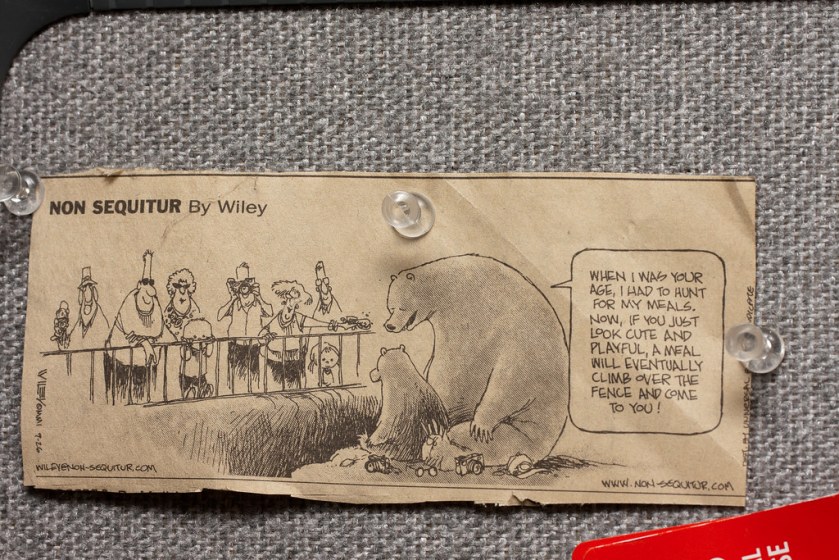
Wiley Miller is the creator of the comic strip, Non Sequitur. When apolitical, Miller’s strip can be enjoyable. I cut one of his strips from a daily edition of The Fayetteville Observer (Fayetteville, NC) back in the early aughts featuring “the eternal optimist.” In the one-panel comic, the grim reaper stands before a man in business attire. This eternal optimist calls to his wife in another room: “Well, honey, it doesn’t look like I have to worry about that long commute anymore.” I kept that strip until it yellowed with age and crumbled into oblivion. I did so for another reason than having a dark sense of humor. I hope I am an optimist on the order of the businessman finding something good to say even in the face of death.

Paul had such a character. He told the Philippians that he had everything to gain in death, as a Christian, and needed only remain for the sake of the brethren (Philippians 1.21-26). Nearing the end of his life, a confident Paul told Timothy, “I have fought the good fight, I have finished the course, I have kept the faith; in the future there is laid up for me the crown of righteousness, which the Lord, the righteous Judge, will award to me on that day; and not only to me, but also to all who have loved His appearing.” (2 Timothy 4.7-8 NASB). Why was Paul an eternal optimist? It was not because he was free of sin. Indeed, Paul considered himself the chief of sinners (1 Timothy 1.15). However, Paul was full of faith and understood God’s grace.

We cannot afford to live in fear, whether that fear is of death or whether we are “good enough.” We must do the will of God. John says, “But if we walk in the Light as He Himself is in the Light, we have fellowship with one another, and the blood of Jesus His Son cleanses us from all sin” (1 John 1.7 NASB). That faith may not always take us to places providing comfort. Shadrach, Meshach, and Abed-nego had their faith put to the test. Nebuchadnezzar had instructed everyone to bow to his golden image in worship. The young Hebrews refused because they remembered the Law of Moses and their covenant relationship with God. Nebuchadnezzar was angry with the young men and told them they would perish in a fiery furnace. They replied, “O Nebuchadnezzar, we do not need to give you an answer concerning this matter. If it be so, our God whom we serve is able to deliver us from the furnace of blazing fire; and He will deliver us out of your hand, O king. But even if He does not, let it be known to you, O king, that we are not going to serve your gods or worship the golden image that you have set up.” (Daniel 3.16b-18 NASB).

Did you notice why they did not fear? Can you see why they were optimistic? They understood their God was more powerful than a king and could deliver them. Yet, even if God did not deliver them, they still realized they had an obligation to serve Him regardless. These days the world seems scary. There is so much bad news on TV. But our God is more powerful. Thus, we can even say, “If I do catch COVID-19, God will deliver me. But even if He does not, I know Heaven will be my home.” Other scenarios would likewise suffice as an example. However, this is one of the things that seems to be on the minds of many today. Build your faith and become an eternal optimist as well. The world, in turn, will become a less daunting place.

6642913339_1ccb2896d6_b
A different Non Sequitur sampling

Longing For Hope

Thursday’s Column: Captain’s Blog

IMG_0806

Carl Pollard

We’ve spent three weeks looking at a few areas where the world is desperate. They long for guidance, purpose and finally, hope (1 Pt. 5:10).
We have abused this word. We say things like, “I hope there’s some food at the house” or, “I hope the weather is nice tomorrow,” and “I hope my team wins the super bowl.” The hope that’s mentioned is scripture has a completely different definition.
The word in Romans 15:13, for example, is the Greek word “elpis. “Now may the God of hope fill you with all joy and peace in believing, so that you will abound in hope by the power of the Holy Spirit.” This word is defined as, “looking forward to something with confidence” (BDAG 319).  It is an expectation that we have as Christian. We have hope because we call God our Father.
The world does not and because of this they have nothing to hope in. If they look forward to anything it’s pay day or the weekend or vacations. Every one of these come to an end and once again they are left with no hope.
Don’t get me wrong, we look forward to these things too. And there’s nothing wrong with that, but this isn’t what we look forward to solely. We know that there is more to life than vacation.
1 Peter 5:10 is an incredible verse that describes the hope we have. It says, “After you have suffered for a little while, the God of all grace, who called you to His eternal glory in Christ, will Himself perfect, confirm, strengthen and establish you.”
This is true hope. This is the God of the universe Himself that will do this for each one of his children. We may not see it every day, but the world is lost and desperate. We have what they need. They’re desperate for guidance because they’re lost. They’re desperate for purpose because they have none. They’re desperate for Hope because the world offers nothing to those who are struggling.
God has entrusted us with the answers to life, so what are we doing with this knowledge?
66510003_10156443547920922_292784965630820352_o